Guide and picks
Ceiling fan direction in winter
Reversing the blades is the easy half. The half that decides whether it works at all is the speed, and most people get that wrong.
By Sawyer V. · Published
The short answer
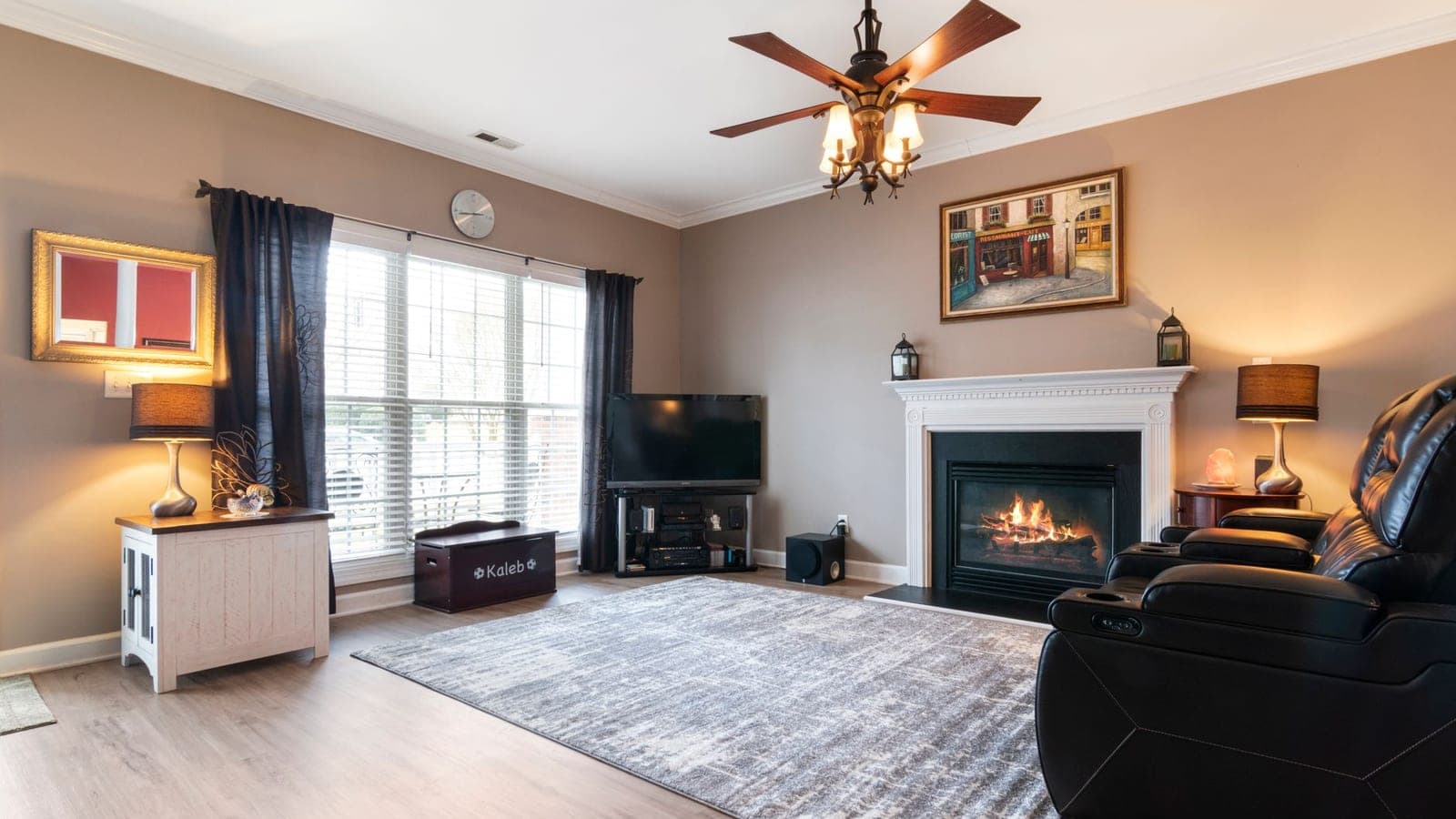
Run the fan clockwise (reverse) and on its lowest speed. That pulls room air up the middle and pushes the warm air trapped at ceiling level gently down the walls, without creating airflow you can feel. Speed is the part that matters. Any breeze you can feel accelerates heat loss from your skin and undoes the benefit. Certified fans draw 1.1 to 6.0 watts on low, so the running cost is effectively nothing.
Fan & Frost earns a commission when you buy through our links, at no cost to you. It never changes a ranking, and we say so when the right answer is the cheaper unit or nothing at all. Full disclosure · How we pick.
At a glance
The picks, ranked
Tap any row to jump to the full reasoning. Prices are live from Amazon where we have them, and read “check price” where we don’t — never a number we cannot verify today.
| # | Product | Best for | Price |
|---|---|---|---|
| 1 | 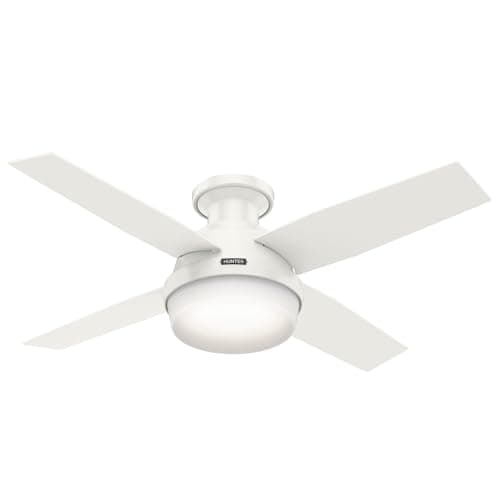 Lowest low-speed draw Hunter Martindale 44" Ceiling Fan 1.1 W on low — the lowest certified low-speed wattage of any fan we hold data for. | A bedroom or office you want destratified all winter for nothing | |
| 2 | 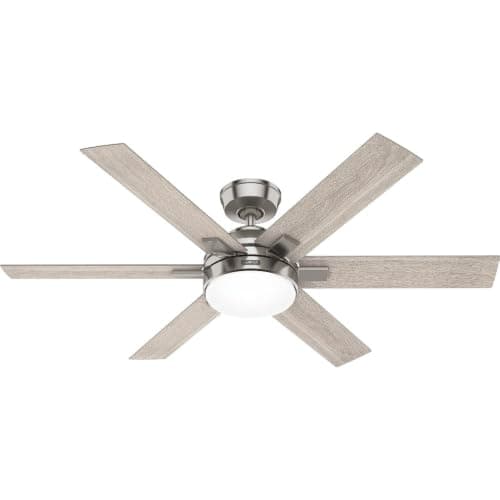 Best low-speed figure at a normal span Hunter Georgetown 52" Ceiling Fan 1.5 W on low at a 52-inch span — the best low-speed draw of any full-size fan here. | A living room or dining room with a standard ceiling | |
| 3 | 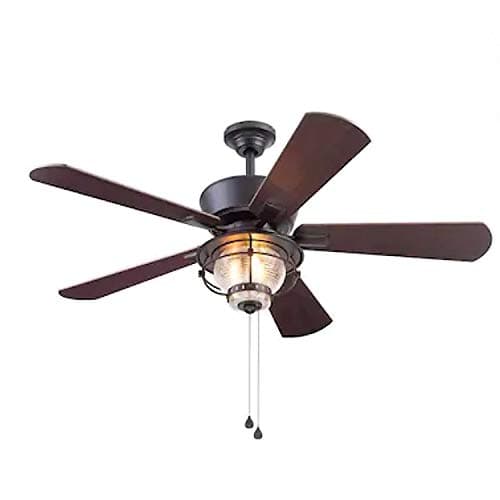 Best for a high or vaulted ceiling Harbor Breeze Cando 84" Ceiling Fan 422.2 CFM per watt and an 84-inch span — the reach a tall room needs to move ceiling air at low speed. | The rooms where stratification is genuinely costing you money | |
| — | 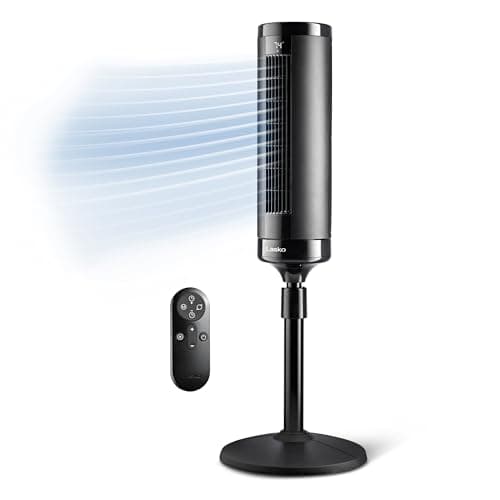 The wrong tool for this job Lasko EcoQuiet 42" DC Tower Fan 2.9 W on low and 23 dBA, and none of it helps in winter, because a floor fan blows across you rather than down from the ceiling. | Summer airflow — not winter destratification |
Warm air is less dense than cold air, so it rises. In a heated room that means the air near the ceiling is warmer than the air you are sitting in, and the taller the room, the bigger the gap.
You have already paid to heat that air. Winter ceiling fan operation is about getting it back down.
Which way
Clockwise, viewed from below
Almost every ceiling fan has a small switch on the motor housing, or a reverse button on the remote.
- Summer: counter-clockwise. The blades push air straight down at you. You feel a breeze and that breeze makes you feel several degrees cooler. The air temperature does not change.
- Winter: clockwise. The blades pull air up through the middle of the fan. That air hits the ceiling, spreads outward, and displaces the warm layer down the walls and back into the room.
The direction is the mechanism. Reversed, the fan never blows down at you — the warm air comes back into the room around its edges, along the walls, which is why the movement is gentle enough not to be felt.
Stand under the fan and look up. If the leading edge of each blade — the edge that arrives first as it turns — is the lower edge, it is pushing air down at you: summer. If the leading edge is the higher one, it is pulling air up: winter.
The part people get wrong
Speed matters more than direction
Reversing the fan and then running it on medium is the most common version of this mistake, and it produces the opposite of the intended result.
If you can feel the air, the speed is too high. Even reversed, a fan running hard sets up enough circulation to create perceptible movement at head height. Air moving across your skin accelerates heat loss from your body, and you feel colder — which is exactly the mechanism that makes a fan useful in July.
The room air genuinely is warmer. You just feel worse in it, so you turn the thermostat up, and the fan has now cost you money twice.
The correct setting is the lowest speed the fan has. You are trying to overturn a stratified layer, not ventilate the room. That takes very little air movement and a lot of time.
Conveniently, the lowest speed is also where certified fans are almost free to run:
| Fan | Low | 12 hours |
|---|---|---|
| Hunter Martindale 44 in | 1.1 W | 0.2¢ |
| Hunter Georgetown 52 in | 1.5 W | 0.3¢ |
| Hunter Anisten 44 in | 1.6 W | 0.4¢ |
| Hunter Vespucci 52 in | 1.8 W | 0.4¢ |
| Hunter Skyway 52 in | 2.1 W | 0.5¢ |
| Hunter Lakeway 72 in | 2.3 W | 0.5¢ |
| Globe 27105 48 in | 3 W | 0.7¢ |
| Maxim 994403 42 in | 3.7 W | 0.8¢ |
| Visual Comfort Kingston 72 in | 4.1 W | 0.9¢ |
| Harbor Breeze Cando 84 in | 6 W | 1.3¢ |
Low-speed wattage from the ENERGY STAR Certified Ceiling Fans dataset.
This one is not a DIY job
Where this is worth doing, and where it is not.
Worth it: vaulted or double-height ceilings, rooms with a loft or mezzanine, sunrooms and conservatories, and any room where the floor feels cold while the upstairs of the same house is too warm. The taller the space, the larger the stratified layer and the more there is to recover.
Marginal: a standard 8-foot ceiling. The temperature difference between floor and ceiling in a normal room is small, and so is the benefit. It costs about a cent a day to try, so it is worth trying — just do not expect much.
Pointless: an unheated room. Destratification moves existing heat around. If there is no heat input, there is nothing to redistribute.
How to check it is working
Two ways to tell
Measure it. A cheap thermometer at floor level and another as high as you can reach, read before you start and again an hour later. If the gap between them narrows, the fan is doing its job. If they were close to begin with, your room does not stratify much and there was nothing to recover.
Feel for a draft. Sit where you normally sit. If you can detect air movement, drop the speed. On a fan with only three speeds, if the lowest still produces a felt breeze in a small room, the fan is oversized for the space and winter use is not going to work well in it.
Say the unwelcome thing
Do not leave the fan reversed and forget about it.
The single most common failure is a fan that stays in winter mode through the following summer. In reverse, it pulls air up instead of pushing it down, so it produces essentially none of the felt cooling you want in July — while drawing the same power.
People conclude the fan is broken, or that ceiling fans do not work, and buy a floor fan to sit underneath it.
Tie the switch to something you already do seasonally — the same weekend you change the thermostat over, or when the clocks change. The summer direction is covered here.
In full
Every pick, and what is wrong with it
Published specifications only, each linked to the page it came from. Where a manufacturer publishes nothing, the row says so — we do not fill blanks in.
1. Lowest low-speed draw
Hunter Martindale 44" Ceiling Fan
Hunter · model 44in Martindale
1.1 W on low — the lowest certified low-speed wattage of any fan we hold data for.
1.1 watts. Running this continuously for a twelve-hour winter evening costs 0.2¢. Across a 120-day heating season at twelve hours a day it is 29¢.
That number is the whole argument for winter ceiling fan use. The benefit is modest — you are moving heat you already paid for from the ceiling to where you are — but the cost is so close to zero that the payback question does not arise.
304.5 CFM per watt makes it the most efficient small certified fan in our data, and the low setting is exactly what winter operation calls for.
What’s wrong with it
No light kit, and 44 inches suits a normal room rather than an open-plan space with a high ceiling.
Running cost — 44in Martindale
| Nameplate power | 1.1 W – 10.1 W | manufacturer's published figure |
|---|---|---|
| Energy, 8-hour night | 0.08 kWh | 10.1 ÷ 1000 × 8 |
| Cost per hour | 0.2¢ | at 18.34¢/kWh |
| Cost per 8-hour night | 1.5¢ | on the highest speed |
| Cost per 30 nights | 44¢ | 2.4 kWh |
| Same month, lowest speed | 4.8¢ | at 1.1 W |
Rate: 18.34¢/kWh, the US average residential price for June 2026 (EIA Electric Power Monthly, Table 5.3). Yours will differ — swap it in: (watts ÷ 1000) × hours × your rate.
| Blade span | 44 in |
|---|---|
| Efficiency | 304.5 CFM per watt |
| Power, high speed | 10.1 W |
| Power, low speed | 1.1 W |
| Standby power | 0.4 W |
| Type | Indoor, fan only |
| Warranty | 3 years, components |
| ENERGY STAR | Certified |
Every figure above is from ENERGY STAR Certified Ceiling Fans dataset. Blanks are shown as “not published” rather than filled in.
2. Best low-speed figure at a normal span
Hunter Georgetown 52" Ceiling Fan
Hunter · model 52" Georgetown
1.5 W on low at a 52-inch span — the best low-speed draw of any full-size fan here.
1.5 W on low at 52 inches. Most rooms that benefit from winter destratification are living spaces rather than bedrooms, and 52 inches is the span that suits them.
About 0.3¢ for a twelve-hour evening. Rated for indoor and outdoor use, which also makes it a candidate for a heated porch or a sunroom — spaces where warm air stratifies severely because of the glazing.
326.3 CFM per watt certified. Sunrooms get their own page, since they are the hardest version of this problem.
What’s wrong with it
20.6 W on high is unremarkable, so its summer credentials are weaker than its winter ones.
Running cost — 52" Georgetown
| Nameplate power | 1.5 W – 20.6 W | manufacturer's published figure |
|---|---|---|
| Energy, 8-hour night | 0.16 kWh | 20.6 ÷ 1000 × 8 |
| Cost per hour | 0.4¢ | at 18.34¢/kWh |
| Cost per 8-hour night | 3.0¢ | on the highest speed |
| Cost per 30 nights | 91¢ | 4.9 kWh |
| Same month, lowest speed | 6.6¢ | at 1.5 W |
Rate: 18.34¢/kWh, the US average residential price for June 2026 (EIA Electric Power Monthly, Table 5.3). Yours will differ — swap it in: (watts ÷ 1000) × hours × your rate.
| Blade span | 52 in |
|---|---|
| Efficiency | 326.3 CFM per watt |
| Power, high speed | 20.6 W |
| Power, low speed | 1.5 W |
| Type | Rated for indoor and outdoor use |
| ENERGY STAR | Certified |
Every figure above is from ENERGY STAR Certified Ceiling Fans dataset. Blanks are shown as “not published” rather than filled in.
3. Best for a high or vaulted ceiling
Harbor Breeze Cando 84" Ceiling Fan
Harbor Breeze · model 84" Cando
422.2 CFM per watt and an 84-inch span — the reach a tall room needs to move ceiling air at low speed.
Stratification scales with ceiling height. In an 8-foot room the temperature difference between floor and ceiling is small enough to ignore; in a vaulted or double-height space it is the reason the room never feels warm.
An 84-inch span moves a large volume slowly, which is precisely the winter requirement: you want the ceiling layer displaced without a perceptible draft anywhere. 422.2 CFM per watt is the highest certified efficiency at an 84-inch span.
6.0 W on low — about 1.3¢ for a twelve-hour evening. Higher than the small fans above, and still negligible against the heating bill it is helping with.
What’s wrong with it
6.0 W on low is the highest of the fans here, and an 84-inch fan needs the ceiling height and clearance to suit it.
Running cost — 84" Cando
| Nameplate power | 6 W – 30.6 W | manufacturer's published figure |
|---|---|---|
| Energy, 8-hour night | 0.24 kWh | 30.6 ÷ 1000 × 8 |
| Cost per hour | 0.6¢ | at 18.34¢/kWh |
| Cost per 8-hour night | 4.5¢ | on the highest speed |
| Cost per 30 nights | $1.35 | 7.3 kWh |
| Same month, lowest speed | 26¢ | at 6 W |
Rate: 18.34¢/kWh, the US average residential price for June 2026 (EIA Electric Power Monthly, Table 5.3). Yours will differ — swap it in: (watts ÷ 1000) × hours × your rate.
| Blade span | 84 in |
|---|---|
| Efficiency | 422.2 CFM per watt |
| Power, high speed | 30.6 W |
| Power, low speed | 6.0 W |
| Type | Outdoor ceiling fan |
| ENERGY STAR | Certified |
Every figure above is from ENERGY STAR Certified Ceiling Fans dataset. Blanks are shown as “not published” rather than filled in.
Skip this one
Lasko EcoQuiet 42" DC Tower Fan
Lasko · model T42710
2.9 W on low and 23 dBA, and none of it helps in winter, because a floor fan blows across you rather than down from the ceiling.
An excellent fan, and irrelevant to this page. Winter destratification depends on where the fan sits, not on how good it is.
The warm air you are trying to recover is at ceiling level. A tower fan standing on the floor cannot reach it, and the air it does move travels horizontally across the room at body height — which is the one thing you want to avoid in winter.
Air moving across skin accelerates evaporative and convective heat loss. In summer that is the entire point. In a cold room it makes you feel colder, which is why the two formats are not interchangeable.
What’s wrong with it
It cannot reach the warm layer at ceiling level, and any air it moves across you in a cold room makes you feel colder.
Running cost — T42710
| Nameplate power | 2.9 W – 19 W | manufacturer's published figure |
|---|---|---|
| Energy, 8-hour night | 0.15 kWh | 19 ÷ 1000 × 8 |
| Cost per hour | 0.3¢ | at 18.34¢/kWh |
| Cost per 8-hour night | 2.8¢ | on the highest speed |
| Cost per 30 nights | 84¢ | 4.6 kWh |
| Same month, lowest speed | 13¢ | at 2.9 W |
Rate: 18.34¢/kWh, the US average residential price for June 2026 (EIA Electric Power Monthly, Table 5.3). Yours will differ — swap it in: (watts ÷ 1000) × hours × your rate.
| Power | 2.9 W - 19 W (0.06-0.303 A at 120 V) |
|---|---|
| Noise | 23 dBA low, 46 dBA high |
| Speeds | 12 |
| Height | 41.6 in |
| Footprint | 12.8 x 12.8 in |
| Weight | 7.8 lb |
| Timer | 8 hours |
| Air delivery (CFM) | Not published |
| Warranty | 2 years |
Every figure above is from Lasko product page, T42710. Blanks are shown as “not published” rather than filled in.
We are not linking a buy button for this one. If you want to look at it anyway, it is easy enough to find — but we would rather send you to something that fits your room.
Questions people actually ask
Frequently asked
Which way should a ceiling fan turn in winter?
Clockwise when viewed from below, so the blades pull air up through the middle of the fan. That air hits the ceiling, spreads out, and pushes the warm layer down the walls without creating a breeze you can feel.
What speed should a ceiling fan run at in winter?
The lowest it has. If you can feel the air moving, the speed is too high — air moving across your skin accelerates heat loss and makes you feel colder, which is the opposite of the goal even though the room air really is warmer.
Does running a ceiling fan in winter save money?
It can, by recovering heat you already paid for from the ceiling. The saving is modest and depends heavily on ceiling height, but the cost is trivial — certified fans draw 1.1 to 6.0 watts on low, so twelve hours costs a fraction of a cent.
How do I tell which direction my ceiling fan is turning?
Stand under it and look up at the leading edge of each blade — the edge that arrives first. If the leading edge is the lower one, the fan is pushing air down at you: summer. If the leading edge is the higher one, it is pulling air up: winter.
Is a winter ceiling fan worth it with an 8-foot ceiling?
Only marginally. Stratification scales with ceiling height, so a standard room has a small floor-to-ceiling temperature gap and little to recover. It costs about a cent a day to try, so test it with a thermometer rather than assuming either way.
Can I use a floor or tower fan instead?
No. The warm air you are trying to recover sits at ceiling level, which a floor fan cannot reach, and the air it does move travels horizontally at body height — creating exactly the draft that makes a cold room feel colder. Ceiling fan vs tower fan.
Sources
Where these numbers came from
Read next
Where to go from here
Back to Whole-House Airflow, or read how we pick.