Head to head
Lasko Misto YF300 vs 7050
Lasko's two outdoor misting fans cost and weigh about the same. One throws mist at a group; the other stands beside them.
By Sawyer V. · Published
The short answer
The 15-inch Misto 7050 moves more air for less money — up to 350 CFM on 72–90 W against 276 CFM on 55–86 W — and its pivoting head lets you aim the mist at a specific group of people. Choose the 42-inch Misto YF300 if you want ambient cooling over a seating area rather than a directed stream: it stands 41.59 inches tall, has four speeds against three, and carries a two-year warranty against one.
Fan & Frost earns a commission when you buy through our links, at no cost to you. It never changes a ranking, and we say so when the right answer is the cheaper unit or nothing at all. Full disclosure · How we pick.
At a glance
The picks, ranked
Tap any row to jump to the full reasoning. Prices are live from Amazon where we have them, and read “check price” where we don’t — never a number we cannot verify today.
| # | Product | Best for | Price |
|---|---|---|---|
| 1 | 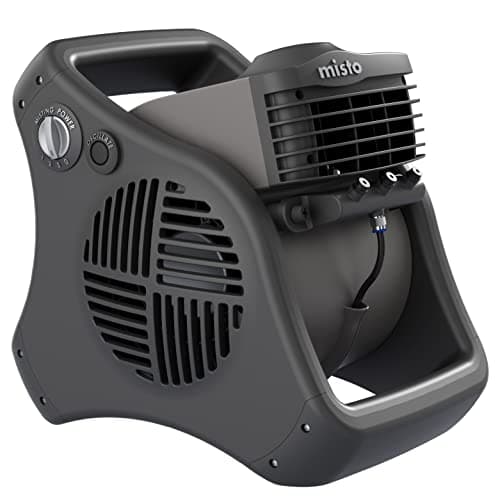 The 15-inch blower case Lasko Misto 15" Outdoor Misting Fan Up to 350 CFM published, a pivoting head, and the lower price of the two. The most directed cooling Lasko makes for outdoors. | Aiming mist at a specific spot — a seating group, a grill station, a sideline | |
| 2 | 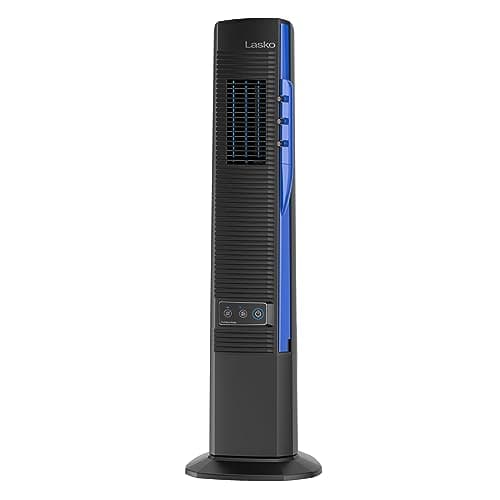 The 42-inch tower case Lasko Misto 42" Outdoor Misting Tower Fan 276 CFM on 55 W at its lowest setting, four speeds, internal oscillation and 41.59 inches of height — mist at seated head level without aiming anything. | Ambient cooling over a seated group on a deck or porch, left running for an evening |
Misting fans are the one outdoor cooling category that genuinely lowers air temperature rather than just moving air, because evaporating water absorbs heat. Both of these do that. The question is geometry: where the mist goes, and who is standing in it.
Head to head
Published figures, side by side
| Misto 7050, 15 in | Misto YF300, 42 in | |
|---|---|---|
| Air delivery | Up to 350 CFM | 276 CFM |
| Power | 72 - 90 W | 55 - 86 W |
| Current | 0.8 A | 0.49 - 0.73 A |
| Speeds | 3 | 4 |
| Height | 14.85 in | 41.59 in |
| Footprint | 16.25 x 12.3 in | 12.78 x 12.78 in |
| Weight | 13.23 lb | 15.11 lb |
| Aiming | Pivoting head | Internal oscillation |
| Hose | 9 ft, adjustable valve | Standard garden hose |
| Cord | In-line GFCI | 10 ft, in-line GFCI |
| Noise | Not published | Not published |
| Warranty | 1 year | 2 years |
Every figure is Lasko’s own published specification. Prices checked 11 October 2026: the 15-inch was $149.99 and the 42-inch $202.99. The buttons above carry the live price and the date it was read.
The decider
Nozzle height decides whether the mist reaches anyone
Mist is heavier than air and it falls. A nozzle at 41.59 inches releases it at roughly the head height of a seated adult, so it drifts across faces and shoulders before it settles. A nozzle at 14.85 inches releases it at ankle height unless you put the fan on something.
That is why the lower-airflow fan can still feel cooler in the right setting, and why the higher-airflow one needs a table. If the blower is going on the ground and the people are standing, buy the tower.
This one is not a DIY job
Both of these only work in dry air, and the same limit applies as to any evaporative cooling. Misting adds water to the air to absorb heat, so in humid conditions you get wet without getting cool. Below about 40 per cent relative humidity they work well; above about 60 per cent they mostly do not. The humidity threshold, with the numbers.
Which one
How to choose
- A seated group on a deck or porch: the 42-inch tower. Height beats airflow here, and the fourth speed lets you dial it down for a long evening.
- A grill station, workshop door or sideline: the 15-inch blower. An aimed stream of 350 CFM is what that job wants.
- Most air for the money: the blower. More published CFM at the lower price.
- Cheapest to run: the tower on its 55 W setting — 6.1¢ for six hours against 7.9¢.
- Longest warranty: the tower, at two years against one.
Say the unwelcome thing
Do not run either one without the GFCI cord they ship with.
Both fans include an in-line GFCI on the power cord, and it is there because the appliance is deliberately producing a water mist near mains electricity. Using an extension lead that bypasses it, or replacing the cord, removes the one protection designed for exactly this hazard.
The other thing not to do is leave either connected to a pressurised garden tap over winter. Water left in the line freezes and splits the fittings. Winterizing evaporative equipment.
In full
Every pick, and what is wrong with it
Published specifications only, each linked to the page it came from. Where a manufacturer publishes nothing, the row says so — we do not fill blanks in.
1. The 15-inch blower case
Lasko Misto 15" Outdoor Misting Fan
Lasko · model 7050
Up to 350 CFM published, a pivoting head, and the lower price of the two. The most directed cooling Lasko makes for outdoors.
Up to 350 CFM on 72 W to 90 W (0.8 A at 120 V), across three speeds. That is 27 per cent more air than the tower publishes, from a fan that costs less.
The reason to buy it is the pivoting head. An outdoor misting fan is only useful where the mist actually lands, and a drum-style blower you can aim at a table, a grill or a group puts it there. A tower sprays an even curtain whether or not anyone is standing in it.
A 9 ft hose to a standard garden tap with an adjustable valve, and an in-line GFCI cord — the safety fitting that matters on any mains appliance you are deliberately spraying water through.
13.23 lb and 14.85 inches tall. Light enough to move between a deck and a sideline, and low enough that you will want it on a table for standing guests.
9.9¢ for a six-hour afternoon on high at 18.34¢/kWh. Lasko publishes no noise figure for either fan.
What’s wrong with it
72 W is a higher floor than the tower's 55 W, it stands only 14.85 inches tall so the mist arrives at knee height on a standing adult, and the warranty is one year.
Running cost — 7050
| Nameplate power | 72 W – 90 W | manufacturer's published figure |
|---|---|---|
| Energy, 8-hour night | 0.72 kWh | 90 ÷ 1000 × 8 |
| Cost per hour | 1.7¢ | at 18.34¢/kWh |
| Cost per 8-hour night | 13¢ | on the highest speed |
| Cost per 30 nights | $3.96 | 21.6 kWh |
| Same month, lowest speed | $3.17 | at 72 W |
Rate: 18.34¢/kWh, the US average residential price for June 2026 (EIA Electric Power Monthly, Table 5.3). Yours will differ — swap it in: (watts ÷ 1000) × hours × your rate.
| Power | 72 W - 90 W (0.8 A at 120 V) |
|---|---|
| Air delivery | Up to 350 CFM |
| Speeds | 3 |
| Dimensions | 14.85 H x 16.25 L x 12.3 W in |
| Weight | 13.23 lb |
| Water connection | 9 ft hose to a standard garden hose, adjustable valve |
| Cord | In-line GFCI |
| Noise | Not published |
| Warranty | 1 year |
Every figure above is from Lasko product page, 7050. Blanks are shown as “not published” rather than filled in.
2. The 42-inch tower case
Lasko Misto 42" Outdoor Misting Tower Fan
Lasko · model YF300
276 CFM on 55 W at its lowest setting, four speeds, internal oscillation and 41.59 inches of height — mist at seated head level without aiming anything.
276 CFM on 55 W to 86 W (0.49–0.73 A) across four speeds. The headline airflow is lower, and the fourth speed and the 55 W floor are the compensations: this is the fan you leave running for three hours rather than point at someone for twenty minutes.
41.59 inches tall on a 12.78-inch square footprint with internal oscillation. Height is the whole argument. Mist leaving a nozzle at 40 inches drifts across seated people at head and shoulder level; mist leaving one at 15 inches mostly wets the decking.
Its low setting is the cheapest misting option here: 6.1¢ for a six-hour evening, against 7.9¢ for the blower’s lowest.
Two years of warranty against one, a 10 ft in-line GFCI cord, and a standard garden-hose connection. At 15.11 lb it is marginally heavier than the blower despite being nearly three times as tall.
What’s wrong with it
27 per cent less published airflow than the blower, a larger footprint to find room for, and it costs more.
Running cost — YF300
| Nameplate power | 55 W – 86 W | manufacturer's published figure |
|---|---|---|
| Energy, 8-hour night | 0.69 kWh | 86 ÷ 1000 × 8 |
| Cost per hour | 1.6¢ | at 18.34¢/kWh |
| Cost per 8-hour night | 13¢ | on the highest speed |
| Cost per 30 nights | $3.79 | 20.6 kWh |
| Same month, lowest speed | $2.42 | at 55 W |
Rate: 18.34¢/kWh, the US average residential price for June 2026 (EIA Electric Power Monthly, Table 5.3). Yours will differ — swap it in: (watts ÷ 1000) × hours × your rate.
| Power | 55 W - 86 W (0.49-0.73 A at 120 V) |
|---|---|
| Air delivery | 276 CFM |
| Speeds | 4 |
| Height | 41.59 in |
| Footprint | 12.78 x 12.78 in |
| Weight | 15.11 lb |
| Water connection | Standard garden hose |
| Cord | 10 ft, in-line GFCI, 3-prong grounded |
| Noise | Not published |
| Warranty | 2 years |
Every figure above is from Lasko product page, YF300. Blanks are shown as “not published” rather than filled in.
Questions people actually ask
Frequently asked
Which Lasko Misto is better, the YF300 or the 7050?
The 15-inch 7050 publishes more air — up to 350 CFM against 276 — for less money, and its pivoting head lets you aim the mist. The 42-inch YF300 is the better buy for a seated group, because its nozzle sits at 41.59 inches where mist drifts across people rather than onto the decking.
How much air does the Lasko Misto YF300 move?
276 CFM, published, on 55 to 86 W across four speeds. The 15-inch Misto 7050 publishes up to 350 CFM on 72 to 90 W across three speeds, so the smaller fan moves about 27 per cent more air.
Do misting fans actually cool you down?
Yes, by evaporation — unlike an ordinary fan, which only moves air. The catch is the same one that limits every evaporative device: the air needs spare capacity to absorb water. Below about 40 per cent relative humidity misting works well; above about 60 per cent you get damp without getting cool. The humidity threshold.
What does a Lasko misting fan cost to run?
Between 6.1¢ and 9.9¢ for a six-hour afternoon at 18.34¢/kWh, depending on the fan and the speed. The tower's 55 W low setting is the cheapest option of the two; the blower's 90 W high is the dearest.
Do these need a water tank?
No. Both connect to a standard garden hose rather than carrying a reservoir — the 15-inch ships with a 9 ft hose and an adjustable valve, and the 42-inch takes a standard hose connection. That means continuous running, and it also means the fan has to live within reach of a tap.
Is a misting fan better than an evaporative cooler outdoors?
They do the same thing by different means. A misting fan sprays water into moving air; an evaporative cooler draws air through a wetted pad. The misting fan is lighter, cheaper and needs a hose; the cooler moves far more air and needs a tank or a supply. Misting fan vs evaporative cooler.
Sources
Where these numbers came from
Read next
Where to go from here
Back to Fans, or read how we pick.