Head to head
Air King 9155 vs 9166F window fan
Two whole-house window fans from the same maker. The bigger one moves 44 per cent more air; the smaller one is more efficient, weighs a third as much, and fits far more windows.
By Sawyer V. · Published
The short answer
Measure the height of your window opening before anything else. The 16-inch 9155 needs 22 inches of height; the 20-inch 9166F needs 26.25. If both fit, the smaller fan is the better buy for most houses — 27.4 CFM per watt against 20.9, and 15.0 lb against 36.6. Choose the 20-inch only when you genuinely need to flush a whole house: 3,560 CFM against 2,470.
Fan & Frost earns a commission when you buy through our links, at no cost to you. It never changes a ranking, and we say so when the right answer is the cheaper unit or nothing at all. Full disclosure · How we pick.

At a glance
The picks, ranked
Tap any row to jump to the full reasoning. Prices are live from Amazon where we have them, and read “check price” where we don’t — never a number we cannot verify today.
| # | Product | Best for | Price |
|---|---|---|---|
| 1 | 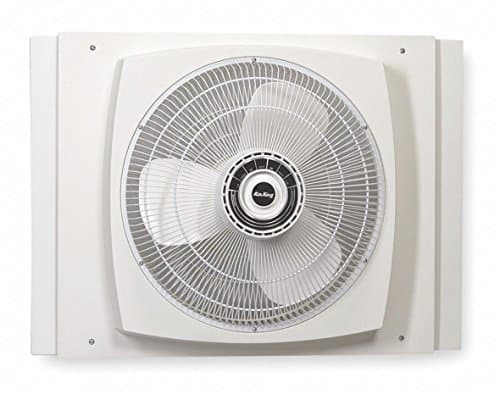 The 16-inch case Air King 16" Whole House Window Fan 2,470 CFM on 90 W is 27.4 CFM per watt, the best published efficiency of any portable fan on this site, in a 15 lb body that needs only 22 inches of window height. | Most houses — a standard sash window, and anyone who will lift the fan in and out each season | |
| 2 | 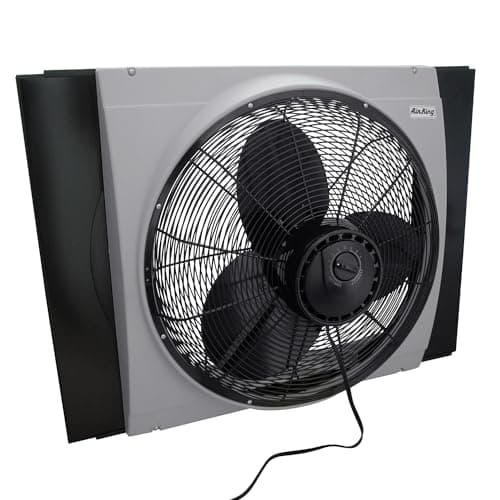 The 20-inch case Air King 20" Whole House Window Fan 3,560 CFM on 170 W, and the only fan of the pair with published decibels — 64 / 57 / 50 dB across its three speeds. | A large window in a house you want to flush out completely on a cool night |
These two are the whole of the whole-house window fan category that publishes complete data, and they come from the same manufacturer. That makes this an unusually clean comparison: the test method, the disclosure and the Storm Guard mechanism are identical, so the numbers are directly comparable in a way they almost never are between brands.
Head to head
Published figures, side by side
| 9155, 16 in | 9166F, 20 in | |
|---|---|---|
| Air delivery, high | 2,470 CFM | 3,560 CFM |
| Air delivery, low | 1,360 CFM | 2,510 CFM |
| Power | 90 / 65 / 52 W | 170 / 145 / 115 W |
| CFM per watt, high | 27.4 | 20.9 |
| CFM per watt, low | 26.2 | 21.8 |
| Noise | Not published | 64 / 57 / 50 dB |
| Window width needed | 26.5 - 34.5 in | 27 - 38 in |
| Window height needed | 22 in | 26.25 in |
| Depth | 8.25 in | 11.25 in |
| Weight | 15.0 lb | 36.6 lb |
| Storm Guard | Yes | Yes |
Figures from Air King’s whole house window fan product page; CFM per watt is our arithmetic. Prices checked 11 October 2026: the 16-inch was $154.00 and the 20-inch $249.99. The buttons above carry the live price and the date it was read.
The decider
Window height rules out more buyers than anything else
The whole window fan category is built for double-hung geometry: a wide, short opening. Width is rarely the constraint — most sash windows are wide enough for either fan. Height is, and the gap between these two is 4.25 inches of it.
Measure the opening with the lower sash fully raised, from the sill to the bottom edge of the raised sash. If that figure is between 22 and 26.25 inches, only the 16-inch fan fits. Under 22 inches and neither fits, and you mount a fan in front of the opening instead. What to do when no window fan fits.
This one is not a DIY job
Run the 20-inch on low rather than the 16-inch on high. If you have the window for it, 2,510 CFM at 50 dB on 115 W beats 2,470 CFM at an unpublished noise level on 90 W for about four cents more a night. More air, quieter, and a figure you can hold the manufacturer to.
Which one
How to choose
- Window height between 22 and 26.25 inches: the 16-inch. It is the only one that fits, and it happens to be the more efficient fan.
- You will remove it every autumn: the 16-inch. 15 lb against 36.6 is the difference between a one-person job and a two-person one.
- A two-storey house you want to purge overnight: the 20-inch, on low. Its low setting alone exceeds the smaller fan at full speed.
- You care about a published noise figure: the 20-inch. It is the only fan here with one.
- Lowest running cost: the 16-inch, at $2.29 a month on low against $5.06.
Say the unwelcome thing
Do not buy either one before measuring, and do not run either when it is warmer outside.
A window fan only cools when the outdoor air is genuinely cooler than the indoor air. Running one at 7pm when it is still 88°F outside actively heats the house, and this is the most common mistake in no-air-conditioning cooling. Check a thermometer, not your skin.
On fit: both figures above are minimums with no tolerance. A window that measures 22 inches exactly will not accept the 16-inch fan comfortably once the frame and the seals are accounted for.
In full
Every pick, and what is wrong with it
Published specifications only, each linked to the page it came from. Where a manufacturer publishes nothing, the row says so — we do not fill blanks in.
1. The 16-inch case
Air King 16" Whole House Window Fan
Air King · model 9155
2,470 CFM on 90 W is 27.4 CFM per watt, the best published efficiency of any portable fan on this site, in a 15 lb body that needs only 22 inches of window height.
2,470 / 1,700 / 1,360 CFM on 90 / 65 / 52 W. Our arithmetic puts that at 27.4 CFM per watt on high and 26.2 on low — the highest published figure for any portable fan we hold data for, and better than its bigger sibling by 31 per cent.
That efficiency is not a coincidence of blade size. Both fans are sealed into the opening with Storm Guard, so the sash closes behind them and nothing recirculates around the frame. The 16-inch simply runs a smaller blade at a sensible speed instead of pushing a bigger one hard.
22 inches of required height is the number that decides most purchases. Sash openings vary far more in height than width, and 22 inches is the lowest requirement in the whole whole-house window fan category.
15.0 lb and 8.25 inches deep. A fan you install in June and remove in September needs to be liftable by one person, and this is.
7.6¢ a night on low, $2.29 across a month of them. The honest gap: no published noise figure, where the 20-inch has one.
What’s wrong with it
Air King publishes no decibel figure for this one, and 2,470 CFM will not turn over a large two-storey house the way the 20-inch will.
Running cost — 9155
| Nameplate power | 52 W – 90 W | manufacturer's published figure |
|---|---|---|
| Energy, 8-hour night | 0.72 kWh | 90 ÷ 1000 × 8 |
| Cost per hour | 1.7¢ | at 18.34¢/kWh |
| Cost per 8-hour night | 13¢ | on the highest speed |
| Cost per 30 nights | $3.96 | 21.6 kWh |
| Same month, lowest speed | $2.29 | at 52 W |
Rate: 18.34¢/kWh, the US average residential price for June 2026 (EIA Electric Power Monthly, Table 5.3). Yours will differ — swap it in: (watts ÷ 1000) × hours × your rate.
| Air delivery | 2,470 / 1,700 / 1,360 CFM (high / medium / low) |
|---|---|
| Power | 90 / 65 / 52 W (0.8 / 0.6 / 0.5 A) |
| Efficiency | 27.4 CFM per watt on high, 26.2 on low (our arithmetic) |
| Blade | 16 in |
| Speeds | 3 |
| Window required | 26.5 - 34.5 in wide x 22 in high |
| Dimensions | 26.5 W x 8.25 D x 22 H in |
| Weight | 15.0 lb |
| Storm Guard | Window can close behind the fan |
| Mounting | Hardware included |
| Noise | Not published |
| ENERGY STAR | No program exists for window fans |
Every figure above is from Air King whole house window fan product page, models 9155 and 9166F. Blanks are shown as “not published” rather than filled in.
2. The 20-inch case
Air King 20" Whole House Window Fan
Air King · model 9166F
3,560 CFM on 170 W, and the only fan of the pair with published decibels — 64 / 57 / 50 dB across its three speeds.
3,560 / 3,120 / 2,510 CFM on 170 / 145 / 115 W, at 64 / 57 / 50 dB. Both tables published, which makes this the better-documented of the two.
The number worth dwelling on is the low setting: 2,510 CFM on 115 W is more air than the 16-inch fan moves on high, at 50 dB. If the goal is a lot of air quietly, that setting is the reason to buy this fan.
Efficiency is where it loses: 20.9 CFM per watt on high, 21.8 on low, against 27.4 and 26.2. You are buying scale, not economy — and the same is true of its physical scale.
36.6 lb is two and a half times the smaller fan. This is installed equipment: you will fit it once and leave it, and a seasonal lift-out is a two-person job.
17¢ a night on low, 25¢ on high.
What’s wrong with it
36.6 lb, 11.25 inches deep, and it needs 26.25 inches of window height. It is also 31 per cent less efficient per watt than the smaller fan.
Running cost — 9166F
| Nameplate power | 115 W – 170 W | manufacturer's published figure |
|---|---|---|
| Energy, 8-hour night | 1.36 kWh | 170 ÷ 1000 × 8 |
| Cost per hour | 3.1¢ | at 18.34¢/kWh |
| Cost per 8-hour night | 25¢ | on the highest speed |
| Cost per 30 nights | $7.48 | 40.8 kWh |
| Same month, lowest speed | $5.06 | at 115 W |
Rate: 18.34¢/kWh, the US average residential price for June 2026 (EIA Electric Power Monthly, Table 5.3). Yours will differ — swap it in: (watts ÷ 1000) × hours × your rate.
| Air delivery | 3,560 / 3,120 / 2,510 CFM (high / medium / low) |
|---|---|
| Power | 170 / 145 / 115 W (1.4 / 1.2 / 1.0 A) |
| Efficiency | 20.9 CFM per watt on high, 21.8 on low (our arithmetic) |
| Noise | 64 / 57 / 50 dB (high / medium / low) |
| Blade | 20 in |
| Speeds | 3 |
| Window required | 27 - 38 in wide x 26.25 in high |
| Dimensions | 26.75 W x 11.25 D x 26.25 H in |
| Weight | 36.6 lb |
| Storm Guard | Window can close behind the fan |
| Mounting | Hardware included |
| ENERGY STAR | No program exists for window fans |
Every figure above is from Air King whole house window fan product page, models 9155 and 9166F. Blanks are shown as “not published” rather than filled in.
Questions people actually ask
Frequently asked
Which Air King window fan should I buy, the 9155 or the 9166F?
Measure the window height first: the 16-inch 9155 needs 22 inches of opening height and the 20-inch 9166F needs 26.25. If both fit, the 16-inch is the better buy for most houses — 27.4 CFM per watt against 20.9, and 15.0 lb against 36.6. Choose the 20-inch if you need to flush a whole house, where it moves 3,560 CFM against 2,470.
Is the bigger Air King window fan more efficient?
No, substantially less. The 16-inch publishes 27.4 CFM per watt on high and the 20-inch 20.9 — the smaller fan is 31 per cent more efficient. The 20-inch buys scale rather than economy: more total air, at a higher cost per unit of it.
How loud is the Air King 9166F?
64 dB on high, 57 on medium and 50 on low, published by Air King. The 16-inch 9155 has no published noise figure at all, which is unusual given the same company publishes one for the larger fan. How loud a fan actually is.
What window height do I need for a whole-house window fan?
At least 22 inches for the smallest one available, measured from the sill to the bottom of the raised sash with the lower sash fully up. Under 22 inches no whole-house window fan on the market fits, and the fix is mounting a fan in front of the opening instead. When no window fan fits.
What does a whole-house window fan cost to run?
Between about 7.6¢ and 25¢ for an eight-hour night at 18.34¢/kWh, depending on the fan and the speed. The 16-inch on low is the cheapest at 52 W; the 20-inch on high is the dearest at 170 W.
Is a window fan better than a whole-house fan?
It is the same mechanism at a fraction of the airflow and none of the installation. A whole-house fan publishes up to 6,996 CFM but needs a ceiling opening and attic venting; the 20-inch window fan publishes 3,560 CFM and needs a window. The window fan is the way to test whether night-air cooling works in your climate before cutting a hole in a ceiling. What a whole house fan costs.
Sources
Where these numbers came from
Read next
Where to go from here
Back to Fans, or read how we pick.