Guide and picks
Is a portable air conditioner worth it?
It is the least efficient way to cool a room and sometimes the only permitted one, which is the whole of the answer.
By Sawyer V. · Published
The short answer
Only if a window or wall unit is genuinely impossible. Zero of the 505 certified room air conditioners are portables — the category cannot meet the efficiency threshold, because a single-hose unit exhausts conditioned indoor air and pulls replacement air in through every gap in the room. If you can mount a unit, mount one.
Fan & Frost earns a commission when you buy through our links, at no cost to you. It never changes a ranking, and we say so when the right answer is the cheaper unit or nothing at all. Full disclosure · How we pick.
At a glance
The picks, ranked
Tap any row to jump to the full reasoning. Prices are live from Amazon where we have them, and read “check price” where we don’t — never a number we cannot verify today.
| # | Product | Best for | Price |
|---|---|---|---|
| 1 | Best if it has to be a portable Whynter ARC-14S Dual Hose Portable Air Conditioner A dual-hose design that draws its condenser air from outside instead of from the room — the only portable arrangement that is not self-defeating. | A room where nothing can be mounted and the heat load is real | |
| 2 | Best for both seasons Whynter ARC-14SH Dual Hose Portable Air Conditioner and Heater The same dual-hose arrangement with a heating mode, which makes the purchase cover two problems rather than one. | A room with no permanent heating either | |
| 3 | 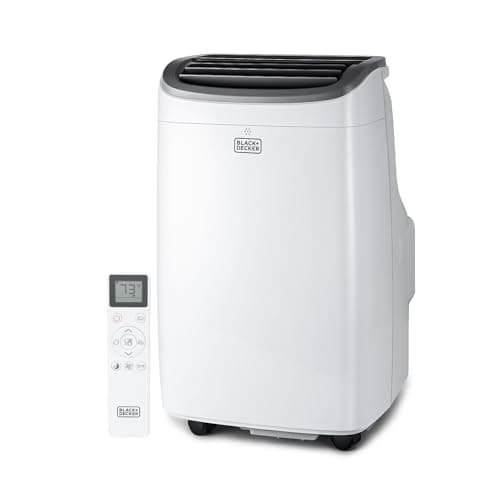 Smallest sensible portable BLACK+DECKER BPACT08WT Portable Air Conditioner The lightest portable we hold data for, for a small room that genuinely cannot take a window unit. | A small room where a bigger unit would be absurd | |
| — | 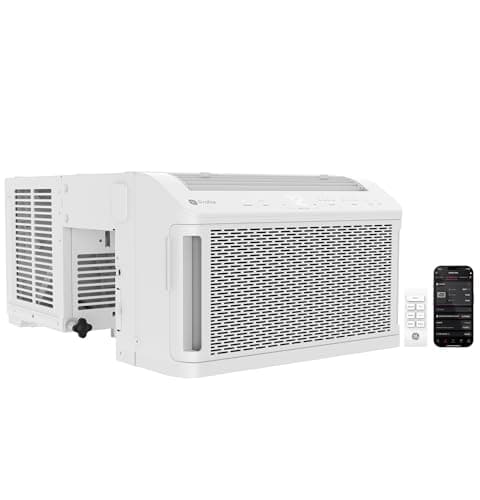 Buy this instead, if you possibly can GE Profile ClearView Window Air Conditioner, 8,000 BTU CEER 16 and 375 kWh a year — certified, Most Efficient, and about a quarter of the running power of a portable. | Anyone with a window that opens vertically |
Portables occupy an odd position. They are heavily bought, widely disliked by anyone who measures them, and genuinely the right answer for a real slice of households. All three of those are true at once.
The finding
No portable is ENERGY STAR certified
This is the cleanest way to state the efficiency case, and it does not require trusting anybody’s opinion.
The ENERGY STAR certified room air conditioner dataset holds 505 US-market records. Every one of them is a window, saddle or through-the-wall unit. None is a portable.
That is not an oversight in the program. The certification threshold is an efficiency threshold, and the portable form factor cannot clear it — for reasons that are architectural rather than a matter of build quality.
Why
The hose is the whole problem
Any air conditioner has to dump the heat it removes somewhere outside. A window unit sits in the wall of the building: its cold side faces the room and its hot side faces the street, and the two never mix.
A portable is entirely inside the room, with a hose. That creates a problem the window unit does not have:
- It needs air to cool its condenser, and on a single-hose unit that air comes from the room.
- That air is then blown outside through the hose, permanently.
- The room is now at negative pressure, so an equal volume of hot outdoor air is pulled in through door gaps, floorboards and the window kit itself.
- The unit now has to cool that too. It is, in part, air conditioning the outdoors.
A dual-hose design fixes step one by drawing condenser air from outside, which removes most of the penalty. It is why we would not recommend a single-hose unit to anyone who has a choice — the mechanism in detail.
There is a second, separate trap in the ratings. Portables are marketed on a headline BTU figure that is typically well above their DOE SACC rating, which is the one that reflects real conditions. Buying on the headline number is how people end up with a unit that cannot hold the room — BTU against SACC.
When yes
Four situations where it is the right buy
None of the above means “never”. It means the portable should be a considered second choice rather than a default. These are the cases where it is genuinely correct:
- Casement or awning windows. A window that cranks outward cannot take a conventional unit at all. There are casement-specific units, but they are scarce — the options for awkward windows.
- A lease or a building rule that forbids window units. Common in managed blocks and historic districts, and not negotiable — what renters can actually install.
- A room with no usable window at all. An interior room, a basement with glass block, a converted loft — what to do when there is no window.
- You need it in more than one room. A portable genuinely moves. If it cools the home office by day and the bedroom at night, it is doing work two fixed units would be needed for.
This one is not a DIY job
If you are buying a portable, buy the window-kit seal seriously. The plastic panel that ships in the box leaves gaps around the sash, and every gap undoes part of what the machine is doing. A foam or fabric seal that closes the whole opening is the highest-return accessory in this category, and it costs almost nothing.
Running cost
What it actually costs to run
Here is where the absence of certification bites practically rather than theoretically: there is no standardized annual figure to quote, so the only honest comparison is nameplate power.
| Appliance | Power | Eight hours | Certified? |
|---|---|---|---|
| Dual-hose portable, 14,000 BTU | 1,300 W | $1.91 | No |
| Window unit, 8,000 BTU, CEER 16 | 375 kWh/yr | — | Yes |
| Evaporative cooler | 235 W | 34¢ | No program |
| Ceiling fan on low | 1.1 W | 0.2¢ | Yes |
The window unit row deliberately has no eight-hour figure, because its published number is an annual one under a standard duty cycle and converting it to a nightly figure would be inventing arithmetic. That asymmetry is the point: one category has a measured annual number and the other does not.
For a fuller treatment of what a portable adds to a bill over a season, the running-cost page works it through.
Alternatives
Things to rule out first
Before committing, check whether one of these covers the case — each is cheaper to run and several are cheaper to buy.
- A window unit, if the window and the lease allow one. The default answer.
- A through-the-wall unit, if you own the place and the window is worth keeping — what that involves.
- An evaporative cooler, if you are in a dry climate. At 235 W against 1,300 it is a different scale of running cost, but it only works where the air is dry — the humidity limit.
- Air movement plus shading, if the room is close to tolerable already — cooling a room without an air conditioner.
Say the unwelcome thing
Do not buy a single-hose portable if a dual-hose one fits.
The single hose is the reason the category has the reputation it does. It exhausts conditioned room air, puts the room under negative pressure, and pulls hot outdoor air in through every gap to replace it.
A dual-hose unit draws its condenser air from outside instead, so the room is not used as the supply. It is the single biggest difference available within the category, and it costs far less than the efficiency it recovers.
And do not oversize on the theory that a portable is inefficient so it needs more capacity. An oversized unit cycles, which removes less humidity and holds a worse temperature — the dual-hose arrangement is the thing to insist on, not the BTU number.
In full
Every pick, and what is wrong with it
Published specifications only, each linked to the page it came from. Where a manufacturer publishes nothing, the row says so — we do not fill blanks in.
1. Best if it has to be a portable
Whynter ARC-14S Dual Hose Portable Air Conditioner
Whynter · model ARC-14S
A dual-hose design that draws its condenser air from outside instead of from the room — the only portable arrangement that is not self-defeating.
If the answer has to be a portable, the hose count is the decision that matters most, and this is the arrangement to insist on.
Dual hose. One brings outdoor air in to cool the condenser, the other sends it back out. The room is not used as the air supply, so it is not put under negative pressure — the full comparison.
1,300 W and 11.6 A at 115 V. Eight hours of that is about $1.91 at 18.34¢/kWh, which is the honest running figure for this category.
No ENERGY STAR certification, because no portable has one. Whynter publishes the electrical figures, which is more than several rivals do.
What’s wrong with it
1,300 W running, and two hoses through the window panel instead of one.
Running cost — ARC-14S
| Nameplate power | 1300 W | manufacturer's published figure |
|---|---|---|
| Energy, 8-hour night | 10.40 kWh | 1300 ÷ 1000 × 8 |
| Cost per hour | 24¢ | at 18.34¢/kWh |
| Cost per 8-hour night | $1.91 | on the highest speed |
| Cost per 30 nights | $57 | 312.0 kWh |
Rate: 18.34¢/kWh, the US average residential price for June 2026 (EIA Electric Power Monthly, Table 5.3). Yours will differ — swap it in: (watts ÷ 1000) × hours × your rate.
| Marketing capacity | 14,000 BTU (ASHRAE-128) |
|---|---|
| DOE-rated capacity | 9,500 BTU SACC |
| Hoses | Dual |
| Power | 1,300 W / 11.6 A at 115 V |
| Noise | Under 51 dBA low, under 56 dBA high |
| Dehumidification | 71 pints/day |
| Refrigerant | R-32 |
| Dimensions | 16 W x 19 D x 35.5 H in |
| Weight | 73 lb |
| Manufacturer coverage claim | 500 sq ft |
| Warranty | 1 year unit, 3 years compressor |
Every figure above is from Whynter product page, ARC-14S. Blanks are shown as “not published” rather than filled in.
2. Best for both seasons
Whynter ARC-14SH Dual Hose Portable Air Conditioner and Heater
Whynter · model ARC-14SH
The same dual-hose arrangement with a heating mode, which makes the purchase cover two problems rather than one.
The argument for a portable improves considerably when it solves a winter problem too, because the fixed cost is spread across two seasons.
Dual hose with a heat mode, in the same chassis and with the same venting arrangement.
This matters in exactly the rooms portables suit: a converted garage, a sunroom, a rented flat with no provision for either. One machine wheeled into place covers both ends of the year.
Be clear-eyed about the heating. A window heat pump at CEER 17.6 with reverse-cycle heat is a far better machine if a window is available at all — window units that heat.
What’s wrong with it
Portable heating is resistance-grade in practice, and it is still an uncertified category.
Running cost — ARC-14SH
| Nameplate power | 1300 W | manufacturer's published figure |
|---|---|---|
| Energy, 8-hour night | 10.40 kWh | 1300 ÷ 1000 × 8 |
| Cost per hour | 24¢ | at 18.34¢/kWh |
| Cost per 8-hour night | $1.91 | on the highest speed |
| Cost per 30 nights | $57 | 312.0 kWh |
Rate: 18.34¢/kWh, the US average residential price for June 2026 (EIA Electric Power Monthly, Table 5.3). Yours will differ — swap it in: (watts ÷ 1000) × hours × your rate.
| Marketing capacity | 14,000 BTU (ASHRAE-128) |
|---|---|
| DOE-rated capacity | 9,200 BTU SACC |
| Heating capacity | 13,000 BTU/h (ASHRAE-128) |
| Hoses | Dual |
| Power, cooling | 1,300 W / 11.6 A at 115 V |
| Power, heating | 1,000 W / 11.6 A at 115 V |
| Dehumidification | 71 pints/day |
| Thermostat range | 61 - 89 degrees F cooling, 61 - 77 heating |
| Refrigerant | R-32 |
| Dimensions | 16 W x 19 D x 35.5 H in |
| Weight | 85 lb |
| Manufacturer coverage claim | 500 sq ft |
| ENERGY STAR | No program exists for portable air conditioners |
Every figure above is from Whynter product page, ARC-14SH. Blanks are shown as “not published” rather than filled in.
3. Smallest sensible portable
BLACK+DECKER BPACT08WT Portable Air Conditioner
BLACK+DECKER · model BPACT08WT
The lightest portable we hold data for, for a small room that genuinely cannot take a window unit.
Portables get bought far too large, on the reasoning that a portable is inefficient so it should be oversized. That compounds the problem.
A smaller unit in a small room runs longer at lower output, which removes more humidity and holds a steadier temperature than a large unit that blasts and stops.
Single hose is the honest limitation. Every cubic foot it exhausts is replaced by outdoor air drawn in through door gaps, so part of its output is spent cooling air it just invited in.
Seal the window kit properly and shut the door. Venting it correctly recovers more than any setting does.
What’s wrong with it
Single hose, so it depressurizes the room it is cooling.
Running cost
BLACK+DECKER does not publish a wattage for the BPACT08WT, so we cannot calculate what it costs to run. We are not going to estimate one. If BLACK+DECKER publishes a nameplate figure, this block will show the arithmetic.
| Manufacturer capacity | 4,000 BTU (8,000 BTU ASHRAE) |
|---|---|
| Hoses | Single |
| Refrigerant | R-410A |
| Dimensions | 15.3 W x 14.0 D x 25.0 H in |
| Weight | 52.9 lb |
| Power | Not published by the manufacturer |
| Noise | Not published |
| Coverage claim | Not published by the manufacturer |
| Warranty | 1 year parts and labor, 5 years compressor |
Every figure above is from BLACK+DECKER product page, BPACT08WT. Blanks are shown as “not published” rather than filled in.
Skip this one
GE Profile ClearView Window Air Conditioner, 8,000 BTU
GE Profile · model PWJV08W
CEER 16 and 375 kWh a year — certified, Most Efficient, and about a quarter of the running power of a portable.
Marked as the one not to skip past. This is what the portable is being compared against, and the gap is not subtle.
CEER 16 and 375 kWh a year — about $69 at 18.34¢/kWh for a whole season, against roughly $1.91 for a single eight-hour night on a 1,300 W portable.
Those two figures are measured differently and are not a like-for-like comparison, which is exactly the point: the portable has no certified annual figure to quote, because the category is not certified.
46.2 lb and it does not straddle the sill. If your window opens vertically and your lease permits it, this is the answer — the two compared directly.
What’s wrong with it
It has to live in the window all season and it needs a support bracket.
Running cost — PWJV08W
| Annual energy use | 375 kWh | ENERGY STAR certified figure |
|---|---|---|
| Annual cost | $69 | 375 × 18.34¢/kWh |
| Per cooling month | $17 | spread over a four-month season |
The annual figure is the certified value from the ENERGY STAR Certified Room Air Conditioners dataset, which models a standard cooling season rather than your actual summer. It is more useful than a nameplate wattage here, because a variable-speed compressor spends most of its life well below nameplate.
Rate: 18.34¢/kWh, the US average residential price for June 2026 (EIA Electric Power Monthly, Table 5.3). Yours will differ — swap it in: (watts ÷ 1000) × hours × your rate.
| Cooling capacity | 8,000 BTU/h |
|---|---|
| CEER | 16 |
| Annual energy use | 375 kWh/yr |
| vs federal standard | 47% less energy |
| Dimensions | 12.6 H x 18.6 W x 15.3 D in |
| Weight | 46.2 lb |
| Refrigerant | R-32 |
| Installation | Does not straddle the windowsill |
| Compressor | Variable speed |
| ENERGY STAR | Certified, and on the Most Efficient list |
Every figure above is from ENERGY STAR Certified Room Air Conditioners dataset. Blanks are shown as “not published” rather than filled in.
We are not linking a buy button for this one. If you want to look at it anyway, it is easy enough to find — but we would rather send you to something that fits your room.
Questions people actually ask
Frequently asked
Are portable air conditioners worth buying?
Only when a window or wall unit is genuinely impossible — casement windows, a lease that forbids them, a room with no window, or a need to move between rooms. Zero of the 505 certified room air conditioners are portables, because the form factor cannot meet the efficiency threshold.
Why are portable air conditioners not ENERGY STAR certified?
Because a single-hose unit exhausts conditioned indoor air to cool its condenser, putting the room under negative pressure so hot outdoor air is drawn in through every gap to replace it. The category cannot clear the efficiency threshold for that structural reason. Single hose against dual.
Are portable air conditioners expensive to run?
Yes, relative to the alternatives. A 14,000 BTU dual-hose unit draws 1,300 W, about $1.91 for an eight-hour night at the current average residential rate. An evaporative cooler at 235 W is roughly 34¢ over the same period, where the climate suits one. Running costs in full.
Is a dual-hose portable air conditioner worth the extra?
Yes. It draws condenser air from outside rather than from the room, so it does not depressurize the space and pull hot air in to replace what it exhausts. It is the single biggest efficiency difference available inside the category.
Do portable air conditioners really cool a room?
Yes, a correctly sized and properly vented one does. The complaints usually trace to three things: a single hose, a badly sealed window kit, and a unit bought on its headline BTU rather than its DOE SACC rating, which is typically well below it. BTU against SACC.
What is better than a portable air conditioner?
A window unit if the window allows one, a through-the-wall unit if you own the property, or an evaporative cooler if you live somewhere dry. A certified 8,000 BTU window unit uses 375 kWh a year and is 47% under the federal standard; no portable has a certified figure at all.
Sources
Where these numbers came from
- ENERGY STAR Certified Room Air Conditioners dataset — 505 US-market records, none of them portable units
- Whynter ARC-14S product page — dual hose, 1,300 W, 11.6 A at 115 V
- Honeywell CL25AE product page — 235 W, used for the evaporative comparison
- EIA Electric Power Monthly, Table 5.3 — average residential electricity price
Read next
Where to go from here
Back to Guides & Calculators, or read how we pick.