The picks
The best bathroom fans with a heater, for a bathroom that is freezing at six in the morning
A bathroom fan is normally bought on efficiency. Put a 1,500-watt heater in the same housing and efficiency stops being the question — the questions become how much heat, how loud, and whether your circuit can take it.
By Sawyer V. · Published
The short answer
For a full bathroom, the Broan-NuTone BHF110 is the pick: a 1,500 W heater behind 110 CFM at 2.0 sones, both HVI certified. It draws 14 A at 120 V, which is the figure to check before anything else. For a small or quiet bathroom, the Delta BreezRadiance RAD80LED runs at 1.5 sones on 11 A.
Fan & Frost earns a commission when you buy through our links, at no cost to you. It never changes a ranking, and we say so when the right answer is the cheaper unit or nothing at all. Full disclosure · How we pick.
At a glance
The picks, ranked
Tap any row to jump to the full reasoning. Prices are live from Amazon where we have them, and read “check price” where we don’t — never a number we cannot verify today.
| # | Product | Best for | Price |
|---|---|---|---|
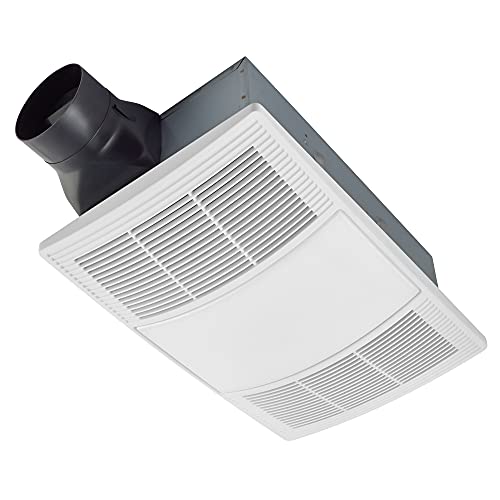
| 1 | Most heat and most air Broan-NuTone PowerHeat Heater Exhaust Fan, 110 CFM 1,500 W of heat behind 110 CFM at 2.0 sones, with both the air and sound ratings HVI certified. The most capable unit on this page and the one that needs the most electrical headroom. | A full bathroom up to about 105 sq ft that someone showers in first thing on a winter morning — the most heater wattage and the most certified airflow here | |
| 2 | 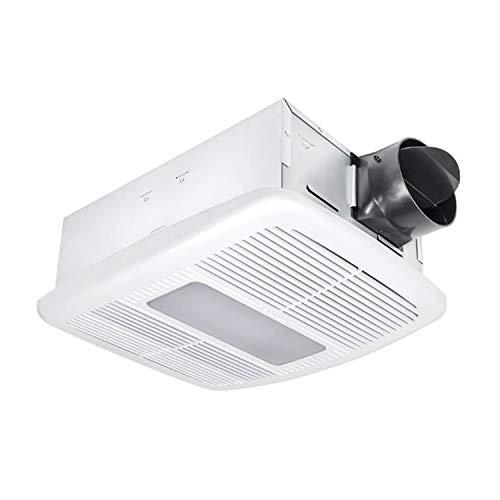 Quietest, and the only one that publishes an efficiency figure Delta BreezRadiance RAD80LED Fan, Heater and LED Light 80 CFM at 1.5 sones on an 11.7 W brushless DC motor — 6.8 CFM per watt — with a 1,300 W heater and a dimmable 850-lumen LED. 1,327 W total, 11 A. | A bathroom off a bedroom, or any bathroom where 2.0 sones is too much — and for anyone who wants a maker that still publishes CFM per watt on a product with a heater in it | |
| 3 | 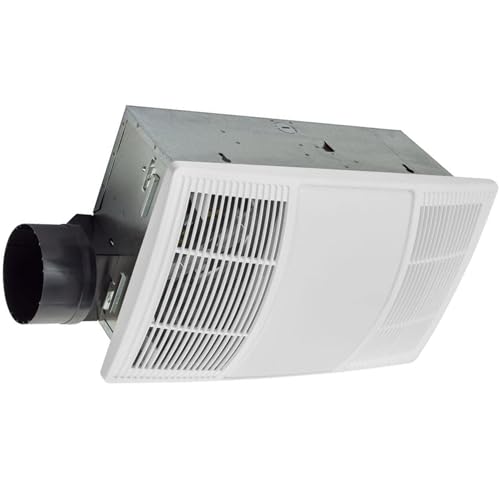 Best for a small bathroom Broan-NuTone PowerHeat Heater Exhaust Fan with LED, 80 CFM 80 CFM at 1.5 sones with a 1,300 W heater and a selectable-color LED, on 12 amps rather than 14. The cheapest route to a certified heater fan with a light in it. | A bathroom around 75 sq ft — a powder room, an en suite, a cottage bathroom — where 110 CFM and 14 amps are both more than the room needs | |
| 4 | 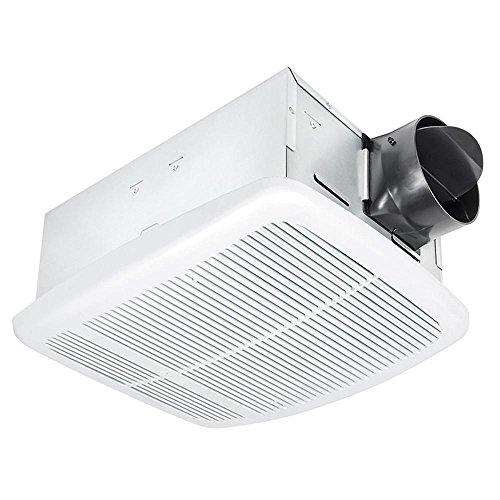 Best without a light Delta BreezRadiance RAD80 Fan and Heater The RAD80LED without the LED: the same 80 CFM at 1.5 sones, the same 11.7 W and 6.8 CFM per watt, the same 1,300 W heater, for less money. | A bathroom whose lighting is already sorted and which only needs heat and extraction — the cheapest way to get 1.5 sones and a published efficiency figure | |
| — | 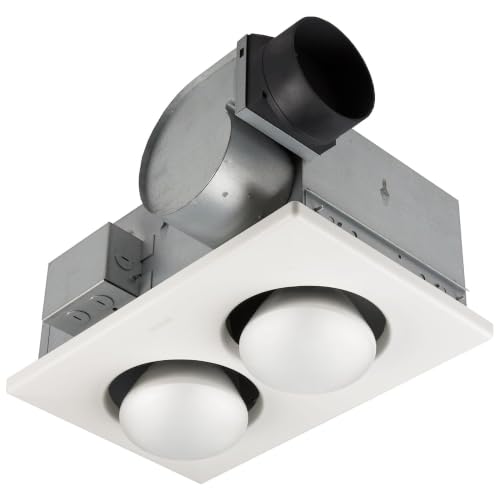 The one to skip Broan-NuTone Two-Bulb Infrared Heater/Ventilation Fan 70 CFM, 545 W of heat from two 250 W infrared bulbs, and 5.0 sones. The quietest unit on this page is 1.5 sones; this is more than three times as loud. | A reader who specifically wants radiant bulb heat and accepts 5.0 sones to get it — on the published figures it is a third of the heat for two and a half times the noise |
Everywhere else on this site, a bathroom fan is chosen on certified numbers. The federal dataset publishes airflow, efficacy in CFM per watt and loudness in sones for 973 certified bathroom and utility fans, and the main bathroom-fan roundup ranks straight down that list.
Put a heater in the housing and that method stops working, for a reason worth stating plainly.
The finding
Not one certified ventilating fan has a heater in it
We read the whole ENERGY STAR Certified Ventilating Fans dataset: 1,142 records — 973 bathroom and utility fans, 92 range hoods and 77 in-line fans. Not a single record’s model name or number mentions a heater, and Panasonic’s 101 certified records contain no WhisperWarm entry at all.
Broan confirms it from the other direction. On the BHF110, the BHFLED80 and every other fan in its PowerHeat line, its own specification table reads “ENERGY STAR certified: No”.
The reason is arithmetic rather than conspiracy. ENERGY STAR for ventilating fans is awarded on CFM per watt. A certified fan delivers somewhere between about 4 and 17 CFM per watt. Put a 1,300-watt heater in series with an 11.7-watt fan and the combined figure collapses to a rounding error — so the category is simply not entered.
What that means for you: the efficiency figure that decides every other bathroom-fan purchase is unavailable and irrelevant here. Three figures replace it.
What to compare instead
Heater watts, sones and rated amps
| Unit | Heater | CFM | Sones | Amps | Room size |
|---|---|---|---|---|---|
| Broan BHF110 | 1,500 W | 110 | 2.0 | 14 | 105 sq ft |
| Delta RAD80LED | 1,300 W | 80 | 1.5 | 11 | Not published |
| Broan BHFLED80 | 1,300 W | 80 | 1.5 | 12 | 75 sq ft |
| Delta RAD80 | 1,300 W | 80 | 1.5 | 11 | Not published |
| Broan 164 (bulb) | 545 W | 70 | 5.0 | 4.5 | Not published |
Every figure is the manufacturer’s own. Broan states that its air and sound ratings are HVI certified; Delta publishes airflow at both 0.1 and 0.25 in w.g. and only the 0.1 figures are shown here. None of these units is ENERGY STAR certified, because the program does not cover them.
- Heater watts is the heat. 1,500 W against 545 W is not a nuance; it is a nearly threefold difference in how fast a cold room becomes bearable.
- Sones is whether you will use it. 1.5 to 2.0 sones is a background hum. 5.0 is a machine running in a tiled box. Where those numbers sit against the certified field.
- Rated amps is whether you can install it. Read the next section before you buy anything here.
Before you buy
Fourteen amps is the whole problem
A normal bathroom fan draws well under an amp. The fans on this page draw 4.5 to 14 amps, and that changes what kind of job this is.
The arithmetic, which is ours and is trivial: 14 A at 120 V is 1,680 VA. A 15-amp breaker is rated for 15 amps, so the BHF110 alone accounts for all but one of them. Twelve amps for the BHFLED80 leaves three. Eleven for the Delta units leaves four.
Neither Broan nor Delta publishes a circuit requirement on its product page. Not “dedicated 20-amp”, not “do not share”, nothing. That absence is itself the finding: the manufacturer states the draw and leaves the decision to whoever does the wiring, which in practice means the figure has to go to an electrician before the unit goes in a cart.
This one is not a DIY job
If the bathroom is cold because it is damp rather than because it is unheated, a heater is the expensive way to fix it. Moving air out faster is the cheap way, and a humidity-sensing fan does it without anyone touching a switch — at a certified 15.3 CFM per watt instead of 1,500 watts. Humidity-sensing bathroom fans on certified efficacy, and why cold glass and warm bathrooms produce water.
Sizing
Size it on the room, not on the CFM
Broan publishes a recommended room size for its heater fans — 105 sq ft for the BHF110, 75 sq ft for the BHFLED80 — and that figure is doing something the CFM rating does not. It is bounding the heat, not the extraction.
A 1,500 W element in a 40 sq ft powder room is uncomfortable. The same element in a 120 sq ft family bathroom with an outside wall is underpowered. Delta publishes no equivalent figure for either Radiance model, which leaves its 1,300 W unbounded on paper.
For the extraction half of the job the usual rule applies: roughly 1 CFM per square foot of floor for a bathroom under 100 sq ft, which puts an 80 CFM fan at the limit of a 75 sq ft room and the 110 CFM fan comfortably inside a 100 sq ft one. And then the run time matters more than the rating.
Say the unwelcome thing
Do not buy a heater fan to replace a dead fan on the same switch.
A fan swap is a ten-minute job on the same wires. A fan-and-heater is a different appliance on a different load: one more switch leg for the heater, frequently a thicker conductor, and an amp draw that the existing circuit was never sized for.
If what you want is the same fan but warmer, price the electrical work first. If the answer makes you wince, a quiet certified extractor plus a separate heater on its own circuit is frequently cheaper and always easier to service.
In full
Every pick, and what is wrong with it
Published specifications only, each linked to the page it came from. Where a manufacturer publishes nothing, the row says so — we do not fill blanks in.
1. Most heat and most air
Broan-NuTone PowerHeat Heater Exhaust Fan, 110 CFM
Broan-NuTone · model BHF110
1,500 W of heat behind 110 CFM at 2.0 sones, with both the air and sound ratings HVI certified. The most capable unit on this page and the one that needs the most electrical headroom.
110 CFM at 2.0 sones, both HVI certified, with a 1,500 W heater, a 4-inch duct and a housing of 16 x 10-3/4 x 5-7/8 inches. Broan publishes a recommended room size of 105 sq ft, which is the figure to size from rather than the CFM.
The 1,500 W is why you are here. At 18.34¢/kWh, a fifteen-minute blast while you shower costs 6.9¢, and a full hour costs 28¢. That is the correct way to think about a heater fan: it is a short-burst appliance, and its running cost is trivial as long as nobody leaves it on.
14 rated amps at 120 V is the number to take to an electrician. A 15-amp breaker is rated for 15 amps; this unit asks for 14 of them on its own. Broan does not publish a circuit requirement anywhere on the product page, so whether it can share the bathroom circuit with the lights is not a question the manufacturer answers.
One more line from Broan’s own specification table worth reading before you buy: “UL listed for use over bathtubs or showers when connected to a GFCI circuit: No”. It is UL listed; it is not listed for that position.
What’s wrong with it
14 rated amps at 120 V, which leaves one amp of a 15-amp breaker — and Broan publishes no circuit requirement to tell you whether that is acceptable. It is also 2.0 sones against the Delta's 1.5, and Broan lists it as NOT UL listed for use over a tub or shower on a GFCI circuit.
Running cost — BHF110
| Nameplate power | 1500 W | manufacturer's published figure |
|---|---|---|
| Energy, 8-hour night | 12.00 kWh | 1500 ÷ 1000 × 8 |
| Cost per hour | 28¢ | at 18.34¢/kWh |
| Cost per 8-hour night | $2.20 | on the highest speed |
| Cost per 30 nights | $66 | 360.0 kWh |
Rate: 18.34¢/kWh, the US average residential price for June 2026 (EIA Electric Power Monthly, Table 5.3). Yours will differ — swap it in: (watts ÷ 1000) × hours × your rate.
| Air delivery | 110 CFM, HVI certified |
|---|---|
| Noise | 2.0 sones, HVI certified |
| Heater | 1,500 W |
| Rated amps | 14 A at 120 V |
| Recommended room size | 105 sq ft |
| Duct size | 4 in |
| Housing | 16 x 10-3/4 x 5-7/8 in |
| Grille | 17.75 x 11.75 in, white |
| ENERGY STAR | Not certified |
| Over a tub or shower | No. Broan lists it as not UL listed for use over a tub or shower on a GFCI circuit |
| Warranty | 1 year |
Every figure above is from Broan-NuTone BHF110 product page — 110 CFM, 2.0 sones, 1,500 W heater, 14 rated amps at 120 V, 105 sq ft recommended, 4 in duct, 1-year warranty, not ENERGY STAR certified. Blanks are shown as “not published” rather than filled in.
2. Quietest, and the only one that publishes an efficiency figure
Delta BreezRadiance RAD80LED Fan, Heater and LED Light
Delta Breez · model RAD80LED
80 CFM at 1.5 sones on an 11.7 W brushless DC motor — 6.8 CFM per watt — with a 1,300 W heater and a dimmable 850-lumen LED. 1,327 W total, 11 A.
80 CFM at 0.1 in w.g., 1.5 sones, 11.7 W fan power — which Delta turns into a published 6.8 CFM per watt. That is the only efficiency figure published by anything on this page, and it exists because Delta treats the fan and the heater as separate machines in one box.
The heater is 1,300 W and the fan is 11.7 W. Put those side by side and the whole category snaps into focus: the heater is 111 times the fan’s draw. Total rated power is 1,327 W at 11 A.
13 W LED, 850 lumens, 3000 K, 90 CRI, dimmable, and a brushless DC motor rated for 70,000 hours. The 90 CRI is unusual to see published on a bath fan and it is the figure that decides whether the room looks gray.
Delta also publishes a running cost for the fan alone: about $12.31 a year at 24/7 operation. Our arithmetic on its 11.7 W at 18.34¢/kWh gives $19 a year, which is the same number from the other direction. How long a bathroom fan should actually run.
What’s wrong with it
80 CFM against the Broan's 110, and Delta publishes no warranty term anywhere on the product page. Its airflow also falls to 54 CFM at 0.25 in w.g., which is the static pressure a real duct run actually imposes, and it publishes no sone figure at all at that pressure.
Running cost — RAD80LED
| Nameplate power | 1327 W | manufacturer's published figure |
|---|---|---|
| Energy, 8-hour night | 10.62 kWh | 1327 ÷ 1000 × 8 |
| Cost per hour | 24¢ | at 18.34¢/kWh |
| Cost per 8-hour night | $1.95 | on the highest speed |
| Cost per 30 nights | $58 | 318.5 kWh |
Rate: 18.34¢/kWh, the US average residential price for June 2026 (EIA Electric Power Monthly, Table 5.3). Yours will differ — swap it in: (watts ÷ 1000) × hours × your rate.
| Air delivery | 80 CFM at 0.1 in w.g. |
|---|---|
| Noise | 1.5 sones |
| Fan power | 11.7 W |
| Efficacy | 6.8 CFM per watt |
| Heater | 1,300 W element |
| Light | 13 W LED, 850 lumens, 3000 K, 90 CRI, dimmable |
| Total power | 1,327 W |
| Current | 11 A at 120 V / 60 Hz |
| Duct size | No less than 4 in |
| Motor | Brushless DC, 70,000 hour rated life |
| ENERGY STAR | Not stated for this model |
| Warranty | Not published on the product page |
Every figure above is from Delta Breez RAD80LED product page — 80 CFM, 1.5 sones, 11.7 W fan, 6.8 CFM/W, 1,300 W heater, 13 W / 850 lm LED, 1,327 W total, 11 A, 4 in duct. Blanks are shown as “not published” rather than filled in.
3. Best for a small bathroom
Broan-NuTone PowerHeat Heater Exhaust Fan with LED, 80 CFM
Broan-NuTone · model BHFLED80
80 CFM at 1.5 sones with a 1,300 W heater and a selectable-color LED, on 12 amps rather than 14. The cheapest route to a certified heater fan with a light in it.
80 CFM, 1.5 sones (both HVI certified), 1,300 W heater, 12 rated amps at 120 V, and a recommended room size of 75 sq ft. The housing is 14-1/4 x 8-1/4 x 5-3/4 inches, which is noticeably smaller than the BHF110’s and matters in a shallow ceiling.
Two amps less than the BHF110 for 200 W less heat. That trade is the single most useful thing on this page for anyone with an older panel: 12 A leaves three amps of a 15-amp breaker rather than one.
The light is an integrated dimmable LED with selectable 2700 K, 3500 K and 5000 K. Broan publishes the color temperatures and publishes neither the wattage nor the lumens, so you cannot compare its brightness with the Delta’s stated 850.
At 18.34¢/kWh, ten minutes of its heater costs 4.0¢ and an hour costs 24¢.
What’s wrong with it
Broan publishes no wattage or lumen figure for the LED at all, which is a gap on a product whose light is half the point, and the spec table rounds the sone rating to 1 while the product title says 1.5. Same one-year warranty and same no-ENERGY-STAR status as the rest of the range.
Running cost — BHFLED80
| Nameplate power | 1300 W | manufacturer's published figure |
|---|---|---|
| Energy, 8-hour night | 10.40 kWh | 1300 ÷ 1000 × 8 |
| Cost per hour | 24¢ | at 18.34¢/kWh |
| Cost per 8-hour night | $1.91 | on the highest speed |
| Cost per 30 nights | $57 | 312.0 kWh |
Rate: 18.34¢/kWh, the US average residential price for June 2026 (EIA Electric Power Monthly, Table 5.3). Yours will differ — swap it in: (watts ÷ 1000) × hours × your rate.
| Air delivery | 80 CFM, HVI certified |
|---|---|
| Noise | 1.5 sones, HVI certified (Broan's spec table rounds this to 1) |
| Heater | 1,300 W |
| Rated amps | 12 A at 120 V |
| Recommended room size | 75 sq ft |
| Duct size | 4 in |
| Housing | 14-1/4 x 8-1/4 x 5-3/4 in |
| Grille | 16.25 x 9.75 in, white |
| Light | Integrated dimmable LED, selectable 2700 K / 3500 K / 5000 K. Wattage and lumens not published |
| ENERGY STAR | Not certified |
| Warranty | 1 year |
Every figure above is from Broan-NuTone BHFLED80 product page — 80 CFM, 1.5 sones, 1,300 W heater, 12 rated amps at 120 V, 75 sq ft recommended, selectable-CCT LED, 1-year warranty, not ENERGY STAR certified. Blanks are shown as “not published” rather than filled in.
4. Best without a light
Delta BreezRadiance RAD80 Fan and Heater
Delta Breez · model RAD80
The RAD80LED without the LED: the same 80 CFM at 1.5 sones, the same 11.7 W and 6.8 CFM per watt, the same 1,300 W heater, for less money.
80 CFM and 1.5 sones at 0.1 in w.g.; 54 CFM at 0.25 in w.g. Delta is one of the few makers that publishes both points, and the second one is the honest one: once there is a real duct, an elbow and a wall cap in the way, the fan moves a third less air.
11.7 W fan, 6.8 CFM per watt, 1,300 W heater, 1,314 W total, 11 A at 120 V, into a duct Delta says must be no less than 4 inches. The housing is alloy steel rather than painted mild steel.
The reason to take this over the LED version is not only price. A combined fan, heater and light wants a three-switch wall plate and frequently gets a two-switch one, after which the heater and the light share a switch and the heater runs every time somebody goes in.
Delta publishes no warranty term on either page. Broan publishes one year. Neither is generous, and both are worth knowing before you commit a ceiling to one.
What’s wrong with it
Delta publishes 80 CFM at 0.1 in w.g. but only 54 CFM at 0.25 — a 33 percent fall across the pressure range an ordinary duct run imposes — and publishes no sone rating at 0.25 at all. No warranty term is published on the page either.
Running cost — RAD80
| Nameplate power | 1314 W | manufacturer's published figure |
|---|---|---|
| Energy, 8-hour night | 10.51 kWh | 1314 ÷ 1000 × 8 |
| Cost per hour | 24¢ | at 18.34¢/kWh |
| Cost per 8-hour night | $1.93 | on the highest speed |
| Cost per 30 nights | $58 | 315.4 kWh |
Rate: 18.34¢/kWh, the US average residential price for June 2026 (EIA Electric Power Monthly, Table 5.3). Yours will differ — swap it in: (watts ÷ 1000) × hours × your rate.
| Air delivery | 80 CFM at 0.1 in w.g.; 54 CFM at 0.25 in w.g. |
|---|---|
| Noise | 1.5 sones at 0.1 in w.g.; not rated at 0.25 |
| Fan power | 11.7 W at 0.1 in w.g.; 8.2 W at 0.25 |
| Efficacy | 6.8 CFM per watt at 0.1 in w.g.; 6.5 at 0.25 |
| Heater | 1,300 W element |
| Total power | 1,314 W |
| Current | 11 A at 120 V / 60 Hz |
| Duct size | No less than 4 in |
| Motor | Brushless DC in an alloy steel housing |
| Fan-only running cost | Delta publishes about $12.31 a year for 24/7 operation |
| Warranty | Not published on the product page |
Every figure above is from Delta Breez RAD80 product page — 80 CFM at 0.1 in w.g. and 54 at 0.25, 1.5 sones, 11.7 W fan, 6.8 CFM/W, 1,300 W heater, 1,314 W total, 11 A. Blanks are shown as “not published” rather than filled in.
Skip this one
Broan-NuTone Two-Bulb Infrared Heater/Ventilation Fan
Broan-NuTone · model 164
70 CFM, 545 W of heat from two 250 W infrared bulbs, and 5.0 sones. The quietest unit on this page is 1.5 sones; this is more than three times as loud.
Bulb heaters are the oldest answer to a cold bathroom and they have one real advantage: infrared warms you rather than the air, so it feels immediate. Broan still publishes the figures, which is more than most of this category manages.
The figures are the problem. 5.0 sones against 1.5 for the quietest fan here. Sones are close to linear in perceived loudness, so that is roughly three times as loud, in a tiled room that reflects everything.
545 W of total heater wattage, from two 250 W BR40 infrared bulbs, at 4.5 rated amps. The low amp draw is the one thing in its favor and it is a real one on an old circuit — but you are buying a third of the heat for it.
Bulbs are a consumable. Two 250 W infrared lamps will not last the life of the fixture, and Broan does not state whether any are supplied. A heater with a shopping list attached is a different purchase from a sealed resistance element.
What’s wrong with it
5.0 sones is a genuinely intrusive noise in a small hard-surfaced room, 545 W is about a third of the heat the resistance units deliver, and Broan does not publish whether the two BR40 bulbs it needs are included. It is also 70 CFM, the least air here.
Running cost — 164
| Nameplate power | 545 W | manufacturer's published figure |
|---|---|---|
| Energy, 8-hour night | 4.36 kWh | 545 ÷ 1000 × 8 |
| Cost per hour | 10.0¢ | at 18.34¢/kWh |
| Cost per 8-hour night | 80¢ | on the highest speed |
| Cost per 30 nights | $24 | 130.8 kWh |
Rate: 18.34¢/kWh, the US average residential price for June 2026 (EIA Electric Power Monthly, Table 5.3). Yours will differ — swap it in: (watts ÷ 1000) × hours × your rate.
| Air delivery | 70 CFM |
|---|---|
| Noise | 5.0 sones |
| Heater | 545 W total, from two 250 W BR40 infrared bulbs |
| Rated amps | 4.5 A at 120 V |
| Duct size | 4 in |
| Heater type | Infrared bulb, Type IC ceiling heater |
| Bulbs included | Not published |
| Warranty | 1 year |
Every figure above is from Broan-NuTone model 164 product page — 70 CFM, 5.0 sones, 545 W heater wattage from two 250 W BR40 infrared bulbs, 4.5 rated amps, 4 in duct. Blanks are shown as “not published” rather than filled in.
We are not linking a buy button for this one. If you want to look at it anyway, it is easy enough to find — but we would rather send you to something that fits your room.
Questions people actually ask
Frequently asked
What is the best bathroom fan with a heater?
For a full bathroom, the Broan-NuTone BHF110: a 1,500 W heater behind 110 CFM at 2.0 sones, both HVI certified, with a recommended room size of 105 sq ft. It draws 14 rated amps at 120 V, so check the circuit first. For a small or quiet bathroom the Delta BreezRadiance RAD80LED runs at 1.5 sones and 11 amps.
Are bathroom fans with heaters ENERGY STAR certified?
No, and none of them is. We read all 1,142 records in the ENERGY STAR Certified Ventilating Fans dataset and not one mentions a heater; Broan's own specification tables for its PowerHeat line read 'ENERGY STAR certified: No'. The program awards certification on CFM per watt, and a 1,300-watt heater in series with a 12-watt fan destroys that figure. The certified fans, ranked.
Does a bathroom heater fan need its own circuit?
Neither Broan nor Delta publishes a circuit requirement, which is why this has to go to an electrician. What they do publish is the draw: 14 rated amps for the Broan BHF110, 12 for the BHFLED80, 11 for both Delta Radiance units and 4.5 for the Broan 164 bulb heater. At 14 amps there is one amp left of a 15-amp breaker.
How much does it cost to run a bathroom heater fan?
Very little, because nobody runs one for long. A 1,500 W heater costs about 20 cents an hour at the national average rate, so a fifteen-minute burst while you shower is around five cents. The cost only becomes real if the heater shares a switch with the light and runs every time somebody walks in. Where household energy actually goes.
How many watts should a bathroom heater fan be?
Match it to the room rather than maximising it. Broan publishes a recommended room size alongside each wattage: 1,500 W for up to 105 sq ft and 1,300 W for up to 75 sq ft. A 1,500 W element in a small powder room is unpleasant, and 545 W from a two-bulb infrared unit is not enough for a family bathroom.
Is an infrared bulb heater better than a resistance heater?
It feels faster, because infrared warms you rather than the air, and it draws far less current — 4.5 amps against 11 to 14. The published trade-offs are steep: the Broan 164 delivers 545 W against 1,300 to 1,500 W, runs at 5.0 sones against 1.5, and needs two 250 W BR40 bulbs that are a consumable.
What size duct does a bathroom heater fan need?
Four inches on every unit here. Broan lists a 4 in duct size for the BHF110, BHFLED80 and 164, and Delta states that the duct for the Radiance units must be no less than 4 in. That is worth checking against what is already in the ceiling: a 3-inch run is common in older houses and will throttle the fan. Getting at the fan and its duct.
Sources
Where these numbers came from
- ENERGY STAR Certified Ventilating Fans dataset — 1,142 records (973 bathroom/utility, 92 range hood, 77 in-line), none of which names a heater; Panasonic's 101 certified records contain no WhisperWarm entry
- Broan-NuTone BHF110 product page — 110 CFM, 2.0 sones, 1,500 W heater, 14 rated amps at 120 V, 105 sq ft recommended room size, 4 in duct, ENERGY STAR certified: No, 1-year warranty
- Broan-NuTone BHFLED80 product page — 80 CFM, 1.5 sones, 1,300 W heater, 12 rated amps, 75 sq ft recommended, selectable 2700/3500/5000 K LED with no wattage or lumen figure published
- Delta Breez RAD80LED product page — 80 CFM at 0.1 in w.g., 1.5 sones, 11.7 W fan, 6.8 CFM/W, 1,300 W heater, 13 W / 850 lm / 3000 K / 90 CRI LED, 1,327 W total, 11 A, 70,000 hour motor
- Delta Breez RAD80 product page — 80 CFM at 0.1 in w.g. and 54 CFM at 0.25, 1.5 sones, 11.7 W and 8.2 W, 6.8 and 6.5 CFM/W, 1,300 W heater, 1,314 W total, 11 A, and a published annual fan-only cost of about $12.31
- Broan-NuTone model 164 product page — 70 CFM, 5.0 sones, 545 W heater from two 250 W BR40 infrared bulbs, 4.5 rated amps, 4 in duct
- EIA Electric Power Monthly, Table 5.3 — electricity rate
Read next
Where to go from here
Back to Whole-House Airflow, or read how we pick.