The picks
The best pedestal fans, and the spec nobody publishes
This is the worst-documented category on the site. Neither of the major names publishes a wattage for its pedestal fans, so no honest running cost exists for either.
By Sawyer V. · Published
The short answer
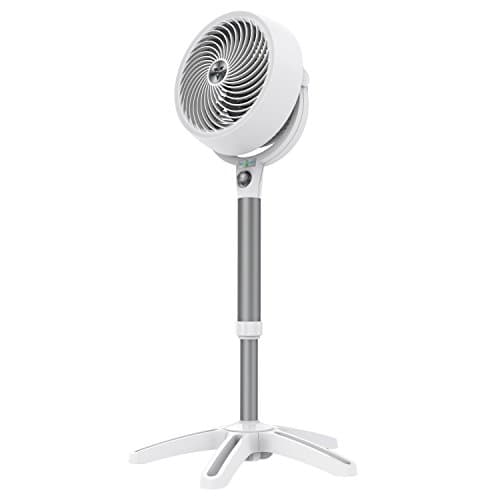
A pedestal fan’s real advantage is height: it puts airflow at bed or chair level from across a room. The Vornado 683DC publishes an 80 ft reach and a 5-year warranty; the Lasko S18931 adjusts 38–54.5 inches and weighs 9 lb. Neither publishes a wattage, so neither has a computable running cost.
Fan & Frost earns a commission when you buy through our links, at no cost to you. It never changes a ranking, and we say so when the right answer is the cheaper unit or nothing at all. Full disclosure · How we pick.
At a glance
The picks, ranked
Tap any row to jump to the full reasoning. Prices are live from Amazon where we have them, and read “check price” where we don’t — never a number we cannot verify today.
| # | Product | Best for | Price |
|---|---|---|---|
| 1 | Best reach Vornado 683DC Energy Smart Medium Pedestal Air Circulator A published 80 ft airflow reach and a 5-year warranty, which is five times the coverage anyone else here offers. | Aiming air across a large room from a corner | |
| 2 | 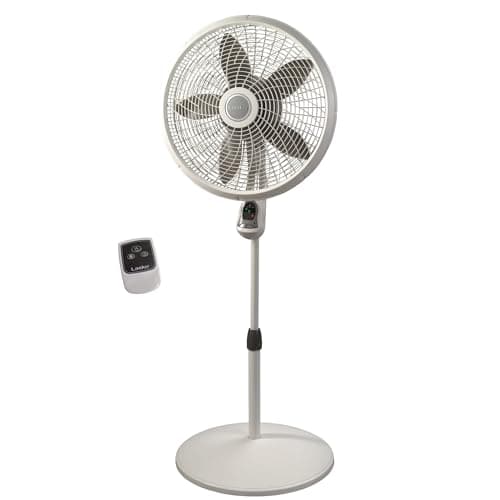 Best height range Lasko Cyclone 18" Pedestal Fan 38 to 54.5 inches of adjustment is the widest here, and 9 lb makes it easy to move between rooms. | Directing air across a bed, where you need it high | |
| 3 | 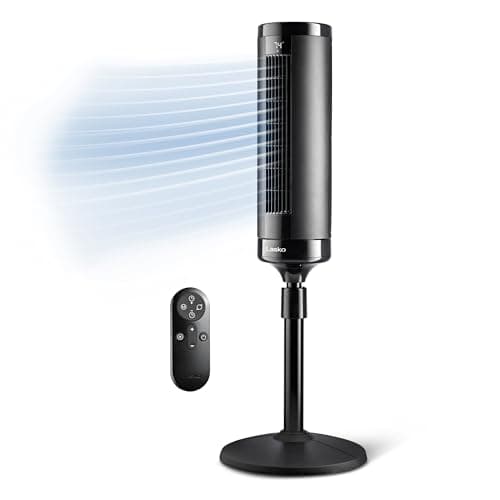 Better for a bedroom Lasko EcoQuiet 42" DC Tower Fan 23 dBA and 2.9-19 W, both published — the specifications a bedroom fan is actually chosen on. | Sleeping, where a pedestal fan's advantages do not apply | |
| — | 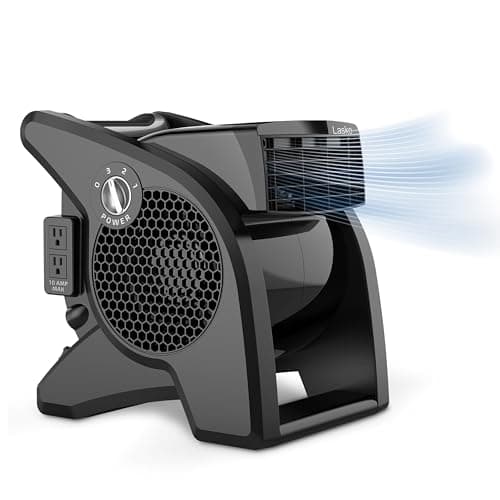 The one to skip indoors Lasko Max Performance 15" Air Mover 178 W of directed blast — more velocity than a pedestal fan and none of the spread you want in a room. | A workshop, not a living room |
A pedestal fan is a fan head on an adjustable column. That single design decision gives it one genuine advantage over every other portable fan, and it is worth being clear about what it is.
The advantage
Height is the point
A box fan sits at ankle level. A tower fan produces a column of air from roughly 12 to 40 inches. A pedestal fan puts the airflow at 38 to 54 inches, which is bed height, desk height and the height of a seated person’s head and shoulders.
That matters more than it sounds, because air aimed at your feet does much less than air aimed at your face and arms — the cooling effect is evaporation from exposed skin, and most of your exposed skin is above waist height. A pedestal fan across the room, aimed at bed level, is doing something a floor fan structurally cannot.
If you do not need that height, you probably want a tower fan, which is quieter, cheaper to run, more stable and better documented.
The problem
Nobody publishes what you need to compare them
This is the least documented category we have covered, and it is worth seeing laid out.
| Lasko S18931 | Vornado 683DC | |
|---|---|---|
| Wattage | Not published | Not published |
| CFM | Not published | Not published |
| Noise | Not published | Not published |
| Weight | 9.0 lb | Not published |
| Height | 38 – 54.5 in | 32 – 38 in |
| Airflow claim | Up to 1,200 ft/min | Moves air up to 80 ft |
| Speeds | 3 | Variable (no count published) |
| Warranty | 1 year | 5 years |
Taken from each manufacturer’s own product page on 2026-09-03.
Neither manufacturer publishes a wattage, a CFM figure or a noise rating. That means no running cost can be honestly computed for either, and there is no way to compare their airflow against each other or against any other fan on this site.
Worse, the two airflow claims they do publish are in incompatible units. “1,200 feet per minute” is a velocity at the outlet. “Moves air up to 80 feet” is a distance. Neither is a volume, and neither can be converted into the other without knowing the outlet area — which is also not published.
We are not going to fill those gaps with estimates. Everywhere else on this site we rank on certified CFM per watt or published wattage. Here we can rank only on height, reach claims and warranty, and you should know that is what you are getting.
Say the unwelcome thing
Do not read '1,200 feet per minute' as a performance figure you can compare.
Air velocity at the outlet tells you how fast air leaves the fan, not how much of it there is. A narrow outlet can produce a very high velocity while moving a modest total volume — which is exactly how a garden hose with a thumb over the end works.
What you actually want to know is CFM (volume per minute) and watts, so you can compute air per watt. Neither is published here. Treat velocity claims as marketing until someone publishes a volume.
Buying
What to check, given what is knowable
- Maximum height, against where you actually need the air. If it is for a bed, you want the top of the range near 54 inches.
- Base weight and diameter. A tall fan with a light base is a tipping hazard, particularly with children or dogs. Some of the lightness that makes these portable works against stability.
- Warranty. With no performance data to compare, this is one of the few genuine signals available. Five years against one is a meaningful difference.
- Oscillation and tilt. Standard, but check the tilt range if you plan to aim downward from height.
- A published wattage, if you can find one. Some pedestal fans do publish it. Prefer those, on principle — a manufacturer that tells you what its product consumes is easier to trust on everything else.
And if the room is genuinely hot rather than warm, no fan setting will fix it. Above roughly 95°F, moving air stops helping at all, and you want something that removes heat.
In full
Every pick, and what is wrong with it
Published specifications only, each linked to the page it came from. Where a manufacturer publishes nothing, the row says so — we do not fill blanks in.
1. Best reach
Vornado 683DC Energy Smart Medium Pedestal Air Circulator
Vornado · model 683DC
A published 80 ft airflow reach and a 5-year warranty, which is five times the coverage anyone else here offers.
Vornado’s design premise is different from a normal fan. Rather than pushing a wide, soft column of air a short distance, it uses a shrouded deep-pitch blade to produce a focused vortex that holds together over distance. The claim for this model is “moves air up to 80 feet” — and in a long living room, air that still has velocity at the far end is genuinely useful in a way that a fan stirring its immediate surroundings is not.
The 5-year warranty is the other real differentiator. Almost everything else in this category carries one year. Five years is a statement about expected service life, and it is worth weighing against a lower purchase price elsewhere.
Height adjusts 32 to 38 inches, which is a narrower range than the Lasko and sits lower — better aimed at seated people than at a bed.
We cannot tell you what it costs to run, because Vornado does not publish a wattage. Nor a CFM, nor a weight, nor a noise figure. For a site that computes running costs from published specs, that is a real limitation, and we would rather state it than estimate around it. If you own one, a $15 plug-in energy meter would settle it in a minute and we would like to know the answer.
What’s wrong with it
Vornado publishes no wattage, no CFM, no weight and no noise figure — only a distance in feet. That is the least complete spec sheet of any product on this site, and it means no running cost can be calculated.
Running cost
Vornado does not publish a wattage for the 683DC, so we cannot calculate what it costs to run. We are not going to estimate one. If Vornado publishes a nameplate figure, this block will show the arithmetic.
| Power | Not published |
|---|---|
| Airflow reach | Moves air up to 80 ft |
| Speeds | Variable-speed dial; Vornado publishes no fixed speed count |
| Motor | Brushless DC |
| Height | 32 - 38 in, adjustable |
| Air delivery (CFM) | Not published |
| Warranty | 5 years |
Every figure above is from Vornado product page, 683DC Energy Smart. Blanks are shown as “not published” rather than filled in.
2. Best height range
Lasko Cyclone 18" Pedestal Fan
Lasko · model S18931
38 to 54.5 inches of adjustment is the widest here, and 9 lb makes it easy to move between rooms.
38 to 54.5 inches of height adjustment is the widest range in this roundup, and height is the actual reason to buy a pedestal fan rather than a tower or a box fan. At the top of that range it aims air across a bed from the far side of a room, which nothing sitting on the floor can do.
9 lb makes it genuinely portable between rooms — lighter than the Lasko Wind Curve tower at 10.62 lb, despite standing taller.
Lasko publishes an air velocity figure of “up to 1,200 feet per minute”, which is a speed rather than a volume. It tells you the air is moving fast at the outlet; it does not tell you how much air, and it cannot be compared with a CFM figure or with Vornado’s distance claim. Three manufacturers, three incompatible units.
No wattage published, so again no running cost. If it helps calibrate: Lasko’s 18-inch pedestal fans that do publish figures generally sit in the same range as its tower fans, but we are not going to put a number on this specific model that Lasko has not published.
What’s wrong with it
Lasko publishes no wattage and no CFM for this fan — only a 1,200 ft/min air velocity figure, which is not comparable with anyone else's numbers. The warranty is one year.
Running cost
Lasko does not publish a wattage for the S18931, so we cannot calculate what it costs to run. We are not going to estimate one. If Lasko publishes a nameplate figure, this block will show the arithmetic.
| Power | Not published (120 V stated, no wattage) |
|---|---|
| Air velocity | Up to 1,200 ft per minute |
| Speeds | 3 |
| Height | 38 - 54.5 in, adjustable |
| Weight | 9.0 lb |
| Air delivery (CFM) | Not published |
| Warranty | 1 year |
Every figure above is from Lasko product page, S18931. Blanks are shown as “not published” rather than filled in.
3. Better for a bedroom
Lasko EcoQuiet 42" DC Tower Fan
Lasko · model T42710
23 dBA and 2.9-19 W, both published — the specifications a bedroom fan is actually chosen on.
If the fan is for a bedroom, this is the honest recommendation — and the reason is simply that you can check its specifications.
23 dBA on low, 2.9 W, both published, twelve speeds. About 13¢ for a month of eight-hour nights at 18.34¢/kWh. Every one of those is a number a pedestal fan in this roundup does not give you.
A tower also takes up about a square foot against a pedestal fan’s wider base, and it will not be knocked over by a child or a dog, which is a real consideration with a top-heavy 18-inch head on a thin column.
What’s wrong with it
Its airflow comes out at 12 to 40 inches from the floor rather than at bed height, so if you need air aimed across a mattress from across the room, a pedestal fan does it better.
Running cost — T42710
| Nameplate power | 2.9 W – 19 W | manufacturer's published figure |
|---|---|---|
| Energy, 8-hour night | 0.15 kWh | 19 ÷ 1000 × 8 |
| Cost per hour | 0.3¢ | at 18.34¢/kWh |
| Cost per 8-hour night | 2.8¢ | on the highest speed |
| Cost per 30 nights | 84¢ | 4.6 kWh |
| Same month, lowest speed | 13¢ | at 2.9 W |
Rate: 18.34¢/kWh, the US average residential price for June 2026 (EIA Electric Power Monthly, Table 5.3). Yours will differ — swap it in: (watts ÷ 1000) × hours × your rate.
| Power | 2.9 W - 19 W (0.06-0.303 A at 120 V) |
|---|---|
| Noise | 23 dBA low, 46 dBA high |
| Speeds | 12 |
| Height | 41.6 in |
| Footprint | 12.8 x 12.8 in |
| Weight | 7.8 lb |
| Timer | 8 hours |
| Air delivery (CFM) | Not published |
| Warranty | 2 years |
Every figure above is from Lasko product page, T42710. Blanks are shown as “not published” rather than filled in.
Skip this one
Lasko Max Performance 15" Air Mover
Lasko · model U15720
178 W of directed blast — more velocity than a pedestal fan and none of the spread you want in a room.
Air movers appear in pedestal fan searches because they are floor-standing and clearly powerful. They are not the same product.
160–178 W, published, which is at least a number — $7.83 for a month of nights. But an air mover concentrates air into a narrow high-velocity stream aimed at a surface. In a living room that produces an unpleasant directed blast on one person and nothing elsewhere.
It is a good tool for its actual purpose, with two 120 V accessory outlets and a 9.5-foot cord, and that purpose is a garage.
What’s wrong with it
160-178 W published, and it is engineered as a drying tool. It is loud by design and its airflow is a narrow jet rather than a comfortable wash of air.
Running cost — U15720
| Nameplate power | 160 W – 178 W | manufacturer's published figure |
|---|---|---|
| Energy, 8-hour night | 1.42 kWh | 178 ÷ 1000 × 8 |
| Cost per hour | 3.3¢ | at 18.34¢/kWh |
| Cost per 8-hour night | 26¢ | on the highest speed |
| Cost per 30 nights | $7.83 | 42.7 kWh |
| Same month, lowest speed | $7.04 | at 160 W |
Rate: 18.34¢/kWh, the US average residential price for June 2026 (EIA Electric Power Monthly, Table 5.3). Yours will differ — swap it in: (watts ÷ 1000) × hours × your rate.
| Power | 160 W - 178 W (1.35-1.53 A at 120 V) |
|---|---|
| Speeds | 3 |
| Dimensions | 14.5 H x 14.0 D x 11.5 W in |
| Weight | 12.55 lb |
| Extras | Two 120 V accessory outlets, 9.5 ft cord, pivoting head |
| Air delivery (CFM) | Not published |
| Warranty | 1 year |
Every figure above is from Lasko product page, U15720. Blanks are shown as “not published” rather than filled in.
We are not linking a buy button for this one. If you want to look at it anyway, it is easy enough to find — but we would rather send you to something that fits your room.
Questions people actually ask
Frequently asked
What is the best pedestal fan?
The Vornado 683DC if reach matters, with a published 80 ft airflow claim and a 5-year warranty. The Lasko S18931 if height matters, adjusting from 38 to 54.5 inches at 9 lb. Neither publishes a wattage or a CFM figure, which limits how confidently either can be recommended.
How much electricity does a pedestal fan use?
Neither Lasko nor Vornado publishes a wattage for the pedestal fans we looked at, so no honest running cost can be calculated for them. For comparison, fans that do publish figures range from 2.9 W for a DC tower on low to 102 W for a 20-inch box fan. Fans that do publish wattages.
Is a pedestal fan or a tower fan better?
A pedestal fan if you need airflow at bed or seated-head height from across a room — that is its genuine advantage. A tower fan for almost everything else: quieter, better documented, more stable, and with published wattage and decibel figures you can actually compare. The full head-to-head.
What does 1,200 feet per minute mean on a fan?
It is the air velocity at the outlet — how fast air leaves the fan, not how much of it there is. A narrow outlet can produce high velocity while moving a modest total volume. It is not comparable with a CFM figure or with another brand's distance claim.
How tall should a pedestal fan be?
Match it to where you need the air. Around 50 to 54 inches to aim across a bed from the far side of a room; 32 to 40 inches for seated people in a living room. Airflow aimed below waist height does much less, because the cooling effect depends on exposed skin.
Are pedestal fans stable enough around children?
It varies, and it is worth checking. A tall fan with an 18-inch head on a thin column and a light base is top-heavy by design. Look for a wide, weighted base, and consider a tower fan instead — its center of mass is much lower.
Sources
Where these numbers came from
- Lasko S18931 Cyclone pedestal fan specifications — no wattage published
- Vornado 683DC Energy Smart pedestal air circulator — 80 ft reach, variable-speed DC motor, 5-year warranty, no wattage
- Lasko EcoQuiet T42710 specifications — the published-figure comparison
- EIA Electric Power Monthly, Table 5.3 — electricity rate
Read next
Where to go from here
Back to Fans, or read how we pick.