Guide and picks
Why is my air conditioner not cooling?
Almost every complaint in this category is airflow, sizing or sealing. Refrigerant is the one people assume and the one it usually is not.
By Sawyer V. · Published
The short answer
Check in this order: filter, coils, seal, sizing. A dirty filter or fouled coil starves the machine of airflow, which shows up as weak cooling, icing and short run times. Gaps around the unit let hot outdoor air in continuously. And an oversized unit cools the air quickly, shuts off before it has removed moisture, and leaves the room cold and clammy. Refrigerant loss is real but far less common than any of these.
Fan & Frost earns a commission when you buy through our links, at no cost to you. It never changes a ranking, and we say so when the right answer is the cheaper unit or nothing at all. Full disclosure · How we pick.
At a glance
The picks, ranked
Tap any row to jump to the full reasoning. Prices are live from Amazon where we have them, and read “check price” where we don’t — never a number we cannot verify today.
| # | Product | Best for | Price |
|---|---|---|---|
| 1 | 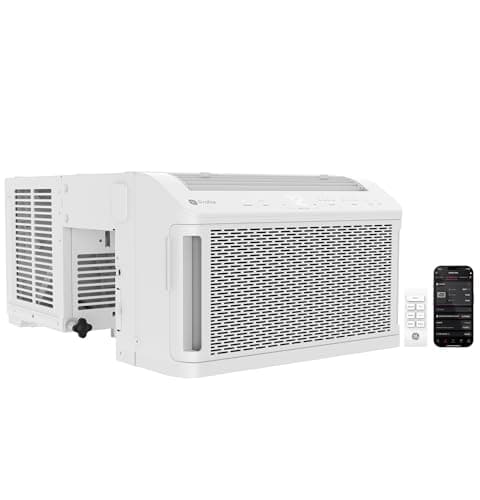 The benchmark to judge yours against GE Profile ClearView Window Air Conditioner, 8,000 BTU CEER 16 and 375 kWh a year at 8,000 BTU — the most efficient unit in its class, with a modulating compressor. | Knowing what a correctly-sized, clean unit should be doing | |
| 2 | The fix for an oversized unit Midea Window Air Conditioner, 6,000 BTU 6,000 BTU at CEER 16 and 281.3 kWh a year — the lowest certified annual energy figure in the dataset. | A small room where the current machine cools too fast and stops | |
| 3 | 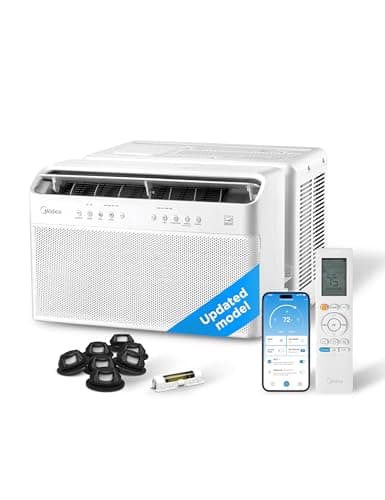 Best seal by design Midea U-Shaped Window Air Conditioner, 8,000 BTU The U-shape closes the sash through the machine, so the window shuts properly instead of sitting open on a flange. | A room where the install has always leaked around the unit | |
| — | The format most likely to disappoint Whynter ARC-14S Dual Hose Portable Air Conditioner 14,000 BTU on the box, 9,500 BTU SACC in the DOE test — a 32.1% haircut before anything goes wrong. | A room with no usable window — and nothing else |
An air conditioner has one job, and only a handful of things stop it doing it. The symptom narrows it down quickly, and the answer is almost never the one people reach for first.
Diagnose
Six symptoms and what each means
| Symptom | Most likely cause | Fix |
|---|---|---|
| Runs constantly, room never cools | Undersized, or hot air infiltrating around the unit | Seal, then re-size |
| Cools, but the room feels clammy | Oversized — short runs remove no moisture | Smaller unit, or a modulating one |
| Weak airflow from the vents | Blocked filter or fouled evaporator coil | Clean it |
| Coil ices up | Restricted airflow, almost always the filter | Clean it, and let it thaw fully |
| Turns on and off every few minutes | Oversized, or a fouled condenser raising pressure | Clean, then re-size |
| Runs but blows air at room temperature | Compressor not engaging, or refrigerant loss | Not a DIY fix |
Note that four of the six are airflow or sizing. That distribution is the most useful thing on this page.
Check first
Airflow, before anything else
The evaporator coil is cold. Room air passes over it, gives up heat and moisture, and returns to the room cooler and drier. Everything depends on how much air passes over it per minute.
Restrict that airflow and three things happen at once: less air gets cooled, so the room warms; the coil gets colder than designed, because less warm air is arriving to load it; and eventually the coil drops below freezing and ice forms, which restricts airflow further. That feedback loop is why a slightly dirty filter can end with a solid block of ice.
The airflow checks, in order:
- Pull the filter and look at it against the light. If you cannot see through it, that is your answer.
- Look at the evaporator fins behind the filter. Gray felt between the fins is restricting flow even if the filter is clean.
- Check the outdoor grille. A condenser packed with pollen or grass cannot reject heat, which raises pressure through the whole system.
- Check nothing is blocking the vents — curtains over the outlet, furniture against the intake, a blind pressed to the front.
The full cleaning procedure is here. It resolves the majority of complaints in this category.
This one is not a DIY job
If the coil has iced up, switch to fan-only and let it thaw completely. Do not chip at it, and do not keep running it in cooling mode. Running a compressor against a blocked coil is how a recoverable problem becomes a replacement.
A full thaw can take several hours. Once it has cleared, clean the filter and coil before restarting — if you do not remove the restriction, it will simply ice again.
Refrigerant is not a consumable. A sealed system does not use it up. If a unit is genuinely low on refrigerant there is a leak, and topping it up without finding the leak is money into the atmosphere. That work is legally restricted to certified technicians in the United States.
The counter-intuitive one
Cold and clammy means too big, not too small
This is the diagnosis people get backwards most reliably, and buying their way further into it is expensive.
An air conditioner removes moisture as a side effect of cooling. Humid room air passes over the cold coil, water condenses on it, and drains away. That only happens while the compressor is running.
An oversized unit hits the thermostat setpoint in a few minutes and stops. The air is cold; almost no moisture has been removed. Twenty minutes later it runs briefly again. The result is a cold, damp room — which feels worse than a warmer dry one, so people turn the setpoint down, which makes the cycling worse.
Signs you are oversized: runs for under ten minutes at a time; room reaches temperature fast but never feels comfortable; clammy or muggy despite a low reading; noticeable temperature swings between cycles.
The fix is a smaller unit, or a variable-speed model that modulates down instead of stopping. ENERGY STAR’s sizing guidance states plainly that an oversized unit costs more, wastes energy and does not cool better.
The invisible one
Air coming in around the unit
A unit that runs constantly without ever winning is often fighting a continuous supply of hot outdoor air, and the leak is usually somewhere nobody looks.
- Between the two sashes. Raising the lower sash separates its top rail from the upper sash’s bottom rail, opening a full-width slot above the unit. This is the biggest leak in a typical install and the one most often missed.
- Behind and around the side curtains. Accordion curtains block the opening; they do not seal it.
- Under the unit at the sill, where the foam gasket has compressed or perished.
- Outside, around the sill, where exhaust heat can drift back toward the condenser intake.
None of this is captured by any certified figure. A unit rated at 375 kWh a year was measured with no air leaking around it. Sealing, in detail.
Say the unwelcome thing
Do not buy a bigger unit until you have cleaned and sealed the one you have.
“It cannot keep up any more” is overwhelmingly a maintenance symptom, not a capacity one. The machine has not shrunk; its airflow has fallen and its installation has loosened over a couple of seasons.
Buying up a band then creates the opposite problem. An oversized unit short-cycles, dehumidifies poorly, and produces the cold-and-clammy complaint that sends people back for a third machine.
Clean the filter and both coils, re-seal the install, and re-check the tilt. If it still cannot hold the room after that, size the replacement from the room — not from the unit you are replacing.
In full
Every pick, and what is wrong with it
Published specifications only, each linked to the page it came from. Where a manufacturer publishes nothing, the row says so — we do not fill blanks in.
1. The benchmark to judge yours against
GE Profile ClearView Window Air Conditioner, 8,000 BTU
GE Profile · model PWJV08W
CEER 16 and 375 kWh a year at 8,000 BTU — the most efficient unit in its class, with a modulating compressor.
375 kWh a year, about $69 for a cooling season, at CEER 16 and on the Most Efficient list.
The specification that matters for diagnosis is the variable-speed compressor. A modulating unit runs long and slow rather than cycling hard on and off, which is both quieter and better at dehumidifying — the coil is cold for longer, so more moisture condenses out.
If your current unit short-cycles and leaves the room clammy, that is often a single-speed compressor in an oversized machine, and it is not something cleaning will fix.
47% less energy than the federal standard, R-32, 15.3 inches deep and 46.2 lb.
What’s wrong with it
46.2 lb and it occupies the window for the season, like any conventional unit.
Running cost — PWJV08W
| Annual energy use | 375 kWh | ENERGY STAR certified figure |
|---|---|---|
| Annual cost | $69 | 375 × 18.34¢/kWh |
| Per cooling month | $17 | spread over a four-month season |
The annual figure is the certified value from the ENERGY STAR Certified Room Air Conditioners dataset, which models a standard cooling season rather than your actual summer. It is more useful than a nameplate wattage here, because a variable-speed compressor spends most of its life well below nameplate.
Rate: 18.34¢/kWh, the US average residential price for June 2026 (EIA Electric Power Monthly, Table 5.3). Yours will differ — swap it in: (watts ÷ 1000) × hours × your rate.
| Cooling capacity | 8,000 BTU/h |
|---|---|
| CEER | 16 |
| Annual energy use | 375 kWh/yr |
| vs federal standard | 47% less energy |
| Dimensions | 12.6 H x 18.6 W x 15.3 D in |
| Weight | 46.2 lb |
| Refrigerant | R-32 |
| Installation | Does not straddle the windowsill |
| Compressor | Variable speed |
| ENERGY STAR | Certified, and on the Most Efficient list |
Every figure above is from ENERGY STAR Certified Room Air Conditioners dataset. Blanks are shown as “not published” rather than filled in.
2. The fix for an oversized unit
Midea Window Air Conditioner, 6,000 BTU
Midea · model MAW06S1KWT-A
6,000 BTU at CEER 16 and 281.3 kWh a year — the lowest certified annual energy figure in the dataset.
Counter-intuitive but frequently correct: the fix for a room that feels cold and clammy is a smaller unit, not a bigger one.
An oversized machine satisfies the thermostat in minutes and stops. Moisture only condenses out while the compressor runs, so short runs mean a cold room at high humidity — which feels worse than a slightly warmer, drier one.
281.3 kWh a year, about $52 for a season, at CEER 16 and 45% below the federal standard. The lowest annual consumption of any certified room unit.
31.6 lb and 13.3 inches deep, so it also happens to be the easiest to install and to clean. Size it from the room first.
What’s wrong with it
6,000 BTU is genuinely small. If the room is large or sunny, this will run constantly and still lose.
Running cost — MAW06S1KWT-A
| Annual energy use | 281.3 kWh | ENERGY STAR certified figure |
|---|---|---|
| Annual cost | $52 | 281.3 × 18.34¢/kWh |
| Per cooling month | $13 | spread over a four-month season |
The annual figure is the certified value from the ENERGY STAR Certified Room Air Conditioners dataset, which models a standard cooling season rather than your actual summer. It is more useful than a nameplate wattage here, because a variable-speed compressor spends most of its life well below nameplate.
Rate: 18.34¢/kWh, the US average residential price for June 2026 (EIA Electric Power Monthly, Table 5.3). Yours will differ — swap it in: (watts ÷ 1000) × hours × your rate.
| Cooling capacity | 6,000 BTU/h |
|---|---|
| CEER | 16 |
| Annual energy use | 281.3 kWh/yr |
| vs federal standard | 45% less energy |
| Dimensions | 12.1 H x 16.0 W x 13.3 D in |
| Weight | 31.6 lb |
| Installation | Does not straddle the windowsill |
| Support bracket | Not required |
| Compressor | Variable speed |
| Refrigerant | R-32 |
| ENERGY STAR | Certified, and on the Most Efficient list |
Every figure above is from ENERGY STAR Certified Room Air Conditioners dataset. Blanks are shown as “not published” rather than filled in.
3. Best seal by design
Midea U-Shaped Window Air Conditioner, 8,000 BTU
Midea · model MAW08V1QWT-S
The U-shape closes the sash through the machine, so the window shuts properly instead of sitting open on a flange.
Sealing is one of the four things worth checking, and this format removes most of the problem structurally.
A conventional unit props the sash open on its top flange, leaving a full-width gap between the two sashes that has to be foam-stripped. The U-shape lets the sash close down through the middle of the machine, so the window genuinely shuts.
That also puts the compressor outside a closed window, which is why these are the quiet option.
400 kWh a year at CEER 15, about $73 for a season, with a variable-speed compressor. More on the quiet case.
What’s wrong with it
53.2 lb, 22 inches deep, and it only works on a vertical sash window.
Running cost — MAW08V1QWT-S
| Annual energy use | 400 kWh | ENERGY STAR certified figure |
|---|---|---|
| Annual cost | $73 | 400 × 18.34¢/kWh |
| Per cooling month | $18 | spread over a four-month season |
The annual figure is the certified value from the ENERGY STAR Certified Room Air Conditioners dataset, which models a standard cooling season rather than your actual summer. It is more useful than a nameplate wattage here, because a variable-speed compressor spends most of its life well below nameplate.
Rate: 18.34¢/kWh, the US average residential price for June 2026 (EIA Electric Power Monthly, Table 5.3). Yours will differ — swap it in: (watts ÷ 1000) × hours × your rate.
| Cooling capacity | 8,000 BTU/h |
|---|---|
| CEER | 15 |
| Annual energy use | 400 kWh/yr |
| vs federal standard | 38% less energy |
| Dimensions | 13.5 H x 19.2 W x 22.0 D in |
| Weight | 53.2 lb |
| Refrigerant | R-32 |
| Installation | U-shape; sash closes through the middle of the unit |
| Compressor | Variable speed |
| ENERGY STAR | Certified |
Every figure above is from ENERGY STAR Certified Room Air Conditioners dataset. Blanks are shown as “not published” rather than filled in.
Skip this one
Whynter ARC-14S Dual Hose Portable Air Conditioner
Whynter · model ARC-14S
14,000 BTU on the box, 9,500 BTU SACC in the DOE test — a 32.1% haircut before anything goes wrong.
A large share of “my air conditioner is not cooling” starts with a portable, and often the machine is not faulty.
14,000 BTU marketing, 9,500 BTU SACC. The DOE figure subtracts heat radiating off the exhaust duct and the cooling load from outdoor air infiltrating to replace exhausted room air. If you sized the room against 14,000, you bought a third less machine than you thought.
1,300 W while it runs, and no ENERGY STAR program covers portables, so there is no certified figure to compare against.
Before assuming a fault, check the SACC number against the room. The full explanation is here.
What’s wrong with it
If a portable is underperforming, it may be working exactly as designed. Its rated capacity is a third below its headline figure.
Running cost — ARC-14S
| Nameplate power | 1300 W | manufacturer's published figure |
|---|---|---|
| Energy, 8-hour night | 10.40 kWh | 1300 ÷ 1000 × 8 |
| Cost per hour | 24¢ | at 18.34¢/kWh |
| Cost per 8-hour night | $1.91 | on the highest speed |
| Cost per 30 nights | $57 | 312.0 kWh |
Rate: 18.34¢/kWh, the US average residential price for June 2026 (EIA Electric Power Monthly, Table 5.3). Yours will differ — swap it in: (watts ÷ 1000) × hours × your rate.
| Marketing capacity | 14,000 BTU (ASHRAE-128) |
|---|---|
| DOE-rated capacity | 9,500 BTU SACC |
| Hoses | Dual |
| Power | 1,300 W / 11.6 A at 115 V |
| Noise | Under 51 dBA low, under 56 dBA high |
| Dehumidification | 71 pints/day |
| Refrigerant | R-32 |
| Dimensions | 16 W x 19 D x 35.5 H in |
| Weight | 73 lb |
| Manufacturer coverage claim | 500 sq ft |
| Warranty | 1 year unit, 3 years compressor |
Every figure above is from Whynter product page, ARC-14S. Blanks are shown as “not published” rather than filled in.
We are not linking a buy button for this one. If you want to look at it anyway, it is easy enough to find — but we would rather send you to something that fits your room.
Questions people actually ask
Frequently asked
Why is my air conditioner running but not cooling?
Most often restricted airflow — a blocked filter or a fouled evaporator coil — or hot outdoor air infiltrating through gaps around the unit. Both make the machine run continuously without winning. Refrigerant loss is possible but far less common than either.
Why does my air conditioner ice up?
Restricted airflow, almost always the filter. Less warm air over the coil means the coil runs colder than designed, drops below freezing, and forms ice — which restricts airflow further. Switch to fan-only, let it thaw fully, then clean the filter and coil before restarting.
Why is my room cold but still humid?
The unit is oversized. Moisture only condenses out of the air while the compressor is running, so a machine that hits the setpoint in a few minutes and stops removes almost none. The fix is a smaller unit or a variable-speed one that modulates instead of cycling. Sizing guide.
Does my air conditioner need more refrigerant?
Probably not. A sealed system does not consume refrigerant, so a low charge means a leak — and topping it up without finding the leak just vents it again. That work is legally restricted to certified technicians in the United States.
Why does my air conditioner turn on and off so often?
Usually oversizing, sometimes a fouled condenser raising system pressure. Runs shorter than about ten minutes point at capacity that is too large for the room, which also explains a cold room that still feels muggy.
Is my portable air conditioner faulty or just weak?
Check the SACC figure before assuming a fault. A unit sold as 14,000 BTU can be DOE-rated at 9,500 SACC — a 32% haircut — because SACC accounts for exhaust duct heat and infiltration. If you sized the room on the headline number, the machine may be working exactly as designed. BTU vs SACC.
Sources
Where these numbers came from
- ENERGY STAR Certified Room Air Conditioners dataset — CEER, annual kWh, variable-speed compressor data
- ENERGY STAR room air conditioner sizing guidance — the oversizing warning
- Whynter ARC-14S product page — 14,000 BTU ASHRAE and 9,500 BTU SACC, 1,300 W
- EIA Electric Power Monthly, Table 5.3 — electricity rate
Read next
Where to go from here
Back to Air Conditioners, or read how we pick.