Head to head
Portable vs window air conditioner
The window unit wins on running cost, capacity honesty, noise and price. The portable wins on four specific constraints — and if you have one of them, that settles it.
By Sawyer V. · Published
The short answer
Buy a window unit whenever one physically fits. A certified 8,000 BTU window unit uses 375 kWh a year (about $69); a 1,300 W portable uses more than that in six weeks of overnight running. The portable’s duct sits inside the room, and single-hose models pull hot outdoor air in. Buy a portable only when a window unit cannot go in.
Fan & Frost earns a commission when you buy through our links, at no cost to you. It never changes a ranking, and we say so when the right answer is the cheaper unit or nothing at all. Full disclosure · How we pick.

At a glance
The picks, ranked
Tap any row to jump to the full reasoning. Prices are live from Amazon where we have them, and read “check price” where we don’t — never a number we cannot verify today.
| # | Product | Best for | Price |
|---|---|---|---|
| 1 | The window pick GE Profile ClearView Window Air Conditioner, 8,000 BTU CEER 16 and 375 kWh a year, in the lightest 8,000 BTU body in the certified data. | Any room with a usable vertical sash window | |
| 2 | 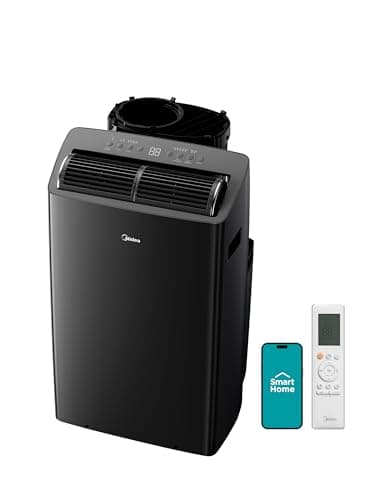 The portable pick Midea Duo Smart Inverter Portable Air Conditioner If a window unit is genuinely impossible, this is the portable to get: dual hose, 12,000 SACC, 43 dBA. | Casement windows, sliders, or a room you cannot occupy a window in |
This decision is usually framed as convenience versus efficiency, with the implication that it is a matter of taste. It is not. The gap is large, it is structural, and it comes from where the hot side of the machine physically sits.
Side by side
The comparison
| Window unit | Portable unit | |
|---|---|---|
| Where the heat goes | Outside, from a unit in the wall | Out a duct that runs through the room |
| Running cost | 375 kWh/yr certified — about $69 | 1,300 W nameplate — about $57 for 30 nights |
| Efficiency certification | ENERGY STAR certified, tested CEER published | No ENERGY STAR program exists |
| Capacity honesty | Labeled capacity is the capacity | Box BTU is 14–32% above DOE SACC |
| Noise in the room | Compressor is outside the glass | Compressor is in the room with you |
| Floor space | None | Roughly 2 sq ft, plus hose clearance |
| Install | Lift into the window, secure, seal | Fit the window panel, attach hose |
| Moving it | Uninstall and reinstall | Wheel it to another room |
| Draining | Drains outside on its own | Recycles, but needs draining in humid weather |
| Window types | Vertical sash only | Sash, and with the right kit sliders and casements |
The mechanism
Why the gap exists
Both machines run the same refrigeration cycle: absorb heat on the cold side, reject it on the hot side. The only difference is where the hot side is, and that difference produces three separate penalties for the portable.
One: the duct is hot and it is in your room. A flexible hose full of exhaust air runs from the machine to the window, radiating heat back into the space you are cooling. Some of the cooling is spent undoing that.
Two: single-hose units create negative pressure. A single-hose portable takes the air it needs to cool its condenser from the room, then blows it outside. That air has to be replaced, and it is replaced by hot outdoor air infiltrating around your doors, windows and floorboards. You are paying to pull the outdoors in.
Three: the whole machine is a heat source. Compressor, fans and electronics all sit inside the conditioned space, and their electrical losses land in your room. On a window unit, most of that hardware is outside the glass.
The DOE test procedure accounts for the first two, which is why a portable’s SACC rating comes out well below its box BTU — by 14% on one 14,000 BTU unit and 32% on another.
The certification gap
One number a portable simply does not have
ENERGY STAR certifies room air conditioners and publishes tested CEER and modeled annual kWh for every certified model. We used that dataset to rank the window units.
There is no ENERGY STAR program for portable air conditioners. The certified dataset returns window and through-the-wall units only. A portable cannot carry the label because there is no specification for it to meet.
So when you compare two portables, you are comparing manufacturer claims. When you compare two window units, you are comparing tested figures neither brand wrote. That is a real difference in how much you can trust the comparison, and it is not in the portable’s favor.
The verdict
Choose the portable if one of these is true
These are the cases where a portable is the correct purchase rather than the convenient one. If none applies, buy the window unit.
- Your windows are casements or horizontal sliders. A window unit needs a vertical sash to close down onto it. A crank-out casement cannot hold one, and most sliders cannot either. A portable vents through a panel and does not care.
- Your lease or building forbids window units. Common in apartments, and usually about exterior appearance or brackets. A portable is normally permitted because nothing hangs outside — though also check whether a U-shaped window unit would satisfy the rule, since many do.
- You need to move it between rooms. A portable on wheels genuinely solves a problem a window unit cannot: one machine, bedroom at night and office by day.
- You cannot lift 45+ lb into a window. A portable rolls. A window unit has to be held at arm’s length over a sill, which is a real constraint and not a small one.
Notice what is not on that list: “a portable is easier to set up”. It is, and that convenience costs you real money every month the machine runs. Over a season the gap is usually larger than the price difference between the two units.
Neither
If the answer is neither
Sometimes it is. A room with no window at all has a different set of options, none of which is a portable in the usual sense. A room that is only uncomfortable for a few weeks a year may be better served by a blind and a fan at a hundredth of the running cost. And a hot upstairs often has a diagnosable cause that no amount of capacity in one room will fix.
In full
Every pick, and what is wrong with it
Published specifications only, each linked to the page it came from. Where a manufacturer publishes nothing, the row says so — we do not fill blanks in.
1. The window pick
GE Profile ClearView Window Air Conditioner, 8,000 BTU
GE Profile · model PWJV08W
CEER 16 and 375 kWh a year, in the lightest 8,000 BTU body in the certified data.
375 kWh for an entire year, about $69 at 18.34¢/kWh. That is a tested, certified figure from the ENERGY STAR dataset, not a manufacturer’s claim, and it already accounts for the compressor cycling across a standard season.
46.2 lb and 15.3 inches deep makes it the easiest 8,000 BTU unit here to actually get installed, which matters because the install is the part people dread.
What’s wrong with it
It occupies the window for the season and needs an opening it fits inside rather than straddling. No use at all on a casement window or a slider.
Running cost — PWJV08W
| Annual energy use | 375 kWh | ENERGY STAR certified figure |
|---|---|---|
| Annual cost | $69 | 375 × 18.34¢/kWh |
| Per cooling month | $17 | spread over a four-month season |
The annual figure is the certified value from the ENERGY STAR Certified Room Air Conditioners dataset, which models a standard cooling season rather than your actual summer. It is more useful than a nameplate wattage here, because a variable-speed compressor spends most of its life well below nameplate.
Rate: 18.34¢/kWh, the US average residential price for June 2026 (EIA Electric Power Monthly, Table 5.3). Yours will differ — swap it in: (watts ÷ 1000) × hours × your rate.
| Cooling capacity | 8,000 BTU/h |
|---|---|
| CEER | 16 |
| Annual energy use | 375 kWh/yr |
| vs federal standard | 47% less energy |
| Dimensions | 12.6 H x 18.6 W x 15.3 D in |
| Weight | 46.2 lb |
| Refrigerant | R-32 |
| Installation | Does not straddle the windowsill |
| Support bracket | Required |
| Compressor | Variable speed |
| ENERGY STAR | Certified, and on the Most Efficient list |
Every figure above is from ENERGY STAR Certified Room Air Conditioners dataset. Blanks are shown as “not published” rather than filled in.
2. The portable pick
Midea Duo Smart Inverter Portable Air Conditioner
Midea · model MAP14S1TBL
If a window unit is genuinely impossible, this is the portable to get: dual hose, 12,000 SACC, 43 dBA.
The smallest SACC haircut we found (14,000 box, 12,000 SACC) and the quietest published figure at 43 dBA. Dual hose, so the condenser draws its air from outside rather than from your room.
It is the right buy under the constraints below. It is not the right buy simply because it is easier to set up than a window unit — that convenience costs real money every month you run it.
What’s wrong with it
Midea publishes no wattage, so its running cost cannot be calculated — and every portable pays the duct-heat penalty no matter how well it is engineered.
Running cost
Midea does not publish a wattage for the MAP14S1TBL, so we cannot calculate what it costs to run. We are not going to estimate one. If Midea publishes a nameplate figure, this block will show the arithmetic.
| Marketing capacity | 14,000 BTU |
|---|---|
| DOE-rated capacity | 12,000 BTU SACC |
| Hoses | Dual |
| Noise | 43 dBA |
| Speeds | 3 |
| Refrigerant | R-32 |
| Dimensions | 19.52 W x 16.73 D x 32.48 H in |
| Weight | 74.96 lb |
| Manufacturer coverage claim | 550 sq ft |
| Power | Not published (115 V stated, no wattage) |
| Warranty | 1 year |
Every figure above is from Midea product page, MAP14S1TBL. Blanks are shown as “not published” rather than filled in.
Questions people actually ask
Frequently asked
Is a portable or window air conditioner better?
A window unit, whenever one physically fits. It is cheaper to run, cheaper to buy, quieter in the room, and its labeled capacity is its real capacity. A portable is the right choice only when your window type, your lease, portability, or lifting ability rules a window unit out.
Why are portable air conditioners less efficient than window units?
Three reasons, all geometric. The exhaust duct is hot and runs through the room being cooled; a single-hose unit blows room air outside so hot outdoor air infiltrates to replace it; and the compressor and electronics sit inside the conditioned space rather than outside it.
How much more does a portable air conditioner cost to run?
A certified 8,000 BTU window unit uses 375 kWh for a whole year, about $69. A 1,300 W portable at nameplate draw uses roughly 312 kWh in thirty eight-hour nights — so it can approach a window unit's annual consumption in about six weeks. The full arithmetic.
Can I put a window air conditioner in a casement window?
Not a standard one. Window units need a vertical sash that closes down onto the unit, and a casement cranks outward. Your options are a portable vented through a custom panel, a through-the-wall installation, or a casement-specific unit, which is a small and expensive category.
Do portable air conditioners have an ENERGY STAR rating?
No. There is no ENERGY STAR certification program for portable air conditioners at all, so no portable carries a tested efficiency figure. Window and through-the-wall units do, which means comparisons between window units rest on data the manufacturers did not write.
Is a dual hose portable as good as a window unit?
Better than a single-hose portable, but not as good as a window unit. Dual hose removes the infiltration penalty by drawing condenser air from outside, but the exhaust duct still runs hot through your room and the compressor still sits in the conditioned space.
Sources
Where these numbers came from
Read next
Where to go from here
Back to Air Conditioners, or read how we pick.