Guide and picks
BTU chart by room size
The whole table, reproduced exactly, plus the adjustments and a second table of common room dimensions already worked out. Take it and use it.
By Sawyer V. · Published · Last updated
The short answer
5,000 BTU for 100–150 sq ft, 6,000 for 150–250, 8,000 for 300–350, 10,000 for 400–450, 12,000 for 450–550, 14,000 for 550–700 — from the ENERGY STAR table, which assumes an 8-foot ceiling. Then ±10% for sun or shade, +600 BTU per extra occupant beyond two, and +4,000 BTU in a kitchen.
Fan & Frost earns a commission when you buy through our links, at no cost to you. It never changes a ranking, and we say so when the right answer is the cheaper unit or nothing at all. Full disclosure · How we pick.

At a glance
The picks, ranked
Tap any row to jump to the full reasoning. Prices are live from Amazon where we have them, and read “check price” where we don’t — never a number we cannot verify today.
| # | Product | Best for | Price |
|---|---|---|---|
| 1 | 6,000 BTU — 150 to 250 sq ft Midea U-Shaped Window Air Conditioner, 6,000 BTU The row most bedrooms land on, and the lowest annual running cost of anything we cover. | Standard and larger bedrooms | |
| 2 | 8,000 BTU — 300 to 350 sq ft GE Profile ClearView Window Air Conditioner, 8,000 BTU CEER 16 at 375 kWh a year, in the lightest and shallowest body in its class. | Large bedrooms and small living rooms | |
| 3 | 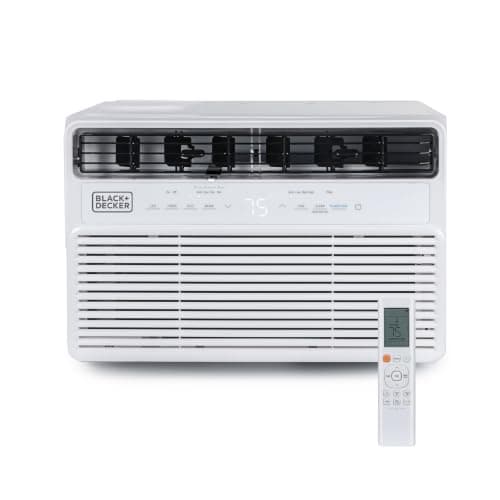 12,000 BTU — 450 to 550 sq ft BLACK+DECKER Inverter Window Air Conditioner, 12,000 BTU 600 kWh a year for a capacity that suits a genuinely large room, and no support bracket to fit. | Open-plan living areas and studio apartments | |
| — | 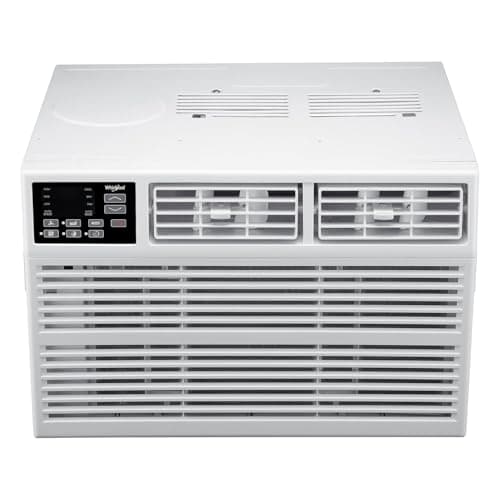 24,000 BTU — 1,400 to 1,500 sq ft Whirlpool Window Air Conditioner, 24,000 BTU If your calculation produced this row for a single room, re-measure. | Not a room. Included as a sanity check on your arithmetic. |
This page exists to be the chart, without a preamble. It is the ENERGY STAR room air conditioner sizing table, reproduced verbatim, and if you cite it or screenshot it we would appreciate a link but we are not going to make you read 900 words first.
If you want the full five-step walkthrough with worked examples, that is the sizing guide.
The chart
Room area to cooling capacity
| Room area (sq ft) | Capacity needed (BTU/h) |
|---|---|
| 100 up to 150 | 5,000 |
| 150 up to 250 | 6,000 |
| 250 up to 300 | 7,000 |
| 300 up to 350 | 8,000 |
| 350 up to 400 | 9,000 |
| 400 up to 450 | 10,000 |
| 450 up to 550 | 12,000 |
| 550 up to 700 | 14,000 |
| 700 up to 1,000 | 18,000 |
| 1,000 up to 1,200 | 21,000 |
| 1,200 up to 1,400 | 23,000 |
| 1,400 up to 1,500 | 24,000 |
| 1,500 up to 2,000 | 30,000 |
| 2,000 up to 2,500 | 34,000 |
Source: ENERGY STAR, Room Air Conditioners. ENERGY STAR notes the capacities “are calculated based on an 8-foot ceiling.”
Corrections
The four adjustments
These are not optional refinements. The kitchen adjustment alone can move you two capacity bands, and it is the one most often skipped.
| If | Then |
|---|---|
| The room is heavily shaded | reduce capacity by 10 percent |
| The room is very sunny | increase capacity by 10 percent |
| More than two people regularly occupy the room | add 600 BTUs for each additional person |
| The unit is used in a kitchen | increase capacity by 4,000 BTUs |
All four quoted from ENERGY STAR.
Pre-calculated
Common room dimensions, already worked out
Base capacity from the chart above, before any adjustment. Assumes an 8-foot ceiling and a room with a door you can close.
| Room size | Sq ft | Base BTU/h | Typically |
|---|---|---|---|
| 8 × 10 ft | 80 | 5,000 | Small bedroom, home office, nursery |
| 10 × 10 ft | 100 | 5,000 | Small bedroom, dorm room |
| 10 × 12 ft | 120 | 5,000 | Standard bedroom |
| 12 × 12 ft | 144 | 5,000 | Standard bedroom |
| 12 × 14 ft | 168 | 6,000 | Larger bedroom |
| 12 × 16 ft | 192 | 6,000 | Main bedroom, small living room |
| 14 × 16 ft | 224 | 6,000 | Living room |
| 15 × 18 ft | 270 | 7,000 | Living room |
| 16 × 20 ft | 320 | 8,000 | Large living room |
| 18 × 20 ft | 360 | 9,000 | Open-plan living area |
| 20 × 22 ft | 440 | 10,000 | Large open-plan space |
| 20 × 25 ft | 500 | 12,000 | Studio apartment, great room |
| 24 × 25 ft | 600 | 14,000 | Large open-plan floor |
| 25 × 32 ft | 800 | 18,000 | Whole small apartment |
Areas are length × width; capacities are read off the ENERGY STAR table above. Our arithmetic, their table.
Read this before you use it
Three things the chart does not do
It does not know about your portable’s SACC
If you are buying a portable air conditioner, the number on the box is not the number to bring to this chart. Use its DOE-rated SACC figure, which subtracts exhaust duct heat and infiltration. Real examples: 14,000 BTU on the box, 12,000 SACC for one unit and 9,500 SACC for another. The full explanation is here and it changes which row of this chart applies to you.
It assumes a room with a door
Open-plan changes the arithmetic completely. If your living room flows into a kitchen with no door, you are cooling both volumes and you must measure both — and then add the 4,000 BTU kitchen adjustment on top. A room unit cannot cool half of a shared space; the air simply mixes.
Bigger is not safer
ENERGY STAR’s own words: “An oversized air conditioner costs more to purchase, wastes energy and does not provide better cooling.” An oversized unit reaches temperature before it has removed any humidity, then shuts off, so the room reads cool on a thermometer and feels damp. Where you fall between two rows, take the smaller one unless an adjustment pushed you up.
Next
What to do with the number
Capacity is the first constraint. The next two are what fits your window and what it costs to run.
- Window air conditioners — ranked on certified CEER and annual kWh, from 6,000 to 24,000 BTU.
- Small-room portables — if your answer was 5,000–8,000 BTU and a window unit is out.
- Running cost arithmetic — the number that matters over a season.
- The full sizing walkthrough — with four rooms worked start to finish.
And if the chart says 5,000 BTU, it is worth pausing: a small bedroom is often better served by a good fan and a blackout blind than by the cheapest compressor on the shelf.
In full
Every pick, and what is wrong with it
Published specifications only, each linked to the page it came from. Where a manufacturer publishes nothing, the row says so — we do not fill blanks in.
1. 6,000 BTU — 150 to 250 sq ft
Midea U-Shaped Window Air Conditioner, 6,000 BTU
Midea · model MAW06V1QWT
The row most bedrooms land on, and the lowest annual running cost of anything we cover.
298 kWh a year, about $55 at 18.34¢/kWh, and on the ENERGY STAR Most Efficient list. A 12×14 or 12×16 room sits in this band.
What’s wrong with it
53.1 lb, and the U-shape needs a single-hung or double-hung sash window. Not an option on a casement or a slider.
Running cost — MAW06V1QWT
| Annual energy use | 298 kWh | ENERGY STAR certified figure |
|---|---|---|
| Annual cost | $55 | 298 × 18.34¢/kWh |
| Per cooling month | $14 | spread over a four-month season |
The annual figure is the certified value from the ENERGY STAR Certified Room Air Conditioners dataset, which models a standard cooling season rather than your actual summer. It is more useful than a nameplate wattage here, because a variable-speed compressor spends most of its life well below nameplate.
Rate: 18.34¢/kWh, the US average residential price for June 2026 (EIA Electric Power Monthly, Table 5.3). Yours will differ — swap it in: (watts ÷ 1000) × hours × your rate.
| Cooling capacity | 6,000 BTU/h |
|---|---|
| CEER | 15.1 |
| Annual energy use | 298 kWh/yr |
| vs federal standard | 37% less energy |
| Dimensions | 13.5 H x 19.2 W x 22.0 D in |
| Weight | 53.1 lb |
| Refrigerant | R-32 |
| Installation | U-shape; sash closes through the middle of the unit |
| Compressor | Variable speed |
| ENERGY STAR | Certified, and on the Most Efficient list |
Every figure above is from ENERGY STAR Certified Room Air Conditioners dataset. Blanks are shown as “not published” rather than filled in.
2. 8,000 BTU — 300 to 350 sq ft
GE Profile ClearView Window Air Conditioner, 8,000 BTU
GE Profile · model PWJV08W
CEER 16 at 375 kWh a year, in the lightest and shallowest body in its class.
About $69 a year, 47% below the federal standard, and 46.2 lb — which makes it the easiest 8,000 BTU unit here to actually install.
What’s wrong with it
Sits inside the window opening rather than straddling the sill, so measure your sash height against its 12.6 inches first.
Running cost — PWJV08W
| Annual energy use | 375 kWh | ENERGY STAR certified figure |
|---|---|---|
| Annual cost | $69 | 375 × 18.34¢/kWh |
| Per cooling month | $17 | spread over a four-month season |
The annual figure is the certified value from the ENERGY STAR Certified Room Air Conditioners dataset, which models a standard cooling season rather than your actual summer. It is more useful than a nameplate wattage here, because a variable-speed compressor spends most of its life well below nameplate.
Rate: 18.34¢/kWh, the US average residential price for June 2026 (EIA Electric Power Monthly, Table 5.3). Yours will differ — swap it in: (watts ÷ 1000) × hours × your rate.
| Cooling capacity | 8,000 BTU/h |
|---|---|
| CEER | 16 |
| Annual energy use | 375 kWh/yr |
| vs federal standard | 47% less energy |
| Dimensions | 12.6 H x 18.6 W x 15.3 D in |
| Weight | 46.2 lb |
| Refrigerant | R-32 |
| Installation | Does not straddle the windowsill |
| Support bracket | Required |
| Compressor | Variable speed |
| ENERGY STAR | Certified, and on the Most Efficient list |
Every figure above is from ENERGY STAR Certified Room Air Conditioners dataset. Blanks are shown as “not published” rather than filled in.
3. 12,000 BTU — 450 to 550 sq ft
BLACK+DECKER Inverter Window Air Conditioner, 12,000 BTU
BLACK+DECKER · model BD12NWES
600 kWh a year for a capacity that suits a genuinely large room, and no support bracket to fit.
$110 a year at 18.34¢/kWh. If your room reached this band because it is open-plan, remember to add the +4,000 BTU kitchen adjustment if a kitchen is part of that volume.
What’s wrong with it
CEER 15 rather than 16 — the more efficient units in this class straddle the sill and need a bracket. Confirm you measured the whole open-plan volume before buying this size.
Running cost — BD12NWES
| Annual energy use | 600 kWh | ENERGY STAR certified figure |
|---|---|---|
| Annual cost | $110 | 600 × 18.34¢/kWh |
| Per cooling month | $28 | spread over a four-month season |
The annual figure is the certified value from the ENERGY STAR Certified Room Air Conditioners dataset, which models a standard cooling season rather than your actual summer. It is more useful than a nameplate wattage here, because a variable-speed compressor spends most of its life well below nameplate.
Rate: 18.34¢/kWh, the US average residential price for June 2026 (EIA Electric Power Monthly, Table 5.3). Yours will differ — swap it in: (watts ÷ 1000) × hours × your rate.
| Cooling capacity | 12,000 BTU/h |
|---|---|
| CEER | 15 |
| Annual energy use | 600 kWh/yr |
| vs federal standard | 38% less energy |
| Dimensions | 14.6 H x 19.1 W x 21.8 D in |
| Weight | 50.7 lb |
| Refrigerant | R-32 |
| Installation | Does not straddle the windowsill |
| Support bracket | Not required |
| Compressor | Variable speed |
| ENERGY STAR | Certified |
Every figure above is from ENERGY STAR Certified Room Air Conditioners dataset. Blanks are shown as “not published” rather than filled in.
Skip this one
Whirlpool Window Air Conditioner, 24,000 BTU
Whirlpool · model WHAW-241IN
If your calculation produced this row for a single room, re-measure.
$260 a year, against $69 for the 8,000 BTU row. At this capacity you should be pricing a mini-split or two smaller units rather than hanging a hundred pounds out of a window.
What’s wrong with it
CEER 12.7 and 1,417.3 kWh a year, in a 115.7 lb body that straddles the window and needs a support bracket.
Running cost — WHAW-241IN
| Annual energy use | 1417.3 kWh | ENERGY STAR certified figure |
|---|---|---|
| Annual cost | $260 | 1417.3 × 18.34¢/kWh |
| Per cooling month | $65 | spread over a four-month season |
The annual figure is the certified value from the ENERGY STAR Certified Room Air Conditioners dataset, which models a standard cooling season rather than your actual summer. It is more useful than a nameplate wattage here, because a variable-speed compressor spends most of its life well below nameplate.
Rate: 18.34¢/kWh, the US average residential price for June 2026 (EIA Electric Power Monthly, Table 5.3). Yours will differ — swap it in: (watts ÷ 1000) × hours × your rate.
| Cooling capacity | 24,000 BTU/h |
|---|---|
| CEER | 12.7 |
| Annual energy use | 1,417.3 kWh/yr |
| vs federal standard | 35% less energy |
| Dimensions | 20.7 H x 30.0 W x 28.8 D in |
| Weight | 115.7 lb |
| Refrigerant | R-32 |
| Installation | Straddles the window; support bracket territory |
| ENERGY STAR | Certified |
Every figure above is from ENERGY STAR Certified Room Air Conditioners dataset. Blanks are shown as “not published” rather than filled in.
We are not linking a buy button for this one. If you want to look at it anyway, it is easy enough to find — but we would rather send you to something that fits your room.
Questions people actually ask
Frequently asked
How many BTU do I need for 500 sq ft?
12,000 BTU per hour. The ENERGY STAR table puts 450 up to 550 square feet at 12,000. Add 10 percent if the space is very sunny, and 4,000 BTU on top if it includes a kitchen.
How many BTU for a 12x12 room?
5,000 BTU. A 12 by 12 room is 144 square feet, which sits in the table's 100-to-150 band. That is also the smallest window unit capacity commonly sold, so most small bedrooms land on the same answer.
How many BTU do I need for 1,000 sq ft?
21,000 BTU, since 1,000 to 1,200 square feet maps to 21,000 on the table. At that size, though, one room unit is rarely the right tool — you are usually looking at multiple units, a mini-split, or central air.
Is 8,000 BTU enough for a bedroom?
For almost any bedroom, yes, and it is often more than needed. 8,000 BTU covers 300 to 350 square feet, which is a very large bedroom. A typical 12 by 14 room wants 6,000.
Does ceiling height change the BTU I need?
The chart assumes an 8-foot ceiling, so a 10-foot ceiling is 25 percent more air. ENERGY STAR suggests choosing a unit with higher airflow rather than simply buying more capacity, since the additional volume is mainly a circulation issue.
Can I use this chart for a portable air conditioner?
Yes, but feed it the SACC figure rather than the box BTU. SACC is the DOE-rated capacity and accounts for duct heat and infiltration; using the box number instead will oversize your expectations by anywhere from 14 to 32 percent depending on the unit. How the two numbers differ.
Sources
Where these numbers came from
Read next
Where to go from here
Back to Guides & Calculators, or read how we pick.