Guide and picks
Which direction should a ceiling fan turn in summer?
Counterclockwise, seen from below. It takes ten seconds to check and it is the most common reason a ceiling fan feels like it is doing nothing on a hot day.
By Sawyer V. · Published
The short answer
Counterclockwise when you stand underneath and look up. That pushes air straight down and creates the breeze you feel. Clockwise is the winter setting, which pulls air up and pushes warm ceiling air down the walls without a draft. Most fans reverse with a small switch on the motor housing.
Fan & Frost earns a commission when you buy through our links, at no cost to you. It never changes a ranking, and we say so when the right answer is the cheaper unit or nothing at all. Full disclosure · How we pick.
At a glance
The picks, ranked
Tap any row to jump to the full reasoning. Prices are live from Amazon where we have them, and read “check price” where we don’t — never a number we cannot verify today.
| # | Product | Best for | Price |
|---|---|---|---|
| 1 | 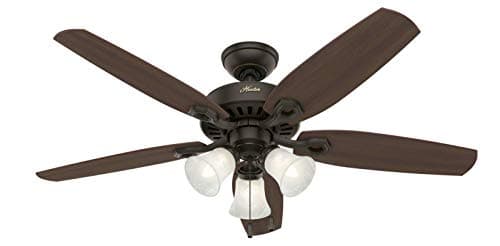 If yours is old or inefficient Hunter Vespucci 52" Ceiling Fan 366.7 CFM per watt certified, 13.9 W on high and 1.8 W on low — the best 52-inch figure in the certified data. | A standard 175-350 sq ft room, 52 inch span | |
| 2 | If yours hangs too low Hunter Anisten 44" Hugger Ceiling Fan A flush-mount hugger at 295.9 CFM per watt, which is strong for a form factor that usually sacrifices efficiency. | Rooms with 8 ft ceilings, where a downrod is unsafe | |
| 3 | 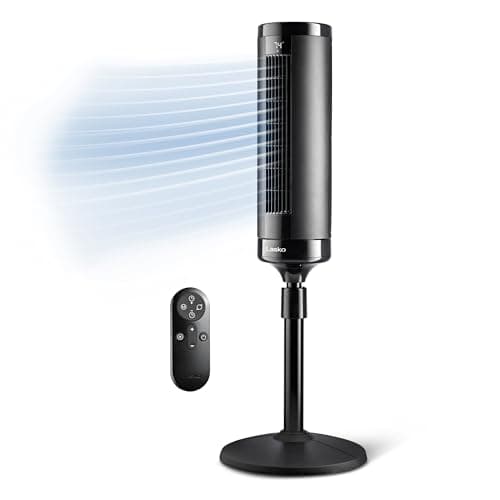 If you rent and cannot install one Lasko EcoQuiet 42" DC Tower Fan 23 dBA and 2.9 W on low, with twelve speeds — the closest portable equivalent. | A room where a ceiling fan is not an option at all |
This is the shortest useful fix in home cooling. If your ceiling fan is running and the room does not feel any better, there is a reasonable chance it is turning the wrong way, and correcting it costs nothing.
The check
How to tell in ten seconds
You do not need a ladder and you do not need to look at the switch.
- Stand directly underneath the fan and run it on its highest speed.
- Do you feel air on your face and arms? If yes, it is turning counterclockwise and it is set correctly for summer. Stop here.
- If you feel almost nothing directly below it, it is turning clockwise — the winter setting — and it is pulling air up instead of pushing it down.
The direct-underneath test is more reliable than trying to watch the blades, which is genuinely hard at speed and easy to get backwards. If you do want to watch them: counterclockwise means the leading edge of each blade — the edge that arrives first — is higher than the trailing edge, so the blade scoops air downward.
Fixing it
How to reverse it
Turn the fan off and wait for the blades to stop completely. Then, depending on the fan:
- A small slide switch on the motor housing. This is the most common arrangement — a toggle on the side of the body between the blades and the ceiling. Slide it the other way and turn the fan back on.
- A button on the remote. Usually marked with a circular arrow or labeled “reverse” or “summer/winter”.
- An app or a wall control, on smart fans. Look for a direction or season setting.
Never flip the switch while the blades are moving. On some fans it does nothing, and on others it is hard on the motor.
Why it works
Why direction changes anything
A ceiling fan does not lower the temperature of a room. It never has. Its motor adds a small amount of heat, so strictly it makes the room very slightly warmer. What it does is move air, and which way it moves the air changes what that airflow does to you.
Counterclockwise, summer. Blades push a column of air straight down. That air moves across your skin, which does two things: it speeds evaporation of moisture from your skin, which carries heat away, and it strips off the thin layer of warm air that sits against you. Together that is worth several degrees of perceived temperature — enough that people commonly raise a thermostat setting by 4°F with a fan running and feel no different.
Clockwise, winter. Blades pull air up the middle of the room and push it out along the ceiling and down the walls. Warm air collects at ceiling level, and this gently recirculates it into the occupied part of the room without creating a draft you would feel. On a low speed it makes a heated room more even.
The key point: a fan only helps a person who is in the airflow. Running one in an empty room accomplishes nothing at all — there is no one for the evaporative effect to work on. Turn it off when you leave.
Cost
What the correct setting is worth
Nothing, in running cost — the fan draws the same power either way. What it changes is whether that power buys you anything.
And the power is trivially small. From the ENERGY STAR certified data, a Hunter Vespucci 52-inch draws 1.8 W on low and 13.9 W on high. At 18.34¢/kWh:
| On low, 8 hours | 0.3¢ |
|---|---|
| On low, 30 nights | 7.9¢ |
| On high, 30 nights | 61¢ |
| On high, 24/7 for a month | $1.86 |
The real saving is indirect and much larger. If the fan lets you raise your air conditioning set point by a few degrees, you are trading a 14 W fan against a compressor drawing hundreds of watts. The comparison table is here, and the certified efficiency ranking is here.
Say the unwelcome thing
If your fan has no reverse switch, do not try to add one.
Some fans — particularly older ones and some budget models — are single-direction by design. There is no hidden switch and no setting to find.
That is not a problem worth solving. A single-direction fan is almost always wired for the summer counterclockwise setting, which is the one you actually want on a hot day. The winter mode is a comfort refinement, not a necessity.
Rewiring a fan motor to reverse it is electrical work with no meaningful payoff, and it will void any warranty. Leave it.
Still not working
If the direction is right and it still feels useless
Three other things worth checking, in order:
- Is it too small for the room? A 42-inch fan in a 350 sq ft living room cannot move enough air. The rough guide is 52 to 56 inches for 175–350 sq ft — full sizing table here.
- Is it mounted too close to the ceiling? A flush-mount hugger restricts how freely blades can draw air from above, and it costs real airflow — the certified data shows roughly 19% less air per watt for a hugger than for the equivalent downrod fan.
- Is the room simply too hot for a fan? Above roughly 95°F, moving air can stop helping altogether: air hotter than your skin adds heat faster than the extra evaporation removes it. At that point you need something that actually removes heat, and no fan setting will substitute.
And if the room in question is upstairs and much hotter than the rest of the house, the cause is probably diagnosable at the source rather than fixable at the ceiling.
In full
Every pick, and what is wrong with it
Published specifications only, each linked to the page it came from. Where a manufacturer publishes nothing, the row says so — we do not fill blanks in.
1. If yours is old or inefficient
Hunter Vespucci 52" Ceiling Fan
Hunter · model Vespucci
366.7 CFM per watt certified, 13.9 W on high and 1.8 W on low — the best 52-inch figure in the certified data.
If you have checked the direction and the fan still feels weak, the fan itself may be the problem. Certified efficiency varies by more than 35% between fans that look identical on a shelf.
About 7.9¢ for a month of eight-hour nights on low at 18.34¢/kWh.
What’s wrong with it
Fan only, with no light kit, so it cannot replace a fixture that is also your room's main light. 0.8 W standby is on the high side.
Running cost — Vespucci
| Nameplate power | 1.8 W – 13.9 W | manufacturer's published figure |
|---|---|---|
| Energy, 8-hour night | 0.11 kWh | 13.9 ÷ 1000 × 8 |
| Cost per hour | 0.3¢ | at 18.34¢/kWh |
| Cost per 8-hour night | 2.0¢ | on the highest speed |
| Cost per 30 nights | 61¢ | 3.3 kWh |
| Same month, lowest speed | 7.9¢ | at 1.8 W |
Rate: 18.34¢/kWh, the US average residential price for June 2026 (EIA Electric Power Monthly, Table 5.3). Yours will differ — swap it in: (watts ÷ 1000) × hours × your rate.
| Blade span | 52 in |
|---|---|
| Efficiency | 366.7 CFM per watt |
| Power, high speed | 13.9 W |
| Power, low speed | 1.8 W |
| Standby power | 0.8 W |
| Type | Indoor, fan only (no light kit) |
| Warranty | 3 years, components |
| ENERGY STAR | Certified |
Every figure above is from ENERGY STAR Certified Ceiling Fans dataset. Blanks are shown as “not published” rather than filled in.
2. If yours hangs too low
Hunter Anisten 44" Hugger Ceiling Fan
Hunter · model 44 Anisten
A flush-mount hugger at 295.9 CFM per watt, which is strong for a form factor that usually sacrifices efficiency.
Blades should sit at least 7 feet above the floor. On an 8-foot ceiling a standard mount puts them uncomfortably close to head height, and a hugger is the right answer.
12.5 W on high, 1.6 W on low, and 0.3 W standby — the lowest standby draw of the certified fans we looked at.
What’s wrong with it
Blades close to the ceiling cannot draw air freely from above, which costs roughly 19% of the airflow per watt compared with a downrod fan of similar size.
Running cost — 44 Anisten
| Nameplate power | 1.6 W – 12.5 W | manufacturer's published figure |
|---|---|---|
| Energy, 8-hour night | 0.10 kWh | 12.5 ÷ 1000 × 8 |
| Cost per hour | 0.2¢ | at 18.34¢/kWh |
| Cost per 8-hour night | 1.8¢ | on the highest speed |
| Cost per 30 nights | 55¢ | 3.0 kWh |
| Same month, lowest speed | 7.0¢ | at 1.6 W |
Rate: 18.34¢/kWh, the US average residential price for June 2026 (EIA Electric Power Monthly, Table 5.3). Yours will differ — swap it in: (watts ÷ 1000) × hours × your rate.
| Blade span | 44 in |
|---|---|
| Efficiency | 295.9 CFM per watt |
| Power, high speed | 12.5 W |
| Power, low speed | 1.6 W |
| Standby power | 0.3 W |
| Type | Indoor hugger (flush mount), fan only |
| Warranty | 3 years, components |
| ENERGY STAR | Certified |
Every figure above is from ENERGY STAR Certified Ceiling Fans dataset. Blanks are shown as “not published” rather than filled in.
3. If you rent and cannot install one
Lasko EcoQuiet 42" DC Tower Fan
Lasko · model T42710
23 dBA and 2.9 W on low, with twelve speeds — the closest portable equivalent.
No direction switch to worry about, no wiring, and it comes with you when you move. 13¢ for a month of nights on low.
What’s wrong with it
It draws roughly ten times a ceiling fan on low for less airflow, and takes floor space. A ceiling fan wins whenever you can actually mount one.
Running cost — T42710
| Nameplate power | 2.9 W – 19 W | manufacturer's published figure |
|---|---|---|
| Energy, 8-hour night | 0.15 kWh | 19 ÷ 1000 × 8 |
| Cost per hour | 0.3¢ | at 18.34¢/kWh |
| Cost per 8-hour night | 2.8¢ | on the highest speed |
| Cost per 30 nights | 84¢ | 4.6 kWh |
| Same month, lowest speed | 13¢ | at 2.9 W |
Rate: 18.34¢/kWh, the US average residential price for June 2026 (EIA Electric Power Monthly, Table 5.3). Yours will differ — swap it in: (watts ÷ 1000) × hours × your rate.
| Power | 2.9 W - 19 W (0.06-0.303 A at 120 V) |
|---|---|
| Noise | 23 dBA low, 46 dBA high |
| Speeds | 12 |
| Height | 41.6 in |
| Footprint | 12.8 x 12.8 in |
| Weight | 7.8 lb |
| Timer | 8 hours |
| Air delivery (CFM) | Not published |
| Warranty | 2 years |
Every figure above is from Lasko product page, T42710. Blanks are shown as “not published” rather than filled in.
Questions people actually ask
Frequently asked
Which direction should a ceiling fan turn in summer?
Counterclockwise when you stand underneath and look up. That pushes air straight down and creates the breeze you feel on your skin, which speeds evaporation and makes you feel several degrees cooler.
How do I know if my ceiling fan is going the right way?
Stand directly underneath it on high speed. If you feel air on your face and arms, it is counterclockwise and correct for summer. If you feel almost nothing directly below it, it is on the winter clockwise setting.
Where is the reverse switch on a ceiling fan?
Usually a small slide switch on the motor housing, on the side of the body between the blades and the ceiling. Some fans use a button on the remote marked with a circular arrow, and smart fans use an app or wall control. Always stop the blades completely before switching.
Does ceiling fan direction actually make a difference?
For how the room feels, yes, considerably. Counterclockwise pushes air down onto you, which is where the cooling sensation comes from. Clockwise recirculates warm ceiling air without a noticeable draft, which is useful in winter and does very little on a hot day.
Should I run my ceiling fan when I leave the room?
No. A ceiling fan does not lower the room's temperature — it moves air across skin so a person feels cooler. In an empty room it accomplishes nothing and its motor adds a small amount of heat. Turn it off when you leave.
What if my ceiling fan has no reverse switch?
Some fans are single-direction by design, and they are almost always wired for the summer counterclockwise setting — the one you want on a hot day. Winter mode is a refinement rather than a necessity, and rewiring a motor to reverse it is not worth doing.
Sources
Where these numbers came from
Read next
Where to go from here
Back to Whole-House Airflow, or read how we pick.