Head to head
Mini-split vs window air conditioner
A mini-split is more efficient, far quieter and leaves the window alone. It also cannot be installed by you, and that single fact decides this for most people.
By Sawyer V. · Published
The short answer
A mini-split is more efficient and much quieter, and it frees the window permanently — certified units reach SEER2 35.1 and EER2 19.1. A window unit tops out around CEER 16, costs a fraction as much, and you can install it yourself this afternoon. Mini-split installation is licensed work involving refrigerant, and usually costs more than the equipment.
Fan & Frost earns a commission when you buy through our links, at no cost to you. It never changes a ranking, and we say so when the right answer is the cheaper unit or nothing at all. Full disclosure · How we pick.
At a glance
The picks, ranked
Tap any row to jump to the full reasoning. Prices are live from Amazon where we have them, and read “check price” where we don’t — never a number we cannot verify today.
| # | Product | Best for | Price |
|---|---|---|---|
| 1 | 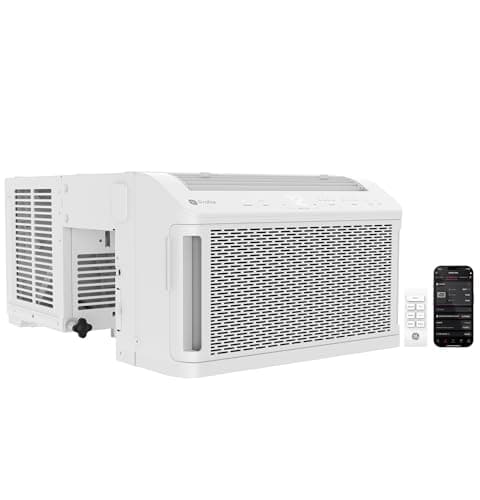 The window pick GE Profile ClearView Window Air Conditioner, 8,000 BTU CEER 16 and 375 kWh a year, installed by you in an afternoon for the price of the unit alone. | Anyone who wants cooling this week without a contractor | |
| 2 | 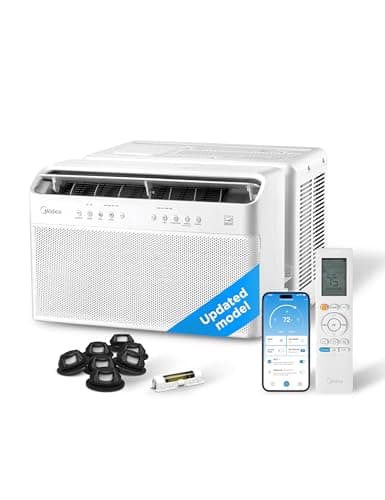 The quiet window compromise Midea U-Shaped Window Air Conditioner, 8,000 BTU The U-shape puts the compressor outside a closed window — the closest a window unit gets to a mini-split's acoustic advantage. | A bedroom where mini-split quiet is the attraction | |
| 3 | The permanent option you can actually buy Friedrich Through-the-Wall Air Conditioner, 10,100 BTU Through-the-wall gives you the permanence of a mini-split without the refrigerant work, at CEER 14.2. | A room where you want the window free year-round | |
| — | The one to skip in this comparison Whynter ARC-14S Dual Hose Portable Air Conditioner 1,300 W and 9,500 BTU SACC, with no certification program behind it at all. | Neither — a portable is the fallback when both options fail |
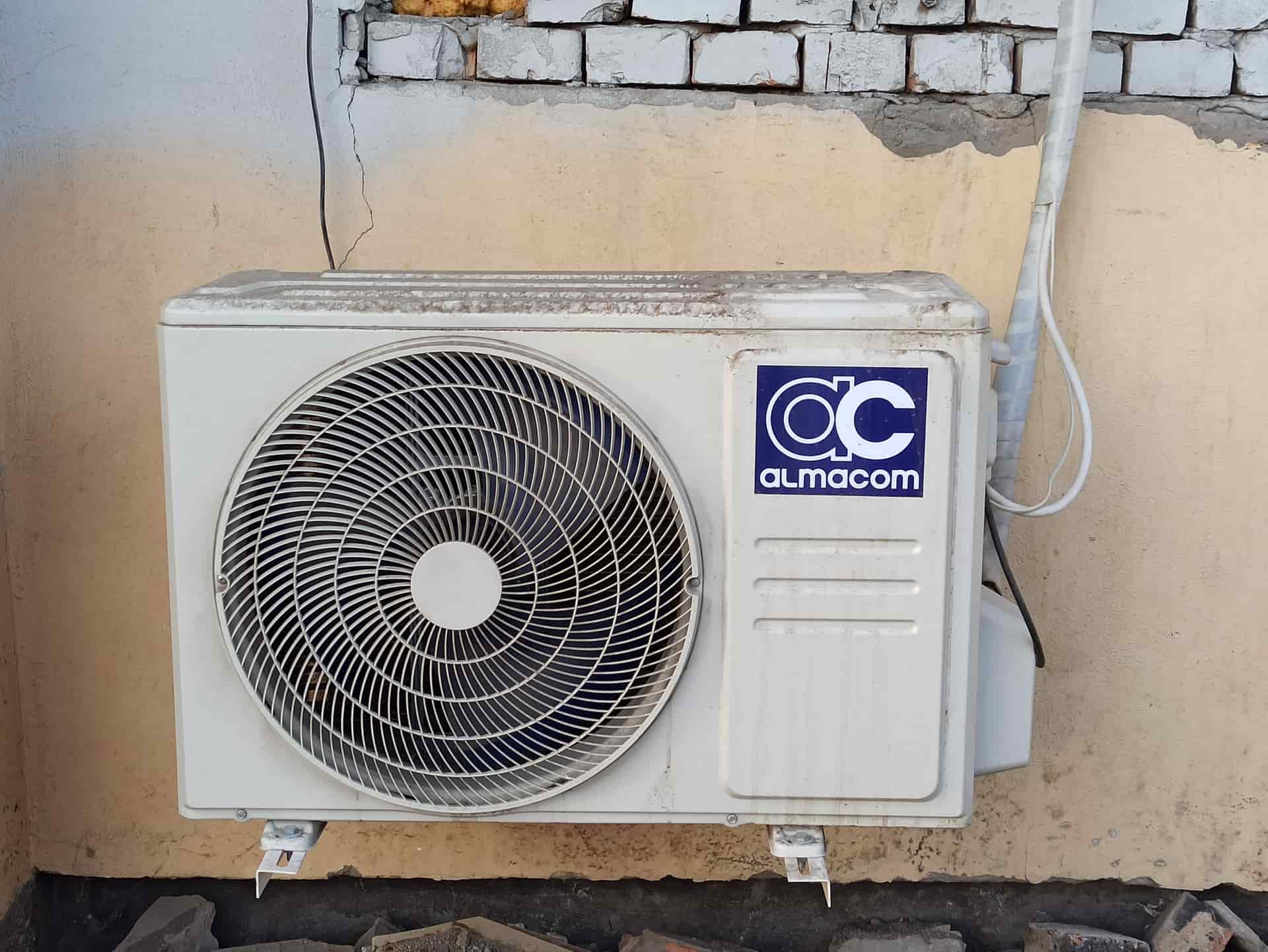
A mini-split splits the machine in two: a compressor and condenser outside on a pad or bracket, and a slim indoor head on the wall, joined by refrigerant lines through a three-inch hole. A window unit puts the whole thing in your window.
That single architectural difference produces every advantage and every drawback below.
Read this first
The efficiency numbers are not directly comparable
This trips up almost every comparison of these two, so it is worth being precise before quoting any figures.
- CEER (Combined Energy Efficiency Ratio) rates room air conditioners. It is BTU per watt-hour at a rating condition, plus standby.
- SEER2 (Seasonal Energy Efficiency Ratio 2) rates mini-splits and central systems across a modeled cooling season, with part-load operation included.
- EER2 is the steady-state figure for the same equipment, and it is the closest thing to an apples-to-apples comparison with CEER.
So comparing a mini-split’s SEER2 35 against a window unit’s CEER 16 and concluding it is twice as efficient is wrong. They are different test procedures. The honest comparison is EER2 against CEER, and there the certified data shows mini-splits reaching EER2 19.1 against the best window units’ CEER 16.
| Format | Best certified figure | Metric |
|---|---|---|
| Mini-split (best certified) | SEER2 35.1 / EER2 19.1 | Seasonal + steady-state |
| Window unit (8,000 BTU) | CEER 16 | Combined, incl. standby |
| Through-the-wall (10,100 BTU) | CEER 14.2 | Combined, incl. standby |
| Portable | No certification program exists | — |
Mini-split figures are the highest values in the ENERGY STAR Certified Mini-Split Heat Pumps dataset across 11,494 US-market records; the SEER2 and EER2 maxima belong to different models. Room AC figures from the Certified Room Air Conditioners dataset.
The mini-split is genuinely more efficient — and the honest margin on the comparable metric is roughly three points of EER at the very top of each field, plus a further seasonal advantage from part-load modulation that SEER2 captures and CEER does not. It is a real gap. It is not the doubling the headline numbers imply.
Side by side
The comparison
| Mini-split | Window unit | |
|---|---|---|
| Efficiency | SEER2 up to 35.1, EER2 up to 19.1 | CEER up to 16 |
| Compressor location | Outside, on a pad or bracket | In the window frame |
| Noise indoors | A fan only — no compressor in the room | Compressor a few feet away |
| The window | Free, permanently | Occupied for the season |
| Installation | Licensed, refrigerant handling required | Two people and an afternoon |
| Install cost | Frequently exceeds the equipment price | Zero |
| Heating | Most models heat as well as cool | Cooling only, typically |
| Renter-friendly | No | Usually, especially a U-shaped unit |
| Take it with you | No | Yes |
The real gap
Where the mini-split genuinely wins: noise
The efficiency gap is modest. The acoustic gap is not, and it is the thing owners actually notice.
A window unit has its compressor in the window frame, a few feet from where you sit or sleep. Even the best of them cycle audibly, and not one window unit in the ENERGY STAR certified dataset publishes a noise rating at all — the dataset records capacity, CEER, kWh, dimensions and weight, and no acoustic figure.
A mini-split indoor head contains a fan and a coil. The compressor — the loud part — is outside on a pad. There is no cycling thunk in the room, because the noisy component is not in the room.
If quiet is your main motivation, note there is a cheaper route to most of that benefit: a U-shaped window unit closes the sash through the machine, putting the compressor outside a shut window. Not as good as a true split, considerably better than a conventional unit, and a fraction of the cost.
This one is not a DIY job
Mini-split installation is licensed work and we are not going to walk you through it. It involves brazing or flaring refrigerant line sets, pulling a vacuum on the system, charging with refrigerant, and an electrical connection to the outdoor unit — frequently a dedicated circuit.
In the United States, handling refrigerant is legally restricted to EPA-certified technicians. This is not a bureaucratic detail: an improperly evacuated system fails early, and a badly flared joint leaks refrigerant slowly until the unit stops cooling.
What this page can give you is the scope, so a quote makes sense when it arrives: outdoor unit siting and mounting, a 3-inch core-drilled wall penetration, line set run and insulation, condensate drain, electrical, vacuum and charge, and commissioning.
“DIY mini-split” kits with pre-charged line sets exist and reduce but do not remove the refrigerant question. Check your local code before assuming one is permitted.
Say the unwelcome thing
Do not choose a mini-split for one room you rent, or one you might leave.
A mini-split is a fixture. It attaches to the building, needs a hole through an exterior wall and an outdoor unit on a pad or bracket, and it stays when you go. In a rental it is almost never permitted, and where it is, you have improved somebody else’s property at your own expense.
The payback maths also needs a long horizon. The efficiency advantage over a certified window unit is around one EER point plus a seasonal modulation benefit — a real saving, but measured in tens of dollars a year against an installation that frequently costs more than the equipment.
Buy a mini-split for a room you own and will keep, where the quiet and the permanence are worth paying for. For anything else, a certified window unit is the better decision.
Decide
Which one
Mini-split if: you own the room and intend to stay; quiet is a priority you will pay for; you want heating as well as cooling; the window cannot be spared; or you are already having other work done and the install can piggyback on it.
Window unit if: you rent; the budget covers the equipment and not a contractor; you need cooling now rather than after a quote and a schedule; or you may move and want to take it with you.
Through-the-wall if you want the permanence without the refrigerant work — especially if a sleeve already exists.
And whichever you choose, size it from the room first. Oversizing causes the same short-cycling and clammy air in a mini-split as in anything else, and it is a more expensive mistake to correct once it is bolted to a wall.
In full
Every pick, and what is wrong with it
Published specifications only, each linked to the page it came from. Where a manufacturer publishes nothing, the row says so — we do not fill blanks in.
1. The window pick
GE Profile ClearView Window Air Conditioner, 8,000 BTU
GE Profile · model PWJV08W
CEER 16 and 375 kWh a year, installed by you in an afternoon for the price of the unit alone.
375 kWh a year, about $69 at 18.34¢/kWh for an entire cooling season, from a certified figure. CEER 16 is the top of the 8,000 BTU class and it is on the Most Efficient list.
The decisive advantage is not on the spec sheet: total cost of ownership starts and ends at the price of the box. No contractor, no permit, no refrigerant line set, no outdoor pad. At 46.2 lb and 15.3 inches deep it is the easiest unit in its class to get into a window.
For a rented room, a room you will not be in next year, or a budget that has to cover the cooling and nothing else, this is the answer and the mini-split is not.
What’s wrong with it
It occupies the window for the season, has to come out and be stored, and puts the compressor a few feet from your head rather than outside on a pad.
Running cost — PWJV08W
| Annual energy use | 375 kWh | ENERGY STAR certified figure |
|---|---|---|
| Annual cost | $69 | 375 × 18.34¢/kWh |
| Per cooling month | $17 | spread over a four-month season |
The annual figure is the certified value from the ENERGY STAR Certified Room Air Conditioners dataset, which models a standard cooling season rather than your actual summer. It is more useful than a nameplate wattage here, because a variable-speed compressor spends most of its life well below nameplate.
Rate: 18.34¢/kWh, the US average residential price for June 2026 (EIA Electric Power Monthly, Table 5.3). Yours will differ — swap it in: (watts ÷ 1000) × hours × your rate.
| Cooling capacity | 8,000 BTU/h |
|---|---|
| CEER | 16 |
| Annual energy use | 375 kWh/yr |
| vs federal standard | 47% less energy |
| Dimensions | 12.6 H x 18.6 W x 15.3 D in |
| Weight | 46.2 lb |
| Refrigerant | R-32 |
| Installation | Does not straddle the windowsill |
| Compressor | Variable speed |
| ENERGY STAR | Certified, and on the Most Efficient list |
Every figure above is from ENERGY STAR Certified Room Air Conditioners dataset. Blanks are shown as “not published” rather than filled in.
2. The quiet window compromise
Midea U-Shaped Window Air Conditioner, 8,000 BTU
Midea · model MAW08V1QWT-S
The U-shape puts the compressor outside a closed window — the closest a window unit gets to a mini-split's acoustic advantage.
If the reason you are considering a mini-split is noise, this is worth knowing about before you price an installation.
The sash closes down through the middle of the unit, so the compressor and condenser end up on the outside of a closed window with the glass between them and the room. That is the same principle a mini-split uses — put the noisy half outside — at a tenth of the cost.
400 kWh a year, about $73. Not as quiet as a genuine mini-split, whose indoor head contains no compressor at all, but a large improvement on a conventional window unit.
What’s wrong with it
CEER 15 rather than 16, 53.2 lb, and it only fits a vertical sash window. It is still a compressor attached to your window frame, not one sitting outside on a pad.
Running cost — MAW08V1QWT-S
| Annual energy use | 400 kWh | ENERGY STAR certified figure |
|---|---|---|
| Annual cost | $73 | 400 × 18.34¢/kWh |
| Per cooling month | $18 | spread over a four-month season |
The annual figure is the certified value from the ENERGY STAR Certified Room Air Conditioners dataset, which models a standard cooling season rather than your actual summer. It is more useful than a nameplate wattage here, because a variable-speed compressor spends most of its life well below nameplate.
Rate: 18.34¢/kWh, the US average residential price for June 2026 (EIA Electric Power Monthly, Table 5.3). Yours will differ — swap it in: (watts ÷ 1000) × hours × your rate.
| Cooling capacity | 8,000 BTU/h |
|---|---|
| CEER | 15 |
| Annual energy use | 400 kWh/yr |
| vs federal standard | 38% less energy |
| Dimensions | 13.5 H x 19.2 W x 22.0 D in |
| Weight | 53.2 lb |
| Refrigerant | R-32 |
| Installation | U-shape; sash closes through the middle of the unit |
| Compressor | Variable speed |
| ENERGY STAR | Certified |
Every figure above is from ENERGY STAR Certified Room Air Conditioners dataset. Blanks are shown as “not published” rather than filled in.
3. The permanent option you can actually buy
Friedrich Through-the-Wall Air Conditioner, 10,100 BTU
Friedrich · model WCVT10B10B
Through-the-wall gives you the permanence of a mini-split without the refrigerant work, at CEER 14.2.
The middle option people forget. If what you want from a mini-split is permanence — nothing in the window, nothing to remove in October — a through-the-wall unit delivers that without any refrigerant handling.
533.5 kWh a year, about $98. Less efficient than either alternative, because the closed sleeve restricts condenser airflow.
If you already have a sleeve, this is dramatically cheaper than a mini-split for a similar outcome. The full comparison is here.
What’s wrong with it
CEER 14.2 is below both a window unit and a mini-split — the sleeve restricts airflow. And it needs an existing sleeve, or licensed work to create one.
Running cost — WCVT10B10B
| Annual energy use | 533.5 kWh | ENERGY STAR certified figure |
|---|---|---|
| Annual cost | $98 | 533.5 × 18.34¢/kWh |
| Per cooling month | $24 | spread over a four-month season |
The annual figure is the certified value from the ENERGY STAR Certified Room Air Conditioners dataset, which models a standard cooling season rather than your actual summer. It is more useful than a nameplate wattage here, because a variable-speed compressor spends most of its life well below nameplate.
Rate: 18.34¢/kWh, the US average residential price for June 2026 (EIA Electric Power Monthly, Table 5.3). Yours will differ — swap it in: (watts ÷ 1000) × hours × your rate.
| Cooling capacity | 10,100 BTU/h |
|---|---|
| CEER | 14.2 |
| Annual energy use | 533.5 kWh/yr |
| Weight | 110.0 lb |
| Refrigerant | R-32 |
| Installation | Through the wall (existing sleeve required) |
| Compressor | Variable speed |
| ENERGY STAR | Certified, and on the Most Efficient list |
Every figure above is from ENERGY STAR Certified Room Air Conditioners dataset. Blanks are shown as “not published” rather than filled in.
Skip this one
Whynter ARC-14S Dual Hose Portable Air Conditioner
Whynter · model ARC-14S
1,300 W and 9,500 BTU SACC, with no certification program behind it at all.
Portables get considered alongside mini-splits because both avoid a permanent window unit. They are not comparable on anything else.
1,300 W, and a 14,000 BTU headline that is DOE-rated at just 9,500 BTU SACC once duct heat and infiltration are subtracted. There is no ENERGY STAR program for portables, so there is no tested figure to place beside CEER 16 or SEER2 35.
Buy one when a window unit will not physically fit and a mini-split is out of budget — not as a considered alternative to either. The SACC explanation is here.
What’s wrong with it
It is the least efficient of the four formats and the only one with no tested efficiency figure to compare, because ENERGY STAR does not certify portable air conditioners.
Running cost — ARC-14S
| Nameplate power | 1300 W | manufacturer's published figure |
|---|---|---|
| Energy, 8-hour night | 10.40 kWh | 1300 ÷ 1000 × 8 |
| Cost per hour | 24¢ | at 18.34¢/kWh |
| Cost per 8-hour night | $1.91 | on the highest speed |
| Cost per 30 nights | $57 | 312.0 kWh |
Rate: 18.34¢/kWh, the US average residential price for June 2026 (EIA Electric Power Monthly, Table 5.3). Yours will differ — swap it in: (watts ÷ 1000) × hours × your rate.
| Marketing capacity | 14,000 BTU (ASHRAE-128) |
|---|---|
| DOE-rated capacity | 9,500 BTU SACC |
| Hoses | Dual |
| Power | 1,300 W / 11.6 A at 115 V |
| Noise | Under 51 dBA low, under 56 dBA high |
| Dehumidification | 71 pints/day |
| Refrigerant | R-32 |
| Dimensions | 16 W x 19 D x 35.5 H in |
| Weight | 73 lb |
| Manufacturer coverage claim | 500 sq ft |
| Warranty | 1 year unit, 3 years compressor |
Every figure above is from Whynter product page, ARC-14S. Blanks are shown as “not published” rather than filled in.
We are not linking a buy button for this one. If you want to look at it anyway, it is easy enough to find — but we would rather send you to something that fits your room.
Questions people actually ask
Frequently asked
Is a mini-split more efficient than a window air conditioner?
Yes, but by less than the headline numbers suggest. Certified mini-splits reach SEER2 35.1 and EER2 19.1; the best window units reach CEER 16. SEER2 and CEER are different test procedures, so the fair comparison is EER2 against CEER — roughly three points at the top of each field, plus a seasonal benefit from part-load modulation.
Can I install a mini-split myself?
No. Installation involves refrigerant line work, pulling a vacuum, and charging the system — and in the United States handling refrigerant is legally restricted to EPA-certified technicians. There is also an electrical connection to the outdoor unit, often on a dedicated circuit.
Are mini-splits quieter than window units?
Considerably, and it is their strongest advantage. The compressor sits outside on a pad, so the indoor head contains only a fan and a coil — there is no compressor cycling in the room. Notably, no window unit in the ENERGY STAR certified dataset publishes a noise rating at all.
Is a mini-split worth it for one room?
Only if you own the room and plan to stay. The efficiency saving over a certified window unit is real but modest, while installation frequently costs more than the equipment. Buy one for the quiet and the permanence, not on a payback calculation.
What is the quietest option that is not a mini-split?
A U-shaped window unit. The sash closes down through the middle of the machine, so the compressor ends up outside a closed window with the glass between it and the room — the same put-the-noisy-half-outside principle, at a fraction of the cost. Quiet air conditioners.
What is the difference between SEER2 and CEER?
SEER2 rates mini-splits and central systems across a modeled cooling season including part-load operation. CEER rates room air conditioners at a rating condition plus standby. They are not interchangeable, so a SEER2 35 mini-split is not twice as efficient as a CEER 16 window unit.
Sources
Where these numbers came from
Read next
Where to go from here
Back to Air Conditioners, or read how we pick.