Head to head
Whole-house fan vs air conditioner
These are not competitors so much as machines for different halves of the day — and in some climates one of them is simply unusable.
By Sawyer V. · Published
The short answer
A whole-house fan exchanges indoor air for outdoor air, so it is very cheap to run and only works once outdoor air is cooler than indoor — typically evening and overnight. An air conditioner moves heat out through a refrigeration cycle, so it works at any outdoor temperature and removes humidity too. The deciding question is not budget: it is whether your nights actually cool off.
Fan & Frost earns a commission when you buy through our links, at no cost to you. It never changes a ranking, and we say so when the right answer is the cheaper unit or nothing at all. Full disclosure · How we pick.

At a glance
The picks, ranked
Tap any row to jump to the full reasoning. Prices are live from Amazon where we have them, and read “check price” where we don’t — never a number we cannot verify today.
| # | Product | Best for | Price |
|---|---|---|---|
| 1 | The cheap way to test the idea Lasko Twin Window Fan with Remote Up to 560 CFM on 22 to 31 W with a thermostat — the same mechanism as a whole-house fan, for the price of a fan. | Finding out whether night ventilation works in your climate | |
| 2 | 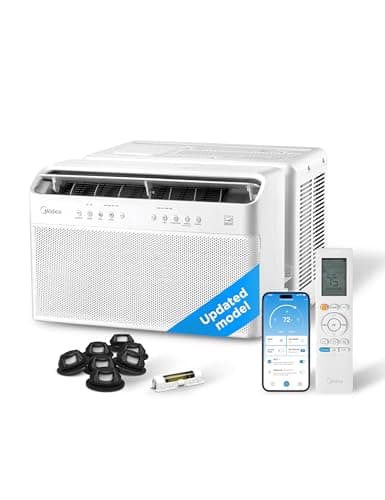 The machine that works regardless Midea U-Shaped Window Air Conditioner, 8,000 BTU 8,000 BTU at CEER 15 and 400 kWh a year, with the compressor outside a closed window. | Any climate, and any hour — including humid nights | |
| 3 | 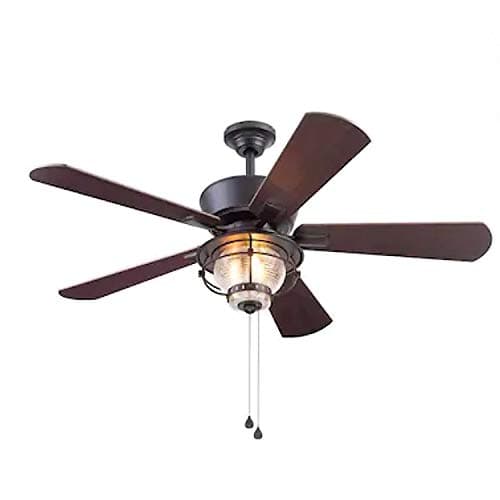 The part people skip Harbor Breeze Cando 84" Ceiling Fan 422.2 CFM per watt on 30.6 W, and 6.0 W on low — air movement that raises the temperature you can tolerate. | Making either option feel better, for almost nothing | |
| — | Neither, and the most expensive of the three Whynter ARC-14S Dual Hose Portable Air Conditioner 1,300 W and 9,500 BTU SACC. Running it eight hours a night for a season is the largest cooling cost on this site. | A room with no usable window — not a whole-house strategy |
A whole-house fan sits in the top-floor ceiling, pulls air out of the house and pushes it into the attic, and draws replacement air in through the windows you have opened. An air conditioner moves heat across the building envelope using a refrigeration cycle.
Those are different mechanisms with different preconditions, and that difference decides everything.
Side by side
The comparison
| Whole-house fan | Air conditioner | |
|---|---|---|
| Mechanism | Exchanges indoor air for outdoor air | Moves heat across the envelope |
| Works when it is hot outside | No | Yes |
| Works on a humid night | No — imports the humidity | Yes — removes moisture |
| Needs windows open | Yes, and it is non-negotiable | No, and they must be shut |
| Best hours | Evening and overnight | Any |
| Coverage | The whole house | The room it is in |
| Running cost | Very low | Moderate to high |
| Air quality | Brings outdoor air in, good and bad | Recirculates, filters |
| Installation | Cut into the ceiling, needs attic venting | Window, wall or licensed split |
| Renter-friendly | No | Often |
Rows two and three are the ones that settle it. A whole-house fan has two hard preconditions, and where either fails the machine is not cheaper than air conditioning — it is unusable.
The test
Does your climate support it?
This is answerable with a thermometer and no purchase at all.
- Check the outdoor temperature at bedtime and again at dawn across a week of typical summer weather.
- Compare against your indoor temperature at the same moments.
- If outdoor is meaningfully below indoor for several hours a night, a whole-house fan has something to work with.
- If it stays at or above indoor — common in humid climates where nights barely drop — it does not, and no amount of capacity changes that.
Also check the humidity. A cool but very humid night imports moisture into the house, and a humid 75-degree interior feels worse than a dry 78-degree one. The mechanism behind that.
For a cheap real-world trial, run a thermostat-controlled window fan overnight in the room you care about. It is the same idea at one-room scale, at 22 to 31 W.
This one is not a DIY job
A whole-house fan needs attic exhaust vent area, and this is the most commonly missed requirement. The fan pushes house air into the attic, and that air has to leave through roof or gable vents.
Insufficient exhaust area means the fan works against its own back pressure and moves far less than its rating, while pressurising the attic. Sizing net free vent area against the fan’s airflow is part of the job, not an optional extra.
It also needs windows open — enough of them, and in the right places. Running a whole-house fan with the house shut depressurizes it, which can pull air backwards through flues on fuel-burning appliances. If you have any, get a professional view before installing one.
And it is a hole in your insulated ceiling. Modern units include insulated sealing doors for the winter; older ones frequently do not, and an unsealed fan is a permanent thermal bypass into the attic.
Together
The pairing that actually works
Framing these as rivals is slightly false. In a climate where nights do cool off, the strongest arrangement uses both across the day.
- Afternoon: everything shut and shaded, air conditioner running if needed.
- Evening, once outdoor drops below indoor: air conditioner off, windows open, whole-house fan on. This is where the saving is.
- Overnight: ventilate and let the building fabric cool down, which delays how quickly it warms tomorrow.
- Morning: shut everything before the outdoor temperature overtakes the indoor.
A ceiling fan runs through all of it at 6.0 W on low, letting you tolerate a higher temperature at either stage.
The free version of that schedule, and the whole-house fan economics.
Say the unwelcome thing
Do not install a whole-house fan to replace air conditioning in a humid climate.
It is sold as the cheap alternative to air conditioning, and in the right climate that is true. In the wrong one it is not a cheaper alternative — it is a machine that cannot do the job at all.
Two failures compound. If nights do not drop below your indoor temperature, there is no cooler air to bring in. And if they are humid, the air you bring in raises indoor humidity, which makes the same temperature feel worse because it slows evaporation from your skin.
Meanwhile you have cut a large opening in your insulated ceiling.
Test it first with a thermometer over a week, and with a window fan for a real trial. If the answer is no, a correctly sized air conditioner is the honest option.
In full
Every pick, and what is wrong with it
Published specifications only, each linked to the page it came from. Where a manufacturer publishes nothing, the row says so — we do not fill blanks in.
1. The cheap way to test the idea
Lasko Twin Window Fan with Remote
Lasko · model W09550
Up to 560 CFM on 22 to 31 W with a thermostat — the same mechanism as a whole-house fan, for the price of a fan.
Before committing to a hole in your ceiling, this answers the question a whole-house fan depends on: does night ventilation actually cool your house?
Same physics at one-room scale. Up to 560 CFM on 22 to 31 W — about 4.5¢ for an eight-hour night — with two independent motors so one window can intake and exhaust at once.
The adjustable thermostat is what makes the test valid: set it, run it overnight, and see whether the room actually drops. If it does not, a whole-house fan will not either, and you have saved yourself an installation.
What’s wrong with it
It ventilates one room, not a house, and it only fits 24 to 32 inch windows.
Running cost — W09550
| Nameplate power | 22 W – 31 W | manufacturer's published figure |
|---|---|---|
| Energy, 8-hour night | 0.25 kWh | 31 ÷ 1000 × 8 |
| Cost per hour | 0.6¢ | at 18.34¢/kWh |
| Cost per 8-hour night | 4.5¢ | on the highest speed |
| Cost per 30 nights | $1.36 | 7.4 kWh |
| Same month, lowest speed | 97¢ | at 22 W |
Rate: 18.34¢/kWh, the US average residential price for June 2026 (EIA Electric Power Monthly, Table 5.3). Yours will differ — swap it in: (watts ÷ 1000) × hours × your rate.
| Power | 22 W - 31 W at 120 V |
|---|---|
| Air delivery | Up to 560 CFM |
| Window fit | 24 - 32 in wide |
| Modes | Intake, exhaust or exchange (independent motors) |
| Thermostat | Adjustable |
| Speeds | 3 |
| Dimensions | 12.9 H x 24.0 W x 4.9 D in |
| Weight | 8.0 lb |
| Warranty | 1 year |
Every figure above is from Lasko product page, W09550. Blanks are shown as “not published” rather than filled in.
2. The machine that works regardless
Midea U-Shaped Window Air Conditioner, 8,000 BTU
Midea · model MAW08V1QWT-S
8,000 BTU at CEER 15 and 400 kWh a year, with the compressor outside a closed window.
The decisive advantage over any ventilation approach: it does not care what the outdoor air is doing. A humid 85-degree night defeats a whole-house fan entirely and is unremarkable for this.
It also removes moisture rather than importing it, which is the other half of comfort. Why that matters more than temperature.
400 kWh a year, about $73 for a season, with a variable-speed compressor that modulates rather than cycling.
The U-shape puts the compressor outside a closed window, which is also the quietest window unit architecture available.
What’s wrong with it
53.2 lb and 22 inches deep, and it cools one room where a whole-house fan serves the whole house.
Running cost — MAW08V1QWT-S
| Annual energy use | 400 kWh | ENERGY STAR certified figure |
|---|---|---|
| Annual cost | $73 | 400 × 18.34¢/kWh |
| Per cooling month | $18 | spread over a four-month season |
The annual figure is the certified value from the ENERGY STAR Certified Room Air Conditioners dataset, which models a standard cooling season rather than your actual summer. It is more useful than a nameplate wattage here, because a variable-speed compressor spends most of its life well below nameplate.
Rate: 18.34¢/kWh, the US average residential price for June 2026 (EIA Electric Power Monthly, Table 5.3). Yours will differ — swap it in: (watts ÷ 1000) × hours × your rate.
| Cooling capacity | 8,000 BTU/h |
|---|---|
| CEER | 15 |
| Annual energy use | 400 kWh/yr |
| vs federal standard | 38% less energy |
| Dimensions | 13.5 H x 19.2 W x 22.0 D in |
| Weight | 53.2 lb |
| Refrigerant | R-32 |
| Installation | U-shape; sash closes through the middle of the unit |
| Compressor | Variable speed |
| ENERGY STAR | Certified |
Every figure above is from ENERGY STAR Certified Room Air Conditioners dataset. Blanks are shown as “not published” rather than filled in.
3. The part people skip
Harbor Breeze Cando 84" Ceiling Fan
Harbor Breeze · model 84" Cando
422.2 CFM per watt on 30.6 W, and 6.0 W on low — air movement that raises the temperature you can tolerate.
Neither machine on this page moves air across your skin, and that is what actually makes a person feel cooler.
A ceiling fan running alongside either lets you accept a higher air temperature for the same comfort — which means less whole-house fan run time, or a higher air conditioner setpoint.
6.0 W on low is about 0.9¢ for an eight-hour night. Against a compressor, that is a rounding error attached to a real effect.
422.2 CFM per watt, the best outdoor-rated figure in the certified data. Ceiling fans ranked.
What’s wrong with it
It changes no air temperature at all, so it supplements both options rather than replacing either.
Running cost — 84" Cando
| Nameplate power | 6 W – 30.6 W | manufacturer's published figure |
|---|---|---|
| Energy, 8-hour night | 0.24 kWh | 30.6 ÷ 1000 × 8 |
| Cost per hour | 0.6¢ | at 18.34¢/kWh |
| Cost per 8-hour night | 4.5¢ | on the highest speed |
| Cost per 30 nights | $1.35 | 7.3 kWh |
| Same month, lowest speed | 26¢ | at 6 W |
Rate: 18.34¢/kWh, the US average residential price for June 2026 (EIA Electric Power Monthly, Table 5.3). Yours will differ — swap it in: (watts ÷ 1000) × hours × your rate.
| Blade span | 84 in |
|---|---|
| Efficiency | 422.2 CFM per watt |
| Power, high speed | 30.6 W |
| Power, low speed | 6.0 W |
| Type | Outdoor ceiling fan |
| ENERGY STAR | Certified |
Every figure above is from ENERGY STAR Certified Ceiling Fans dataset. Blanks are shown as “not published” rather than filled in.
Skip this one
Whynter ARC-14S Dual Hose Portable Air Conditioner
Whynter · model ARC-14S
1,300 W and 9,500 BTU SACC. Running it eight hours a night for a season is the largest cooling cost on this site.
Included because people compare a whole-house fan against “air conditioning” and picture a portable.
1,300 W — $1.91 for an eight-hour night, or $172 across a 90-day season. That is the worst of both: single-room coverage at a cost no other option here approaches.
And the capacity is smaller than the box says: 9,500 BTU SACC from a 14,000 BTU headline, a 32.1% haircut, because a portable exhausts room air and pulls hot outdoor air in to replace it.
If you are weighing whole-house ventilation against cooling, weigh it against a certified window unit, not this.
What’s wrong with it
It is a single-room machine at whole-house running cost, with no certification behind any of its figures.
Running cost — ARC-14S
| Nameplate power | 1300 W | manufacturer's published figure |
|---|---|---|
| Energy, 8-hour night | 10.40 kWh | 1300 ÷ 1000 × 8 |
| Cost per hour | 24¢ | at 18.34¢/kWh |
| Cost per 8-hour night | $1.91 | on the highest speed |
| Cost per 30 nights | $57 | 312.0 kWh |
Rate: 18.34¢/kWh, the US average residential price for June 2026 (EIA Electric Power Monthly, Table 5.3). Yours will differ — swap it in: (watts ÷ 1000) × hours × your rate.
| Marketing capacity | 14,000 BTU (ASHRAE-128) |
|---|---|
| DOE-rated capacity | 9,500 BTU SACC |
| Hoses | Dual |
| Power | 1,300 W / 11.6 A at 115 V |
| Noise | Under 51 dBA low, under 56 dBA high |
| Dehumidification | 71 pints/day |
| Refrigerant | R-32 |
| Dimensions | 16 W x 19 D x 35.5 H in |
| Weight | 73 lb |
| Manufacturer coverage claim | 500 sq ft |
| Warranty | 1 year unit, 3 years compressor |
Every figure above is from Whynter product page, ARC-14S. Blanks are shown as “not published” rather than filled in.
We are not linking a buy button for this one. If you want to look at it anyway, it is easy enough to find — but we would rather send you to something that fits your room.
Questions people actually ask
Frequently asked
Is a whole-house fan cheaper than air conditioning?
To run, considerably — it moves air rather than running a compressor. But it only works once outdoor air is cooler than indoor, so in a climate where nights stay warm it is not a cheaper alternative, it is an unusable one.
Can a whole-house fan replace an air conditioner?
Only where nights reliably drop below your indoor temperature and are not too humid. It cannot lower the indoor temperature below outdoor, and it cannot remove moisture — it imports whatever humidity the outdoor air carries.
How do I know if a whole-house fan will work in my climate?
Check outdoor temperature at bedtime and dawn against your indoor temperature across a week of typical summer weather. If outdoor is meaningfully below indoor for several hours a night, there is something to work with. Also check humidity.
Do whole-house fans need windows open?
Yes, and it is non-negotiable — the fan pulls replacement air in through them. Running one with the house shut depressurizes it, which can pull air backwards through flues on fuel-burning appliances.
Do whole-house fans need attic vents?
Yes, and it is the most commonly missed requirement. The fan pushes house air into the attic and that air must leave through roof or gable vents. Insufficient exhaust area means the fan fights its own back pressure and moves far less than its rating.
Can I use a whole-house fan and an air conditioner together?
Not simultaneously — you would be exhausting air you paid to cool. Use them across the day instead: air conditioning while it is hot outside, then switch off, open up and ventilate once the outdoor temperature drops below indoor. Whole-house fan economics.
Sources
Where these numbers came from
Read next
Where to go from here
Back to Whole-House Airflow, or read how we pick.