The picks
The best room-to-room transfer fans, for one room that is always colder than the rest of the house
A back bedroom with one register, a converted garage, a room added on behind a closed door: the heat exists elsewhere in the house and never arrives. A transfer fan cuts a path through the wall and moves it.
By Sawyer V. · Published
The short answer
For most houses the Suncourt ThruWall TW108 is the pick: 192 CFM on 45 W, rated by Suncourt for rooms up to 440 sq ft. If the fan goes in a bedroom wall, take the Tjernlund AireShare AS1 instead — 1.15 sones and 42 dB against the Suncourt’s 3 sones and 49 dBA, for 75 CFM.
Fan & Frost earns a commission when you buy through our links, at no cost to you. It never changes a ranking, and we say so when the right answer is the cheaper unit or nothing at all. Full disclosure · How we pick.
At a glance
The picks, ranked
Tap any row to jump to the full reasoning. Prices are live from Amazon where we have them, and read “check price” where we don’t — never a number we cannot verify today.
| # | Product | Best for | Price |
|---|---|---|---|
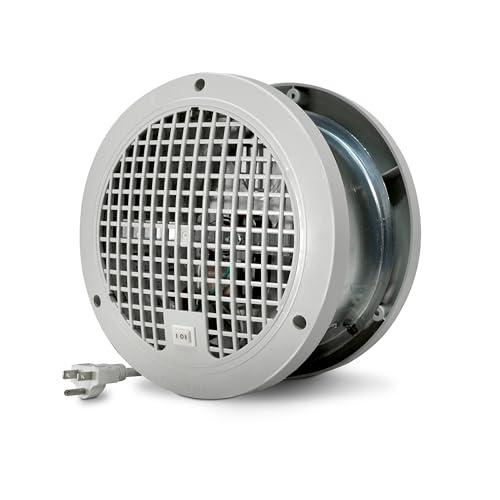
| 1 | Best overall Suncourt ThruWall TW108 Room-to-Room Transfer Fan 192 CFM on 45 running watts, two speeds, a 10-foot cord and a published rating for rooms up to 440 sq ft. The most air of any transfer fan we found figures for. | A cold back bedroom, a bonus room or a converted garage up to about 440 sq ft, where there is a shared interior wall and a socket on the warm side | |
| 2 | 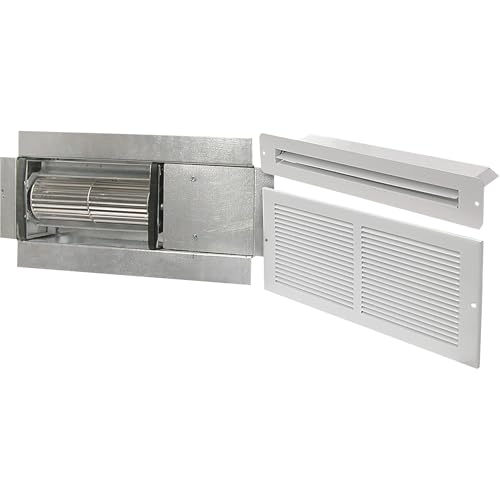 Quietest by a wide margin Tjernlund AireShare AS1 Room-to-Room Transfer Fan 1.15 sones and 42 dB on 25 W, from a factory-balanced cross-flow blower in 20-gauge aluminized steel. Less than half the Suncourt's loudness for 39 percent of its airflow. | A bedroom wall, a nursery, a home office — anywhere the fan will be running while somebody is trying to sleep or think in the room it blows into | |
| 3 | 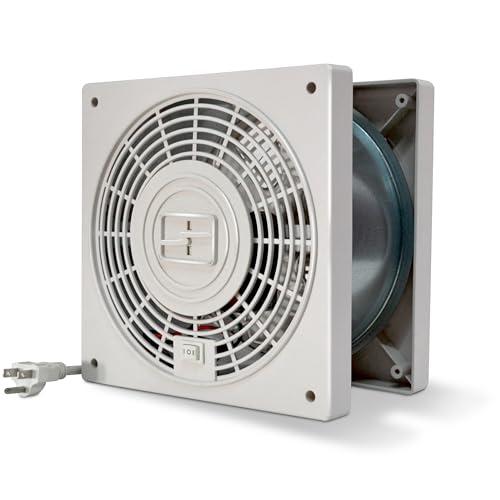 Quieter Suncourt, for a smaller room Suncourt ThruWall TW408 Transfer Fan with Airflow Adaptor Plates 40 dBA instead of 49, for 130 CFM instead of 192, on the same 45 watts and the same 10-foot cord. Airflow adaptor plates are included. | A room up to about 275 sq ft where the TW108 would be too loud but a hardwired fan is too much work — and for an awkward wall that needs the adaptor plates | |
| 4 | 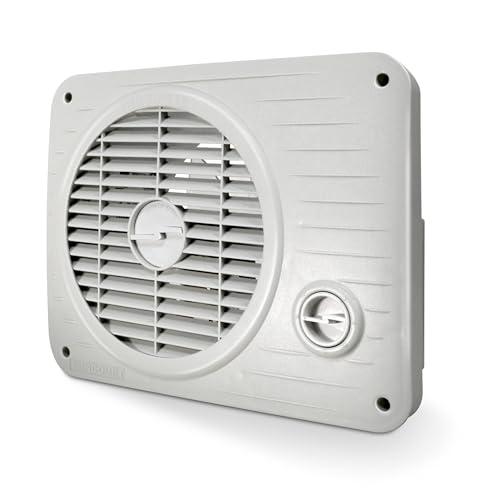 For a hardwired install and a steerable grille Suncourt ThruWall TW208 Variable-Speed Transfer Fan The only variable-speed transfer fan here, with a rotating grille that lets you change which way the air goes after it is in the wall. Hardwired, so nothing hangs down the wall. | A clean permanent installation with no visible cord, where being able to dial the speed down and rotate the airflow direction is worth losing the published numbers | |
| — | 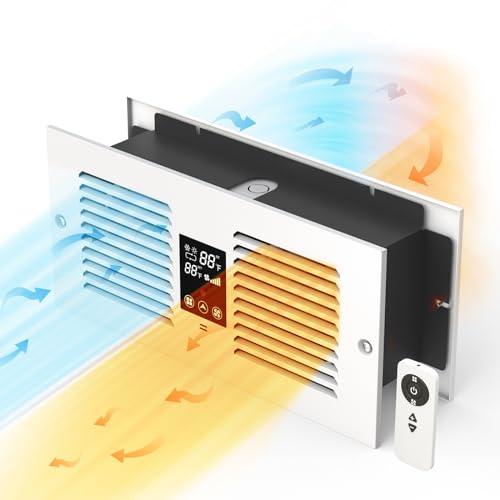 The one to skip Apexicalo RTR300-CV Through-Wall Room-to-Room Fan A claimed 300 CFM with a remote and a built-in temperature sensor, for less than the Suncourt. It publishes no wattage, no noise rating and no wall-thickness range. | A reader shopping on the biggest CFM number in the search results — which on this page is exactly the wrong way to choose |
There is a specific kind of cold room that no amount of thermostat gets at. The furnace is running, the rest of the house is fine, and one room — the back bedroom, the room over the garage, the addition, the office with the door shut — sits five degrees behind everything else.
A transfer fan does not make heat. It moves the heat that already exists on the other side of a wall. You cut an opening between the two rooms, the fan sits in the cavity, and a grille on each side hides it. It is the cheapest piece of equipment on this site that solves a whole-room problem.
The finding
The maker that advertises CFM curves publishes none for this line
Suncourt’s own homepage states that it provides “Real CFM curves and static pressure specifications for every fan model”. Its ThruWall product pages — for all three models — carry no airflow figure, no wattage and no noise rating.
The figures do exist. They are in the per-model specification PDFs linked from those pages, and we pulled them out:
| Fan | CFM | Watts | CFM/W | Noise | Rated for |
|---|---|---|---|---|---|
| Suncourt TW108 | 192 | 45 | 4.3 | 49 dBA / 3 sones | 440 sq ft |
| Suncourt TW408 | 130 | 45 | 2.9 | 40 dBA / 3 sones | 275 sq ft |
| Tjernlund AS1 | 75 | 25 | 3.0 | 42 dB / 1.15 sones | Not published |
| Suncourt TW208 | Not published | Not published | — | Not published | Not published |
| Apexicalo RTR300-CV | 300 claimed | Not published | — | Not published | Not published |
Suncourt figures from the TW108-SS-DS-0426 and TW408-SS-DS-0426 specification sheets; Tjernlund from the AS1 AireShare spec sheet (8513030), whose listing says 70 CFM where the sheet says 75. CFM per watt is our arithmetic. Every “Not published” is a figure the maker does not state anywhere we could find.
Two things fall straight out of that table. The quietest fan here moves the least air, and the only fan with a three-figure airflow claim publishes nothing else at all.
How to choose
Noise first, then the room size
The ordering on this page is deliberately the reverse of the usual. On a box fan or a circulator, airflow comes first because the fan is in the room with you and you can move it or switch it off. A transfer fan is in a wall, running unattended, blowing into a room somebody sleeps in.
- Where does the air come out? If it is a bedroom, nursery or office, start with the 1.15-sone Tjernlund and only move up if 75 CFM is clearly not enough. If it is a den, a workshop or a garage conversion, start with the 192 CFM Suncourt.
- How big is the cold room? Suncourt publishes an “effective for room size” figure — 440 sq ft for the TW108, 275 for the TW408 — and it is the only sizing guidance anybody in this category provides.
- How thick is the wall, and what kind? The ThruWall line fits frame walls 3-3/4 to 6-1/2 inches thick. Tjernlund states its fan must not go in an exterior wall or a fire-rated wall at all.
- Cord or hardwired? The TW108 and TW408 come with 10-foot cords. The TW208 and the Tjernlund are hardwired, which means an electrician but no visible lead.
This one is not a DIY job
If the cold room has a supply register that simply does not deliver, the cheaper fix is at the register rather than in the wall. A register booster sits in the floor or wall vent and pulls harder on the duct that is already there, with no hole to cut and no grille to paint. Register booster fans, on published airflow. If the room has no duct at all, a transfer fan is the answer and the booster is not.
Running cost
Forty-five watts, all winter
These fans are meant to run continuously or on a thermostat, so the running cost is worth a line. At 18.34¢/kWh:
- Suncourt, 45 W: 20¢ a day, $5.94 a month, $24 for a four-month heating season running flat out.
- Tjernlund, 25 W: 11¢ a day, $3.30 a month, $13 for the same season.
Both are small enough that efficiency is not the deciding factor, which is a different situation from most of this site. The same arithmetic for ordinary fans.
What it cannot do
It equalizes. It does not heat.
Suncourt states the limit on its own collection page, and it is worth quoting because it is the honest version: “The fan transfers existing air rather than generating heat or cooling. Results depend on the temperature difference, room layout, airflow path, and the capacity of the heating or cooling source.”
In practice that means three things. If the warm room is only two degrees warmer, you will move two degrees. If the cold room has no return path — no gap under the door, no second opening — the fan will pressurize it and stall. And if the furnace is already struggling to heat the house, taking air out of one room to warm another just relocates the problem.
Say the unwelcome thing
Do not put a transfer fan in an exterior wall.
Tjernlund says it outright in its typical specification: the device shall not be installed in an exterior wall, and shall not be installed in a fire-rated wall. Suncourt’s range is specified for frame walls of 3-3/4 to 6-1/2 inches — an interior partition, in other words.
An exterior wall contains insulation, a vapor control layer and a weather barrier, and a transfer fan is not a weatherproof assembly. If what you want is outside air brought in and conditioned on the way, the product class is a heat or energy recovery ventilator, not this. Energy recovery ventilators, on HVI-certified figures.
In full
Every pick, and what is wrong with it
Published specifications only, each linked to the page it came from. Where a manufacturer publishes nothing, the row says so — we do not fill blanks in.
1. Best overall
Suncourt ThruWall TW108 Room-to-Room Transfer Fan
Suncourt · model TW108
192 CFM on 45 running watts, two speeds, a 10-foot cord and a published rating for rooms up to 440 sq ft. The most air of any transfer fan we found figures for.
Up to 192 CFM on up to 45 running watts, at 120 V, 0.75 A, 60 Hz, rated effective for room sizes up to 440 sq ft. Our arithmetic on that is 4.3 CFM per watt, and the running cost at 18.34¢/kWh is $5.94 for a month of continuous operation.
It fits frame walls 3-3/4 to 6-1/2 inches thick on a telescoping housing, takes a 9.75-inch round grille on each side, and both grilles are paintable, which is the difference between a fitting and a visible appliance.
Two speeds and a 10-foot cord with a molded grounded plug. The cord is the quiet advantage over the hardwired models here: no electrician, and you can unplug it in April. The airflow exhausts on the switch side, so decide which room you are pushing air into before you cut the hole.
Suncourt names the application itself: “For use with PTAC units, mini split systems, fireplaces, wood stoves, and window air conditioning units”. That is the whole category — one room has the machine, the next room does not. Moving wood-stove heat, at the stove.
What’s wrong with it
49 dBA and 3 sones, which is roughly twice as loud as the Tjernlund and too much for a wall behind a bed. Suncourt also publishes none of these figures on the product page itself — they are in a specification PDF — and the warranty is 12 months.
Running cost — TW108
| Nameplate power | 45 W | manufacturer's published figure |
|---|---|---|
| Energy, 8-hour night | 0.36 kWh | 45 ÷ 1000 × 8 |
| Cost per hour | 0.8¢ | at 18.34¢/kWh |
| Cost per 8-hour night | 6.6¢ | on the highest speed |
| Cost per 30 nights | $1.98 | 10.8 kWh |
Rate: 18.34¢/kWh, the US average residential price for June 2026 (EIA Electric Power Monthly, Table 5.3). Yours will differ — swap it in: (watts ÷ 1000) × hours × your rate.
| Air delivery | Up to 192 CFM |
|---|---|
| Running watts | Up to 45 W |
| Power | 120 V, 0.75 A, 60 Hz |
| Noise | As low as 49 dBA; 3 sones |
| Effective for room size | Up to 440 sq ft |
| Speeds | 2 |
| Wall thickness | Frame walls 3-3/4 to 6-1/2 in |
| Grille | 9.75 in diameter, paintable |
| Cord | 10 ft, molded grounded plug |
| Weight | 4.3 lb |
| Listing | MET listed to UL and CSA standards |
| Warranty | 12-month limited |
Every figure above is from Suncourt TW108 specification sheet (TW108-SS-DS-0426) — up to 192 CFM, up to 45 running watts, 120 V 0.75 A, 49 dBA / 3 sones, effective for rooms up to 440 sq ft, 4.3 lb. Blanks are shown as “not published” rather than filled in.
2. Quietest by a wide margin
Tjernlund AireShare AS1 Room-to-Room Transfer Fan
Tjernlund · model AS1
1.15 sones and 42 dB on 25 W, from a factory-balanced cross-flow blower in 20-gauge aluminized steel. Less than half the Suncourt's loudness for 39 percent of its airflow.
1.15 sones / 42 dB on 25 W, at 120 V and 0.50 A, from a cross-flow blower turning 1,800 RPM. Put that against the Suncourt’s 3 sones and the gap is not marginal: sones are roughly linear in perceived loudness, so this is about a third as loud.
Tjernlund’s own typical specification says the device “shall have a sound level no greater than 1.5 sones” and “power consumption no greater than 30 watts” — written as a performance guarantee, which is a different kind of claim from a marketing figure.
The build is the other half of the case: 20-gauge aluminized steel with adjustable-fit flanges, a built-in turning vane and a washable powder-coat finish that can be repainted. The blower and the diffuser can go high or low, independently, so you can take air from the ceiling of a warm room and deliver it at floor level in a cold one.
Two restrictions Tjernlund states outright and nobody else here does: it shall NOT be installed in an exterior wall, and it shall NOT be installed in a fire-rated wall. Both rule out exactly the walls people most often want to use.
What’s wrong with it
75 CFM against 192, hardwired rather than plug-in, and Tjernlund publishes no effective room size at all, so sizing is guesswork. Its spec sheet says 75 CFM while the retail listing says 70. It also must not go in an exterior wall or a fire-rated wall.
Running cost — AS1
| Nameplate power | 25 W | manufacturer's published figure |
|---|---|---|
| Energy, 8-hour night | 0.20 kWh | 25 ÷ 1000 × 8 |
| Cost per hour | 0.5¢ | at 18.34¢/kWh |
| Cost per 8-hour night | 3.7¢ | on the highest speed |
| Cost per 30 nights | $1.10 | 6.0 kWh |
Rate: 18.34¢/kWh, the US average residential price for June 2026 (EIA Electric Power Monthly, Table 5.3). Yours will differ — swap it in: (watts ÷ 1000) × hours × your rate.
| Air delivery | 75 CFM on the spec sheet; the retail listing says 70 CFM |
|---|---|
| Running watts | 25 W |
| Power | 120 V, 0.50 A |
| Noise | 1.15 sones / 42 dB |
| Blower | Cross-flow, factory balanced, 1,800 RPM |
| Housing | 20 gauge aluminized steel, washable powder coat |
| Install | Hardwired. No power cord outside the wall |
| Where it must not go | Tjernlund states it shall NOT be installed in an exterior wall or a fire-rated wall |
| Effective for room size | Not published |
| Warranty | 1 year material and workmanship |
Every figure above is from Tjernlund AS1 AireShare specification sheet (8513030) — 75 CFM, 25 W, 120 V 0.50 A, 1,800 RPM, 1.15 sones / 42 dB, sound level no greater than 1.5 sones, 1-year warranty. Blanks are shown as “not published” rather than filled in.
3. Quieter Suncourt, for a smaller room
Suncourt ThruWall TW408 Transfer Fan with Airflow Adaptor Plates
Suncourt · model TW408
40 dBA instead of 49, for 130 CFM instead of 192, on the same 45 watts and the same 10-foot cord. Airflow adaptor plates are included.
Up to 130 CFM, up to 45 running watts, 0.75 A, as low as 40 dBA, 3 sones, and effective for room sizes up to 275 sq ft. The adaptor plates are the reason it exists: they let the opening be adapted to a wall cavity that will not take the standard round grille cleanly.
Nine decibels quieter than the TW108. That is the whole purchase, and it is a real difference — roughly half the perceived loudness — but note that Suncourt still publishes 3 sones for both. Two noise scales, two different answers, on the same manufacturer’s spec sheets.
Our arithmetic: 130 CFM on 45 W is 2.9 CFM per watt, against 4.3 for the TW108 and 3.0 for the Tjernlund. A certified bathroom extractor manages 10 to 17. Where those certified figures come from.
Class B thermally protected motor, polycarbonate blade, 4.65 lb, and the same 3-3/4 to 6-1/2 inch wall range as the rest of the ThruWall line.
What’s wrong with it
You are paying the same money for 32 percent less air, the sone rating is still 3 (Suncourt only improves the dBA figure), and the effective room size drops from 440 to 275 sq ft. At 45 W for 130 CFM, it is the least efficient fan here at 2.9 CFM per watt.
Running cost — TW408
| Nameplate power | 45 W | manufacturer's published figure |
|---|---|---|
| Energy, 8-hour night | 0.36 kWh | 45 ÷ 1000 × 8 |
| Cost per hour | 0.8¢ | at 18.34¢/kWh |
| Cost per 8-hour night | 6.6¢ | on the highest speed |
| Cost per 30 nights | $1.98 | 10.8 kWh |
Rate: 18.34¢/kWh, the US average residential price for June 2026 (EIA Electric Power Monthly, Table 5.3). Yours will differ — swap it in: (watts ÷ 1000) × hours × your rate.
| Air delivery | Up to 130 CFM |
|---|---|
| Running watts | Up to 45 W |
| Power | 120 V, 0.75 A, 60 Hz |
| Noise | As low as 40 dBA; 3 sones |
| Effective for room size | Up to 275 sq ft |
| Speeds | 2 |
| Extras | Airflow adaptor plates included |
| Wall thickness | Frame walls 3-3/4 to 6-1/2 in |
| Motor | Class B thermally protected; polycarbonate blade |
| Cord | 10 ft |
| Weight | 4.65 lb |
| Warranty | 12-month limited |
Every figure above is from Suncourt TW408 specification sheet (TW408-SS-DS-0426) — up to 130 CFM, up to 45 running watts, 120 V 0.75 A, 40 dBA / 3 sones, effective for rooms up to 275 sq ft, 4.65 lb. Blanks are shown as “not published” rather than filled in.
4. For a hardwired install and a steerable grille
Suncourt ThruWall TW208 Variable-Speed Transfer Fan
Suncourt · model TW208
The only variable-speed transfer fan here, with a rotating grille that lets you change which way the air goes after it is in the wall. Hardwired, so nothing hangs down the wall.
Variable speed, a rotating grille that allows the airflow direction to be changed, and a hardwired connection for what Suncourt calls a clean installation. Same 3-3/4 to 6-1/2 inch frame-wall range, same paintable grilles, same 12-month limited warranty, same MET listing to UL and CSA standards.
Variable speed is the genuinely useful feature here, and it is the one feature a transfer fan most needs. These fans are either on or off, and on is frequently too much at two in the morning. Being able to set it at a trickle is worth more than another 60 CFM.
Now the gap. Suncourt publishes no CFM, no wattage and no decibel figure for the TW208 on its product page — while publishing all three for the TW108 and the TW408 in their specification sheets. We are not going to borrow the TW108’s numbers for it.
Take it if you want the install tidy and the speed adjustable, and accept that you are buying it on the strength of its siblings. How we pick.
What’s wrong with it
Suncourt publishes no airflow figure, no wattage and no noise rating for this model on its product page — the only ThruWall model with no numbers at all. Buying it is buying the feature list rather than the performance.
Running cost
Suncourt does not publish a wattage for the TW208, so we cannot calculate what it costs to run. We are not going to estimate one. If Suncourt publishes a nameplate figure, this block will show the arithmetic.
| Speeds | Variable |
|---|---|
| Grille | Rotating, so airflow direction can be changed; paintable |
| Install | Hardwired |
| Wall thickness | Frame walls 3-3/4 to 6-1/2 in |
| Air delivery | Not published on Suncourt's product page for this model |
| Running watts | Not published on the product page |
| Noise | Not published on the product page |
| Listing | MET listed to UL and CSA standards |
| Warranty | 12-month limited |
Every figure above is from Suncourt TW208 product page — variable speed, hardwired, rotating grille, frame walls 3-3/4 to 6-1/2 in, MET listed, 12-month limited warranty. No airflow, wattage or noise figure is published for this model. Blanks are shown as “not published” rather than filled in.
Skip this one
Apexicalo RTR300-CV Through-Wall Room-to-Room Fan
Apexicalo · model RTR300-CV
A claimed 300 CFM with a remote and a built-in temperature sensor, for less than the Suncourt. It publishes no wattage, no noise rating and no wall-thickness range.
The commodity end of this category is full of these: a steel sleeve, a DC motor, a remote, a temperature sensor, a big airflow number, and a brand name that returns nothing but the listing.
300 CFM claimed is 56 percent more than the Suncourt TW108’s published 192, and if it were measured the same way that would be worth having. There is no way to know. There is no mandatory airflow test for a through-wall transfer fan, and no maker page to check the figure against.
The missing noise figure is the disqualifying one. This is a hole in the wall between a bedroom and a hallway. The Suncourt publishes 49 dBA; the Tjernlund publishes 42 dB and 1.15 sones. Both of those numbers tell you something you need. A fan with no noise rating and a 300 CFM claim is a fan you will install once and switch off at night.
It is real and it is purchasable, which is why it is listed. We would rather you spent slightly more on a figure somebody is willing to print.
What’s wrong with it
A transfer fan goes in the wall between two rooms you live in, so its noise rating is the specification that decides whether you keep it switched on. There is none. There is also no certification named, no wall range, and no manufacturer specification page for the brand.
Running cost
Apexicalo does not publish a wattage for the RTR300-CV, so we cannot calculate what it costs to run. We are not going to estimate one. If Apexicalo publishes a nameplate figure, this block will show the arithmetic.
| Air delivery | 300 CFM (claimed on the listing) |
|---|---|
| Speeds | 5 |
| Control | Remote, with temperature control |
| Install | Hardwired |
| Running watts | Not published on the listing |
| Noise | Not published on the listing |
| Wall thickness | Not published on the listing |
| Certification | Not published on the listing |
| Warranty | Not published on the listing |
Every figure above is from Apexicalo RTR300-CV product listing — 300 CFM claimed, 5 speeds, temperature control, hardwired. No manufacturer specification page could be found for this brand. Blanks are shown as “not published” rather than filled in.
We are not linking a buy button for this one. If you want to look at it anyway, it is easy enough to find — but we would rather send you to something that fits your room.
Questions people actually ask
Frequently asked
What is the best room-to-room transfer fan?
The Suncourt ThruWall TW108 for most houses: 192 CFM on 45 watts, rated by Suncourt as effective for rooms up to 440 sq ft, with two speeds and a 10-foot cord. For a bedroom wall, the Tjernlund AireShare AS1 instead — 1.15 sones and 42 dB on 25 watts, which is about a third as loud for 75 CFM.
Do room-to-room transfer fans actually work?
Within a limit Suncourt states itself: the fan transfers existing air rather than generating heat, so results depend on the temperature difference, the room layout, the airflow path and the capacity of the heating source. If the warm room is only two degrees warmer, two degrees is what you will move.
How loud is a through-wall transfer fan?
It depends on the model and the spread is wide. Suncourt publishes as low as 49 dBA for the TW108 and as low as 40 dBA for the TW408, both at 3 sones. Tjernlund publishes 42 dB and 1.15 sones for the AS1, and specifies it as no greater than 1.5 sones. Several commodity models publish no noise figure at all. What fan noise figures mean.
Can a transfer fan go in an exterior wall?
No. Tjernlund states that its fan shall not be installed in an exterior wall or a fire-rated wall, and Suncourt specifies its ThruWall range for frame walls 3-3/4 to 6-1/2 inches thick — an interior partition. For bringing outside air in, the correct product is a heat or energy recovery ventilator. Energy recovery ventilators.
What does a transfer fan cost to run?
Very little. The Suncourt models draw up to 45 running watts and the Tjernlund 25, so a four-month heating season of continuous operation is a few dollars at the national average rate. Efficiency is not the deciding factor in this category, which is unusual for anything with a fan in it. The same arithmetic for ordinary fans.
Transfer fan or register booster fan?
If the cold room has a supply register that underdelivers, a register booster is cheaper and needs no hole cut — it pulls harder on the duct that is already there. If the room has no duct at all, or the problem is a closed door between a heated space and an unheated one, the transfer fan is the only one of the two that can help. Register booster fans compared.
How big an opening does a transfer fan need?
Suncourt's ThruWall models take a 9.75-inch round grille on each side of a frame wall between 3-3/4 and 6-1/2 inches thick, on a telescoping housing. Tjernlund's AS1 uses a rectangular blower and diffuser that can be mounted high or low independently, so the two openings need not line up.
Sources
Where these numbers came from
- Suncourt TW108 specification sheet (TW108-SS-DS-0426) — up to 192 CFM, up to 45 running watts, 120 V 0.75 A 60 Hz, as low as 49 dBA, 3 sones, effective for rooms up to 440 sq ft, 4.3 lb
- Suncourt TW408 specification sheet (TW408-SS-DS-0426) — up to 130 CFM, up to 45 running watts, as low as 40 dBA, 3 sones, effective for rooms up to 275 sq ft, 4.65 lb
- Suncourt room-to-room fans collection page — three models, frame walls 3-3/4 to 6-1/2 in, paintable grilles, 12-month limited warranty, and the statement that the fan transfers existing air rather than generating heat
- Suncourt TW208 product page — variable speed, hardwired, rotating grille, MET listed, with no airflow, wattage or noise figure published
- Tjernlund AS1 AireShare specification sheet (8513030) — 75 CFM, 25 W, 120 V 0.50 A, 1,800 RPM, 1.15 sones / 42 dB, 20 gauge aluminized steel, not for exterior or fire-rated walls, 1-year warranty
- Apexicalo RTR300-CV product listing — 300 CFM claimed, 5 speeds, temperature control, hardwired, with no wattage or noise figure
- EIA Electric Power Monthly, Table 5.3 — electricity rate
Read next
Where to go from here
Back to Whole-House Airflow, or read how we pick.