Guide and picks
Cooling a home with solar panels
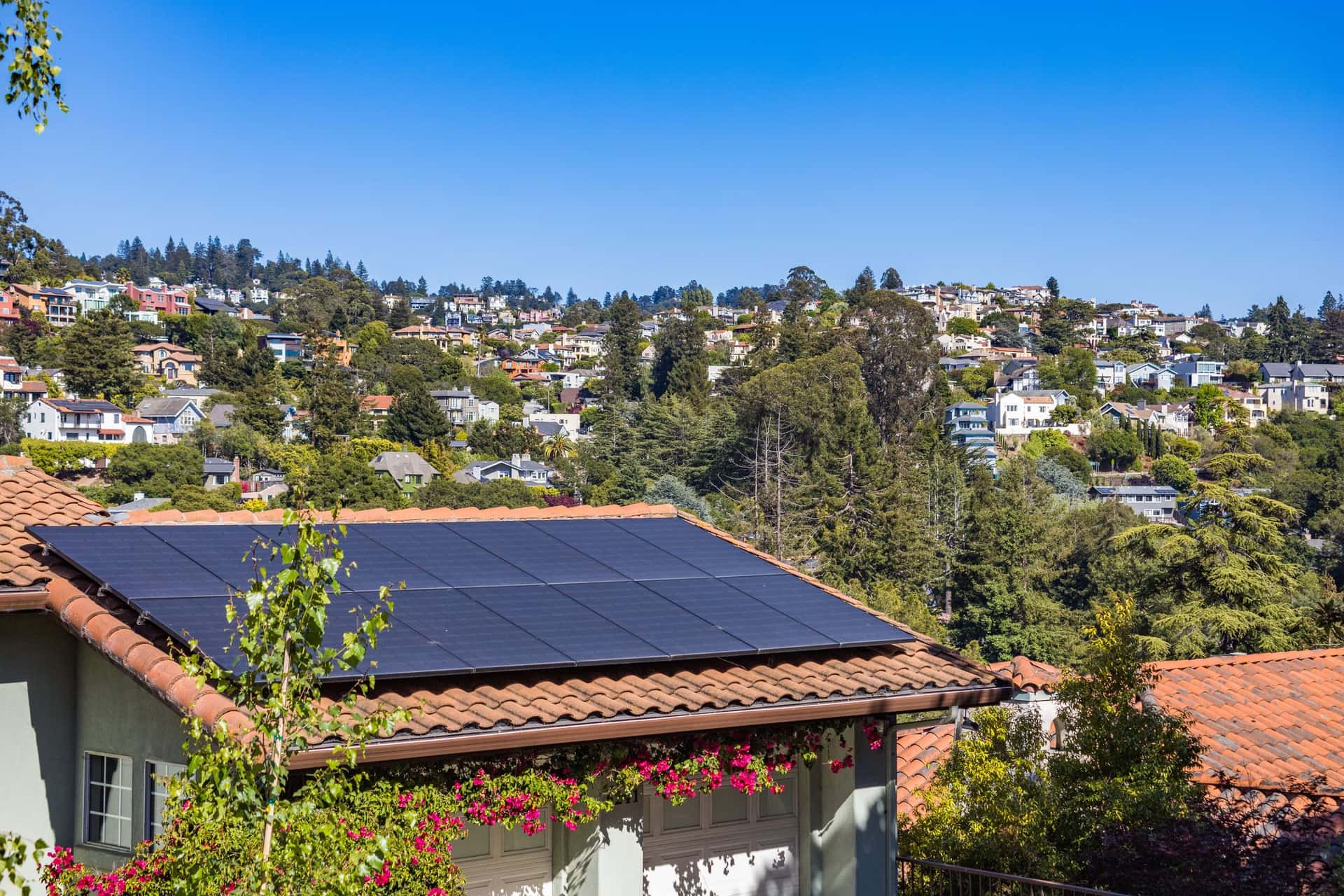
Cooling is the one major household load that peaks at the same hour your panels do, and that changes the arithmetic more than most people expect.
By Sawyer V. · Published
The short answer
Cooling is the best-matched load a house has. Demand peaks in the early afternoon, which is close to when a fixed array peaks, so a large share of the electricity is used as it is generated rather than exported. A certified 8,000 BTU window unit needs about 375 kWh a year; a certified ceiling fan on low needs about 1.1 W. Size the equipment first, then the array.
Fan & Frost earns a commission when you buy through our links, at no cost to you. It never changes a ranking, and we say so when the right answer is the cheaper unit or nothing at all. Full disclosure · How we pick.
At a glance
The picks, ranked
Tap any row to jump to the full reasoning. Prices are live from Amazon where we have them, and read “check price” where we don’t — never a number we cannot verify today.
| # | Product | Best for | Price |
|---|---|---|---|
| 1 | 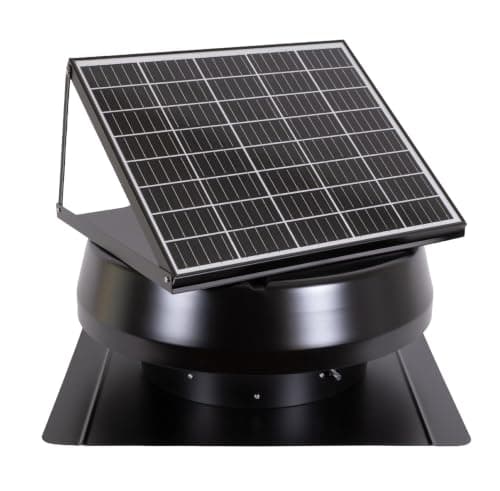 Runs on its own panel iLIVING 14" Solar Roof Attic Exhaust Fan 1,150 CFM from a 40 W panel with an adjustable 50 to 122°F thermostat — it draws nothing from the house at all. | An attic that bakes, with no wiring run to it | |
| 2 | Best load per watt Midea Window Heat Pump Air Conditioner, 9,500 BTU CEER 17.6 and 404.8 kWh a year — the most efficient certified room air conditioner, which is the same thing as needing the fewest panels. | A home where the array is the constraint | |
| 3 | 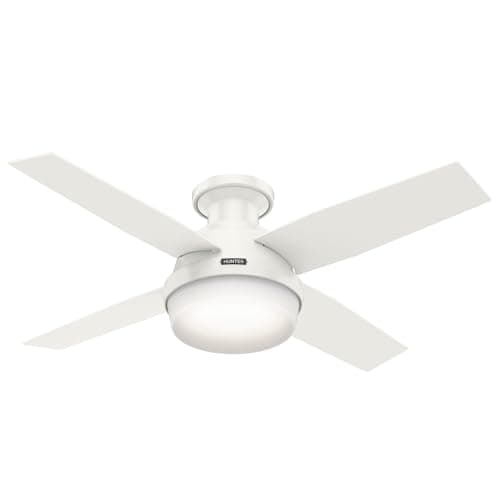 Effectively free to run Hunter Martindale 44" Ceiling Fan 1.1 W on low at 304.5 CFM per watt — small enough that array sizing never has to account for it. | Every room you are not air conditioning | |
| — | The worst fit for an array Whynter ARC-14S Dual Hose Portable Air Conditioner 1,300 W running, from an uncertified category with no annual figure to size an array against. | A room where nothing else is possible — not a solar strategy |
Most household loads are badly matched to a solar array. Cooking, laundry and lighting cluster around the evening, when generation has collapsed. Cooling is the exception, and it is worth understanding why before sizing anything.
Load matching
Why cooling is the best-matched load you have
A fixed south-facing array generates most around solar noon and tapers either side. Cooling demand is driven by the same sun through the same hours, lagging a couple of hours because the building takes time to heat up.
The consequence is unusual: a large proportion of the electricity your air conditioner uses is generated on your own roof at the moment it is consumed, rather than exported and bought back later. That matters because export is almost always worth less than what you pay to import.
Two practical effects follow:
- Pre-cooling works better here than anywhere. Running the unit hard in the early afternoon while generation is high, then letting the house coast into the evening, uses your own generation rather than imported power — timing, in general.
- An efficient unit needs fewer panels, not just less money. When roof area is the limit, CEER is a sizing constraint.
Arithmetic
Working out what your cooling actually needs
You cannot size anything without a number. Where the equipment is certified, you have one; where it is not, you have a nameplate and some judgement.
| Equipment | Draw | Certified annual figure? |
|---|---|---|
| Ceiling fan, low | 1.1 W | Yes — CFM per watt |
| Tower fan, low | 2.9 W | No program |
| Window AC, 8,000 BTU, CEER 16 | 375 kWh/yr | Yes |
| Window heat pump, CEER 17.6 | 404.8 kWh/yr | Yes |
| Evaporative cooler | 235 W | No program |
| Portable AC, 14,000 BTU | 1,300 W | No — uncertified category |
| Whole-house fan, low | 166 W | No program |
| Solar attic fan | 0 W from the house | No program |
Note how the table splits. Room air conditioners and ceiling fans are certified and give you real numbers. Everything else — portables, evaporative coolers, whole-house fans, attic fans — has no certification program at all, so you are working from manufacturer figures.
That is not a reason to avoid them. It is a reason to be conservative when they are a significant share of your planned load — how to read what manufacturers do publish.
This one is not a DIY job
A certified annual kWh figure is not what your unit will use. It is a standardized figure produced under a fixed duty cycle for comparison between models. A unit in Phoenix running from May to October will exceed it; one in Maine used for three weeks will not come close. Use it to compare models, then apply your own runtime for array sizing.
Reduce first
Cut the load before you size the array
Every watt you do not need is a panel you do not buy, and the cheapest measures here have nothing to do with electricity.
- Shade the windows, from outside. Solar gain is the largest single heat input in most houses. Blocking it before it enters the glass removes load from the compressor entirely — shading and film compared.
- Vent the attic. A roof cavity at 140°F radiates into the rooms below all afternoon. On a solar house the panels themselves shade part of the roof, which helps, but ventilation does more — attic ventilation options.
- Purge at night. Free cooling from outdoor air, using a fraction of the electricity a compressor would — whether a whole-house fan is worth it.
- Move air over people. A fan lets you hold a higher setpoint comfortably, which reduces compressor runtime directly — what to set it to.
- Then buy the efficient unit. Certified CEER spans 12.0 to 17.6, a 47% range — and every certified unit is now an inverter, so the label tells you nothing.
Limits
What solar does not solve
Being straightforward about the boundaries, because this is an area with a lot of enthusiastic arithmetic in it.
- A grid-tied array without a battery does nothing in an outage. Standard inverters disconnect for the safety of line workers. If outage resilience is the goal, that needs specific equipment, and a battery fan is a far cheaper answer for one room — cooling during an outage.
- Evening and overnight cooling is imported power. Generation is zero at the exact hours a bedroom needs cooling most, which is a strong argument for pre-cooling and for fans overnight rather than compressors.
- Heat waves and generation do not always coincide. Wildfire smoke, high cloud and simple haze cut output on days when demand is highest.
- Panel efficiency falls as panels get hot. The hottest afternoons are not the highest-output afternoons, which narrows the match slightly.
- We cannot tell you about tariffs or net metering. Export rates, time-of-use bands and net-metering rules vary by utility and change. Our cost figures throughout use 18.34¢/kWh, a national average, which is a comparison baseline rather than your rate.
Say the unwelcome thing
Do not size an array from a portable air conditioner's nameplate.
It is the least suitable load in the house to plan around. A portable draws 1,300 W continuously when the compressor is running, and the category has no certified annual energy figure because no portable holds ENERGY STAR certification.
Worse, a single-hose unit exhausts conditioned room air and pulls hot outdoor air in to replace it, so its real-world consumption depends heavily on how well the window kit is sealed — a variable no spec sheet captures.
If a window unit is possible, it is both measurable and roughly a quarter of the draw. CEER 17.6 and 404.8 kWh a year is a number you can actually design against.
In full
Every pick, and what is wrong with it
Published specifications only, each linked to the page it came from. Where a manufacturer publishes nothing, the row says so — we do not fill blanks in.
1. Runs on its own panel
iLIVING 14" Solar Roof Attic Exhaust Fan
iLIVING · model ILG8SF301
1,150 CFM from a 40 W panel with an adjustable 50 to 122°F thermostat — it draws nothing from the house at all.
The purest version of solar cooling, and the one where the load matching is essentially perfect: the fan runs hardest exactly when the sun is hitting the roof hardest.
1,150 CFM from a 40 W panel, with an adjustable tilt so you can aim it, and a 14-inch brushless IP68-rated motor.
Adjustable thermostat, 50 to 122°F, so it only runs when the attic is genuinely hot rather than whenever the sun is out.
15-year warranty and a claimed coverage of up to 2,900 sq ft. The honest limits: no mains option at all, no published noise figure, and no ENERGY STAR program exists for attic ventilators, so nothing here is third-party certified.
What’s wrong with it
No mains fallback, so it does nothing on a cloudy day or after sunset.
Running cost
iLIVING does not publish a wattage for the ILG8SF301, so we cannot calculate what it costs to run. We are not going to estimate one. If iLIVING publishes a nameplate figure, this block will show the arithmetic.
| Air delivery | 1,150 CFM |
|---|---|
| Fan diameter | 14 in |
| Solar panel | 40 W, adjustable tilt |
| Motor | Brushless, IP68 rated |
| Thermostat | Adjustable, 50 - 122 degrees F |
| Coverage claim | Up to 2,900 sq ft |
| Dimensions | 23.5 x 23.5 x 10.5 in |
| Weight | 32 lb |
| Warranty | 15 years |
| Noise | Not published |
| ENERGY STAR | No program exists for attic ventilators |
Every figure above is from iLiving USA product page, ILG8SF301. Blanks are shown as “not published” rather than filled in.
2. Best load per watt
Midea Window Heat Pump Air Conditioner, 9,500 BTU
Midea · model MAH09B1AGR
CEER 17.6 and 404.8 kWh a year — the most efficient certified room air conditioner, which is the same thing as needing the fewest panels.
When generation is capped by roof area, efficiency stops being about the bill and starts being about whether the array can carry the load at all.
CEER 17.6 and 404.8 kWh a year, about $74 at 18.34¢/kWh if you bought it all from the grid. It is 80% under the federal standard and the highest CEER of all 505 certified room units.
Reverse-cycle heating in the same box, which matters for a solar household in a way it does not otherwise: winter heating from a heat pump is electricity your array contributes to, where gas or oil is not.
129 lb and a saddle mount. No bracket needed, but plan the install — getting a heavy unit up safely.
What’s wrong with it
129 lb in a window, and a heat-pump body is far bigger than a cooling-only one.
Running cost — MAH09B1AGR
| Annual energy use | 404.8 kWh | ENERGY STAR certified figure |
|---|---|---|
| Annual cost | $74 | 404.8 × 18.34¢/kWh |
| Per cooling month | $19 | spread over a four-month season |
The annual figure is the certified value from the ENERGY STAR Certified Room Air Conditioners dataset, which models a standard cooling season rather than your actual summer. It is more useful than a nameplate wattage here, because a variable-speed compressor spends most of its life well below nameplate.
Rate: 18.34¢/kWh, the US average residential price for June 2026 (EIA Electric Power Monthly, Table 5.3). Yours will differ — swap it in: (watts ÷ 1000) × hours × your rate.
| Cooling capacity | 9,500 BTU/h |
|---|---|
| Heating mode | Yes, reverse cycle |
| CEER | 17.6 |
| Annual energy use | 404.8 kWh/yr |
| vs federal standard | 80% less energy |
| Dimensions | 20.9 H x 25.0 W x 41.2 D in |
| Weight | 129.0 lb |
| Installation | Straddles the windowsill (saddle style) |
| Support bracket | Not required |
| Compressor | Variable speed |
| Refrigerant | R-32 |
| ENERGY STAR | Certified, and on the Most Efficient list |
Every figure above is from ENERGY STAR Certified Room Air Conditioners dataset. Blanks are shown as “not published” rather than filled in.
3. Effectively free to run
Hunter Martindale 44" Ceiling Fan
Hunter · model 44in Martindale
1.1 W on low at 304.5 CFM per watt — small enough that array sizing never has to account for it.
The most useful thing a solar household can do about cooling is reduce how much compressor time it needs, and fans are how.
1.1 W on low. Ten of these running simultaneously draw 11 W — less than a single LED floodlight. Over an eight-hour evening that is 0.2¢ at 18.34¢/kWh.
304.5 CFM per watt, certified, Most Efficient at a 44-inch span.
The 0.4 W standby is worth noting because it runs all year: about 64¢ annually. That is small, and it is the kind of always-on load worth counting when you are trying to zero a bill — standby draw across the certified field.
What’s wrong with it
It lowers no temperature, and 0.4 W of standby runs all 8,760 hours of the year.
Running cost — 44in Martindale
| Nameplate power | 1.1 W – 10.1 W | manufacturer's published figure |
|---|---|---|
| Energy, 8-hour night | 0.08 kWh | 10.1 ÷ 1000 × 8 |
| Cost per hour | 0.2¢ | at 18.34¢/kWh |
| Cost per 8-hour night | 1.5¢ | on the highest speed |
| Cost per 30 nights | 44¢ | 2.4 kWh |
| Same month, lowest speed | 4.8¢ | at 1.1 W |
Rate: 18.34¢/kWh, the US average residential price for June 2026 (EIA Electric Power Monthly, Table 5.3). Yours will differ — swap it in: (watts ÷ 1000) × hours × your rate.
| Blade span | 44 in |
|---|---|
| Efficiency | 304.5 CFM per watt |
| Power, high speed | 10.1 W |
| Power, low speed | 1.1 W |
| Standby power | 0.4 W |
| Type | Indoor, fan only |
| Warranty | 3 years, components |
| ENERGY STAR | Certified |
Every figure above is from ENERGY STAR Certified Ceiling Fans dataset. Blanks are shown as “not published” rather than filled in.
Skip this one
Whynter ARC-14S Dual Hose Portable Air Conditioner
Whynter · model ARC-14S
1,300 W running, from an uncertified category with no annual figure to size an array against.
Flagged because portables get bought for exactly the rooms solar households tend to have — converted garages, sunrooms, home offices — and they are the hardest load to plan for.
1,300 W and 11.6 A at 115 V. Eight hours is about $1.91 at 18.34¢/kWh, and in solar terms it is a large, sustained draw right through the generating day.
No certified annual figure exists, because no portable holds ENERGY STAR certification. You are sizing an array against a nameplate rather than a measured seasonal number.
If a window unit is at all possible, it is a better machine on every axis that matters here. If it truly is not, at least insist on dual hose — the version that also heats spreads the cost across both seasons.
What’s wrong with it
You cannot plan generation around a load nobody has measured to a standard.
Running cost — ARC-14S
| Nameplate power | 1300 W | manufacturer's published figure |
|---|---|---|
| Energy, 8-hour night | 10.40 kWh | 1300 ÷ 1000 × 8 |
| Cost per hour | 24¢ | at 18.34¢/kWh |
| Cost per 8-hour night | $1.91 | on the highest speed |
| Cost per 30 nights | $57 | 312.0 kWh |
Rate: 18.34¢/kWh, the US average residential price for June 2026 (EIA Electric Power Monthly, Table 5.3). Yours will differ — swap it in: (watts ÷ 1000) × hours × your rate.
| Marketing capacity | 14,000 BTU (ASHRAE-128) |
|---|---|
| DOE-rated capacity | 9,500 BTU SACC |
| Hoses | Dual |
| Power | 1,300 W / 11.6 A at 115 V |
| Noise | Under 51 dBA low, under 56 dBA high |
| Dehumidification | 71 pints/day |
| Refrigerant | R-32 |
| Dimensions | 16 W x 19 D x 35.5 H in |
| Weight | 73 lb |
| Manufacturer coverage claim | 500 sq ft |
| Warranty | 1 year unit, 3 years compressor |
Every figure above is from Whynter product page, ARC-14S. Blanks are shown as “not published” rather than filled in.
We are not linking a buy button for this one. If you want to look at it anyway, it is easy enough to find — but we would rather send you to something that fits your room.
Questions people actually ask
Frequently asked
Can solar panels run an air conditioner?
Yes, and cooling is the best-matched load a house has — demand peaks within a couple of hours of generation. A certified 8,000 BTU window unit uses about 375 kWh a year; the most efficient certified room unit uses 404.8 kWh for a larger capacity with heating included.
Why is cooling a good match for solar?
Because both are driven by the same sun through the same hours. Generation peaks around solar noon and cooling demand peaks a couple of hours later as the building heats up, so much of the electricity is used as it is generated rather than exported and bought back.
Will my solar panels keep the air conditioner running in a power cut?
Not on a standard grid-tied system. The inverter disconnects during an outage for the safety of line workers, so the array produces nothing unless you have specific battery and islanding equipment. A battery-powered fan is a far cheaper answer for one room. Cooling in an outage.
How many panels do I need to run air conditioning?
That depends on your equipment, your climate and your runtime, and anyone giving a single number is guessing. Start from the certified annual kWh of the unit you are buying, apply your own expected runtime rather than the standard duty cycle, and size from there.
Do solar attic fans actually work?
They move real air — 1,150 CFM from a 40 W panel on the unit we hold data for — and the load matching is near-perfect because they run hardest when the roof is hottest. But no ENERGY STAR program exists for attic ventilators, so nothing in the category is third-party certified. Solar attic fans.
Should I pre-cool the house while the sun is out?
On a solar house, yes — more than on a grid-only one. Running the unit while generation is high uses your own electricity; running it in the evening imports power at full retail rate. The building's thermal mass carries some of that cooling into the evening.
Sources
Where these numbers came from
- ENERGY STAR Certified Room Air Conditioners dataset — CEER, annual kWh and Most Efficient status for every unit cited
- ENERGY STAR Certified Ceiling Fans dataset — certified low-speed and standby wattage for the fan cited
- iLiving USA product page, ILG8SF301 — 1,150 CFM, 40 W panel, 50 to 122°F thermostat, 15-year warranty
- QuietCool Stealth Pro X specification sheet — published low-speed wattage used in the comparison table
- Whynter ARC-14S product page — 1,300 W, 11.6 A at 115 V
- EIA Electric Power Monthly, Table 5.3 — average residential electricity price
Read next
Where to go from here
Back to Guides & Calculators, or read how we pick.