The picks
The best air conditioners for occasional use
If the unit runs for a fortnight each summer, the number on the energy label is almost irrelevant. These are the numbers that are not.
By Sawyer V. · Published
The short answer
Optimize for handling and storage, not efficiency. Across a two-week heat wave the gap between a certified 260 kWh unit and a 274 kWh one is under a dollar. What you will actually notice is 40 lb versus 70 in and out of a window, whether it survives a winter in the garage, and whether a window fan would have done the job on most of those nights anyway.
Fan & Frost earns a commission when you buy through our links, at no cost to you. It never changes a ranking, and we say so when the right answer is the cheaper unit or nothing at all. Full disclosure · How we pick.
At a glance
The picks, ranked
Tap any row to jump to the full reasoning. Prices are live from Amazon where we have them, and read “check price” where we don’t — never a number we cannot verify today.
| # | Product | Best for | Price |
|---|---|---|---|
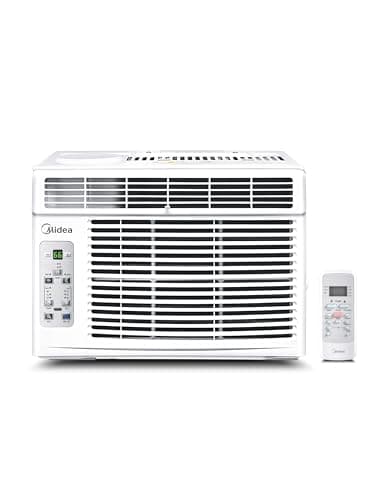
| 1 | Best overall for a short season Midea Window Air Conditioner, 5,000 BTU 5,000 BTU at CEER 14.4 in the lightest format that still removes heat — easy to fit, easy to lift out, cheap to own. | A bedroom that needs real cooling for a couple of weeks a year | |
| 2 | 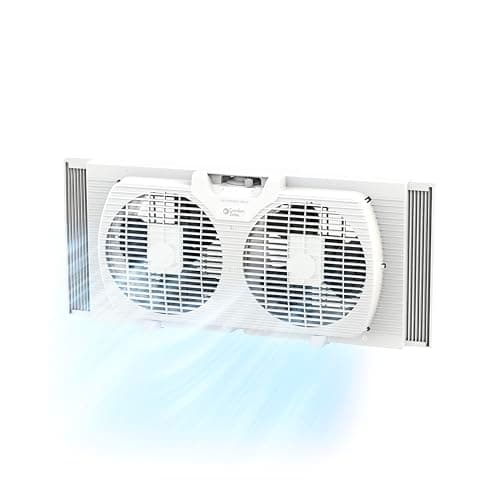 Buy this first, honestly Comfort Zone 9" Twin Window Fan A reversible twin window fan that exchanges indoor air for cooler outdoor air — for a fraction of the price and weight of any air conditioner. | Anyone whose hot nights are followed by cool ones | |
| 3 | 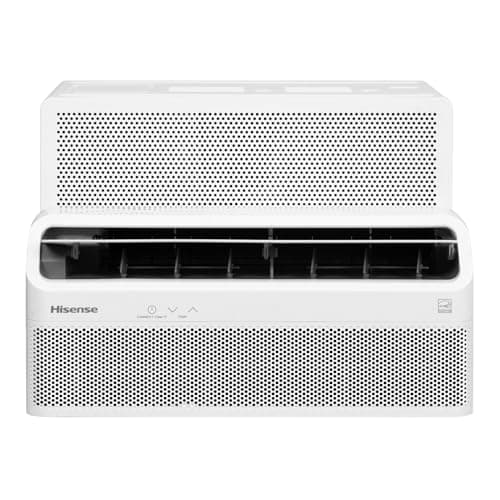 If the room is larger Hisense Window Air Conditioner, 8,000 BTU 8,000 BTU at CEER 15 and 400 certified kWh — enough capacity to pull a real room down quickly. | A living room or open-plan space during a short hot spell | |
| — | The one to skip for occasional use Whynter ARC-14S Dual Hose Portable Air Conditioner 73 lb of portable that still needs a window kit, at 9,500 BTU SACC from 1,300 W — the worst of both worlds for brief use. | Rooms where no window unit can be fitted at all |
What changes
Why the usual advice does not apply
Almost every buying guide optimizes for seasonal running cost, because that is what dominates when a unit runs from June to September. Run the same machine for two weeks and the priorities invert.
| Factor | All summer | Two weeks a year |
|---|---|---|
| Certified annual kWh | Decisive | Almost irrelevant |
| Purchase price | Amortized over use | The whole cost |
| Weight and bulk | Handled twice a year | Handled every time |
| Storage footprint | Minor | Major |
| Install effort | One afternoon | Repeated |
| Noise | Lived with | Endured briefly |
| Inverter compressor | Worth paying for | Hard to justify |
This one is not a DIY job
Storage
The eleven months that decide its life
A unit used occasionally spends most of its life in storage, and storage is what kills window air conditioners — not running hours. The failure modes are corrosion in the pan, seized fan bearings and perished seals, all of which come from damp.
- Drain it fully and run it on fan only for a few minutes before removing it, so the coil and pan are dry.
- Store it upright, indoors if possible, off a concrete floor.
- Cover it loosely rather than sealing it in plastic, which traps moisture against the metal.
- Keep the hardware together. Side panels, brackets and screws going missing is why the second summer is harder than the first.
The full method, including units that stay in the window, is in how to store a window air conditioner, and what actually ends these machines is in how long they last.
Before you buy
Two questions worth asking first
Do your nights cool off? If the outdoor temperature drops below indoor temperature for several hours, a window fan handles most short heat waves for a fraction of the money and none of the storage — the mechanism is in running a window fan on exhaust.
Is it one room or the house? Occasional use almost always means one room, usually a bedroom. Cooling that room properly for three weeks is a small, cheap project; trying to keep a whole house comfortable for the same three weeks is not.
Say the unwelcome thing
Do not buy an inverter model for two weeks a year.
Inverter compressors are genuinely better: quieter, steadier, more efficient. All three of those advantages are paid back over hundreds of hours of running, and a fortnight a year does not get you there.
Spend the difference on the smallest adequate unit and better storage. 5,000 BTU at CEER 14.4 is light enough to install alone, and a reversible twin window fan may cover most of those nights before the air conditioner is needed at all.
In full
Every pick, and what is wrong with it
Published specifications only, each linked to the page it came from. Where a manufacturer publishes nothing, the row says so — we do not fill blanks in.
1. Best overall for a short season
Midea Window Air Conditioner, 5,000 BTU
Midea · model MAW05R1VWWT-T
5,000 BTU at CEER 14.4 in the lightest format that still removes heat — easy to fit, easy to lift out, cheap to own.
The smallest true air conditioner is the right buy for brief use. It fits a standard sash window, one person can handle it, and it stores on a shelf rather than taking a corner of the garage.
Certified at 260.4 kWh a year, about $48 at 18.34¢/kWh — and across a fortnight rather than a season, a fraction of that.
Mechanical controls and a washable filter are an advantage here rather than a compromise: there is less to fail in a machine that spends eleven months unplugged.
What’s wrong with it
5,000 BTU covers about 150 sq ft, so a living room will defeat it — and it still has to come out and be stored each autumn.
Running cost — MAW05R1VWWT-T
| Annual energy use | 260.4 kWh | ENERGY STAR certified figure |
|---|---|---|
| Annual cost | $48 | 260.4 × 18.34¢/kWh |
| Per cooling month | $12 | spread over a four-month season |
The annual figure is the certified value from the ENERGY STAR Certified Room Air Conditioners dataset, which models a standard cooling season rather than your actual summer. It is more useful than a nameplate wattage here, because a variable-speed compressor spends most of its life well below nameplate.
Rate: 18.34¢/kWh, the US average residential price for June 2026 (EIA Electric Power Monthly, Table 5.3). Yours will differ — swap it in: (watts ÷ 1000) × hours × your rate.
| Cooling capacity | 5,000 BTU/h |
|---|---|
| CEER | 14.4 |
| Annual energy use | 260.4 kWh/yr |
| vs federal standard | 31% less energy |
| Dimensions | 12.1 H x 16.0 W x 13.3 D in |
| Weight | 30.2 lb |
| Installation | Does not straddle the windowsill |
| Support bracket | Not required |
| Compressor | Variable speed |
| Refrigerant | R-32 |
| ENERGY STAR | Certified (not on the Most Efficient list) |
Every figure above is from ENERGY STAR Certified Room Air Conditioners dataset. Blanks are shown as “not published” rather than filled in.
2. Buy this first, honestly
Comfort Zone 9" Twin Window Fan
Comfort Zone · model CZ319WT
A reversible twin window fan that exchanges indoor air for cooler outdoor air — for a fraction of the price and weight of any air conditioner.
For occasional heat in a climate where nights cool off, this is the honest first purchase. It replaces the room’s air rather than cooling it, which on most of those nights is enough.
It weighs a few pounds, fits openings from 22.25 inches, stores in a cupboard, and costs almost nothing to run. If it turns out not to be enough on the worst three nights, you have lost very little and can add an air conditioner then.
Comfort Zone publishes no airflow or wattage, so there is nothing to compare on paper — the format comparison is in twin versus single window fans.
What’s wrong with it
It can only deliver the air outside, so it does nothing on a humid night that stays warm — and it publishes no specifications at all.
Running cost
Comfort Zone does not publish a wattage for the CZ319WT, so we cannot calculate what it costs to run. We are not going to estimate one. If Comfort Zone publishes a nameplate figure, this block will show the arithmetic.
| Modes | Intake or exhaust, reversed by a manual control |
|---|---|
| Speeds | 2 |
| Blades | Two 9 in fans |
| Window fit | 22.25 - 33 in wide |
| Opening required | Not published |
| Air delivery | Not published |
| Power | Not published |
| Cover | Removable fabric cover |
| Warranty | 1 year |
Every figure above is from Comfort Zone product page, CZ319WT. Blanks are shown as “not published” rather than filled in.
3. If the room is larger
Hisense Window Air Conditioner, 8,000 BTU
Hisense · model AHW0823TW1W
8,000 BTU at CEER 15 and 400 certified kWh — enough capacity to pull a real room down quickly.
Occasional use has one requirement that steady use does not: the unit has to make a difference fast, because you are asking it to rescue a specific evening rather than hold a set point all summer.
8,000 BTU at CEER 15 does that in a normal living room, and the certified 400 kWh a year figure — $73 at 18.34¢/kWh — is for a full season, not a fortnight.
The cost of that capacity is weight and bulk, which matters more to you than to someone who installs once and leaves it until October.
What’s wrong with it
Heavier and bulkier to install and store, and oversized for a bedroom, where it will short-cycle.
Running cost — AHW0823TW1W
| Annual energy use | 400 kWh | ENERGY STAR certified figure |
|---|---|---|
| Annual cost | $73 | 400 × 18.34¢/kWh |
| Per cooling month | $18 | spread over a four-month season |
The annual figure is the certified value from the ENERGY STAR Certified Room Air Conditioners dataset, which models a standard cooling season rather than your actual summer. It is more useful than a nameplate wattage here, because a variable-speed compressor spends most of its life well below nameplate.
Rate: 18.34¢/kWh, the US average residential price for June 2026 (EIA Electric Power Monthly, Table 5.3). Yours will differ — swap it in: (watts ÷ 1000) × hours × your rate.
| Cooling capacity | 8,000 BTU/h |
|---|---|
| CEER | 15 |
| Annual energy use | 400 kWh/yr |
| vs federal standard | 38% less energy |
| Dimensions | 13.2 H x 18.5 W x 18.9 D in |
| Weight | 44.5 lb |
| Refrigerant | R-32 |
| Installation | Does not straddle the windowsill |
| Compressor | Variable speed |
| ENERGY STAR | Certified |
Every figure above is from ENERGY STAR Certified Room Air Conditioners dataset. Blanks are shown as “not published” rather than filled in.
Skip this one
Whynter ARC-14S Dual Hose Portable Air Conditioner
Whynter · model ARC-14S
73 lb of portable that still needs a window kit, at 9,500 BTU SACC from 1,300 W — the worst of both worlds for brief use.
Portables get bought for occasional use because they look like the low-commitment option. They are the opposite: the heaviest thing here, with a hose and window kit to fit each time and a tank or drain to manage while it runs.
They are also the least efficient format, at roughly 7.3 BTU per watt-hour. Over a fortnight that costs little, but it buys nothing either — the window unit is cheaper, lighter and better.
The genuine case for a portable is a window that cannot take a unit. If that is your situation, it is the right buy and the portable page is the place to start.
What’s wrong with it
73 lb, a hose and window kit to install every time, condensate to manage, and the lowest efficiency of any format here.
Running cost — ARC-14S
| Nameplate power | 1300 W | manufacturer's published figure |
|---|---|---|
| Energy, 8-hour night | 10.40 kWh | 1300 ÷ 1000 × 8 |
| Cost per hour | 24¢ | at 18.34¢/kWh |
| Cost per 8-hour night | $1.91 | on the highest speed |
| Cost per 30 nights | $57 | 312.0 kWh |
Rate: 18.34¢/kWh, the US average residential price for June 2026 (EIA Electric Power Monthly, Table 5.3). Yours will differ — swap it in: (watts ÷ 1000) × hours × your rate.
| Marketing capacity | 14,000 BTU (ASHRAE-128) |
|---|---|
| DOE-rated capacity | 9,500 BTU SACC |
| Hoses | Dual |
| Power | 1,300 W / 11.6 A at 115 V |
| Noise | Under 51 dBA low, under 56 dBA high |
| Dehumidification | 71 pints/day |
| Refrigerant | R-32 |
| Dimensions | 16 W x 19 D x 35.5 H in |
| Weight | 73 lb |
| Manufacturer coverage claim | 500 sq ft |
| Warranty | 1 year unit, 3 years compressor |
Every figure above is from Whynter product page, ARC-14S. Blanks are shown as “not published” rather than filled in.
We are not linking a buy button for this one. If you want to look at it anyway, it is easy enough to find — but we would rather send you to something that fits your room.
Questions people actually ask
Frequently asked
What air conditioner should I buy if I only need it a few weeks a year?
The smallest one that suits the room, in the lightest format you can install alone. Certified efficiency barely matters across a fortnight — the difference between the best and worst 5,000 BTU units is a couple of dollars a season.
Is a portable air conditioner good for occasional use?
Rarely. It is the heaviest format, it still needs a window kit fitted each time, it has condensate to manage, and it is the least efficient. Its only real advantage is working where no window unit fits.
Does efficiency matter if the unit barely runs?
Not much. Certified annual figures assume a full cooling season, so two weeks of use makes the gap between models negligible. Buy on weight, size, storage and price instead.
How should I store a window air conditioner between summers?
Dry it first by running fan-only for a few minutes, store it upright and indoors off a concrete floor, cover it loosely rather than sealing it in plastic, and keep the panels and brackets with it. Storage, properly.
Could a fan handle a short heat wave instead?
Often, if your nights cool off. A reversible window fan exchanges indoor air for cooler outdoor air, which genuinely lowers room temperature, for a fraction of the price and none of the storage burden. Window fans, ranked.
Sources
Where these numbers came from
Read next
Where to go from here
Back to Air Conditioners, or read how we pick.