Guide and picks
Cooling a living room
The distinguishing feature is not the size. It is that several people are in it at once, and they do not agree.
By Sawyer V. · Published
The short answer
A living room is large, shared, and occupied in the evening — and all three point the same way. A ceiling fan covers everyone from above at 1.5 to 6.0 watts on low, where a directional fan only serves whoever it points at. Evening use also means outdoor air is cooling, so ventilation works. If you need actual cooling, size it from the room — living rooms are usually the largest space in the house.
Fan & Frost earns a commission when you buy through our links, at no cost to you. It never changes a ranking, and we say so when the right answer is the cheaper unit or nothing at all. Full disclosure · How we pick.

At a glance
The picks, ranked
Tap any row to jump to the full reasoning. Prices are live from Amazon where we have them, and read “check price” where we don’t — never a number we cannot verify today.
| # | Product | Best for | Price |
|---|---|---|---|
| 1 | 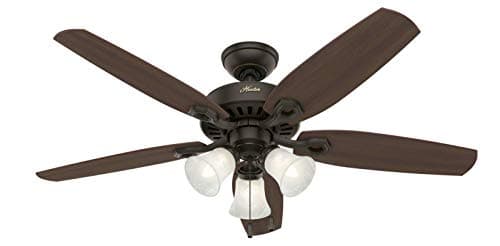 Best overall for a living room Hunter Vespucci 52" Ceiling Fan 366.7 CFM per watt on 13.9 W, and 1.8 W on low — a 52-inch span that covers a sofa without pointing at anyone. | A normal living room where several people want to be comfortable | |
| 2 | Best if you cannot install anything Lasko Aria 40" Smart Wi-Fi Tower Fan 460 CFM with 90 degrees of oscillation and app scheduling — it can start before you sit down. | A rented living room, or one where scheduling matters | |
| 3 | 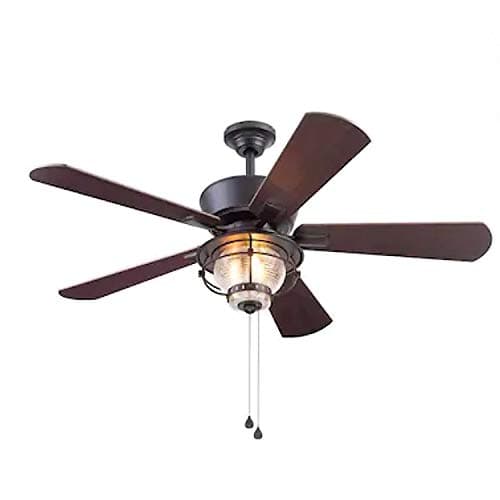 For a large or open-plan room Harbor Breeze Cando 84" Ceiling Fan 422.2 CFM per watt on 30.6 W — the most efficient certified fan at an 84-inch span, at the span a big room needs. | A great room, a vaulted ceiling, or a knocked-through space | |
| — | The expensive way to do this Whynter ARC-14S Dual Hose Portable Air Conditioner 1,300 W and 9,500 BTU SACC from a 14,000 BTU headline, with the compressor in the room with you. | A living room with no window that takes a unit — and little else |
A living room has three properties that no other room on this site combines, and together they change the answer.
What makes it different
Shared, large, and used in the evening
Several people at once. This is the decisive one. A bedroom has one or two people in fixed positions; an office has one. A living room has a sofa, a chair, someone on the floor, and no agreement about temperature.
A directional fan serves whoever it is pointed at and nobody else. Oscillating it shares the same airflow across an arc, so everyone gets it intermittently instead of one person getting it continuously — which is better here and worse almost everywhere else. The trade in detail.
A ceiling fan sidesteps the problem entirely. Mounted centrally it circulates the whole room, so everyone gets some benefit and nobody sits in a jet.
It is usually the largest room. Which matters for sizing: living rooms are where undersized equipment is bought because the number that worked in the bedroom got reused.
It is used in the evening. Uniquely useful, because outdoor air is falling then. Ventilation genuinely works in a living room in a way it does not in a home office at 2pm.
Timing
The evening advantage
Most living room use starts a couple of hours before sunset and continues into the night — which is exactly the window where outdoor air becomes cooler than indoor air.
That makes the free approach genuinely effective here:
- Shade the glass all afternoon. Living rooms tend to have the most glazing in the house, and solar gain through it is usually the largest heat input. Close blinds on the sun side before the sun arrives, not after.
- Keep it shut while outdoor air is hotter. Opening windows at 4pm imports heat.
- Open up once the outdoor temperature drops below indoor, typically a couple of hours after sunset. Two openings on opposite sides beat one, because the air needs a way out.
- Run the ceiling fan through all of it at 0.2¢ an evening.
The full no-cost method, and where to place a fan for each of these jobs.
Running cost
What the options actually cost an evening
| Option | Power | 6-hour evening |
|---|---|---|
| Ceiling fan, low | 1.8 W | 0.2¢ |
| Ceiling fan, high | 13.9 W | 1.5¢ |
| 84-inch ceiling fan, high | 30.6 W | 3.4¢ |
| Tower fan, high | 52 W | 5.7¢ |
| Evaporative cooler | 220 W | 24¢ |
| Portable air conditioner | 1,300 W | $1.43 |
Ceiling fan wattage certified; others from manufacturer pages. A certified window air conditioner is rated in annual kWh rather than watts — the most efficient 8,000 BTU unit uses 375 kWh a year, about $69 for a whole season.
The spread across that table is roughly 720 times from top to bottom. In a room used most evenings for a whole summer, that is the number worth thinking about before anything else.
This one is not a DIY job
Size a ceiling fan to the room, not to the ceiling. Blade tips want at least 18 inches of clearance from the nearest wall and at least 7 feet from the floor. In a living room the wall clearance is usually what binds — a 52-inch fan needs roughly 88 inches of clear width to sit centered.
Ceiling height decides the mount. Under about eight feet, use a flush-mount hugger. Above nine feet, use a downrod so the fan hangs into the occupied zone where its air movement is useful.
Bigger is genuinely better where it fits. Certified data runs 242.3 CFM per watt at 42 inches against 422.2 at 84 — the largest fan is 74% more efficient than the smallest, because a bigger disc moves the same air more slowly.
If you need cooling
Sizing for the biggest room in the house
If shade, ventilation and airflow are not enough, a living room needs proper sizing — and this is the room where people most often reuse a number that worked somewhere smaller.
Size from the room, not from the last unit you bought. Then apply the adjustments: more capacity for a very sunny room, more for the number of people regularly in it, and less for a heavily shaded one. The ENERGY STAR method.
Resist rounding up. An oversized unit reaches temperature quickly, shuts off before it has removed moisture, and leaves a large room cold and clammy — the complaint that sends people back for a third machine. Why that happens.
For a genuinely large living room, the 14,000 to 18,000 BTU certified options are here.
Say the unwelcome thing
Do not put a portable air conditioner in a living room if a window unit will fit.
It is the room where a portable’s drawbacks land hardest, on three counts at once.
The compressor is in the room. In a space built around conversation or a television, a cycling compressor a few feet away is the wrong place for it.
It occupies floor space in the room where floor space is most contested, plus a hose across it to a window.
It costs $1.43 an evening against 0.2¢ for a ceiling fan on low, and it delivers 9,500 BTU from a 14,000 BTU headline.
If the window takes a unit, use one. If it genuinely cannot, venting it properly is the difference between usable and not.
In full
Every pick, and what is wrong with it
Published specifications only, each linked to the page it came from. Where a manufacturer publishes nothing, the row says so — we do not fill blanks in.
1. Best overall for a living room
Hunter Vespucci 52" Ceiling Fan
Hunter · model Vespucci
366.7 CFM per watt on 13.9 W, and 1.8 W on low — a 52-inch span that covers a sofa without pointing at anyone.
366.7 CFM per watt certified, and the reason it suits this room specifically is coverage rather than efficiency.
A ceiling fan mounted centrally sets up a circulation pattern across the whole room. Everyone gets some benefit and nobody is in a directed draft — which matters more here than anywhere else, because a living room is the room where people disagree about temperature.
1.8 W on low is 0.2¢ for a six-hour evening. At that level the question of whether to run it does not arise.
52 inches is the right span for most living rooms. Larger rooms want more.
What’s wrong with it
No light kit, and it is an electrical installation, so it is not an option in most rentals.
Running cost — Vespucci
| Nameplate power | 1.8 W – 13.9 W | manufacturer's published figure |
|---|---|---|
| Energy, 8-hour night | 0.11 kWh | 13.9 ÷ 1000 × 8 |
| Cost per hour | 0.3¢ | at 18.34¢/kWh |
| Cost per 8-hour night | 2.0¢ | on the highest speed |
| Cost per 30 nights | 61¢ | 3.3 kWh |
| Same month, lowest speed | 7.9¢ | at 1.8 W |
Rate: 18.34¢/kWh, the US average residential price for June 2026 (EIA Electric Power Monthly, Table 5.3). Yours will differ — swap it in: (watts ÷ 1000) × hours × your rate.
| Blade span | 52 in |
|---|---|
| Efficiency | 366.7 CFM per watt |
| Power, high speed | 13.9 W |
| Power, low speed | 1.8 W |
| Standby power | 0.8 W |
| Type | Indoor, fan only (no light kit) |
| Warranty | 3 years, components |
| ENERGY STAR | Certified |
Every figure above is from ENERGY STAR Certified Ceiling Fans dataset. Blanks are shown as “not published” rather than filled in.
2. Best if you cannot install anything
Lasko Aria 40" Smart Wi-Fi Tower Fan
Lasko · model T40733
460 CFM with 90 degrees of oscillation and app scheduling — it can start before you sit down.
The scheduling is the genuine argument, and it is specific to this room. A living room is occupied on a predictable evening pattern, so a fan that starts twenty minutes before you sit down is solving the problem at the right moment.
Alexa, Google Assistant or the Aria app. 460 CFM on 41 to 52 W — about 5.7¢ for a six-hour evening at full power.
90 degrees of oscillation is the right arc for a sofa from a corner: three seats covered without anybody sitting in a constant draft.
31.5 dBA low, 48.7 high. The high setting is audible over a television, so plan on running it low with the room occupied.
What’s wrong with it
41 to 52 W against a ceiling fan's 13.9, and 48.7 dBA on high competes with a television.
Running cost — T40733
| Nameplate power | 41 W – 52 W | manufacturer's published figure |
|---|---|---|
| Energy, 8-hour night | 0.42 kWh | 52 ÷ 1000 × 8 |
| Cost per hour | 1.0¢ | at 18.34¢/kWh |
| Cost per 8-hour night | 7.6¢ | on the highest speed |
| Cost per 30 nights | $2.29 | 12.5 kWh |
| Same month, lowest speed | $1.80 | at 41 W |
Rate: 18.34¢/kWh, the US average residential price for June 2026 (EIA Electric Power Monthly, Table 5.3). Yours will differ — swap it in: (watts ÷ 1000) × hours × your rate.
| Power | 41 W - 52 W (0.3-0.44 A at 120 V) |
|---|---|
| Air delivery | 460 CFM |
| Noise | 31.5 dBA low, 48.7 dBA high |
| Speeds | 5 |
| Smart control | Aria for Home app (iOS/Android), Amazon Alexa, Google Assistant |
| Height | 39.58 in |
| Footprint | 11.2 x 11.2 in |
| Weight | 9.5 lb |
| Timer | 9 hours |
| Oscillation | 90 degrees |
| Remote | Not included |
| Warranty | 2 years |
Every figure above is from Lasko product page, T40733. Blanks are shown as “not published” rather than filled in.
3. For a large or open-plan room
Harbor Breeze Cando 84" Ceiling Fan
Harbor Breeze · model 84" Cando
422.2 CFM per watt on 30.6 W — the most efficient certified fan at an 84-inch span, at the span a big room needs.
422.2 CFM per watt, and the efficiency is not the main reason to want it in a big room — the coverage is.
Certified data shows ceiling fan efficiency scales with span: 242.3 CFM per watt at 42 inches against 422.2 at 84. A large fan moves the same air more slowly, and slow air movement is disproportionately cheap.
30.6 W on high — 3.4¢ for a six-hour evening — and 6.0 W on low. Less power than the tower fan above, for far more air.
Check clearance before committing: blade tips want at least 18 inches from any wall, and at least 7 feet from the floor. Sizing detail.
What’s wrong with it
An 84-inch span needs the ceiling height and the wall clearance, which most standard living rooms do not have.
Running cost — 84" Cando
| Nameplate power | 6 W – 30.6 W | manufacturer's published figure |
|---|---|---|
| Energy, 8-hour night | 0.24 kWh | 30.6 ÷ 1000 × 8 |
| Cost per hour | 0.6¢ | at 18.34¢/kWh |
| Cost per 8-hour night | 4.5¢ | on the highest speed |
| Cost per 30 nights | $1.35 | 7.3 kWh |
| Same month, lowest speed | 26¢ | at 6 W |
Rate: 18.34¢/kWh, the US average residential price for June 2026 (EIA Electric Power Monthly, Table 5.3). Yours will differ — swap it in: (watts ÷ 1000) × hours × your rate.
| Blade span | 84 in |
|---|---|
| Efficiency | 422.2 CFM per watt |
| Power, high speed | 30.6 W |
| Power, low speed | 6.0 W |
| Type | Outdoor ceiling fan |
| ENERGY STAR | Certified |
Every figure above is from ENERGY STAR Certified Ceiling Fans dataset. Blanks are shown as “not published” rather than filled in.
Skip this one
Whynter ARC-14S Dual Hose Portable Air Conditioner
Whynter · model ARC-14S
1,300 W and 9,500 BTU SACC from a 14,000 BTU headline, with the compressor in the room with you.
Portables end up in living rooms because they need no installation, and it is the room where they suit least.
1,300 W — $1.43 for a six-hour evening — against 0.2¢ for a ceiling fan on low. And the capacity is smaller than the box says: 9,500 BTU SACC from a 14,000 BTU headline, a 32.1% haircut.
The compressor is in the room, cycling, at under 51 dBA on low by the manufacturer’s own figure. In a room built around listening to something, that is the wrong place for it.
If the window will take a unit, use a window unit. If it genuinely will not, that case is covered here.
What’s wrong with it
It occupies floor space in the room where floor space is most contested, and it is audible during anything you are watching.
Running cost — ARC-14S
| Nameplate power | 1300 W | manufacturer's published figure |
|---|---|---|
| Energy, 8-hour night | 10.40 kWh | 1300 ÷ 1000 × 8 |
| Cost per hour | 24¢ | at 18.34¢/kWh |
| Cost per 8-hour night | $1.91 | on the highest speed |
| Cost per 30 nights | $57 | 312.0 kWh |
Rate: 18.34¢/kWh, the US average residential price for June 2026 (EIA Electric Power Monthly, Table 5.3). Yours will differ — swap it in: (watts ÷ 1000) × hours × your rate.
| Marketing capacity | 14,000 BTU (ASHRAE-128) |
|---|---|
| DOE-rated capacity | 9,500 BTU SACC |
| Hoses | Dual |
| Power | 1,300 W / 11.6 A at 115 V |
| Noise | Under 51 dBA low, under 56 dBA high |
| Dehumidification | 71 pints/day |
| Refrigerant | R-32 |
| Dimensions | 16 W x 19 D x 35.5 H in |
| Weight | 73 lb |
| Manufacturer coverage claim | 500 sq ft |
| Warranty | 1 year unit, 3 years compressor |
Every figure above is from Whynter product page, ARC-14S. Blanks are shown as “not published” rather than filled in.
We are not linking a buy button for this one. If you want to look at it anyway, it is easy enough to find — but we would rather send you to something that fits your room.
Questions people actually ask
Frequently asked
What is the best way to cool a living room?
A ceiling fan, because a living room is shared. It circulates the whole room from above so everyone gets some benefit and nobody sits in a directed draft — and certified models run on 1.5 to 6.0 watts on low, so it can simply stay on.
What size ceiling fan for a living room?
52 inches suits most, and larger is genuinely better where it fits — certified data runs 242.3 CFM per watt at 42 inches against 422.2 at 84. Blade tips need at least 18 inches of wall clearance, so a 52-inch fan wants about 88 inches of clear width.
Should a living room fan oscillate?
Here, usually yes — it is one of the few rooms where oscillation helps. Several people at once means sharing the airflow across an arc serves everyone intermittently, which beats one person getting it continuously. What oscillation does.
When should I open the windows in a living room?
Once outdoor air drops below indoor temperature, typically a couple of hours after sunset — which happens to coincide with when living rooms are used. Keep everything shut and shaded through the afternoon, and use two openings on opposite sides rather than one.
How much does it cost to cool a living room?
The spread is enormous. A ceiling fan on low is a fraction of a cent for a six-hour evening; a portable air conditioner at 1,300 W is roughly 720 times that. A certified 8,000 BTU window unit uses 375 kWh for a whole season.
Why is my living room air conditioner leaving the room clammy?
It is oversized. Moisture only condenses out while the compressor runs, so a unit that reaches temperature in a few minutes and stops removes very little. Living rooms are where this happens most, because people round the capacity up. Sizing properly.
Sources
Where these numbers came from
Read next
Where to go from here
Back to Room Cooling, or read how we pick.