Guide and picks
What size fan do I need? The CFM arithmetic
Fans are not sized in BTU, because they remove no heat. They are sized in air changes — and that is a different, much simpler calculation.
By Sawyer V. · Published
The short answer
Room volume (L × W × ceiling height) × air changes per hour ÷ 60 = CFM needed. Use about 15–20 air changes for a room you are circulating, and 30–40 for a space you are ventilating through an open door. A 12×14 bedroom with an 8 ft ceiling needs roughly 340–450 CFM.
Fan & Frost earns a commission when you buy through our links, at no cost to you. It never changes a ranking, and we say so when the right answer is the cheaper unit or nothing at all. Full disclosure · How we pick.
At a glance
The picks, ranked
Tap any row to jump to the full reasoning. Prices are live from Amazon where we have them, and read “check price” where we don’t — never a number we cannot verify today.
| # | Product | Best for | Price |
|---|---|---|---|
| 1 | 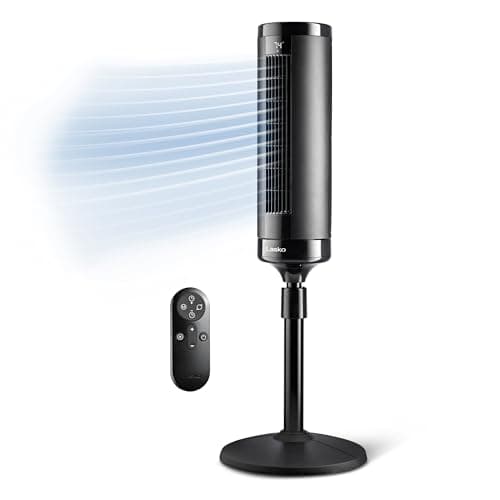 For a bedroom, where sizing barely matters Lasko EcoQuiet 42" DC Tower Fan In a bedroom the fan is aimed at a person, not the room — which makes 23 dBA and 2.9 W more useful specifications than any CFM figure. | Any room up to about 250 sq ft, if you are in the airstream | |
| 2 |  When you do want the room moving Lasko Wind Curve 42" Tower Fan 720 CFM published — enough for about 20 air changes an hour in a 300 sq ft room with an 8 ft ceiling. | A living room of roughly 250-400 sq ft | |
| 3 | For ventilating rather than circulating Lasko Twin Window Fan with Remote 560 CFM through a window is a different job from 560 CFM inside the room — this one changes the temperature. | Exchanging a room's air with cooler outdoor air | |
| 4 | Where sizing is actually published properly Visual Comfort Kingston 72" LED Ceiling Fan 385 CFM per watt certified — the one fan category where airflow is measured to a common standard you can size against. | A large room you own, with a high ceiling |
Air conditioners are sized in BTU because they remove heat. Fans remove no heat, so BTU is meaningless for them — you size a fan by how many times per hour it can turn over the air in a space.
The formula
Air changes per hour
Room volume (cubic feet) × air changes per hour ÷ 60 = CFM required
Three steps:
- Volume. Length × width × ceiling height, in feet. A 12 × 14 room with an 8 ft ceiling is 1,344 cubic feet.
- Pick an air-change target. Roughly 15–20 per hour to circulate a room you are sitting in; 30–40 to ventilate a space with a door or window open, such as a garage.
- Divide by 60 to get cubic feet per minute. 1,344 × 20 ÷ 60 = 448 CFM.
| Room | Volume | Circulate (20 ACH) | Ventilate (35 ACH) |
|---|---|---|---|
| 10 × 12 bedroom, 8 ft | 960 cu ft | 320 CFM | 560 CFM |
| 12 × 14 bedroom, 8 ft | 1,344 cu ft | 448 CFM | 784 CFM |
| 14 × 16 living room, 8 ft | 1,792 cu ft | 597 CFM | 1,045 CFM |
| 16 × 20 living room, 9 ft | 2,880 cu ft | 960 CFM | 1,680 CFM |
| 20 × 20 garage, 9 ft | 3,600 cu ft | 1,200 CFM | 2,100 CFM |
| 24 × 24 great room, 10 ft | 5,760 cu ft | 1,920 CFM | 3,360 CFM |
Our arithmetic. Air-change targets are working rules of thumb for comfort ventilation, not a manufacturer or code specification.
The catch
Most fans do not publish a CFM figure
Having given you the formula, here is the honest problem with using it: the input is frequently unavailable.
There is no certification program and no common test procedure for portable fans. Ceiling fans have one — ENERGY STAR publishes certified CFM per watt — but for tower, box, pedestal and floor fans, publishing airflow is optional and most brands decline.
| Fan | Published airflow |
|---|---|
| Lasko 2554 tower | 720 CFM |
| Lasko W09550 window fan | Up to 560 CFM |
| Lasko Aria T40733 smart tower | 460 CFM |
| Lasko YF300 misting tower | 276 CFM |
| Air King 9145 clip-on | Up to 190 CFM |
| Lasko T42710 DC tower | Not published |
| Lasko B20801 box fan | Not published |
| Lasko A12107 table fan | Not published |
| Lasko S18931 pedestal | Not published (1,200 ft/min velocity) |
| Vornado 630 / 683 | Not published (70/75 ft reach) |
Note the last two rows especially. “1,200 feet per minute” is a velocity at the outlet and “up to 70 feet” is a distance — neither is a volume, and neither converts into CFM without an outlet area that is also unpublished. You cannot size a room with either.
Say the unwelcome thing
Do not size a fan from a 'covers up to X square feet' claim.
Fan listings routinely carry a coverage figure. There is no test procedure behind it, and more fundamentally a fan does not cool an area — it moves air across the skin of whoever is in the stream. A fan in an empty room accomplishes nothing, so “coverage” is describing something that does not happen.
We found the same pattern proven elsewhere in this category: every Honeywell evaporative cooler’s square-footage claim is just its CFM divided by 1.64, the same constant across a thirteen-fold range of models. Coverage claims are arithmetic dressed as measurement.
When it matters
When to size properly, and when not to bother
Sizing matters when you are trying to change what the room does: ventilating a garage, exhausting a hot upstairs, or picking a ceiling fan for a great room. Airflow has to be adequate to the volume, and undersizing is why a small unit in a big space feels like nothing.
Sizing barely matters for a personal fan. If the fan is two feet from you and aimed at you, almost any airflow is enough — and the specifications that actually decide your experience are noise and speed count. A 12 W clip-on at close range beats a 102 W box fan across the room, and that has nothing to do with CFM.
The place to be rigorous is the ceiling fan, because it is the only category where the data supports rigor. Match blade span to room area, and use the certified CFM-per-watt figure to choose between fans of the same size — the sizing table and the rankings are here.
And if what you actually need is a temperature change rather than air movement, fan sizing is the wrong calculation entirely. Size an air conditioner in BTU instead — a different formula, and one with an official table behind it.
In full
Every pick, and what is wrong with it
Published specifications only, each linked to the page it came from. Where a manufacturer publishes nothing, the row says so — we do not fill blanks in.
1. For a bedroom, where sizing barely matters
Lasko EcoQuiet 42" DC Tower Fan
Lasko · model T42710
In a bedroom the fan is aimed at a person, not the room — which makes 23 dBA and 2.9 W more useful specifications than any CFM figure.
The honest answer for most bedrooms is that CFM sizing does not apply, because you are not trying to turn over the room’s air — you are moving air across one person.
For that job the specifications that matter are noise and power: 23 dBA and 2.9 W on low, and twelve speeds so you can sit on the setting that is just enough. 13¢ for a month of eight-hour nights.
What’s wrong with it
Lasko publishes no CFM for it at all, so you cannot size a room from it. You are buying on noise and power, which for a personal fan is the right basis anyway.
Running cost — T42710
| Nameplate power | 2.9 W – 19 W | manufacturer's published figure |
|---|---|---|
| Energy, 8-hour night | 0.15 kWh | 19 ÷ 1000 × 8 |
| Cost per hour | 0.3¢ | at 18.34¢/kWh |
| Cost per 8-hour night | 2.8¢ | on the highest speed |
| Cost per 30 nights | 84¢ | 4.6 kWh |
| Same month, lowest speed | 13¢ | at 2.9 W |
Rate: 18.34¢/kWh, the US average residential price for June 2026 (EIA Electric Power Monthly, Table 5.3). Yours will differ — swap it in: (watts ÷ 1000) × hours × your rate.
| Power | 2.9 W - 19 W (0.06-0.303 A at 120 V) |
|---|---|
| Noise | 23 dBA low, 46 dBA high |
| Speeds | 12 |
| Height | 41.6 in |
| Footprint | 12.8 x 12.8 in |
| Weight | 7.8 lb |
| Timer | 8 hours |
| Air delivery (CFM) | Not published |
| Warranty | 2 years |
Every figure above is from Lasko product page, T42710. Blanks are shown as “not published” rather than filled in.
2. When you do want the room moving
Lasko Wind Curve 42" Tower Fan
Lasko · model 2554
720 CFM published — enough for about 20 air changes an hour in a 300 sq ft room with an 8 ft ceiling.
720 CFM is the only published airflow figure among the portable fans we cover, which makes it the only one you can actually size a room with.
Run the arithmetic: a 300 sq ft room with an 8 ft ceiling is 2,400 cubic feet. At 720 CFM that is 720 × 60 ÷ 2,400 = 18 air changes an hour — comfortably inside the 15–20 band for circulation.
What’s wrong with it
37-49 W and no published noise figure. A tower's soft wide column also dissipates quickly, so the CFM figure overstates what reaches the far end of a long room.
Running cost — 2554
| Nameplate power | 37 W – 49 W | manufacturer's published figure |
|---|---|---|
| Energy, 8-hour night | 0.39 kWh | 49 ÷ 1000 × 8 |
| Cost per hour | 0.9¢ | at 18.34¢/kWh |
| Cost per 8-hour night | 7.2¢ | on the highest speed |
| Cost per 30 nights | $2.16 | 11.8 kWh |
| Same month, lowest speed | $1.63 | at 37 W |
Rate: 18.34¢/kWh, the US average residential price for June 2026 (EIA Electric Power Monthly, Table 5.3). Yours will differ — swap it in: (watts ÷ 1000) × hours × your rate.
| Power | 37 W - 49 W (0.4 A at 120 V) |
|---|---|
| Air delivery | 720 CFM |
| Speeds | 3 |
| Height | 42.5 in |
| Footprint | 13 x 13 in |
| Weight | 10.62 lb |
| Timer | 7.5-hour auto-off |
| Noise | Not published |
| Warranty | 1 year |
Every figure above is from Lasko product page, 2554. Blanks are shown as “not published” rather than filled in.
3. For ventilating rather than circulating
Lasko Twin Window Fan with Remote
Lasko · model W09550
560 CFM through a window is a different job from 560 CFM inside the room — this one changes the temperature.
Sizing for ventilation uses a higher air-change target than sizing for circulation, because you are replacing the air rather than stirring it. 30–40 changes an hour is the working range.
Up to 560 CFM on 22–31 W. In a 2,400 cubic foot bedroom that is 14 changes an hour — good for circulation, modest for a full air exchange, which is why you pair it with a second opening on the other side of the house. The method is here.
What’s wrong with it
Only works once the outdoor air is genuinely cooler than indoor, and fits windows 24-32 inches wide.
Running cost — W09550
| Nameplate power | 22 W – 31 W | manufacturer's published figure |
|---|---|---|
| Energy, 8-hour night | 0.25 kWh | 31 ÷ 1000 × 8 |
| Cost per hour | 0.6¢ | at 18.34¢/kWh |
| Cost per 8-hour night | 4.5¢ | on the highest speed |
| Cost per 30 nights | $1.36 | 7.4 kWh |
| Same month, lowest speed | 97¢ | at 22 W |
Rate: 18.34¢/kWh, the US average residential price for June 2026 (EIA Electric Power Monthly, Table 5.3). Yours will differ — swap it in: (watts ÷ 1000) × hours × your rate.
| Power | 22 W - 31 W at 120 V |
|---|---|
| Air delivery | Up to 560 CFM |
| Window fit | 24 - 32 in wide |
| Modes | Intake, exhaust or exchange (independent motors) |
| Thermostat | Adjustable |
| Speeds | 3 |
| Dimensions | 12.9 H x 24.0 W x 4.9 D in |
| Weight | 8.0 lb |
| Warranty | 1 year |
Every figure above is from Lasko product page, W09550. Blanks are shown as “not published” rather than filled in.
4. Where sizing is actually published properly
Visual Comfort Kingston 72" LED Ceiling Fan
Visual Comfort & Co. · model Kingston 72 LED
385 CFM per watt certified — the one fan category where airflow is measured to a common standard you can size against.
Ceiling fans are the only category with certified airflow data, and it is why sizing them is straightforward: ENERGY STAR publishes CFM per watt and per-speed wattage for every certified model.
27.8 W on high at 385 CFM/W implies roughly 10,700 CFM — an order of magnitude beyond any portable fan, which is what a 600+ sq ft great room actually needs. Blade-span sizing by room area is here.
What’s wrong with it
72 inches needs genuine space and 7 ft of blade clearance, and it is a permanent wired installation.
Running cost — Kingston 72 LED
| Nameplate power | 4.1 W – 27.8 W | manufacturer's published figure |
|---|---|---|
| Energy, 8-hour night | 0.22 kWh | 27.8 ÷ 1000 × 8 |
| Cost per hour | 0.5¢ | at 18.34¢/kWh |
| Cost per 8-hour night | 4.1¢ | on the highest speed |
| Cost per 30 nights | $1.22 | 6.7 kWh |
| Same month, lowest speed | 18¢ | at 4.1 W |
Rate: 18.34¢/kWh, the US average residential price for June 2026 (EIA Electric Power Monthly, Table 5.3). Yours will differ — swap it in: (watts ÷ 1000) × hours × your rate.
| Blade span | 72 in |
|---|---|
| Efficiency | 385.0 CFM per watt |
| Power, high speed | 27.8 W |
| Power, low speed | 4.1 W |
| Standby power | 1.2 W |
| Type | Indoor, with light kit |
| Warranty | 3 years, components |
| ENERGY STAR | Certified |
Every figure above is from ENERGY STAR Certified Ceiling Fans dataset. Blanks are shown as “not published” rather than filled in.
Questions people actually ask
Frequently asked
How many CFM do I need for a room?
Multiply room volume in cubic feet by air changes per hour and divide by 60. Use roughly 15 to 20 air changes to circulate a room you are sitting in, and 30 to 40 to ventilate a space with a door or window open. A 12 by 14 bedroom with an 8 ft ceiling needs about 450 CFM to circulate.
How do you size a fan?
By air changes, not BTU — fans remove no heat, so BTU is meaningless for them. Work out the room's volume, choose an air-change target for circulating or ventilating, and divide by 60 to get the CFM you need.
Why do most fans not list CFM?
There is no certification program or common test procedure for portable fans, so publishing airflow is optional and most brands decline. Ceiling fans are the exception: ENERGY STAR publishes certified CFM per watt for every certified model.
Is 'covers up to 500 square feet' a useful fan spec?
No. There is no test procedure behind coverage claims, and a fan does not cool an area at all — it moves air across the skin of whoever is in the stream. In the evaporative cooler category we found every coverage claim was simply CFM divided by a fixed constant.
Does a bigger fan always mean better cooling?
Not for a personal fan. If it is aimed at you from a couple of feet away, almost any airflow is enough, and noise and speed count matter far more. Size matters when you are changing what the room does — ventilating a garage or picking a ceiling fan for a large space.
What size ceiling fan do I need?
42 to 48 inches for 75 to 175 sq ft, 52 to 56 inches for 175 to 350 sq ft, and 60 inches or more above 450 sq ft. Where you fall between sizes go larger — a bigger fan on a lower speed is quieter and more efficient than a small one working hard. The full sizing table.
Sources
Where these numbers came from
Read next
Where to go from here
Back to Fans, or read how we pick.