The picks
The best window air conditioners for large rooms
Above 14,000 BTU, efficiency normally collapses and weight becomes a structural question. Four certified units hold CEER 16 anyway, and one drops to 12.7.
By Sawyer V. · Published
The short answer
The Friedrich Kühl KCVM14B10B leads on efficiency: 14,100 BTU at CEER 16.2, 652.8 kWh a year (about $120). For the lightest install at that capacity, the Midea MAW14V1KYWT-S is 56.9 lb against the Friedrich’s 70. Only go past 14,000 BTU if you have genuinely measured the space.
Fan & Frost earns a commission when you buy through our links, at no cost to you. It never changes a ranking, and we say so when the right answer is the cheaper unit or nothing at all. Full disclosure · How we pick.
At a glance
The picks, ranked
Tap any row to jump to the full reasoning. Prices are live from Amazon where we have them, and read “check price” where we don’t — never a number we cannot verify today.
| # | Product | Best for | Price |
|---|---|---|---|
| 1 | Best efficiency at 14,000 BTU Friedrich Kuhl Window Air Conditioner, 14,100 BTU CEER 16.2 is the highest we found at this capacity — 51% below the federal standard, at 652.8 kWh a year. | 550-700 sq ft, where running cost over a season matters | |
| 2 | 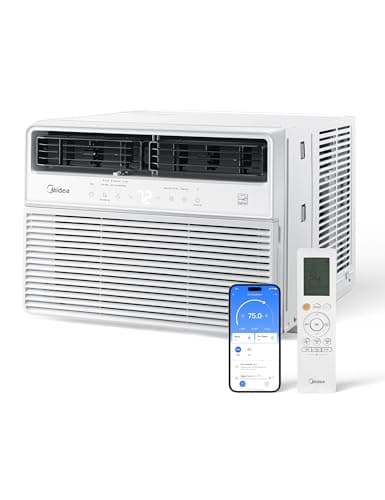 Lightest at 14,000 BTU Midea Window Air Conditioner, 14,000 BTU 56.9 lb and it does not straddle the sill — 13 lb lighter than the Friedrich for the same 656 kWh a year. | A large room where the install has to be manageable | |
| 3 | Best above 14,000 BTU Brothers Window Air Conditioner, 18,000 BTU 18,000 BTU while still holding CEER 16 — the only unit we found that does not give up efficiency to get there. | 700-1,000 sq ft, genuinely measured | |
| 4 | 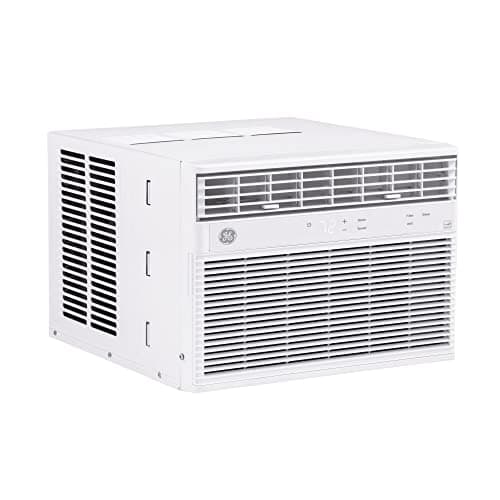 Best documented at this size GE Profile ClearView Window Air Conditioner, 14,000 BTU CEER 16 and Most Efficient listed, from a manufacturer whose dimensions and mounting type are fully published. | 550-700 sq ft, from a brand with a service network | |
| — | 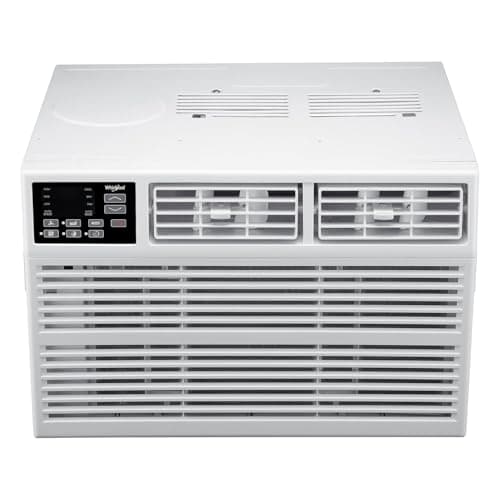 The one to skip Whirlpool Window Air Conditioner, 24,000 BTU CEER 12.7 and 1,417 kWh a year — the efficiency collapse this page exists to help you avoid. | 1,400-1,500 sq ft, which is not one room |
Two things change once you go past about 12,000 BTU, and neither is obvious from a product listing: efficiency usually falls, and weight stops being an inconvenience and becomes a structural question.
First
Check you actually need this much
More capacity is not a safety margin. It is the most expensive mistake available in this category, and it is worse in comfort terms than buying slightly too little.
| Room area (sq ft) | Capacity needed (BTU/h) |
|---|---|
| 100 up to 150 | 5,000 |
| 150 up to 250 | 6,000 |
| 250 up to 300 | 7,000 |
| 300 up to 350 | 8,000 |
| 350 up to 400 | 9,000 |
| 400 up to 450 | 10,000 |
| 450 up to 550 | 12,000 |
| 550 up to 700 | 14,000 |
Source: ENERGY STAR, Room Air Conditioners. ENERGY STAR notes the capacities “are calculated based on an 8-foot ceiling.” The full chart, with the adjustments.
14,000 BTU is a 550–700 sq ft machine and 18,000 BTU is 700–1,000. Rooms that size are almost always open-plan, which means you have to measure the whole connected volume — and add 4,000 BTU if a kitchen is part of it, which is ENERGY STAR’s own adjustment and the one people most often skip.
If your arithmetic came out under 12,000, you are on the wrong page. The general window AC roundup covers 6,000 to 14,000, and the sizing walkthrough is here.
The pattern
Efficiency falls as capacity rises — except in these
| Unit | BTU | CEER | kWh/yr | Cost/yr | Weight |
|---|---|---|---|---|---|
| Friedrich KCVM14B10B | 14,100 | 16.2 | 652.8 | $120 | 70.0 lb |
| GE Profile PWJV14W | 14,000 | 16 | 656.3 | $120 | 70.1 lb |
| Midea MAW14V1KYWT-S | 14,000 | 16 | 656.3 | $120 | 56.9 lb |
| Brothers 102387 | 18,000 | 16 | 843.8 | $155 | 94.4 lb |
| Whirlpool WHAW-241IN | 24,000 | 12.7 | 1417.3 | $260 | 115.7 lb |
CEER, kWh and weight from the ENERGY STAR certified dataset; costs are our arithmetic at 18.34¢/kWh.
The four units above 14,000 BTU that hold CEER 16 are doing so with variable-speed compressors, which modulate output rather than cycling hard on and off. That is where most of the efficiency comes from, and it is worth insisting on at this capacity.
The other constraint
Weight, and the mounting type nobody reads
The certified dataset records whether a unit straddles the windowsill, and at this size it matters more than anywhere else in the range.
A unit that straddles hangs a substantial part of its mass outside the building, cantilevered on the sill. At 70 lb that needs a support bracket; at 115 lb it needs a bracket and a look at local rules, since many municipalities restrict window units above the ground floor.
A unit that does not straddle sits inside the opening. It is easier to install, far easier to get past a landlord, and it puts no load outside — which is why the 56.9 lb Midea is the pick for anyone who has to do this themselves.
Practical thresholds:
- Under 60 lb — two people, no drama.
- 60–80 lb — two capable people and a bracket. Do not attempt alone.
- Over 90 lb — bracket, three people or proper lifting help, and check your local code first.
The installation guide covers the sequence and the sealing.
Say the unwelcome thing
Do not solve a large room with one oversized unit by default.
Above about 18,000 BTU the window-unit answer stops being the good one. Efficiency falls, weight becomes a structural problem, and a single unit in a big open space cools unevenly — the far corner stays warm while the near one is cold.
Two smaller units frequently beat one large one in a long or L-shaped space: better distribution, each one lighter to install, and two CEER-16 machines instead of one CEER-12.7. And in a room you own, a mini-split is more efficient than any window unit and puts nothing in the window at all.
Also worth knowing
Check the circuit before you buy
At this capacity, current draw becomes a real consideration. A large window unit on an older shared circuit — with a fridge, a microwave, or a high-draw appliance on the same run — can trip a breaker repeatedly.
Some units above 15,000 BTU require a dedicated circuit, and a few (like the 23,500 BTU LG in the certified data) run on 208/230 V rather than standard 115 V, which needs a different outlet entirely. Check the electrical requirements on the specific model before ordering, and never run any air conditioner on an extension cord.
In full
Every pick, and what is wrong with it
Published specifications only, each linked to the page it came from. Where a manufacturer publishes nothing, the row says so — we do not fill blanks in.
1. Best efficiency at 14,000 BTU
Friedrich Kuhl Window Air Conditioner, 14,100 BTU
Friedrich · model KCVM14B10B
CEER 16.2 is the highest we found at this capacity — 51% below the federal standard, at 652.8 kWh a year.
CEER 16.2 at 14,100 BTU is genuinely unusual. Efficiency normally falls as capacity rises — the 24,000 BTU unit further down manages 12.7 — and holding above 16 at this size is the best result in the certified data we pulled.
652.8 kWh a year is about $120 at 18.34¢/kWh for an entire cooling season. Put that beside a 1,300 W portable, which costs roughly $57 for a single month of overnight running.
The catch is physical. 17.9 × 25.9 × 29.0 inches and 70 lb, and it straddles the windowsill — the mounting type that hangs weight outside the building. That is a two-person install, a support bracket, and a look at your local code if you are above the ground floor.
What’s wrong with it
It straddles the windowsill, which is the mounting type most leases object to and the one that usually needs a support bracket. At 29 inches deep it also protrudes a long way outside.
Running cost — KCVM14B10B
| Annual energy use | 652.8 kWh | ENERGY STAR certified figure |
|---|---|---|
| Annual cost | $120 | 652.8 × 18.34¢/kWh |
| Per cooling month | $30 | spread over a four-month season |
The annual figure is the certified value from the ENERGY STAR Certified Room Air Conditioners dataset, which models a standard cooling season rather than your actual summer. It is more useful than a nameplate wattage here, because a variable-speed compressor spends most of its life well below nameplate.
Rate: 18.34¢/kWh, the US average residential price for June 2026 (EIA Electric Power Monthly, Table 5.3). Yours will differ — swap it in: (watts ÷ 1000) × hours × your rate.
| Cooling capacity | 14,100 BTU/h |
|---|---|
| CEER | 16.2 |
| Annual energy use | 652.8 kWh/yr |
| vs federal standard | 51% less energy |
| Dimensions | 17.9 H x 25.9 W x 29.0 D in |
| Weight | 70.0 lb |
| Refrigerant | R-32 |
| Installation | Straddles the windowsill |
| Compressor | Variable speed |
| ENERGY STAR | Certified |
Every figure above is from ENERGY STAR Certified Room Air Conditioners dataset. Blanks are shown as “not published” rather than filled in.
2. Lightest at 14,000 BTU
Midea Window Air Conditioner, 14,000 BTU
Midea · model MAW14V1KYWT-S
56.9 lb and it does not straddle the sill — 13 lb lighter than the Friedrich for the same 656 kWh a year.
656.3 kWh a year, about $120 — within a rounding error of the Friedrich, for 13 fewer pounds.
The specification that decides it is the mounting type: does not straddle the windowsill. The unit sits inside the opening rather than hanging out of it, which means no bracket in most cases, far less objection from a landlord, and nothing cantilevered over whatever is below.
14.7 × 21.7 × 19.0 inches is also considerably more compact than the Friedrich’s 29-inch depth. In a window with awkward trim or a security grille outside, that is the difference between fitting and not.
What’s wrong with it
CEER 16 against the Friedrich's 16.2 costs you a few kWh a year, and Midea publishes no noise figure. Nothing in the certified dataset does.
Running cost — MAW14V1KYWT-S
| Annual energy use | 656.3 kWh | ENERGY STAR certified figure |
|---|---|---|
| Annual cost | $120 | 656.3 × 18.34¢/kWh |
| Per cooling month | $30 | spread over a four-month season |
The annual figure is the certified value from the ENERGY STAR Certified Room Air Conditioners dataset, which models a standard cooling season rather than your actual summer. It is more useful than a nameplate wattage here, because a variable-speed compressor spends most of its life well below nameplate.
Rate: 18.34¢/kWh, the US average residential price for June 2026 (EIA Electric Power Monthly, Table 5.3). Yours will differ — swap it in: (watts ÷ 1000) × hours × your rate.
| Cooling capacity | 14,000 BTU/h |
|---|---|
| CEER | 16 |
| Annual energy use | 656.3 kWh/yr |
| vs federal standard | 50% less energy |
| Dimensions | 14.7 H x 21.7 W x 19.0 D in |
| Weight | 56.9 lb |
| Refrigerant | R-32 |
| Installation | Does not straddle the windowsill |
| Compressor | Variable speed |
| ENERGY STAR | Certified |
Every figure above is from ENERGY STAR Certified Room Air Conditioners dataset. Blanks are shown as “not published” rather than filled in.
3. Best above 14,000 BTU
Brothers Window Air Conditioner, 18,000 BTU
Brothers · model 102387
18,000 BTU while still holding CEER 16 — the only unit we found that does not give up efficiency to get there.
18,000 BTU at CEER 16, 843.8 kWh a year, 50% below the federal standard. About $155 at 18.34¢/kWh.
18,000 BTU serves 700–1,000 sq ft on the ENERGY STAR table, which is a genuinely large open-plan floor rather than a room. If your measurement landed here, double-check that you measured the whole connected volume rather than one part of it — and add the 4,000 BTU kitchen adjustment if a kitchen is in that space.
It does not straddle the sill, which helps, but 94.4 lb is the number to plan around. That is a support bracket, two capable people, and a check of whatever your municipality says about window units above ground level.
What’s wrong with it
94.4 lb. That is past comfortable two-person territory and firmly into bracket-and-check-your-code. Also a brand most people will not recognize, so you are buying purely on the certified data.
Running cost — 102387
| Annual energy use | 843.8 kWh | ENERGY STAR certified figure |
|---|---|---|
| Annual cost | $155 | 843.8 × 18.34¢/kWh |
| Per cooling month | $39 | spread over a four-month season |
The annual figure is the certified value from the ENERGY STAR Certified Room Air Conditioners dataset, which models a standard cooling season rather than your actual summer. It is more useful than a nameplate wattage here, because a variable-speed compressor spends most of its life well below nameplate.
Rate: 18.34¢/kWh, the US average residential price for June 2026 (EIA Electric Power Monthly, Table 5.3). Yours will differ — swap it in: (watts ÷ 1000) × hours × your rate.
| Cooling capacity | 18,000 BTU/h |
|---|---|
| CEER | 16 |
| Annual energy use | 843.8 kWh/yr |
| vs federal standard | 50% less energy |
| Dimensions | 17.9 H x 25.4 W x 23.6 D in |
| Weight | 94.4 lb |
| Refrigerant | R-32 |
| Installation | Does not straddle the windowsill |
| Compressor | Variable speed |
| ENERGY STAR | Certified |
Every figure above is from ENERGY STAR Certified Room Air Conditioners dataset. Blanks are shown as “not published” rather than filled in.
4. Best documented at this size
GE Profile ClearView Window Air Conditioner, 14,000 BTU
GE Profile · model PWJV14W
CEER 16 and Most Efficient listed, from a manufacturer whose dimensions and mounting type are fully published.
The GE Profile is on the ENERGY STAR Most Efficient list rather than merely certified, which is a narrower distinction than CEER alone.
656.3 kWh a year, about $120. 15.1 × 20.2 × 21.3 inches, does not straddle the sill, variable-speed compressor, R-32.
It appears in our general window AC roundup as the large-room pick, and it earns the place here for the same reason: at 14,000 BTU it gives up nothing to the smaller units in its own family.
What’s wrong with it
70.1 lb, the same weight class as the Friedrich, and its 656.3 kWh a year is marginally behind the Friedrich's 652.8.
Running cost — PWJV14W
| Annual energy use | 656.3 kWh | ENERGY STAR certified figure |
|---|---|---|
| Annual cost | $120 | 656.3 × 18.34¢/kWh |
| Per cooling month | $30 | spread over a four-month season |
The annual figure is the certified value from the ENERGY STAR Certified Room Air Conditioners dataset, which models a standard cooling season rather than your actual summer. It is more useful than a nameplate wattage here, because a variable-speed compressor spends most of its life well below nameplate.
Rate: 18.34¢/kWh, the US average residential price for June 2026 (EIA Electric Power Monthly, Table 5.3). Yours will differ — swap it in: (watts ÷ 1000) × hours × your rate.
| Cooling capacity | 14,000 BTU/h |
|---|---|
| CEER | 16 |
| Annual energy use | 656.3 kWh/yr |
| vs federal standard | 50% less energy |
| Dimensions | 15.1 H x 20.2 W x 21.3 D in |
| Weight | 70.1 lb |
| Refrigerant | R-32 |
| Installation | Does not straddle the windowsill |
| Compressor | Variable speed |
| ENERGY STAR | Certified, and on the Most Efficient list |
Every figure above is from ENERGY STAR Certified Room Air Conditioners dataset. Blanks are shown as “not published” rather than filled in.
Skip this one
Whirlpool Window Air Conditioner, 24,000 BTU
Whirlpool · model WHAW-241IN
CEER 12.7 and 1,417 kWh a year — the efficiency collapse this page exists to help you avoid.
This is what the top of the capacity range normally looks like, and it is why the four units above are worth seeking out.
CEER 12.7 against 16.2, and 1,417.3 kWh a year — about $260, against $120 for the Friedrich. You are paying roughly $140 more every year.
And 24,000 BTU serves 1,400–1,500 sq ft — most of a small house. In one room it short-cycles, never dehumidifies properly, and leaves the space cold and clammy. At that capacity you should be pricing two smaller units or a mini-split rather than hanging 115.7 lb out of a window.
What’s wrong with it
115.7 lb straddling the window, and more than double the annual energy of the 14,000 BTU units above for capacity almost nobody's single room needs.
Running cost — WHAW-241IN
| Annual energy use | 1417.3 kWh | ENERGY STAR certified figure |
|---|---|---|
| Annual cost | $260 | 1417.3 × 18.34¢/kWh |
| Per cooling month | $65 | spread over a four-month season |
The annual figure is the certified value from the ENERGY STAR Certified Room Air Conditioners dataset, which models a standard cooling season rather than your actual summer. It is more useful than a nameplate wattage here, because a variable-speed compressor spends most of its life well below nameplate.
Rate: 18.34¢/kWh, the US average residential price for June 2026 (EIA Electric Power Monthly, Table 5.3). Yours will differ — swap it in: (watts ÷ 1000) × hours × your rate.
| Cooling capacity | 24,000 BTU/h |
|---|---|
| CEER | 12.7 |
| Annual energy use | 1,417.3 kWh/yr |
| vs federal standard | 35% less energy |
| Dimensions | 20.7 H x 30.0 W x 28.8 D in |
| Weight | 115.7 lb |
| Refrigerant | R-32 |
| Installation | Straddles the window; support bracket territory |
| ENERGY STAR | Certified |
Every figure above is from ENERGY STAR Certified Room Air Conditioners dataset. Blanks are shown as “not published” rather than filled in.
We are not linking a buy button for this one. If you want to look at it anyway, it is easy enough to find — but we would rather send you to something that fits your room.
Questions people actually ask
Frequently asked
What size window air conditioner do I need for a large room?
14,000 BTU covers 550 to 700 sq ft and 18,000 BTU covers 700 to 1,000, per the ENERGY STAR table. Add 4,000 BTU if a kitchen is part of the space, and measure the whole connected volume if the room is open-plan. The sizing walkthrough.
What is the most efficient large window air conditioner?
The Friedrich Kuhl KCVM14B10B at CEER 16.2 and 652.8 kWh a year is the best we found at 14,000 BTU. At 18,000 BTU the Brothers 102387 holds CEER 16, which is unusual — efficiency normally falls as capacity rises.
How much does a 14,000 BTU window air conditioner cost to run?
Around 652 to 656 kWh a year for the certified units here, which is about $120 at 18.34¢/kWh for a whole cooling season. A 1,300 W portable of nominally similar capacity costs roughly $57 for one month of overnight running.
Do large window air conditioners need a support bracket?
Usually, and it depends on weight and whether the unit straddles the windowsill. Under 60 lb is generally fine without one; 60 to 80 lb wants a bracket; over 90 lb needs a bracket plus a check of local rules, since many municipalities restrict heavy window units above ground level.
Is one big air conditioner better than two smaller ones?
Often not, above about 18,000 BTU. Two smaller units distribute air better in a long or open-plan space, each is far easier to install, and you can get two CEER-16 machines instead of one CEER-12.7 — the efficiency collapse at the top of the range is real.
Do large window units need a dedicated circuit?
Some do above roughly 15,000 BTU, and a few large models run on 208/230 V rather than standard 115 V, needing a different outlet entirely. Check the electrical requirements for the specific model before ordering, and never use an extension cord.
Sources
Where these numbers came from
Read next
Where to go from here
Back to Air Conditioners, or read how we pick.