Guide and picks
How loud is a fan?
Two different scales, two different meanings, and three whole categories where nobody publishes a number at all.
By Sawyer V. · Published
The short answer
Published figures on this site run from 23 dBA for a DC tower fan on low to 65 dBA for an evaporative cooler. Ventilating fans use a different scale — sones, from 0.1 to 2.8 — and sones are linear where decibels are logarithmic. Three categories publish nothing at all: certified ceiling fans, window air conditioners, and most box and pedestal fans.
Fan & Frost earns a commission when you buy through our links, at no cost to you. It never changes a ranking, and we say so when the right answer is the cheaper unit or nothing at all. Full disclosure · How we pick.
At a glance
The picks, ranked
Tap any row to jump to the full reasoning. Prices are live from Amazon where we have them, and read “check price” where we don’t — never a number we cannot verify today.
| # | Product | Best for | Price |
|---|---|---|---|
| 1 | 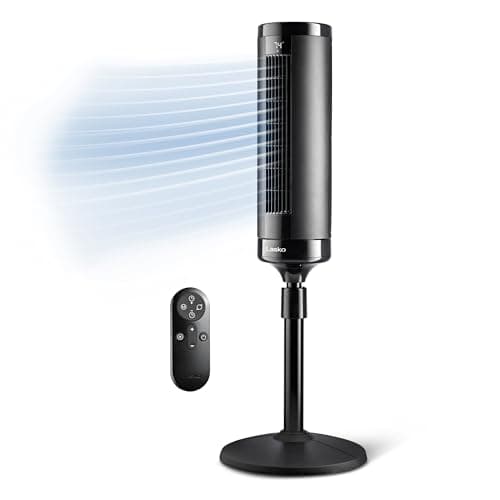 Quietest published figure on the site Lasko EcoQuiet 42" DC Tower Fan 23 dBA on low, rising to 46 on high — the lowest published number of any product we hold data for. | A bedroom, where the absolute floor matters | |
| 2 | 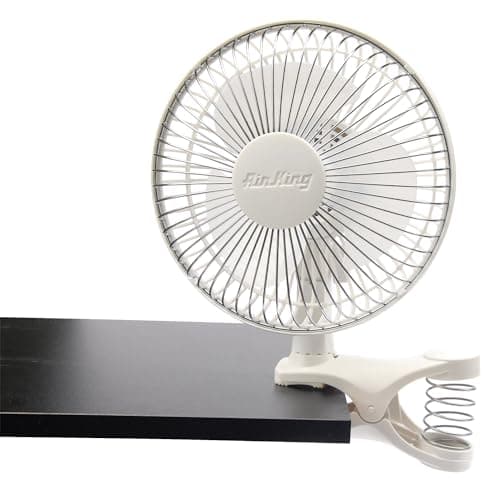 Steadiest across its range Air King 6" Commercial Grade Clip-On Fan 34 dBA low, 37 dBA high — a three-decibel spread, the narrowest of any fan we hold figures for. | A desk or a room where the sound must not change | |
| 3 | 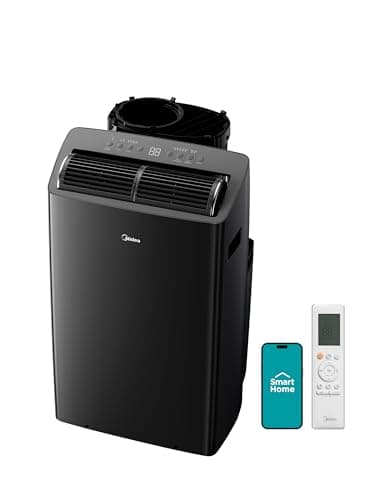 Quietest portable air conditioner published Midea Duo Smart Inverter Portable Air Conditioner 43 dBA — the lowest published figure of any portable air conditioner we hold data for. | A room where a compressor has to live with you | |
| — | The loud end of the published range Honeywell CO60PM Indoor/Outdoor Evaporative Cooler 61 to 65 dBA at 2,697 CFM — the loudest published figure on this site, and appropriate for where it belongs. | A patio or garage, where 65 dBA does not matter |
Noise is the specification people care about most and the one this industry publishes least consistently. Two different scales, and three categories with no figure at all.
Everything published
The complete picture
| Product | Low | High | Scale |
|---|---|---|---|
| Panasonic FV-0511VK3 vent fan | 0.1 | 0.1 | sones, certified |
| Ortech ODD-70-1 vent fan | 0.4 | 0.4 | sones, certified |
| Broan Premium 150 vent fan | 1.4 | 1.4 | sones, certified |
| Range hood category median | 1.5 | 1.5 | sones, certified |
| Lasko EcoQuiet T42710 tower | 23 | 46 | dBA, manufacturer |
| Lasko Aria T40733 tower | 31.5 | 48.7 | dBA, manufacturer |
| Air King 9145 clip-on | 34 | 37 | dBA, manufacturer |
| Lasko Whirlwind A12107 table | 39 | 55 | dBA, manufacturer |
| Midea Duo portable AC | 43 | — | dBA, manufacturer |
| Whynter ARC-14S portable AC | under 51 | under 56 | dBA, manufacturer |
| Honeywell CL25AE evaporative | 52 | 60 | dBA, manufacturer |
| Honeywell CO60PM evaporative | 61 | 65 | dBA, manufacturer |
Sone figures from the ENERGY STAR Certified Ventilating Fans dataset; dBA figures from manufacturer product pages. The two scales are not convertible.
The trap
Sones are linear. Decibels are not.
This is the single most consequential misreading in the category, because the two scales invite opposite intuitions.
Sones are linear against perceived loudness. Two sones sounds twice as loud as one sone. Four sounds four times as loud. No arithmetic required.
Decibels are logarithmic. A 3 dB difference is a small perceived change; roughly 10 dB is a doubling.
So a jump from 0.1 to 1.4 sones is a fourteenfold increase in perceived loudness. A jump from 23 to 46 dBA is roughly a fourfold one, despite looking like a much bigger number.
People carry decibel intuition to sones and badly underestimate what they are reading — then wonder why the “only slightly louder” bathroom fan is unbearable.
This one is not a DIY job
Three categories publish no noise figure at all.
Certified ceiling fans. The ENERGY STAR dataset records CFM per watt, wattage by speed, span, warranty and connectivity — and no acoustic field. All 1,398 US records.
Window air conditioners. Not one of the 485 certified room air conditioners publishes a noise rating. The program records capacity, CEER, annual kWh, dimensions and weight only.
In-line duct fans. The sone field reads “N/A” across the entire category, which is defensible — an in-line fan has no fixed relationship to a room — but it means every quiet claim on one is a manufacturer’s.
In those categories you are choosing on architecture instead. For an air conditioner that means a variable-speed compressor that modulates rather than cycling, and a U-shape that puts the compressor outside a closed window.
Reading a figure
Four things a dBA number does not tell you
- At what distance. Sound falls off sharply with distance, and manufacturers rarely state the measurement point. A figure taken at ten feet is not comparable to one taken at three.
- Under what conditions. There is no certification program for portable fans or portable air conditioners, so test conditions are whatever the brand chose. Figures are comparable within a brand and only indicative across brands.
- What it sounds like. A clean broadband rush at 45 dBA is far easier to live with than a bearing whine at 35. Tonal noise attracts attention; featureless noise does not.
- Whether it changes. A fan that steps between speeds, or a compressor that cycles, produces changes — and changes are what people notice. This is why the three-decibel spread matters.
Practical
Making a fan quieter without buying one
Run it slower. The largest single change available. A DC fan drops from 46 to 23 dBA between high and low, and from 19 W to 2.9 W with it.
Move it further away. Sound falls off with distance, so a fan across the room on a higher setting can be quieter at your ear than a nearer one on low — while still moving useful air.
Clean it. Uneven dust loading on the blades introduces a per-revolution beat, which is structured sound and far more noticeable than a clean rush at the same level. The procedure.
Check what it is standing on. A fan on a resonant surface — a hollow floor, a thin desk, a cabinet — transmits vibration into it. A mat or a different surface can make more difference than a speed setting.
Stop it oscillating. A sweeping head modulates the sound slowly, which is exactly the structure that keeps you noticing it.
Say the unwelcome thing
Do not compare a sone figure against a dBA figure.
They are different measurements on different scales and there is no simple conversion between them, however much it looks like there should be.
A 0.1-sone bathroom fan and a 23 dBA tower fan are both very quiet, and nothing about those two numbers tells you which is quieter. They were measured differently, at different distances, under different procedures — one certified, one not.
Compare sones against sones within the ventilating fan category, where the figures are certified and genuinely comparable. Compare dBA against dBA cautiously, and preferably within a single brand.
And in the categories that publish nothing — ceiling fans, window air conditioners — accept that you are choosing on architecture and reputation, not on a number.
In full
Every pick, and what is wrong with it
Published specifications only, each linked to the page it came from. Where a manufacturer publishes nothing, the row says so — we do not fill blanks in.
1. Quietest published figure on the site
Lasko EcoQuiet 42" DC Tower Fan
Lasko · model T42710
23 dBA on low, rising to 46 on high — the lowest published number of any product we hold data for.
23 dBA. Nothing else on this site publishes lower, and the DC motor is why — AC motors do not run quietly or efficiently at low speed.
The spread matters as much as the floor. 23 dBA low, 46 dBA high is a 23-decibel range, so the quiet figure describes one specific setting rather than the fan in general.
Twelve speeds means you can actually sit near the bottom of that range and still get useful airflow, which a three-speed fan cannot offer.
The gap: no published CFM, so there is no way to compare its noise against its airflow.
What’s wrong with it
A 23-decibel spread means the figure only applies on its lowest setting, and Lasko publishes no CFM to set against it.
Running cost — T42710
| Nameplate power | 2.9 W – 19 W | manufacturer's published figure |
|---|---|---|
| Energy, 8-hour night | 0.15 kWh | 19 ÷ 1000 × 8 |
| Cost per hour | 0.3¢ | at 18.34¢/kWh |
| Cost per 8-hour night | 2.8¢ | on the highest speed |
| Cost per 30 nights | 84¢ | 4.6 kWh |
| Same month, lowest speed | 13¢ | at 2.9 W |
Rate: 18.34¢/kWh, the US average residential price for June 2026 (EIA Electric Power Monthly, Table 5.3). Yours will differ — swap it in: (watts ÷ 1000) × hours × your rate.
| Power | 2.9 W - 19 W (0.06-0.303 A at 120 V) |
|---|---|
| Noise | 23 dBA low, 46 dBA high |
| Speeds | 12 |
| Height | 41.6 in |
| Footprint | 12.8 x 12.8 in |
| Weight | 7.8 lb |
| Timer | 8 hours |
| Air delivery (CFM) | Not published |
| Warranty | 2 years |
Every figure above is from Lasko product page, T42710. Blanks are shown as “not published” rather than filled in.
2. Steadiest across its range
Air King 6" Commercial Grade Clip-On Fan
Air King · model 9145
34 dBA low, 37 dBA high — a three-decibel spread, the narrowest of any fan we hold figures for.
The specification nobody markets. Three decibels between its quietest and loudest settings, against 23 for the EcoQuiet.
That matters in two situations. On a video call, changing background noise defeats noise suppression in a way constant noise does not. And for sound masking, the brain habituates to constant sound and registers any change as an event.
9 to 12 W and up to 190 CFM, ETL listed and OSHA compliant.
Note that a narrow spread is not the same as quiet. This fan is never as quiet as a good tower fan on low; it is simply always the same.
What’s wrong with it
34 dBA is well above the quietest fans here, so it is steady rather than quiet.
Running cost — 9145
| Nameplate power | 9 W – 12 W | manufacturer's published figure |
|---|---|---|
| Energy, 8-hour night | 0.10 kWh | 12 ÷ 1000 × 8 |
| Cost per hour | 0.2¢ | at 18.34¢/kWh |
| Cost per 8-hour night | 1.8¢ | on the highest speed |
| Cost per 30 nights | 53¢ | 2.9 kWh |
| Same month, lowest speed | 40¢ | at 9 W |
Rate: 18.34¢/kWh, the US average residential price for June 2026 (EIA Electric Power Monthly, Table 5.3). Yours will differ — swap it in: (watts ÷ 1000) × hours × your rate.
| Power | 9 W - 12 W (0.1-0.2 A at 120 V) |
|---|---|
| Air delivery | Up to 190 CFM |
| Noise | 34 dBA low, 37 dBA high |
| Speeds | 2 |
| Mounting | Spring-loaded clip, non-marking |
| Dimensions | 10.38 H x 6.25 L x 8.13 W in |
| Weight | 2.22 lb |
| Cord | 6 ft, 3-conductor |
| Listing | ETL listed, OSHA compliant |
| Warranty | 1 year |
Every figure above is from Air King product page, 9145 (via Lasko). Blanks are shown as “not published” rather than filled in.
3. Quietest portable air conditioner published
Midea Duo Smart Inverter Portable Air Conditioner
Midea · model MAP14S1TBL
43 dBA — the lowest published figure of any portable air conditioner we hold data for.
43 dBA is genuinely good for a machine with a compressor in the room, and it is a single figure rather than a range — which tells you less than a range would.
For context, compressors are the noise problem that fans do not have. A fan makes broadband airflow noise; a compressor cycles, which is a change, and changes are what people notice.
12,000 BTU SACC from a 14,000 BTU headline — a 14.3% haircut, the smallest we found.
The gaps: no published wattage, and no certification program covers portables, so nothing here is independently tested.
What’s wrong with it
Midea publishes no wattage at all, and there is no certification program for portables to verify any of it.
Running cost
Midea does not publish a wattage for the MAP14S1TBL, so we cannot calculate what it costs to run. We are not going to estimate one. If Midea publishes a nameplate figure, this block will show the arithmetic.
| Marketing capacity | 14,000 BTU |
|---|---|
| DOE-rated capacity | 12,000 BTU SACC |
| Hoses | Dual |
| Noise | 43 dBA |
| Speeds | 3 |
| Refrigerant | R-32 |
| Dimensions | 19.52 W x 16.73 D x 32.48 H in |
| Weight | 74.96 lb |
| Manufacturer coverage claim | 550 sq ft |
| Power | Not published (115 V stated, no wattage) |
| Warranty | 1 year |
Every figure above is from Midea product page, MAP14S1TBL. Blanks are shown as “not published” rather than filled in.
Skip this one
Honeywell CO60PM Indoor/Outdoor Evaporative Cooler
Honeywell · model CO60PM
61 to 65 dBA at 2,697 CFM — the loudest published figure on this site, and appropriate for where it belongs.
Included to mark the top of the range. 61 to 65 dBA is loud enough that you raise your voice over it.
It is also moving 2,697 CFM on 220 W with a 30-foot throw, which is a genuinely large amount of air. Noise and airflow are related, and a quiet machine moving this much air is not available.
The lesson is about context rather than the product. 65 dBA outdoors on a patio is fine. The same figure in a bedroom is unusable.
The quieter indoor options trade airflow for it.
What’s wrong with it
65 dBA competes with conversation. This is not a fault; it is a machine moving a lot of air.
Running cost — CO60PM
| Nameplate power | 220 W | manufacturer's published figure |
|---|---|---|
| Energy, 8-hour night | 1.76 kWh | 220 ÷ 1000 × 8 |
| Cost per hour | 4.0¢ | at 18.34¢/kWh |
| Cost per 8-hour night | 32¢ | on the highest speed |
| Cost per 30 nights | $9.68 | 52.8 kWh |
Rate: 18.34¢/kWh, the US average residential price for June 2026 (EIA Electric Power Monthly, Table 5.3). Yours will differ — swap it in: (watts ÷ 1000) × hours × your rate.
| Air delivery | 2,697 CFM |
|---|---|
| Power | 220 W |
| Water tank | 15.9 gallons, continuous hookup |
| Air throw | 30 ft |
| Noise | 61-65 dBA |
| Speeds | 3, with oscillation |
| Pads | Triple-sided honeycomb |
| Dimensions | 27.6 W x 18.3 D x 40 H in |
| Weight | 39.2 lb |
| Manufacturer coverage claim | 1,643 sq ft |
| Warranty | 1 year |
Every figure above is from Honeywell Air Comfort product page, CO60PM. Blanks are shown as “not published” rather than filled in.
We are not linking a buy button for this one. If you want to look at it anyway, it is easy enough to find — but we would rather send you to something that fits your room.
Questions people actually ask
Frequently asked
How many decibels is a quiet fan?
23 dBA on low is the quietest published figure we hold, from a DC tower fan. Manufacturer dBA figures across this site run from 23 to 65, but they are not certified and test distances are rarely stated.
Are sones the same as decibels?
No, and confusing them is the most consequential misreading in the category. Sones are linear — two sones is twice as loud as one — while decibels are logarithmic, where roughly 10 dB is a doubling.
How loud is a ceiling fan?
Nobody publishes a figure. The ENERGY STAR certified ceiling fan dataset records CFM per watt, wattage, span, warranty and connectivity across all 1,398 US records — and no acoustic field at all.
How loud are window air conditioners?
Not one of the 485 certified units publishes a noise rating; the program does not measure it. Choose on architecture instead — a variable-speed compressor that modulates rather than cycling, and a U-shape that puts the compressor outside a closed window.
How do I make a fan quieter?
Run it slower — a DC fan drops from 46 to 23 dBA between high and low. Then move it further away, clean the blades so dust does not create a per-revolution beat, check what it is standing on, and stop it oscillating. Cleaning a fan.
Why does a fan with a good dBA rating still bother me?
Usually because the sound changes or has structure. A clean broadband rush at 45 dBA is easier to live with than a bearing whine at 35, and a fan that steps between speeds or oscillates produces changes — which is what people notice.
Sources
Where these numbers came from
- ENERGY STAR Certified Ventilating Fans dataset — sone ratings by unit type, and the absent field for in-line fans
- ENERGY STAR Certified Ceiling Fans dataset — the absence of any acoustic field across 1,398 records
- ENERGY STAR Certified Room Air Conditioners dataset — the absence of any noise rating across 485 records
- Lasko, Air King, Midea, Whynter and Honeywell product pages — the published dBA figures
Read next
Where to go from here
Back to Fans, or read how we pick.