The picks
Best ceiling fans for small rooms
There is a measurable cost to buying a small ceiling fan, and almost nobody mentions it. Once you know the size of it, the choice gets easier.
By Sawyer V. · Published
The short answer
The Hunter Martindale 44-inch is the pick — 304.5 CFM per watt on 10.1 W, the best efficiency of any small certified fan we hold data for. If your ceiling is low, the Hunter Anisten 44-inch hugger gives up only about three percent of that for a flush mount. Expect a genuine efficiency penalty for going small: certified fans run 242 CFM per watt at 42 inches against 422 at 84.
Fan & Frost earns a commission when you buy through our links, at no cost to you. It never changes a ranking, and we say so when the right answer is the cheaper unit or nothing at all. Full disclosure · How we pick.
At a glance
The picks, ranked
Tap any row to jump to the full reasoning. Prices are live from Amazon where we have them, and read “check price” where we don’t — never a number we cannot verify today.
| # | Product | Best for | Price |
|---|---|---|---|
| 1 | 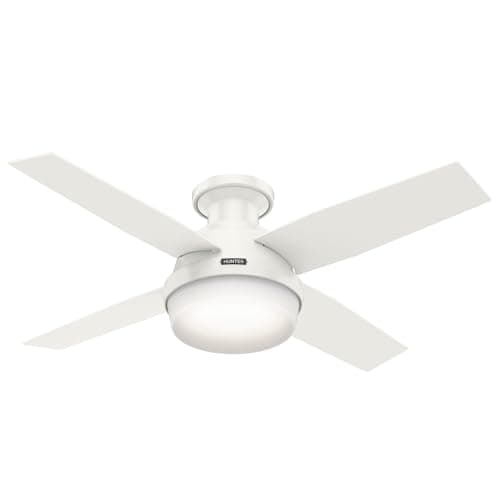 Best small fan overall Hunter Martindale 44" Ceiling Fan 304.5 CFM per watt on 10.1 W — the most efficient small fan in the certified data we hold, and only 1.1 W on low. | A bedroom, office or spare room with normal ceiling height | |
| 2 | 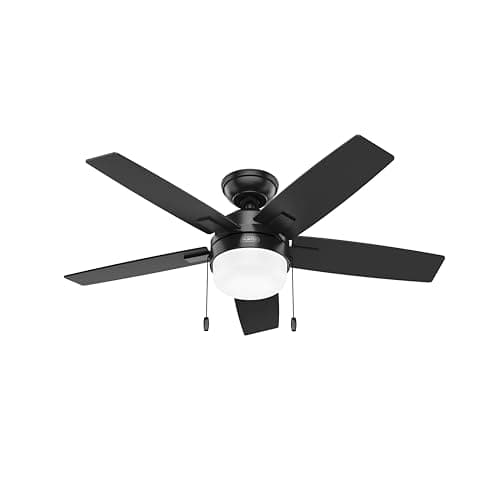 Best for a low ceiling Hunter Anisten 44" Hugger Ceiling Fan 295.9 CFM per watt on 12.5 W as a hugger — about three percent behind the standard-mount 44-inch for a flush fit. | Ceilings under about eight feet, or any room where a downrod is out | |
| 3 | Smallest span, with a light kit Maxim 42" Ceiling Fan with Light Kit 42 inches and 11.8 W with an integrated light kit — the smallest certified span we have data for. | A genuinely small room where 44 inches will not clear the walls | |
| — | What you are giving up Visual Comfort Kingston 72" LED Ceiling Fan 385.0 CFM per watt on 27.8 W. Emphatically not a small-room fan, and that is the point. | A large room — and included here to show the scale of the gap |
Most ceiling fan advice for small rooms is about fitting: measure the room, pick a span, check the clearance. That is all true and it is all available everywhere.
What almost nobody tells you is that going small costs efficiency, and that the cost is large enough to be worth knowing before you shop.
The finding
Small fans are measurably less efficient
We hold certified ENERGY STAR figures for ten ceiling fans across this site. Sorted by blade span, the efficiency data looks like this.
| Span | Fan | CFM per watt | High |
|---|---|---|---|
| 42 in | Maxim 994403 | 242.3 | 11.8 W |
| 44 in | Hunter Martindale | 304.5 | 10.1 W |
| 44 in | Hunter Anisten (hugger) | 295.9 | 12.5 W |
| 48 in | Globe 27105 | 270.7 | 21.6 W |
| 52 in | Hunter Vespucci | 366.7 | 13.9 W |
| 52 in | Hunter Skyway | 363.8 | 16.3 W |
| 52 in | Hunter Georgetown | 326.3 | 20.6 W |
| 72 in | Visual Comfort Kingston | 385.0 | 27.8 W |
| 72 in | Hunter Lakeway | 329.1 | 31.0 W |
| 84 in | Harbor Breeze Cando | 422.2 | 30.6 W |
ENERGY STAR Certified Ceiling Fans dataset. Every figure is a certified test result, not a manufacturer claim.
The extremes are unambiguous: 242.3 CFM per watt at 42 inches against 422.2 at 84. The largest fan in the set is 74 percent more efficient than the smallest.
The trend is not perfectly clean, and we are not going to pretend it is. The 48-inch Globe manages only 270.7 CFM per watt, below both 44-inch Hunters. Span sets the ceiling on what a fan can achieve; motor and blade design decide how close it gets. A well-designed small fan beats a poorly-designed larger one, which is exactly why the Martindale is the pick here.
The physics behind the trend is straightforward. A larger blade disc moves a given air volume more slowly. Aerodynamic drag rises steeply with speed, so slow-moving air is disproportionately cheap. A small fan has to spin faster to move usable air, and pays for the speed.
What it costs you
In money, almost nothing
Having said all that: the absolute numbers here are tiny, and it would be dishonest to let the percentages imply otherwise.
The 42-inch Maxim on high draws 11.8 W — about 1.7¢ for eight hours. The 44-inch Martindale draws 10.1 W, or 1.5¢. Over a whole cooling season the difference between them is not going to change your life.
The efficiency penalty matters for airflow, not for the bill. A less efficient fan at the same wattage moves less air, and airflow is the entire product. When a small fan disappoints, this is why — not because it is broken, and not because you needed a more expensive one.
Which leads to the practical conclusion: buy the largest fan the room will properly take. Not the largest that fits — the largest with correct clearance.
This one is not a DIY job
Blade clearance in a small room. The usual guidance is at least 18 inches from blade tip to the nearest wall, and at least 7 feet from the floor to the blades. Check your own local requirements and the manufacturer’s instructions, which take precedence.
In a small room the wall clearance is what binds. A 44-inch fan needs roughly 80 inches of clear width to sit centered with 18 inches either side — so a 10-foot-wide room is comfortable, and anything narrower needs care.
Height decides mount type before anything else. Under about eight feet, a downrod puts the blades too low, and you want a hugger like the Anisten. Above nine feet, a downrod is better — it brings the fan down into the occupied zone where the air movement is useful.
Flush mount
What a hugger actually costs
Flush-mount fans have a reputation for poor airflow, and the reasoning is sound: a ceiling fan draws air from above the blade disc as well as pushing it down, and mounted tight to the ceiling that intake is restricted.
The two Hunter 44-inch fans let us put a number on it, because they are the same brand and the same span:
- Martindale, standard mount — 304.5 CFM per watt, 10.1 W high, 1.1 W low
- Anisten, hugger — 295.9 CFM per watt, 12.5 W high, 1.6 W low
About a three percent efficiency difference. That is a far smaller penalty than the reputation implies. It is one comparison rather than a controlled study, and the two fans differ in more than mount type — but it is real certified data, and it does not support avoiding a hugger where your ceiling calls for one.
A hugger at the right height beats a downrod fan you keep walking into.
Say the unwelcome thing
Do not buy a ceiling fan for a small room that already has a good portable one.
A ceiling fan is an electrical installation. It needs a fan-rated box, it needs the ceiling to carry a dynamic load, and in a rental it is usually not permitted at all.
In a small room, a good portable fan gets you most of the benefit for none of that. It aims where you are, which a ceiling fan cannot, and it moves with you between rooms.
The case for a ceiling fan in a small room is real but narrow: you own the place, the floor space genuinely matters, and you want it running unattended. Otherwise a desk or pedestal fan is the better buy.
Choose
Which one
Normal ceiling, room at least ten feet wide: the 44-inch Martindale. Best small-fan efficiency in the certified data, and 1.1 W on low.
Low ceiling: the 44-inch Anisten hugger. A three percent penalty is not worth avoiding.
Genuinely tight, or you need the light: the 42-inch Maxim, knowing it is the least efficient of the three.
And if the room turns out to be bigger than you thought, go up a size. The data is unusually consistent on this: bigger is better, and it is better by more than people expect.
In full
Every pick, and what is wrong with it
Published specifications only, each linked to the page it came from. Where a manufacturer publishes nothing, the row says so — we do not fill blanks in.
1. Best small fan overall
Hunter Martindale 44" Ceiling Fan
Hunter · model 44in Martindale
304.5 CFM per watt on 10.1 W — the most efficient small fan in the certified data we hold, and only 1.1 W on low.
10.1 W on high. The lowest high-speed draw of any certified ceiling fan across this site, and about 1.5¢ for an eight-hour night.
1.1 W on low is the figure that changes behavior. That is 0.2¢ across a full night — functionally free, which means the correct way to run this fan is simply to leave it on.
At 304.5 CFM per watt it is the efficiency leader among small fans here, ahead of the 48-inch Globe (270.7) and the 42-inch Maxim (242.3). Buying small does not require buying inefficient — it just makes it likelier.
The absence of a light kit is the trade. If the room has other lighting, take the efficiency.
What’s wrong with it
No light kit, so if the fan is replacing your only ceiling fixture you have a second problem to solve.
Running cost — 44in Martindale
| Nameplate power | 1.1 W – 10.1 W | manufacturer's published figure |
|---|---|---|
| Energy, 8-hour night | 0.08 kWh | 10.1 ÷ 1000 × 8 |
| Cost per hour | 0.2¢ | at 18.34¢/kWh |
| Cost per 8-hour night | 1.5¢ | on the highest speed |
| Cost per 30 nights | 44¢ | 2.4 kWh |
| Same month, lowest speed | 4.8¢ | at 1.1 W |
Rate: 18.34¢/kWh, the US average residential price for June 2026 (EIA Electric Power Monthly, Table 5.3). Yours will differ — swap it in: (watts ÷ 1000) × hours × your rate.
| Blade span | 44 in |
|---|---|
| Efficiency | 304.5 CFM per watt |
| Power, high speed | 10.1 W |
| Power, low speed | 1.1 W |
| Standby power | 0.4 W |
| Type | Indoor, fan only |
| Warranty | 3 years, components |
| ENERGY STAR | Certified |
Every figure above is from ENERGY STAR Certified Ceiling Fans dataset. Blanks are shown as “not published” rather than filled in.
2. Best for a low ceiling
Hunter Anisten 44" Hugger Ceiling Fan
Hunter · model 44 Anisten
295.9 CFM per watt on 12.5 W as a hugger — about three percent behind the standard-mount 44-inch for a flush fit.
A hugger, or flush-mount, fan sits tight against the ceiling instead of hanging on a downrod. In a room with a low ceiling that is not a preference, it is a requirement.
This pairing is unusually informative because the two fans are the same brand and the same 44-inch span. So the difference is the mount: 295.9 CFM per watt against 304.5, and 12.5 W against 10.1 W.
That is roughly a three percent efficiency penalty — noticeably smaller than the flush-mount reputation suggests. The mechanism is real (less clearance above the blades restricts the intake side) but on these two fans it is modest.
1.6 W on low, about 0.2¢ a night. If your ceiling is low, take this and stop worrying about it.
What’s wrong with it
12.5 W against the Martindale's 10.1 W for the same 44-inch span, which is what the flush mount costs you.
Running cost — 44 Anisten
| Nameplate power | 1.6 W – 12.5 W | manufacturer's published figure |
|---|---|---|
| Energy, 8-hour night | 0.10 kWh | 12.5 ÷ 1000 × 8 |
| Cost per hour | 0.2¢ | at 18.34¢/kWh |
| Cost per 8-hour night | 1.8¢ | on the highest speed |
| Cost per 30 nights | 55¢ | 3.0 kWh |
| Same month, lowest speed | 7.0¢ | at 1.6 W |
Rate: 18.34¢/kWh, the US average residential price for June 2026 (EIA Electric Power Monthly, Table 5.3). Yours will differ — swap it in: (watts ÷ 1000) × hours × your rate.
| Blade span | 44 in |
|---|---|
| Efficiency | 295.9 CFM per watt |
| Power, high speed | 12.5 W |
| Power, low speed | 1.6 W |
| Standby power | 0.3 W |
| Type | Indoor hugger (flush mount), fan only |
| Warranty | 3 years, components |
| ENERGY STAR | Certified |
Every figure above is from ENERGY STAR Certified Ceiling Fans dataset. Blanks are shown as “not published” rather than filled in.
3. Smallest span, with a light kit
Maxim 42" Ceiling Fan with Light Kit
Maxim · model 994403FTBK
42 inches and 11.8 W with an integrated light kit — the smallest certified span we have data for.
Sometimes 44 inches genuinely will not fit. Blade tips need clearance from walls, and in a small bedroom or a narrow office the two extra inches matter.
11.8 W on high, 3.7 W on low, with a light kit included — which solves the problem the Martindale creates.
Be clear-eyed about the cost, though. 242.3 CFM per watt is the lowest figure in our certified data, against 422.2 for the largest fan. This is the small-span penalty in its purest form: you are drawing more watts than the more efficient 44-inch Martindale and moving less air per watt while doing it.
Worth it when the space genuinely demands it. Not worth it as a default.
What’s wrong with it
242.3 CFM per watt is the lowest efficiency figure in our certified set, and it is the clearest illustration of the small-fan penalty.
Running cost — 994403FTBK
| Nameplate power | 3.7 W – 11.8 W | manufacturer's published figure |
|---|---|---|
| Energy, 8-hour night | 0.09 kWh | 11.8 ÷ 1000 × 8 |
| Cost per hour | 0.2¢ | at 18.34¢/kWh |
| Cost per 8-hour night | 1.7¢ | on the highest speed |
| Cost per 30 nights | 52¢ | 2.8 kWh |
| Same month, lowest speed | 16¢ | at 3.7 W |
Rate: 18.34¢/kWh, the US average residential price for June 2026 (EIA Electric Power Monthly, Table 5.3). Yours will differ — swap it in: (watts ÷ 1000) × hours × your rate.
| Blade span | 42 in |
|---|---|
| Efficiency | 242.3 CFM per watt |
| Power, high speed | 11.8 W |
| Power, low speed | 3.7 W |
| Type | Indoor, with light kit |
| ENERGY STAR | Certified |
Every figure above is from ENERGY STAR Certified Ceiling Fans dataset. Blanks are shown as “not published” rather than filled in.
Skip this one
Visual Comfort Kingston 72" LED Ceiling Fan
Visual Comfort & Co. · model Kingston 72 LED
385.0 CFM per watt on 27.8 W. Emphatically not a small-room fan, and that is the point.
Included as a measuring stick rather than a recommendation. 385.0 CFM per watt against the 42-inch Maxim’s 242.3 — the same technology, the same certification program, 59 percent more air per watt.
You cannot have this in a small room. Blade clearance alone rules it out, and a fan sized for a great room in a 10 by 12 bedroom produces a draft rather than comfort.
The reason to look at it is to calibrate expectations. When a small fan feels like it is not doing much, that is not a defect — small fans move less air, less efficiently, by physics. The full ceiling fan comparison is here.
What’s wrong with it
A 72-inch span in a small room is unmountable, unsafe for blade clearance, and would create a wind tunnel if it fit.
Running cost — Kingston 72 LED
| Nameplate power | 4.1 W – 27.8 W | manufacturer's published figure |
|---|---|---|
| Energy, 8-hour night | 0.22 kWh | 27.8 ÷ 1000 × 8 |
| Cost per hour | 0.5¢ | at 18.34¢/kWh |
| Cost per 8-hour night | 4.1¢ | on the highest speed |
| Cost per 30 nights | $1.22 | 6.7 kWh |
| Same month, lowest speed | 18¢ | at 4.1 W |
Rate: 18.34¢/kWh, the US average residential price for June 2026 (EIA Electric Power Monthly, Table 5.3). Yours will differ — swap it in: (watts ÷ 1000) × hours × your rate.
| Blade span | 72 in |
|---|---|
| Efficiency | 385.0 CFM per watt |
| Power, high speed | 27.8 W |
| Power, low speed | 4.1 W |
| Standby power | 1.2 W |
| Type | Indoor, with light kit |
| Warranty | 3 years, components |
| ENERGY STAR | Certified |
Every figure above is from ENERGY STAR Certified Ceiling Fans dataset. Blanks are shown as “not published” rather than filled in.
We are not linking a buy button for this one. If you want to look at it anyway, it is easy enough to find — but we would rather send you to something that fits your room.
Questions people actually ask
Frequently asked
What size ceiling fan for a small room?
42 to 44 inches suits most small rooms, and 44 is preferable if the walls allow it. You need roughly 18 inches of clearance from blade tip to wall, so a 44-inch fan wants about 80 inches of clear width to sit centered.
Are small ceiling fans less efficient?
Yes, measurably. Certified data runs 242.3 CFM per watt at 42 inches against 422.2 at 84 — the largest fan is 74 percent more efficient than the smallest. A larger disc moves air more slowly, and slow air movement is disproportionately cheap.
Do flush-mount hugger fans move less air?
Slightly. Comparing two Hunter 44-inch fans, the standard mount achieves 304.5 CFM per watt and the hugger 295.9 — about three percent. That is a much smaller penalty than the reputation suggests, and not a reason to avoid a hugger where the ceiling height requires one.
How much does a small ceiling fan cost to run?
Almost nothing. The certified fans here draw 10.1 to 12.5 watts on high and 1.1 to 3.7 watts on low, so running one all night on low costs well under a cent at current average residential rates.
Should I get a ceiling fan or a portable fan for a small room?
A portable fan gets most of the benefit with no electrical work, aims directly at you, and moves between rooms. A ceiling fan makes sense when you own the place, floor space matters, and you want it running unattended. Desk fans, ranked.
How low should a ceiling fan hang in a small room?
Keep at least 7 feet from floor to blades. Under about an eight-foot ceiling that rules out a downrod, so use a flush-mount hugger; above nine feet a downrod is better because it brings the blades into the occupied zone where the air movement is useful.
Sources
Where these numbers came from
Read next
Where to go from here
Back to Whole-House Airflow, or read how we pick.