Head to head
Box fan vs window fan
Both end up in a window. Only one of them is designed to, and the difference shows up in the gap you leave around it.
By Sawyer V. · Published
The short answer
A window fan seals the opening; a box fan just sits in it. Air King publishes 2,470 CFM on 90 W for a 16-inch window fan with panels that close the gap. Lasko publishes no airflow at all for its box fan, and whatever it moves partly recirculates around the frame. Buy the box fan to move air in a room, the window fan to exchange the air of a room.
Fan & Frost earns a commission when you buy through our links, at no cost to you. It never changes a ranking, and we say so when the right answer is the cheaper unit or nothing at all. Full disclosure · How we pick.
At a glance
The picks, ranked
Tap any row to jump to the full reasoning. Prices are live from Amazon where we have them, and read “check price” where we don’t — never a number we cannot verify today.
| # | Product | Best for | Price |
|---|---|---|---|
| 1 | 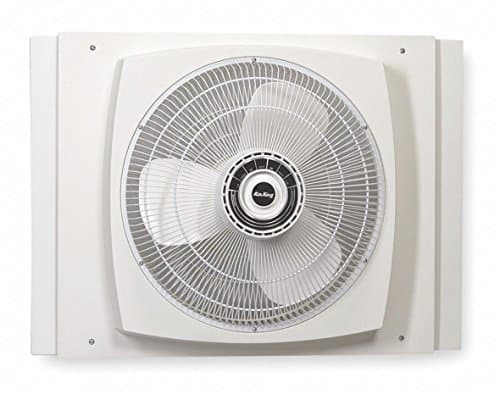 The window fan case Air King 16" Whole House Window Fan 2,470 CFM on 90 W at 27.4 CFM per watt, with expander panels and a housing the sash closes onto. | Exchanging a room or a floor of air with cooler outdoor air | |
| 2 | The box fan case Lasko Power Plus 20" Box Fan 73 to 102 W, a weather-resistant motor and a shape that works on the floor, in a doorway or propped in a window. | Moving air inside a room, and going anywhere you need it |
The real difference
Sealing, not airflow
Put a box fan in a window facing out and you have built an exhaust system with a large leak around it. Some of the air the fan pushes outside is immediately pulled back in through the gaps either side, because that is the path of least resistance — it is inches away rather than across the house.
A window fan closes that path. Expander panels fill the width, the sash closes onto the housing, and the only way air moves is through the blades. That is the entire engineering difference between the two formats, and it is worth more than any specification on either box.
This one is not a DIY job
What is published
One of these publishes numbers
| Box fan | Window fan | |
|---|---|---|
| Published airflow | None | 2,470 to 3,560 CFM |
| Published wattage | 73 - 102 W | 52 - 170 W |
| CFM per watt | Not computable | 20.9 to 27.4 |
| Seals the opening | No | Yes, expander panels |
| Window can close on it | No | Yes, Storm Guard housing |
| Reverses for exhaust | Turn the fan around | Yes, from the fan |
| Useful away from a window | Yes, anywhere | No |
| Typical weight | Under 10 lb | 15 to 36.6 lb |
The first row is the one people skip past. A box fan that publishes no airflow cannot be compared with anything, and there is no certification program for either format to fall back on — unlike ceiling fans, where every certified model files a CFM-per-watt figure.
Cost
Running cost is close enough to ignore
At 18.34¢/kWh, a full night costs 15¢ for the box fan on high and 13¢ for the 16-inch window fan on high. Thirty nights is $4.49 against $3.96.
Neither figure should decide anything. What decides it is that the window fan is moving a documented 2,470 CFM for its 90 W while the box fan moves an unstated amount for its 102, and a meaningful share of the box fan’s output is going straight back through the gap. The wider cost picture is in how much electricity a fan uses.
Which to buy
The honest split
- Buy a box fan if you want one fan that can do several jobs, if the budget is tight, if the window is an odd shape, or if it will mostly be pointed at people rather than out of a window.
- Buy a window fan if the job is overnight air exchange in a room with a standard double-hung window, and especially if you want to run it on exhaust — the case for which is in window fans for exhaust.
- Buy both, honestly, is what a lot of houses end up doing: a window fan in the bedroom that runs on a schedule and a box fan that follows the work around.
If the opening is a slider or a casement, neither format may fit, and the measurements that decide it are in window fans for casement and sliding windows.
Say the unwelcome thing
Do not buy a box fan expecting window-fan performance.
The listing photos show them in windows, the reviews describe them in windows, and the format genuinely works there. What it does not do is seal — and an unsealed opening means part of the airflow is circulating between the fan and the gap rather than between indoors and outdoors.
If overnight air exchange is the job, the window fan is the correct tool and it is not an expensive upgrade. 2,470 CFM on 90 watts, with panels does what a box fan in the same window is attempting.
In full
Every pick, and what is wrong with it
Published specifications only, each linked to the page it came from. Where a manufacturer publishes nothing, the row says so — we do not fill blanks in.
1. The window fan case
Air King 16" Whole House Window Fan
Air King · model 9155
2,470 CFM on 90 W at 27.4 CFM per watt, with expander panels and a housing the sash closes onto.
A window fan is built around the opening rather than around the blade. The housing spans 26.5 to 34.5 inches, the sash comes down on it, and the panels fill what is left. Air that leaves the room leaves through the fan instead of squeezing back past it.
That is what makes the airflow figure mean something. 2,470 CFM on 90 W is 27.4 CFM per watt, the best in the category on our arithmetic, and because the opening is sealed most of it becomes genuine air exchange — the mechanism that actually lowers room temperature, as opposed to moving warm air around.
The Storm Guard housing also lets the window close behind the fan, which matters for weather and for leaving a fan running overnight in a ground-floor room.
What’s wrong with it
Needs 22 inches of opening height and 26.5 of width, weighs 15 lb, and it only does the one job — out of the window it is useless.
Running cost — 9155
| Nameplate power | 52 W – 90 W | manufacturer's published figure |
|---|---|---|
| Energy, 8-hour night | 0.72 kWh | 90 ÷ 1000 × 8 |
| Cost per hour | 1.7¢ | at 18.34¢/kWh |
| Cost per 8-hour night | 13¢ | on the highest speed |
| Cost per 30 nights | $3.96 | 21.6 kWh |
| Same month, lowest speed | $2.29 | at 52 W |
Rate: 18.34¢/kWh, the US average residential price for June 2026 (EIA Electric Power Monthly, Table 5.3). Yours will differ — swap it in: (watts ÷ 1000) × hours × your rate.
| Air delivery | 2,470 / 1,700 / 1,360 CFM (high / medium / low) |
|---|---|
| Power | 90 / 65 / 52 W (0.8 / 0.6 / 0.5 A) |
| Efficiency | 27.4 CFM per watt on high, 26.2 on low (our arithmetic) |
| Blade | 16 in |
| Speeds | 3 |
| Window required | 26.5 - 34.5 in wide x 22 in high |
| Dimensions | 26.5 W x 8.25 D x 22 H in |
| Weight | 15.0 lb |
| Storm Guard | Window can close behind the fan |
| Mounting | Hardware included |
| Noise | Not published |
| ENERGY STAR | No program exists for window fans |
Every figure above is from Air King whole house window fan product page, models 9155 and 9166F. Blanks are shown as “not published” rather than filled in.
2. The box fan case
Lasko Power Plus 20" Box Fan
Lasko · model B20801
73 to 102 W, a weather-resistant motor and a shape that works on the floor, in a doorway or propped in a window.
A box fan is the most versatile object in this entire category. It sits on the floor, stands in a doorway, points at a workbench, props into a window, and costs less than anything else that moves comparable air.
Lasko publishes 73 to 102 W across its speeds and a weather-resistant motor, which is the specification that matters if it is going to spend nights in an open window. At 102 W an eight-hour night is 15¢ at 18.34¢/kWh.
What it does not publish is airflow. No CFM figure appears on the product page, which is normal for box fans and means no honest efficiency comparison with a window fan is possible. When we say a window fan moves more air, we are comparing a published number against an absent one.
What’s wrong with it
No published CFM, nothing to seal the window opening, and a square fan in a rectangular sash leaves gaps that undo much of the work.
Running cost — B20801
| Nameplate power | 73 W – 102 W | manufacturer's published figure |
|---|---|---|
| Energy, 8-hour night | 0.82 kWh | 102 ÷ 1000 × 8 |
| Cost per hour | 1.9¢ | at 18.34¢/kWh |
| Cost per 8-hour night | 15¢ | on the highest speed |
| Cost per 30 nights | $4.49 | 24.5 kWh |
| Same month, lowest speed | $3.21 | at 73 W |
Rate: 18.34¢/kWh, the US average residential price for June 2026 (EIA Electric Power Monthly, Table 5.3). Yours will differ — swap it in: (watts ÷ 1000) × hours × your rate.
| Power | 73 W - 102 W (0.6-0.9 A at 120 V) |
|---|---|
| Speeds | 3 |
| Dimensions | 21.25 H x 22.5 x 4.75 in |
| Weight | 10.1 lb |
| Motor | Weather-resistant |
| Air delivery (CFM) | Not published |
| Warranty | 2 years |
Every figure above is from Lasko product page, B20801. Blanks are shown as “not published” rather than filled in.
Questions people actually ask
Frequently asked
Is a window fan better than a box fan?
For exchanging indoor and outdoor air, yes — it seals the opening with expander panels so the airflow actually crosses the building envelope. For general-purpose air movement anywhere in the house, the box fan is far more useful and costs less.
How many CFM does a box fan move?
Manufacturers generally do not publish a figure, including Lasko for the Power Plus 20-inch model. That absence is why no honest efficiency comparison with a window fan exists: one side of it publishes airflow and wattage, the other publishes wattage only.
Can you use a box fan as a window fan?
Yes, and many people do. Fill the gaps around it with cardboard, foam board or a rolled towel, because an unsealed opening lets the fan pull its own exhaust straight back in. Also check the motor is rated for weather if it will sit in an open window overnight. The box fan method.
Which uses more electricity, a box fan or a window fan?
They are close. A box fan publishes 73 to 102 watts and window fans run 52 to 170 depending on blade size, so a night costs a handful of cents either way. The difference that matters is how much air actually crosses the window, not the wattage.
Does a box fan cool a room?
Only by moving air across skin, unless it is in a window bringing cooler outdoor air in. Air movement makes a room feel cooler without lowering its temperature; exchanging the air genuinely lowers it, which is why the window matters more than the fan. What a fan really does.
Sources
Where these numbers came from
- Air King whole house window fan product page — 2,470 CFM at 90 W for the 16-inch 9155 and 3,560 CFM at 170 W for the 20-inch 9166F, with required window sizes and Storm Guard
- Lasko product page, B20801 Power Plus box fan — 73 to 102 W, three speeds, weather-resistant motor; no CFM published
- EIA Electric Power Monthly, Table 5.3 — average residential electricity price
Read next
Where to go from here
Back to Fans, or read how we pick.