Guide and picks
Cooling a home server or network closet
A closet full of equipment is the one room where you can calculate the heat load precisely before you buy anything.
By Sawyer V. · Published
The short answer
Equipment turns essentially all of the power it draws into heat, so a closet pulling 300 W is a 300 W heater that never switches off. That makes the load knowable and continuous — which is why the answer is almost always extraction, not cooling. A certified in-line fan moves 460 CFM at 5.2 CFM per watt, and moving heat out costs a fraction of what removing it costs.
Fan & Frost earns a commission when you buy through our links, at no cost to you. It never changes a ranking, and we say so when the right answer is the cheaper unit or nothing at all. Full disclosure · How we pick.

At a glance
The picks, ranked
Tap any row to jump to the full reasoning. Prices are live from Amazon where we have them, and read “check price” where we don’t — never a number we cannot verify today.
| # | Product | Best for | Price |
|---|---|---|---|
| 1 | Best extraction Fantech FG 10 EC In-Line Fan 460 CFM at 5.2 CFM per watt — the highest efficacy of any certified in-line fan we hold data for. | Ducting closet air out to a hallway, loft or exterior | |
| 2 | For a larger installation Fantech FG 12XL EC In-Line Fan 750 CFM at 4.6 CFM per watt — the highest certified in-line airflow we hold data for. | A full rack, or a run with a long duct route | |
| 3 | 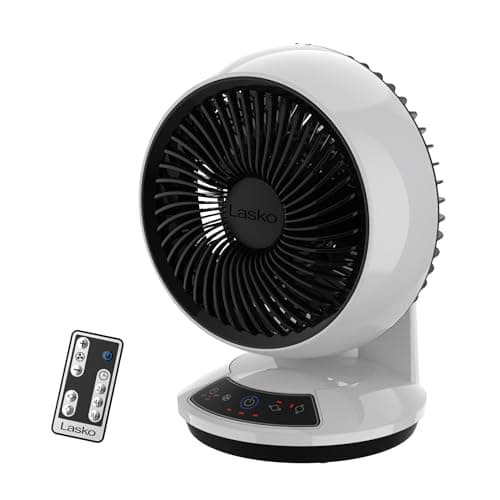 Best cheap fix Lasko Whirlwind Tilt 12" Table Fan 18 to 32 W, throws air 50 ft, and it wall-mounts instead of taking shelf space. | A closet with a door you can leave ajar | |
| — | The trap Whynter ARC-14S Dual Hose Portable Air Conditioner 1,300 W of cooling in a space where you first need somewhere to put the exhaust and the condensate. | A room, not a closet |
This is the one room on the site where you can work out the heat load exactly, before spending anything.
The arithmetic
Watts in equals heat out
Electronics do not consume energy; they convert it. Almost every watt a server, switch or drive array draws leaves the box as heat, because none of it is doing mechanical work and none of it is leaving the room as light.
So the closet’s heat load is its power draw. Put a plug-in energy meter on the equipment and read it — that number, in watts, is the heater you are dealing with.
Three numbers describe this room completely. The heat output in watts equals the equipment’s power draw. The duty cycle is 24 hours a day, unlike every other room on this site. And the best certified in-line fan moves 460 CFM at 5.2 CFM per watt.
Two things follow. First, the load is continuous — no overnight break, no seasonal one. Second, it is small in absolute terms. A home rack is usually 100 to 400 W. That is a fraction of one occupant of a room and nothing like the load an air conditioner is sized for.
Small and continuous is the exact profile that says move the heat, do not remove it.
The failure
What actually goes wrong
Closets fail by stagnation rather than by ambient temperature. Equipment pulls in air, warms it, pushes it out — and in a sealed closet the same air comes back round. Each pass starts warmer than the last, and intake temperature climbs away from room temperature.
Which is why airflow beats cooling here. Break the recirculation and equipment intake sits close to whatever the adjoining space is, whatever that happens to be.
A door left ajar and a circulator often does it. The distinction between a circulator and a fan matters for this — you want throw and mixing, not a broad gentle breeze.
Ducting it
When to extract properly
If the adjoining room cannot absorb the heat — a bedroom, or a larger equipment load — duct the closet air somewhere it can go.
- High extract, low intake. Warm air collects at the top, so take it from there and let make-up air enter low. A door undercut or a low grille supplies the intake.
- Mount the fan in the duct, not the closet. Inline fans are designed for this, and it moves the noise away from the space.
- Size for air changes, not for cooling. The smaller certified fan here moves 460 CFM, which changes the air in a typical closet many times an hour.
- Run it continuously. The load is continuous, so the extraction should be — and an EC motor lets you hold it at a low setting for most of the day.
This one is not a DIY job
Where the air goes matters, and it is not always free. Ducting closet air into a loft, a wall cavity or a crawl space puts heat — and whatever moisture is in it — somewhere it may not belong.
Do not terminate an extract duct into an enclosed unventilated space. Take it outside, or into a room large enough to absorb the load.
If the closet contains anything with a combustion appliance, a flue, or a fire-rated wall, extraction changes pressures in ways that are a building code matter. That belongs to a qualified installer, not to a buying guide.
Practical
Cheap things that work
- Undercut or vent the door. Without an intake path, extraction just pulls a vacuum and the fan moves far less than its rating.
- Get equipment off the floor. Floor-level intakes collect dust, and dust in a heatsink is a slow-motion thermal failure.
- Do not stack gear directly on gear. Each box needs its intake fed with air that has not just left the box below it.
- Check what temperature your equipment actually reports. Most of it will tell you. That is a better signal than how the closet feels to your hand.
- Dust the intakes on a schedule. Continuous airflow through a closet is continuous dust delivery.
Say the unwelcome thing
Do not put an air conditioner in a closet.
The reasoning is practical before it is thermal. An air conditioner rejects heat to somewhere, and in a closet there is nowhere — no window for a portable’s exhaust hose, no exterior wall for a through-wall unit.
Vent a portable into the space it is cooling and it becomes a net heater, because its own compressor draw is added to the room along with the heat it moved.
There is also the condensate. An unattended equipment space and a tank that fills and shuts the unit down is a bad pairing.
Extract instead. A certified inline fan at 460 CFM at 5.2 CFM per watt moves the heat out for a fraction of the running cost, with nothing to drain.
In full
Every pick, and what is wrong with it
Published specifications only, each linked to the page it came from. Where a manufacturer publishes nothing, the row says so — we do not fill blanks in.
1. Best extraction
Fantech FG 10 EC In-Line Fan
Fantech · model FG 10 EC
460 CFM at 5.2 CFM per watt — the highest efficacy of any certified in-line fan we hold data for.
The right shape of answer for a closet, because the goal is to remove heat from the space rather than to make cold.
460 CFM at 0.25 inches of water gauge changes the air in a typical closet many times an hour, which is what keeps equipment intake temperatures near room temperature instead of climbing.
5.2 CFM per watt is the efficiency leader among certified in-line fans, where 4.0 is typical. It is still far below a ceiling-mounted fan, because this one is moving air against real static pressure through rigid duct.
The EC motor is the reason to pick it. You can run it at a fraction of full output most of the time, which suits a load that is continuous but small.
Mount it in the duct rather than in the closet. That puts the motor noise away from the space and leaves the closet wall as a single grille.
What’s wrong with it
A 10-inch duct is a real commitment, and no in-line fan publishes a noise rating.
Running cost
Fantech does not publish a wattage for the FG 10 EC, so we cannot calculate what it costs to run. We are not going to estimate one. If Fantech publishes a nameplate figure, this block will show the arithmetic.
| Air delivery | 460 CFM at 0.25 in w.g. |
|---|---|
| Efficacy | 5.2 CFM per watt |
| Duct size | 10 in diameter |
| Unit type | In-line (single-port), mounted in the duct run |
| Motor | EC (electronically commutated) |
| Noise (sones) | Not published for in-line units |
| ENERGY STAR | Certified |
Every figure above is from ENERGY STAR Certified Ventilating Fans dataset. Blanks are shown as “not published” rather than filled in.
2. For a larger installation
Fantech FG 12XL EC In-Line Fan
Fantech · model FG 12XL EC
750 CFM at 4.6 CFM per watt — the highest certified in-line airflow we hold data for.
The step up, and worth it in exactly two situations: a genuinely large equipment load, or a long duct route where a smaller fan would be losing most of its output to static pressure.
750 CFM at 0.25 inches of water gauge, which is roughly 60% more air than the 10-inch fan above.
4.6 CFM per watt — slightly behind the FG 10 EC on efficiency, which is the usual trade when you buy airflow. Also an EC motor, so you can hold it well below full output for the hours when the load is light.
The honest caveat is the ductwork. A 12-inch route through a home is real construction, and if yours is already 8 or 10 inches the smaller fan is the sensible choice.
What’s wrong with it
12-inch duct is a serious route to build, and 750 CFM is more than most home closets need.
Running cost
Fantech does not publish a wattage for the FG 12XL EC, so we cannot calculate what it costs to run. We are not going to estimate one. If Fantech publishes a nameplate figure, this block will show the arithmetic.
| Air delivery | 750 CFM at 0.25 in w.g. |
|---|---|
| Efficacy | 4.6 CFM per watt |
| Duct size | 12 in diameter |
| Unit type | In-line (single-port), mounted in the duct run |
| Motor | EC (electronically commutated) |
| Noise (sones) | Not published for in-line units |
| ENERGY STAR | Certified |
Every figure above is from ENERGY STAR Certified Ventilating Fans dataset. Blanks are shown as “not published” rather than filled in.
3. Best cheap fix
Lasko Whirlwind Tilt 12" Table Fan
Lasko · model A12107
18 to 32 W, throws air 50 ft, and it wall-mounts instead of taking shelf space.
Before ducting anything, try the cheap version: leave the door ajar and put a fan where it exchanges closet air with room air.
A closet’s real failure mode is stagnation— the same air recirculating through equipment, getting hotter each pass. Breaking that with any meaningful airflow fixes most small installations.
18 to 32 W, about 14¢ a day running flat out, against a ducted installation you have to build. It throws air 50 ft, which is more than a closet needs and means it works from across the room.
Wall-mountable (hardware not included), so it does not take the shelf space you wanted for equipment. 39 to 55 dBA.
Its limit is honest: this relocates heat into the next room. For a few hundred watts of equipment that room absorbs it. For more, duct it.
What’s wrong with it
It moves heat into the adjoining room rather than out of the building.
Running cost — A12107
| Nameplate power | 18 W – 32 W | manufacturer's published figure |
|---|---|---|
| Energy, 8-hour night | 0.26 kWh | 32 ÷ 1000 × 8 |
| Cost per hour | 0.6¢ | at 18.34¢/kWh |
| Cost per 8-hour night | 4.7¢ | on the highest speed |
| Cost per 30 nights | $1.41 | 7.7 kWh |
| Same month, lowest speed | 79¢ | at 18 W |
Rate: 18.34¢/kWh, the US average residential price for June 2026 (EIA Electric Power Monthly, Table 5.3). Yours will differ — swap it in: (watts ÷ 1000) × hours × your rate.
| Power | 18 W - 32 W (0.24-0.5 A at 120 V) |
|---|---|
| Noise | 39 dBA low, 55 dBA high |
| Air distance | 50 ft |
| Speeds | 3 |
| Dimensions | 11.19 H x 11.4 W x 6.2 D in |
| Weight | 2.78 lb |
| Mounting | Wall-mountable (hardware not included) |
| Air delivery (CFM) | Not published |
| Warranty | 1 year |
Every figure above is from Lasko product page, A12107. Blanks are shown as “not published” rather than filled in.
Skip this one
Whynter ARC-14S Dual Hose Portable Air Conditioner
Whynter · model ARC-14S
1,300 W of cooling in a space where you first need somewhere to put the exhaust and the condensate.
The obvious purchase and usually the wrong one, for reasons that are practical before they are thermodynamic.
A portable air conditioner needs an exhaust route to outside, and a closet rarely has a window. Vent it into the same closet and you have added 1,300 W of heat to solve a heat problem.
It needs condensate handling. Unattended equipment spaces and a tank that fills are a poor combination.
And it takes floor area a closet does not have. It is a capable machine — put it in a room.
What’s wrong with it
A portable air conditioner in a closet needs a window, a drain and a large share of the floor. Closets have none.
Running cost — ARC-14S
| Nameplate power | 1300 W | manufacturer's published figure |
|---|---|---|
| Energy, 8-hour night | 10.40 kWh | 1300 ÷ 1000 × 8 |
| Cost per hour | 24¢ | at 18.34¢/kWh |
| Cost per 8-hour night | $1.91 | on the highest speed |
| Cost per 30 nights | $57 | 312.0 kWh |
Rate: 18.34¢/kWh, the US average residential price for June 2026 (EIA Electric Power Monthly, Table 5.3). Yours will differ — swap it in: (watts ÷ 1000) × hours × your rate.
| Marketing capacity | 14,000 BTU (ASHRAE-128) |
|---|---|
| DOE-rated capacity | 9,500 BTU SACC |
| Hoses | Dual |
| Power | 1,300 W / 11.6 A at 115 V |
| Noise | Under 51 dBA low, under 56 dBA high |
| Dehumidification | 71 pints/day |
| Refrigerant | R-32 |
| Dimensions | 16 W x 19 D x 35.5 H in |
| Weight | 73 lb |
| Manufacturer coverage claim | 500 sq ft |
| Warranty | 1 year unit, 3 years compressor |
Every figure above is from Whynter product page, ARC-14S. Blanks are shown as “not published” rather than filled in.
We are not linking a buy button for this one. If you want to look at it anyway, it is easy enough to find — but we would rather send you to something that fits your room.
Questions people actually ask
Frequently asked
How much heat does home server equipment produce?
Essentially all of the power it draws. A rack pulling 300 W is a 300 W heater. Put a plug-in energy meter on it and read the number — that is your heat load, and unlike every other room on this site it runs 24 hours a day.
Is a fan enough to cool a network closet?
Usually, yes. Closets fail by stagnation — the same air recirculating through equipment, warmer each pass — not by ambient temperature. Breaking that recirculation keeps intake temperature close to the adjoining room's. Circulators, ranked.
Can I put a portable air conditioner in a server closet?
Not sensibly. It needs an exhaust route outside, which closets rarely have, plus condensate handling and floor space. Vented into the same closet it becomes a net heater.
Should the extract be at the top or the bottom of the closet?
Top. Warm air collects there, so extract high and let make-up air enter low through a door undercut or a low grille. Without an intake path the fan pulls a vacuum and moves far less than its rating.
How big should the inline fan be?
Size for air changes rather than cooling capacity. The smaller certified fan here moves 460 CFM at 5.2 CFM per watt, which changes the air in a typical closet many times over per hour.
Where should the extracted air go?
Outside, or into a room large enough to absorb the load. Do not terminate into a loft, wall cavity or crawl space — that relocates heat and moisture somewhere it may not belong.
Sources
Where these numbers came from
Read next
Where to go from here
Back to Room Cooling, or read how we pick.