The picks
The best ceiling fans, ranked on certified CFM per watt
This is the one cooling category where the efficiency data is public, complete and decisive — and it says the cheapest cooling in your house is a ceiling fan on low.
By Sawyer V. · Published
The short answer
The Hunter Vespucci 52" for most rooms: 366.7 CFM per watt certified, 13.9 W on high and 1.8 W on low. A month of eight-hour nights on low costs about 7.9¢. For a big room, the 72" Kingston hits 385 CFM/W — the best figure in the certified data.
Fan & Frost earns a commission when you buy through our links, at no cost to you. It never changes a ranking, and we say so when the right answer is the cheaper unit or nothing at all. Full disclosure · How we pick.
At a glance
The picks, ranked
Tap any row to jump to the full reasoning. Prices are live from Amazon where we have them, and read “check price” where we don’t — never a number we cannot verify today.
| # | Product | Best for | Price |
|---|---|---|---|
| 1 | 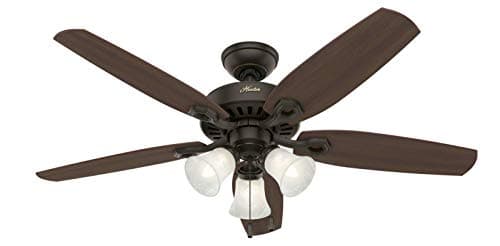 Best overall Hunter Vespucci 52" Ceiling Fan 366.7 CFM per watt is the best certified efficiency at the size that fits most rooms, and 1.8 W on low is remarkable. | A standard bedroom or living room, 52 inch span | |
| 2 | Best for a large room Visual Comfort Kingston 72" LED Ceiling Fan 385.0 CFM per watt, the highest certified figure we found at any size, from a 72 inch span. | Great rooms, high ceilings, open-plan spaces | |
| 3 | Best for a low ceiling Hunter Anisten 44" Hugger Ceiling Fan A flush-mount hugger at 295.9 CFM per watt, which is strong efficiency for a form factor that usually sacrifices it. | Rooms with 8 ft ceilings or less, where a downrod is not an option | |
| 4 | 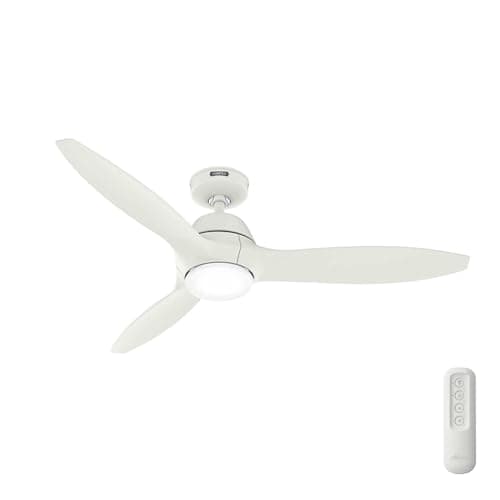 Best with a light kit Hunter Skyway 52" Ceiling Fan with Light Kit 363.8 CFM per watt with a light kit and a damp rating, which is close to the fan-only figure. | A room where the fan is also the main light | |
| — | 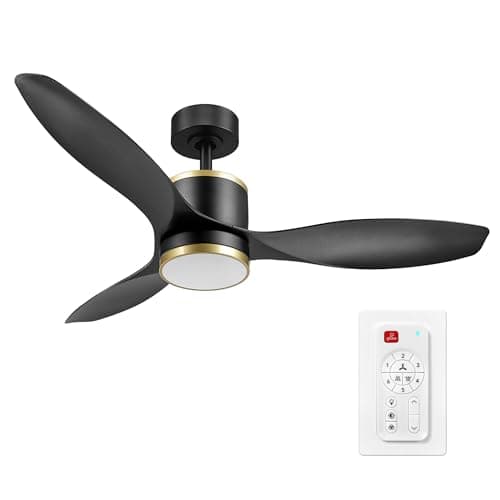 The one to think twice about Globe 48" Ceiling Fan with Light Kit 270.7 CFM per watt and 21.6 W on high, to move less air than a fan drawing 13.9 W. | Nobody who has read the row above it |
Ceiling fans are the one cooling category where the useful data is completely public. ENERGY STAR certifies them and publishes, for every certified model, the tested CFM per watt, the wattage at high and low speed, and the standby wattage. A manufacturer cannot write its own CFM/W figure.
We pulled every US-market certified fan available from 2023 onward — 987 models — and ranked within size bands. What comes out is that blade count, blade shape and price tell you very little, and the certified efficiency figure tells you almost everything.
The finding
The cheapest cooling in your house, by a long way
| Device | Watts | 30 × 8-hr nights |
|---|---|---|
| Hunter Vespucci ceiling fan, low | 1.8 W | 7.9¢ |
| Hunter Vespucci ceiling fan, high | 13.9 W | 61¢ |
| Lasko DC tower fan, high | 19 W | 84¢ |
| Lasko 20" box fan, high | 102 W | $4.49 |
| Evaporative cooler | 220 W | $9.68 |
| Portable air conditioner | 1300 W | $57 |
Wattages from ENERGY STAR certified data and manufacturer pages; costs are our arithmetic at 18.34¢/kWh.
A certified ceiling fan on low costs roughly 7.9¢ for a month of nights. That is not a rounding error against the box fan — it is about one-fiftieth of it, for a comparable amount of comfort in a bedroom.
The reason is blade diameter. A 52-inch blade turning slowly displaces an enormous volume of air for very little energy; a 20-inch blade spinning fast has to work much harder for less. If you have somewhere to hang one, a ceiling fan is the single best cooling purchase in this entire category. The full wattage-to-dollars table is here.
Sizing
What span your room needs
| Room size | Blade span | Typical room |
|---|---|---|
| Up to 75 sq ft | 29–36 in | Bathroom, small office, walk-in |
| 75–175 sq ft | 42–48 in | Bedroom, small dining room |
| 175–350 sq ft | 52–56 in | Standard bedroom, living room |
| 350–450 sq ft | 56–60 in | Large living room |
| Over 450 sq ft | 60–72 in, or two fans | Great room, open plan |
A conventional sizing guide, not a manufacturer specification. Where you are between sizes, larger is generally better: a bigger fan on a lower speed is quieter and more efficient than a smaller one working hard.
Two clearance rules that are safety rather than preference: blades at least 7 feet above the floor, and at least 18 inches from any wall. With an 8-foot ceiling that usually means a flush-mount hugger.
The trap
Standby power, which nobody mentions
The certified data publishes standby wattage separately, and it produces a genuinely odd result.
| Fan | Standby | Standby, per year | Running on low, 30 nights |
|---|---|---|---|
| Kingston 72" | 1.2 W | $1.93 | 18¢ |
| Hunter Vespucci 52" | 0.8 W | $1.29 | 7.9¢ |
| Globe 48" | 0.6 W | 96¢ | 13¢ |
| Hunter Skyway 52" | 0.4 W | 64¢ | 9.2¢ |
| Hunter Anisten 44" | 0.3 W | 48¢ | 7.0¢ |
Compare the last two columns. Several of these fans cost more per year sitting switched off than they cost to actually run on low for a month of nights. Standby power never stops, and a fan with a remote or a smart module is drawing it 8,760 hours a year.
The absolute numbers are small and this is not a reason to avoid a remote. It is a reason to prefer a lower standby figure when two fans are otherwise equal, and it is a nice illustration of why reading the published data beats reading the box.
Say the unwelcome thing
Blade count and 'airflow' claims in the listing tell you nothing useful.
Three blades, five blades, curved blades, wooden blades — none of it predicts performance, and marketing CFM figures in a listing are not comparable between brands because they are not measured the same way.
The certified CFM per watt figure is measured to a common test procedure and published by a third party. Two fans that look identical on a shelf can differ by 35% on it, as the Globe and the Vespucci above do. Look it up before you buy.
Getting it right
Two things after you install it
Check the direction. In summer a ceiling fan should turn counterclockwise viewed from below, pushing air straight down. If your fan seems to be doing nothing on a hot day, this is the first thing to check and it takes ten seconds — how to check yours is here.
Turn it off when you leave the room. A ceiling fan does not lower the temperature; it moves air across skin. In an empty room it is doing nothing except adding a little motor heat. This is the most common way people waste what little energy these use.
In full
Every pick, and what is wrong with it
Published specifications only, each linked to the page it came from. Where a manufacturer publishes nothing, the row says so — we do not fill blanks in.
1. Best overall
Hunter Vespucci 52" Ceiling Fan
Hunter · model Vespucci
366.7 CFM per watt is the best certified efficiency at the size that fits most rooms, and 1.8 W on low is remarkable.
366.7 CFM per watt, certified by ENERGY STAR. At 52 inches this is the span that suits most bedrooms and living rooms, and it is the most efficient 52-inch fan in the certified data we pulled.
The wattages are the striking part. 13.9 W on high and 1.8 W on low. A month of eight-hour nights on low costs about 7.9¢ at 18.34¢/kWh. On high, all night, every night for a month: 61¢. Put that next to a 20-inch box fan at 102 W, which costs $4.49 for the same hours and moves less air.
That gap is not a brand difference. It is a physics difference: a 52-inch blade moving slowly displaces far more air per watt than a small blade spinning fast, and a DC motor holds efficiency at low speed where an AC motor loses it. Certified ceiling fans are the most efficient air movement available in a house, by a wide margin.
3-year components warranty, which is standard across the certified Hunter range.
What’s wrong with it
Fan only — no light kit — so if this is your room's only ceiling fixture you will need lighting elsewhere. 0.8 W of standby draw is also on the high side for a fan with no light.
Running cost — Vespucci
| Nameplate power | 1.8 W – 13.9 W | manufacturer's published figure |
|---|---|---|
| Energy, 8-hour night | 0.11 kWh | 13.9 ÷ 1000 × 8 |
| Cost per hour | 0.3¢ | at 18.34¢/kWh |
| Cost per 8-hour night | 2.0¢ | on the highest speed |
| Cost per 30 nights | 61¢ | 3.3 kWh |
| Same month, lowest speed | 7.9¢ | at 1.8 W |
Rate: 18.34¢/kWh, the US average residential price for June 2026 (EIA Electric Power Monthly, Table 5.3). Yours will differ — swap it in: (watts ÷ 1000) × hours × your rate.
| Blade span | 52 in |
|---|---|
| Efficiency | 366.7 CFM per watt |
| Power, high speed | 13.9 W |
| Power, low speed | 1.8 W |
| Standby power | 0.8 W |
| Type | Indoor, fan only (no light kit) |
| Warranty | 3 years, components |
| ENERGY STAR | Certified |
Every figure above is from ENERGY STAR Certified Ceiling Fans dataset. Blanks are shown as “not published” rather than filled in.
2. Best for a large room
Visual Comfort Kingston 72" LED Ceiling Fan
Visual Comfort & Co. · model Kingston 72 LED
385.0 CFM per watt, the highest certified figure we found at any size, from a 72 inch span.
385.0 CFM per watt is the best efficiency figure in the certified ceiling fan data we pulled, and it comes from the largest span. That is not a coincidence — efficiency rises with blade diameter, because a big blade turning slowly is a more efficient way to move air than a small blade turning fast.
27.8 W on high sounds like a lot next to the Vespucci’s 13.9, but it is moving proportionally far more air. Per unit of airflow it is the most efficient thing on this page, and for a large open space one big fan beats two small ones on both efficiency and noise.
4.1 W on low, so about 18¢ for a month of nights.
The constraint is physical. A 72-inch span needs a room that can take it and a ceiling high enough that blades stay well clear of head height — this is not a fan for a standard 8-foot bedroom.
What’s wrong with it
72 inches needs genuine space and a ceiling high enough to keep the blades safely clear. 1.2 W of standby is the highest here, which costs more over a year than running the fan on low does.
Running cost — Kingston 72 LED
| Nameplate power | 4.1 W – 27.8 W | manufacturer's published figure |
|---|---|---|
| Energy, 8-hour night | 0.22 kWh | 27.8 ÷ 1000 × 8 |
| Cost per hour | 0.5¢ | at 18.34¢/kWh |
| Cost per 8-hour night | 4.1¢ | on the highest speed |
| Cost per 30 nights | $1.22 | 6.7 kWh |
| Same month, lowest speed | 18¢ | at 4.1 W |
Rate: 18.34¢/kWh, the US average residential price for June 2026 (EIA Electric Power Monthly, Table 5.3). Yours will differ — swap it in: (watts ÷ 1000) × hours × your rate.
| Blade span | 72 in |
|---|---|
| Efficiency | 385.0 CFM per watt |
| Power, high speed | 27.8 W |
| Power, low speed | 4.1 W |
| Standby power | 1.2 W |
| Type | Indoor, with light kit |
| Warranty | 3 years, components |
| ENERGY STAR | Certified |
Every figure above is from ENERGY STAR Certified Ceiling Fans dataset. Blanks are shown as “not published” rather than filled in.
3. Best for a low ceiling
Hunter Anisten 44" Hugger Ceiling Fan
Hunter · model 44 Anisten
A flush-mount hugger at 295.9 CFM per watt, which is strong efficiency for a form factor that usually sacrifices it.
A hugger or flush-mount fan sits tight against the ceiling instead of hanging on a downrod. That is the right answer for an 8-foot ceiling, where a standard mount would put blades uncomfortably close to head height.
295.9 CFM per watt, 12.5 W on high, 1.6 W on low. The efficiency is genuinely good for the form factor — hugger fans usually pay a bigger penalty than this, because blades close to a ceiling cannot draw air freely from above.
Compare it with the Vespucci’s 366.7 CFM/W and you can see the cost of the mount: about 19% less air per watt. If your ceiling can take a downrod, take the downrod. If it cannot, this is a good version of the compromise.
0.3 W standby is the lowest here, which over a year is worth more than it looks.
What’s wrong with it
295.9 CFM/W is the lowest of the Hunter fans here — a hugger mount puts the blades close to the ceiling, which restricts airflow and costs efficiency. That is the price of the form factor.
Running cost — 44 Anisten
| Nameplate power | 1.6 W – 12.5 W | manufacturer's published figure |
|---|---|---|
| Energy, 8-hour night | 0.10 kWh | 12.5 ÷ 1000 × 8 |
| Cost per hour | 0.2¢ | at 18.34¢/kWh |
| Cost per 8-hour night | 1.8¢ | on the highest speed |
| Cost per 30 nights | 55¢ | 3.0 kWh |
| Same month, lowest speed | 7.0¢ | at 1.6 W |
Rate: 18.34¢/kWh, the US average residential price for June 2026 (EIA Electric Power Monthly, Table 5.3). Yours will differ — swap it in: (watts ÷ 1000) × hours × your rate.
| Blade span | 44 in |
|---|---|
| Efficiency | 295.9 CFM per watt |
| Power, high speed | 12.5 W |
| Power, low speed | 1.6 W |
| Standby power | 0.3 W |
| Type | Indoor hugger (flush mount), fan only |
| Warranty | 3 years, components |
| ENERGY STAR | Certified |
Every figure above is from ENERGY STAR Certified Ceiling Fans dataset. Blanks are shown as “not published” rather than filled in.
4. Best with a light kit
Hunter Skyway 52" Ceiling Fan with Light Kit
Hunter · model 52" Skyway (damp-rated)
363.8 CFM per watt with a light kit and a damp rating, which is close to the fan-only figure.
363.8 CFM per watt with a light kit is impressive — only 3 CFM/W behind the fan-only Vespucci. A light kit usually costs more efficiency than that, because the fixture sits in the airflow path under the motor.
The damp rating is the other reason to choose it. That makes it suitable for a covered porch, a screened patio or a sunroom — anywhere it may meet humidity or the occasional splash but not direct rain. For a covered patio it is a far better long-term answer than anything on wheels, at 16.3 W.
Note the distinction: damp-rated is not wet-rated. A fully exposed pergola needs a wet-rated fan.
0.4 W standby, and 2.1 W on low — about 9.2¢ for a month of nights.
What’s wrong with it
16.3 W on high against the Vespucci's 13.9 for essentially the same airflow — the light kit assembly costs a little efficiency. Damp-rated is not wet-rated, so it is for covered outdoor spaces, not exposed ones.
Running cost — 52" Skyway (damp-rated)
| Nameplate power | 2.1 W – 16.3 W | manufacturer's published figure |
|---|---|---|
| Energy, 8-hour night | 0.13 kWh | 16.3 ÷ 1000 × 8 |
| Cost per hour | 0.3¢ | at 18.34¢/kWh |
| Cost per 8-hour night | 2.4¢ | on the highest speed |
| Cost per 30 nights | 72¢ | 3.9 kWh |
| Same month, lowest speed | 9.2¢ | at 2.1 W |
Rate: 18.34¢/kWh, the US average residential price for June 2026 (EIA Electric Power Monthly, Table 5.3). Yours will differ — swap it in: (watts ÷ 1000) × hours × your rate.
| Blade span | 52 in |
|---|---|
| Efficiency | 363.8 CFM per watt |
| Power, high speed | 16.3 W |
| Power, low speed | 2.1 W |
| Standby power | 0.4 W |
| Type | Indoor, with light kit; damp-rated |
| Warranty | 3 years, components |
| ENERGY STAR | Certified |
Every figure above is from ENERGY STAR Certified Ceiling Fans dataset. Blanks are shown as “not published” rather than filled in.
Skip this one
Globe 48" Ceiling Fan with Light Kit
Globe · model 27105
270.7 CFM per watt and 21.6 W on high, to move less air than a fan drawing 13.9 W.
This is a perfectly functional ENERGY STAR certified fan, and it is here as the illustration of why the certified data is worth reading before you buy on looks.
270.7 CFM per watt against the Vespucci’s 366.7. 21.6 W on high against 13.9. It is a 48-inch fan drawing substantially more power than a 52-inch one, to move less air per watt.
In absolute dollars the difference is small — 95¢ against 61¢ for a month of nights on high. But a ceiling fan is a ten-to-fifteen-year purchase that you are unlikely to replace early, and the airflow difference is what you actually feel: less air per watt means you run it at a higher speed, which is noisier as well as more expensive.
If the fan is going in a room you use daily, spend the time to check the certified figure. It is public, it is free to look up, and no brand can write its own.
What’s wrong with it
It draws 55% more power than the Hunter Vespucci while delivering 26% less air per watt. Over a decade of use that difference is larger than any plausible saving on the purchase price.
Running cost — 27105
| Nameplate power | 3 W – 21.6 W | manufacturer's published figure |
|---|---|---|
| Energy, 8-hour night | 0.17 kWh | 21.6 ÷ 1000 × 8 |
| Cost per hour | 0.4¢ | at 18.34¢/kWh |
| Cost per 8-hour night | 3.2¢ | on the highest speed |
| Cost per 30 nights | 95¢ | 5.2 kWh |
| Same month, lowest speed | 13¢ | at 3 W |
Rate: 18.34¢/kWh, the US average residential price for June 2026 (EIA Electric Power Monthly, Table 5.3). Yours will differ — swap it in: (watts ÷ 1000) × hours × your rate.
| Blade span | 48 in |
|---|---|
| Efficiency | 270.7 CFM per watt |
| Power, high speed | 21.6 W |
| Power, low speed | 3.0 W |
| Standby power | 0.6 W |
| Type | Indoor, with light kit |
| Warranty | 3 years, components |
| ENERGY STAR | Certified |
Every figure above is from ENERGY STAR Certified Ceiling Fans dataset. Blanks are shown as “not published” rather than filled in.
We are not linking a buy button for this one. If you want to look at it anyway, it is easy enough to find — but we would rather send you to something that fits your room.
Questions people actually ask
Frequently asked
What is the most efficient ceiling fan?
In the ENERGY STAR certified data, the 72-inch Kingston at 385.0 CFM per watt is the highest figure we found at any size. At the more common 52 inches, the Hunter Vespucci leads at 366.7 CFM per watt, drawing 13.9 W on high and 1.8 W on low.
How much does it cost to run a ceiling fan?
Very little. At 18.34¢/kWh, a certified fan drawing 1.8 W on low costs about 7.9¢ for thirty eight-hour nights. On high at 13.9 W it is roughly 61¢. A 20-inch box fan at 102 W costs $4.49 for the same hours.
What size ceiling fan do I need?
42 to 48 inches for a room of 75 to 175 sq ft, 52 to 56 inches for 175 to 350 sq ft, and 60 inches or more above 450 sq ft. Where you are between sizes, go larger — a bigger fan on a lower speed is quieter and more efficient than a small one working hard.
Does blade count affect ceiling fan performance?
Not in any way you can predict from the number. Blade count, shape and material are largely styling decisions. The certified CFM-per-watt figure is measured to a common procedure and is the only comparable performance number — two similar-looking fans can differ by 35 percent on it.
Do ceiling fans use electricity when turned off?
Yes, if they have a remote or smart control. Certified standby figures run from 0.3 to 1.2 W, and that draw never stops. Over a year, several fans cost more sitting off than they cost to run on low for a month of nights — a small amount, but a good tiebreaker between similar fans.
Is a ceiling fan cheaper than air conditioning?
Dramatically, but they do different jobs. A ceiling fan moves air so you feel cooler and does not lower the room's temperature. An air conditioner removes heat and humidity. Use the fan first — it costs a fraction of one percent as much — and the compressor only when the fan is genuinely not enough.
Sources
Where these numbers came from
Read next
Where to go from here
Back to Whole-House Airflow, or read how we pick.