Guide and picks
What a window air conditioner costs to run
This is the one cooling category where you do not have to estimate, because the number is published and independently verified.
By Sawyer V. · Published
The short answer
Certified window units run from 260.4 kWh a year for a 5,000 BTU model to 1,417.3 kWh for a 24,000 BTU one — $48 to $260 at 18.34¢/kWh. A typical efficient 8,000 BTU unit is 375 kWh, or $69 for a season. The figure is published and verified, which is not true of portables.
Fan & Frost earns a commission when you buy through our links, at no cost to you. It never changes a ranking, and we say so when the right answer is the cheaper unit or nothing at all. Full disclosure · How we pick.

At a glance
The picks, ranked
Tap any row to jump to the full reasoning. Prices are live from Amazon where we have them, and read “check price” where we don’t — never a number we cannot verify today.
| # | Product | Best for | Price |
|---|---|---|---|
| 1 | Cheapest to run Midea Window Air Conditioner, 6,000 BTU 281.3 kWh a year at CEER 16 — the lowest running cost of any unit we hold certified data for. | A bedroom or small office | |
| 2 | 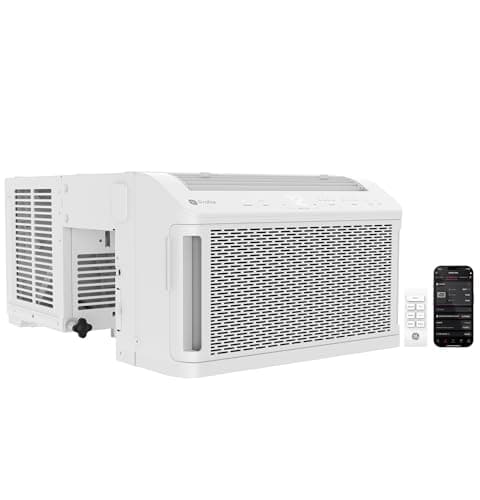 Best cost per BTU GE Profile ClearView Window Air Conditioner, 8,000 BTU 375 kWh a year at CEER 16 — the efficiency leader at the size most people need. | The main room, where 8,000 BTU is the right size | |
| 3 | Best large unit Friedrich Kuhl Window Air Conditioner, 14,100 BTU 652.8 kWh a year at CEER 16.2 — the highest efficiency at large capacity we hold data for. | A genuinely large room, sized deliberately | |
| — | 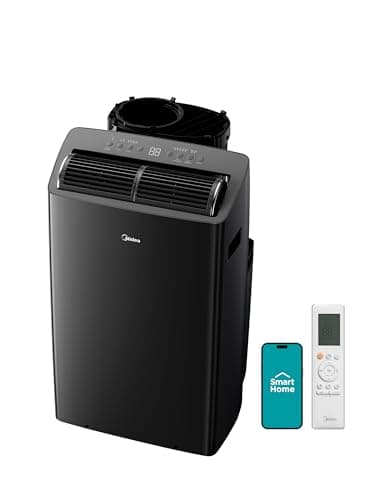 Cannot be costed Midea Duo Smart Inverter Portable Air Conditioner 12,000 BTU SACC and no published wattage at all — there is no honest way to work out what it costs. | A room where a window unit genuinely will not fit |
Almost every running-cost article on the internet estimates. In this one category, estimating is unnecessary.
The table
Certified units, costed
Every unit below carries a published annual energy figure from the certification program. The cost column applies the current rate of 18.34¢/kWh to that figure, and nothing else.
| Unit | Capacity | CEER | kWh/yr | Season |
|---|---|---|---|---|
| Midea MAW05R1VWWT | 5,000 BTU | 14.4 | 260.4 | $48 |
| TCL W5WC72 | 5,000 BTU | 13.7 | 273.7 | $50 |
| Midea MAW06S1KWT | 6,000 BTU | 16.0 | 281.3 | $52 |
| Midea MAW06V1QWT | 6,000 BTU | 15.1 | 298 | $55 |
| GE Profile PWJV08W | 8,000 BTU | 16.0 | 375 | $69 |
| Midea MAW08HV1KWT | 8,000 BTU | 15.1 | 397.4 | $73 |
| Midea MAW08V1QWT | 8,000 BTU | 15.0 | 400 | $73 |
| Friedrich KCVS08B10A | 8,700 BTU | 16.0 | 407.8 | $75 |
| Midea MAH09B1AGR | 9,500 BTU | 17.6 | 404.8 | $74 |
| Gradient CCHP11 | 9,300 BTU | 16.8 | 415.2 | $76 |
| TCL T12WV4S | 12,000 BTU | 16.0 | 562.5 | $103 |
| Friedrich KCVS12B30B | 12,700 BTU | 16.8 | 567 | $104 |
| Midea MAW12V1QWT | 12,000 BTU | 15.0 | 600 | $110 |
| Friedrich KCVM14B10B | 14,100 BTU | 16.2 | 652.8 | $120 |
| GE Profile PWJV14W | 14,000 BTU | 16.0 | 656.3 | $120 |
| Midea MAW14V1KYWT | 14,000 BTU | 16.0 | 656.3 | $120 |
| Whirlpool WHAW241IN | 24,000 BTU | 12.7 | 1417.3 | $260 |
Two things fall out of it. The whole efficient category sits between $48 and $120 for a season, which is a narrower range than most people expect. And the largest unit costs more than five times the smallest, almost all of it capacity rather than inefficiency.
What the number means
And what it does not
The annual kWh figure is a standardized estimate, not a prediction of your bill. It is produced under defined test conditions and a defined usage assumption, which is exactly what makes it useful for comparing units — and exactly why it will not match your meter.
- It assumes a standard amount of running. If you run the unit far more or far less than the assumption, your cost scales with your hours, not theirs.
- It assumes standard conditions. A hotter climate, a poorly shaded room, or a unit undersized for its space will all push real consumption above the figure.
- It includes standby. Which is a small but real part of a modern unit’s annual total.
- It uses a national average rate. Ours is 18.34¢/kWh. Substitute your own rate from your bill and the arithmetic is a single multiplication.
Used the way it is meant to be — as a comparison between two units you are choosing between — it is the most reliable number in home cooling. Where it sits among the other figures.
The comparison
Against everything else
A window unit’s running cost only makes sense next to the alternatives, and the range across the category is enormous.
- A ceiling fan on low: 2.3 W. About 0.3¢ for eight hours. It cools people rather than air, which is why it is three orders of magnitude cheaper.
- A tower fan on low: 2.9 W. 0.4¢ for the same eight hours.
- An evaporative cooler: 220 to 250 W. 37¢ for eight hours, and only in dry air.
- A 1,300 W portable air conditioner. $1.91 for eight hours, or $57 for a month of overnight running — against $69 for an efficient window unit’s entire season.
The full league table puts every product on this site in one ranking.
This one is not a DIY job
Your electricity rate is the biggest variable here, and we do not know it. The figures on this site use a single national average of 18.34¢/kWh, and residential rates vary widely by state and by tariff.
Take the kWh figure from the table, multiply by your own rate from your bill, and you have your number. That is the entire calculation.
If you are on a time-of-use tariff, when you run the unit changes the cost as much as which unit you bought — which hours matter.
Lowering it
The levers that actually move the number
- Buy the right size, not a bigger one. Capacity is the dominant term in the table above — far larger than the efficiency spread within a size.
- Prefer CEER 16 within your size. Worth $4.58 a year at 8,000 BTU. Real, but not worth a worse installation.
- Reduce the load before the capacity. Shading and sealing lower the size you need, which moves you up the table.
- Keep the filter clean. A blocked filter starves the evaporator, so capacity falls and run time rises — the maintenance that pays.
- Use a fan alongside it. At 2.3 W, air movement lets you hold a higher set point for the same comfort, and every degree of set point is run time.
Say the unwelcome thing
Do not compare a window unit's season cost to a portable's hourly one.
It is the most common apples-to-oranges error in cooling, and it makes portables look far better than they are.
Window units publish a certified annual figure that includes cycling, part load and standby. Portables publish, at best, a peak wattage — and frequently, as with the unit above, nothing at all.
Comparing $69 for a window unit’s whole season against a portable’s $1.91 per night is not a comparison, it is two different measurements.
Compare like with like: 375 kWh a year or 281.3 kWh a year, both certified, both verifiable.
In full
Every pick, and what is wrong with it
Published specifications only, each linked to the page it came from. Where a manufacturer publishes nothing, the row says so — we do not fill blanks in.
1. Cheapest to run
Midea Window Air Conditioner, 6,000 BTU
Midea · model MAW06S1KWT-A
281.3 kWh a year at CEER 16 — the lowest running cost of any unit we hold certified data for.
The floor of the category on running cost, and it gets there by being both efficient and correctly small.
281.3 kWh a year is $52 at 18.34¢/kWh — less than a third of what a large unit costs, for the room most people actually need cooled.
CEER 16 and on the Most Efficient list, at 45% below the federal standard. Efficiency and modest capacity compounding in the same direction is what produces a number this low.
31.6 lb, no support bracket required, and a variable-speed compressor.
What’s wrong with it
6,000 BTU is a small room, and sizing up defeats the point.
Running cost — MAW06S1KWT-A
| Annual energy use | 281.3 kWh | ENERGY STAR certified figure |
|---|---|---|
| Annual cost | $52 | 281.3 × 18.34¢/kWh |
| Per cooling month | $13 | spread over a four-month season |
The annual figure is the certified value from the ENERGY STAR Certified Room Air Conditioners dataset, which models a standard cooling season rather than your actual summer. It is more useful than a nameplate wattage here, because a variable-speed compressor spends most of its life well below nameplate.
Rate: 18.34¢/kWh, the US average residential price for June 2026 (EIA Electric Power Monthly, Table 5.3). Yours will differ — swap it in: (watts ÷ 1000) × hours × your rate.
| Cooling capacity | 6,000 BTU/h |
|---|---|
| CEER | 16 |
| Annual energy use | 281.3 kWh/yr |
| vs federal standard | 45% less energy |
| Dimensions | 12.1 H x 16.0 W x 13.3 D in |
| Weight | 31.6 lb |
| Installation | Does not straddle the windowsill |
| Support bracket | Not required |
| Compressor | Variable speed |
| Refrigerant | R-32 |
| ENERGY STAR | Certified, and on the Most Efficient list |
Every figure above is from ENERGY STAR Certified Room Air Conditioners dataset. Blanks are shown as “not published” rather than filled in.
2. Best cost per BTU
GE Profile ClearView Window Air Conditioner, 8,000 BTU
GE Profile · model PWJV08W
375 kWh a year at CEER 16 — the efficiency leader at the size most people need.
8,000 BTU is the volume size of the category, which makes it the most useful place to look at what efficiency is worth.
375 kWh against 400 kWh for the CEER 15 units at the same capacity. That gap is $4.58 a year — real, but small enough that it should not override fit, noise or installation.
CEER 16, Most Efficient, 47% below the federal standard, and 46.2 lb.
Unusually shallow at 15.3 inches, which matters more than the efficiency difference if your window is awkward.
What’s wrong with it
It does not straddle the sill, so installation depends on the window.
Running cost — PWJV08W
| Annual energy use | 375 kWh | ENERGY STAR certified figure |
|---|---|---|
| Annual cost | $69 | 375 × 18.34¢/kWh |
| Per cooling month | $17 | spread over a four-month season |
The annual figure is the certified value from the ENERGY STAR Certified Room Air Conditioners dataset, which models a standard cooling season rather than your actual summer. It is more useful than a nameplate wattage here, because a variable-speed compressor spends most of its life well below nameplate.
Rate: 18.34¢/kWh, the US average residential price for June 2026 (EIA Electric Power Monthly, Table 5.3). Yours will differ — swap it in: (watts ÷ 1000) × hours × your rate.
| Cooling capacity | 8,000 BTU/h |
|---|---|
| CEER | 16 |
| Annual energy use | 375 kWh/yr |
| vs federal standard | 47% less energy |
| Dimensions | 12.6 H x 18.6 W x 15.3 D in |
| Weight | 46.2 lb |
| Refrigerant | R-32 |
| Installation | Does not straddle the windowsill |
| Compressor | Variable speed |
| ENERGY STAR | Certified, and on the Most Efficient list |
Every figure above is from ENERGY STAR Certified Room Air Conditioners dataset. Blanks are shown as “not published” rather than filled in.
3. Best large unit
Friedrich Kuhl Window Air Conditioner, 14,100 BTU
Friedrich · model KCVM14B10B
652.8 kWh a year at CEER 16.2 — the highest efficiency at large capacity we hold data for.
If you genuinely need this much capacity, this is what efficient looks like at the top of the size range.
652.8 kWh a year, $120 at 18.34¢/kWh, at CEER 16.2 and 51% below the federal standard.
Worth comparing directly to the 24,000 BTU unit in the table below, which is not quite twice the capacity but costs more than twice as much to run. Efficiency falls off above this point.
70.0 lb and it straddles the sill. Whether that needs a bracket is not the question you would expect it to be.
What’s wrong with it
70 lb straddling a windowsill, and the running cost is still double a small unit.
Running cost — KCVM14B10B
| Annual energy use | 652.8 kWh | ENERGY STAR certified figure |
|---|---|---|
| Annual cost | $120 | 652.8 × 18.34¢/kWh |
| Per cooling month | $30 | spread over a four-month season |
The annual figure is the certified value from the ENERGY STAR Certified Room Air Conditioners dataset, which models a standard cooling season rather than your actual summer. It is more useful than a nameplate wattage here, because a variable-speed compressor spends most of its life well below nameplate.
Rate: 18.34¢/kWh, the US average residential price for June 2026 (EIA Electric Power Monthly, Table 5.3). Yours will differ — swap it in: (watts ÷ 1000) × hours × your rate.
| Cooling capacity | 14,100 BTU/h |
|---|---|
| CEER | 16.2 |
| Annual energy use | 652.8 kWh/yr |
| vs federal standard | 51% less energy |
| Dimensions | 17.9 H x 25.9 W x 29.0 D in |
| Weight | 70.0 lb |
| Refrigerant | R-32 |
| Installation | Straddles the windowsill |
| Compressor | Variable speed |
| ENERGY STAR | Certified |
Every figure above is from ENERGY STAR Certified Room Air Conditioners dataset. Blanks are shown as “not published” rather than filled in.
Skip this one
Midea Duo Smart Inverter Portable Air Conditioner
Midea · model MAP14S1TBL
12,000 BTU SACC and no published wattage at all — there is no honest way to work out what it costs.
Included as a contrast rather than a criticism of this specific machine, because it illustrates the structural difference between the two categories.
Window air conditioners are covered by a certification program that publishes annual kWh for every model. You can look up any unit and cost it exactly.
Portables publish no such figure. This one states “115 V” and no wattage, so the arithmetic on this page cannot be done for it at all.
What that category actually costs has to be reconstructed from measured wattage instead, and the answer is not favorable.
What’s wrong with it
The manufacturer states 115 V and no power figure, so the running cost cannot be calculated.
Running cost
Midea does not publish a wattage for the MAP14S1TBL, so we cannot calculate what it costs to run. We are not going to estimate one. If Midea publishes a nameplate figure, this block will show the arithmetic.
| Marketing capacity | 14,000 BTU |
|---|---|
| DOE-rated capacity | 12,000 BTU SACC |
| Hoses | Dual |
| Noise | 43 dBA |
| Speeds | 3 |
| Refrigerant | R-32 |
| Dimensions | 19.52 W x 16.73 D x 32.48 H in |
| Weight | 74.96 lb |
| Manufacturer coverage claim | 550 sq ft |
| Power | Not published (115 V stated, no wattage) |
| Warranty | 1 year |
Every figure above is from Midea product page, MAP14S1TBL. Blanks are shown as “not published” rather than filled in.
We are not linking a buy button for this one. If you want to look at it anyway, it is easy enough to find — but we would rather send you to something that fits your room.
Questions people actually ask
Frequently asked
How much does a window air conditioner cost to run?
Certified units run from 260.4 kWh a year for a 5,000 BTU model to 1,417.3 kWh for a 24,000 BTU one — $48 to $260 at 18.34¢/kWh. A typical efficient 8,000 BTU unit is 375 kWh, about $69 for a season.
Is the certified annual kWh figure what I will actually pay?
No — it is a standardized estimate produced under defined test conditions and a defined usage assumption. That is what makes it good for comparing two units against each other, and why it will not match your meter. Multiply by your own rate for your number.
How much does CEER 16 save over CEER 15?
At 8,000 BTU it is 375 kWh against 400 — about $4.58 a year. Real, but small enough that it should not override fit, noise or a better installation.
Why can't I look up a portable air conditioner's annual kWh?
Because the certification program that publishes it covers window and through-the-wall units, not portables. Many portables publish no wattage at all, so their running cost has to be reconstructed from measurements. Costing a portable.
What is the single biggest factor in running cost?
Capacity. The spread across the table is mostly size rather than efficiency — the 24,000 BTU unit costs more than five times the 5,000 BTU one. Buying the right size matters far more than chasing a CEER point.
How does that compare to running a fan?
A ceiling fan on low draws 2.3 W, about 0.3¢ for eight hours. It cools people rather than air, which is why it is orders of magnitude cheaper — and why it is worth running alongside an air conditioner rather than instead of it. Everything, ranked by watts.
Sources
Where these numbers came from
Read next
Where to go from here
Back to Guides & Calculators, or read how we pick.