The picks
The best window air conditioners, ranked on certified efficiency
Every unit here is ranked on data the manufacturer cannot write itself: the tested CEER and modeled annual energy use that ENERGY STAR publishes for every certified model.
By Sawyer V. · Published
The short answer
For most rooms, the GE Profile ClearView PWJV08W: 8,000 BTU at CEER 16, 375 kWh a year (about $69 at 18.34¢/kWh), on the ENERGY STAR Most Efficient list, and at 46.2 lb and 15.3 inches deep it is the easiest of these to actually get into a window. For a small bedroom, drop to the 6,000 BTU Midea U-shaped.
Fan & Frost earns a commission when you buy through our links, at no cost to you. It never changes a ranking, and we say so when the right answer is the cheaper unit or nothing at all. Full disclosure · How we pick.

At a glance
The picks, ranked
Tap any row to jump to the full reasoning. Prices are live from Amazon where we have them, and read “check price” where we don’t — never a number we cannot verify today.
| # | Product | Best for | Price |
|---|---|---|---|
| 1 | Best overall GE Profile ClearView Window Air Conditioner, 8,000 BTU The best certified efficiency at 8,000 BTU, in the lightest and shallowest body of anything here. | Most bedrooms and living rooms, 300-350 sq ft | |
| 2 | Best for a small bedroom Midea U-Shaped Window Air Conditioner, 6,000 BTU The cheapest thing here to run, and the U-shape means you can still open the window above it. | Rooms up to about 250 sq ft | |
| 3 | 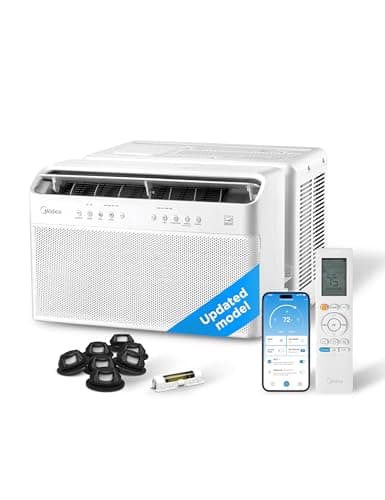 Best U-shaped at 8,000 BTU Midea U-Shaped Window Air Conditioner, 8,000 BTU The same U-shape trick at a size that suits a larger bedroom, at a small efficiency cost against the GE. | A bedroom where noise decides it | |
| 4 | 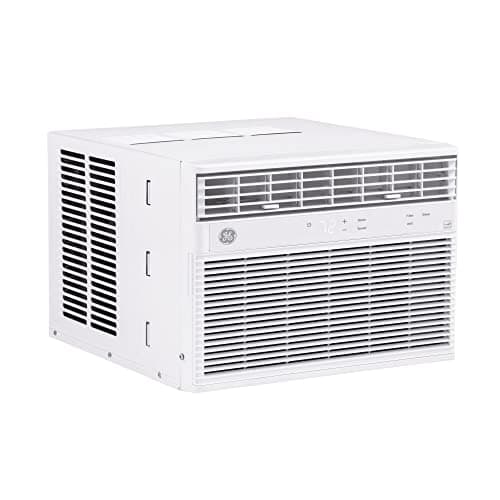 Best for a large room GE Profile ClearView Window Air Conditioner, 14,000 BTU CEER 16 at 14,000 BTU, which is unusual — most units this size give up efficiency to get there. | Open-plan spaces, 550-700 sq ft | |
| 5 | 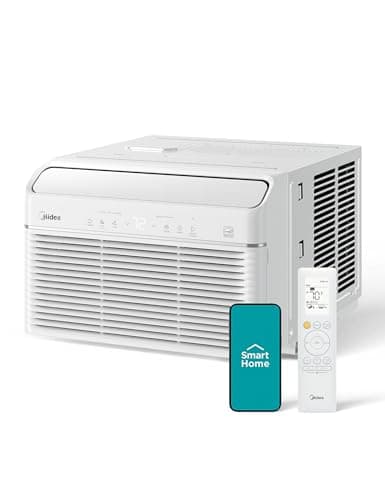 Lightest to lift BLACK+DECKER Window Air Conditioner, 8,000 BTU 44.1 lb, the lightest 8,000 BTU unit in the certified data, with respectable CEER 15. | An awkward window you have to install alone | |
| — | 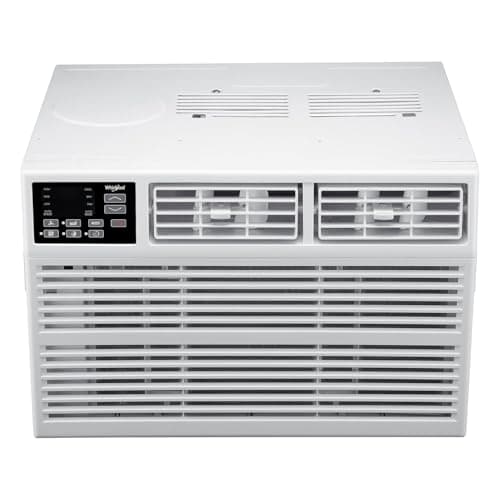 The one to skip Whirlpool Window Air Conditioner, 24,000 BTU The worst efficiency in this roundup, in the heaviest body, at a capacity almost nobody's room needs. | Almost nobody buying for a room |
Window air conditioners are the one part of this category where you can skip the marketing entirely. ENERGY STAR certifies them and publishes, for every certified model, the tested CEER (combined energy efficiency ratio) and a modeled annual energy use in kWh. A brand cannot write its own CEER, and the kWh figure already accounts for the compressor cycling across a standard season — which makes it far more honest than multiplying a nameplate wattage by hours.
So this ranking is built on that dataset. We pulled every US-market certified room air conditioner available from 2024 onward — 392 models — and ranked within capacity bands on CEER, then applied the physical constraints that decide whether a unit can actually go in your window.
Read this first
Size it before you shop
The most expensive mistake in this category is not buying the wrong brand. It is buying too much capacity.
| Room area (sq ft) | Capacity needed (BTU/h) |
|---|---|
| 100 up to 150 | 5,000 |
| 150 up to 250 | 6,000 |
| 250 up to 300 | 7,000 |
| 300 up to 350 | 8,000 |
| 350 up to 400 | 9,000 |
| 400 up to 450 | 10,000 |
| 450 up to 550 | 12,000 |
| 550 up to 700 | 14,000 |
Source: ENERGY STAR, Room Air Conditioners. ENERGY STAR notes the capacities “are calculated based on an 8-foot ceiling.” The full chart, with the adjustments.
Measure length by width in feet, read across, then adjust: +10% if the room is very sunny, −10% if heavily shaded, +600 BTU per person beyond two, and +4,000 BTU if it is a kitchen. The full walkthrough with worked examples is here.
Say the unwelcome thing
Do not round up to be safe.
An oversized unit hits the set temperature quickly, shuts off, and never runs long enough to dehumidify. The thermometer reads 72°F and the room feels damp. Then it short-cycles, which wastes energy and is hard on the compressor. Where you fall between two capacities, take the smaller one unless an adjustment above pushed you up.
What CEER means
How to read the efficiency numbers
CEER is cooling capacity in BTU per hour divided by power draw in watts, including standby. Higher is better. The practical range in current certified units is about 12.7 to 17.6, and the difference between the ends of that range is roughly a factor of three in annual running cost once capacity is accounted for.
Annual kWh is the figure to actually compare, because it folds capacity and efficiency together. Multiply by your electricity rate and you have the running cost. At 18.34¢/kWh:
| Unit | CEER | kWh/yr | Cost/yr |
|---|---|---|---|
| Midea MAW06V1QWT, 6,000 BTU | 15.1 | 298 | $55 |
| GE Profile PWJV08W, 8,000 BTU | 16 | 375 | $69 |
| Midea MAW08V1QWT, 8,000 BTU | 15 | 400 | $73 |
| BLACK+DECKER BD08NWES, 8,000 BTU | 15 | 400 | $73 |
| GE Profile PWJV14W, 14,000 BTU | 16 | 656.3 | $120 |
| Whirlpool WHAW-241IN, 24,000 BTU | 12.7 | 1417.3 | $260 |
CEER and kWh from the ENERGY STAR certified dataset; costs are our arithmetic at 18.34¢/kWh.
The install constraint
What decides whether it fits
Efficiency picks the shortlist; geometry picks the winner. Four things to check with a tape measure before you order:
- Window type. All of these need a single-hung or double-hung sash window that slides vertically. A casement window that cranks outward, or a horizontal slider, needs a different product entirely — usually a portable unit or a through-the-wall install.
- Opening width and height. The unit’s width has to fit between the jambs and the sash has to close down onto or through it.
- Straddles the sill, or not. The certified data records this, and it matters. Most modern units here do not straddle the sill, which is easier to install and usually easier to get past a landlord.
- Weight. 44 lb is a one-person job. 70 lb is two people. 115 lb is a support bracket and a look at your local code.
Why not a portable
Why a window unit beats a portable whenever one fits
A window unit sits in the wall of the room: cold side in, hot side out, and the heat it rejects lands outside. A portable sits inside the room and pushes its heat out through a duct that is itself hot and in your space — and a single-hose portable also blows room air outside, which gets replaced by hot outside air infiltrating in.
Two consequences. There is no ENERGY STAR program for portable air conditioners at all — the certified dataset contains window and through-the-wall units only, because there is no specification for a portable to meet. And a portable’s DOE-rated SACC is well below its box BTU, sometimes by a third.
Buy a portable when a window unit will not physically fit. The full comparison is here, and the no-window case is here.
Also certified
Two more that clear the bar
The picks above are the ones we would buy, but they are not the only certified units worth knowing about in the 8,000 BTU class. Two others appear in the ENERGY STAR data with figures good enough to mention.
The Friedrich Kuhl KCVS08B10A reaches CEER 16 at 8,700 BTU on 407.8 kWh a year, and it is on the Most Efficient list — the same efficiency tier as our top pick, with slightly more capacity and a variable-speed compressor. The certified dataset does not publish its dimensions, which is the reason it is not a headline pick: we cannot tell you whether it will fit your window.
The Hisense AHW0823TW1W is CEER 15 and 400 kWh a year at 8,000 BTU, with a variable-speed compressor and a sub-sill design. At 44.5 lb it is among the lightest certified units in its class, which matters more on install day than one point of CEER does over a season.
Rooms
If you came here from a room, not a product
A window unit is often the right answer, but not always the first move. Start from the room instead: a bedroom is frequently solvable with a blind and a fan for most of the season; an apartment usually has a lease constraint that decides the form factor before efficiency does; and a hot upstairs often has a diagnosable cause that no amount of capacity will fix.
In full
Every pick, and what is wrong with it
Published specifications only, each linked to the page it came from. Where a manufacturer publishes nothing, the row says so — we do not fill blanks in.
1. Best overall
GE Profile ClearView Window Air Conditioner, 8,000 BTU
GE Profile · model PWJV08W
The best certified efficiency at 8,000 BTU, in the lightest and shallowest body of anything here.
CEER 16 is the top of the 8,000 BTU class, and it converts to 375 kWh a year — about $69 at 18.34¢/kWh, for an entire cooling season. That is 47% less energy than the federal standard requires, and it is enough to put this unit on the ENERGY STAR Most Efficient list rather than merely certified.
The specification that decides it, though, is physical. 46.2 lb and 15.3 inches deep makes this the lightest and shallowest 8,000 BTU unit in the certified data we looked at. A Midea U-shaped of the same capacity is 53.2 lb and 22 inches deep. Seven pounds does not sound like much until you are holding it above a windowsill at arm’s length, and seven inches of depth decides whether it clears your window trim.
It runs a variable-speed compressor, which matters more than the spec sheet suggests: instead of slamming on at full power and shutting off, it modulates down and holds the temperature. That is quieter, it dehumidifies properly because it runs for longer at lower intensity, and it is most of where the efficiency comes from.
R-32 refrigerant, like everything else current in this category — lower global warming potential than the R-410A it replaced.
What’s wrong with it
It does not straddle the windowsill, which means it needs a window opening it fits inside rather than sitting across — check your sash height against the 12.6 inches before you order. GE also does not publish a noise figure in the certified dataset, so we cannot tell you how loud it is.
Running cost — PWJV08W
| Annual energy use | 375 kWh | ENERGY STAR certified figure |
|---|---|---|
| Annual cost | $69 | 375 × 18.34¢/kWh |
| Per cooling month | $17 | spread over a four-month season |
The annual figure is the certified value from the ENERGY STAR Certified Room Air Conditioners dataset, which models a standard cooling season rather than your actual summer. It is more useful than a nameplate wattage here, because a variable-speed compressor spends most of its life well below nameplate.
Rate: 18.34¢/kWh, the US average residential price for June 2026 (EIA Electric Power Monthly, Table 5.3). Yours will differ — swap it in: (watts ÷ 1000) × hours × your rate.
| Cooling capacity | 8,000 BTU/h |
|---|---|
| CEER | 16 |
| Annual energy use | 375 kWh/yr |
| vs federal standard | 47% less energy |
| Dimensions | 12.6 H x 18.6 W x 15.3 D in |
| Weight | 46.2 lb |
| Refrigerant | R-32 |
| Installation | Does not straddle the windowsill |
| Support bracket | Required |
| Compressor | Variable speed |
| ENERGY STAR | Certified, and on the Most Efficient list |
Every figure above is from ENERGY STAR Certified Room Air Conditioners dataset. Blanks are shown as “not published” rather than filled in.
2. Best for a small bedroom
Midea U-Shaped Window Air Conditioner, 6,000 BTU
Midea · model MAW06V1QWT
The cheapest thing here to run, and the U-shape means you can still open the window above it.
298 kWh a year, roughly $55 at 18.34¢/kWh. That is the lowest annual figure of anything in this roundup, and it is on the Most Efficient list too.
Most people buying for a bedroom reach for 8,000 BTU because it is the volume size on the shelf. For a 12 by 14 room the ENERGY STAR table says 6,000, and going bigger is actively worse — an oversized unit reaches temperature before it has removed any humidity, shuts off, and leaves you cold and clammy. This is the unit that fits the room most people are actually cooling.
The U-shape is the other reason to pick it. The window sash closes down through the middle of the unit rather than sitting on top of it, which does two useful things: the compressor ends up outside the closed window so the room is quieter, and you can still open the window. It also means no support bracket and, usually, no landlord objection — more on that here.
What’s wrong with it
At 53.1 lb it is heavier than the GE despite being 2,000 BTU smaller, and the U-shape only works on a single-hung or double-hung sash window — it cannot go in a casement or a slider.
Running cost — MAW06V1QWT
| Annual energy use | 298 kWh | ENERGY STAR certified figure |
|---|---|---|
| Annual cost | $55 | 298 × 18.34¢/kWh |
| Per cooling month | $14 | spread over a four-month season |
The annual figure is the certified value from the ENERGY STAR Certified Room Air Conditioners dataset, which models a standard cooling season rather than your actual summer. It is more useful than a nameplate wattage here, because a variable-speed compressor spends most of its life well below nameplate.
Rate: 18.34¢/kWh, the US average residential price for June 2026 (EIA Electric Power Monthly, Table 5.3). Yours will differ — swap it in: (watts ÷ 1000) × hours × your rate.
| Cooling capacity | 6,000 BTU/h |
|---|---|
| CEER | 15.1 |
| Annual energy use | 298 kWh/yr |
| vs federal standard | 37% less energy |
| Dimensions | 13.5 H x 19.2 W x 22.0 D in |
| Weight | 53.1 lb |
| Refrigerant | R-32 |
| Installation | U-shape; sash closes through the middle of the unit |
| Compressor | Variable speed |
| ENERGY STAR | Certified, and on the Most Efficient list |
Every figure above is from ENERGY STAR Certified Room Air Conditioners dataset. Blanks are shown as “not published” rather than filled in.
3. Best U-shaped at 8,000 BTU
Midea U-Shaped Window Air Conditioner, 8,000 BTU
Midea · model MAW08V1QWT-S
The same U-shape trick at a size that suits a larger bedroom, at a small efficiency cost against the GE.
400 kWh a year, about $73. That is 25 kWh more than the GE at the same capacity — call it $4.58 a year, so not a reason to rule it out.
You buy this over the GE for the window geometry. Because the sash closes through the middle of the unit, the compressor and condenser sit outside a closed window rather than inside an open one, and the glass is doing acoustic work for you. If the deciding factor is that someone sleeps in this room, that arrangement matters more than one point of CEER.
It is also the version to buy if you want the window itself back — you can open it for fresh air on a cool evening without uninstalling anything, which nothing in the conventional form factor lets you do.
What’s wrong with it
CEER 15 against the GE's 16 costs you 25 kWh a year — a small but real difference — and at 53.2 lb and 22 inches deep it is the bulkier install of the two.
Running cost — MAW08V1QWT-S
| Annual energy use | 400 kWh | ENERGY STAR certified figure |
|---|---|---|
| Annual cost | $73 | 400 × 18.34¢/kWh |
| Per cooling month | $18 | spread over a four-month season |
The annual figure is the certified value from the ENERGY STAR Certified Room Air Conditioners dataset, which models a standard cooling season rather than your actual summer. It is more useful than a nameplate wattage here, because a variable-speed compressor spends most of its life well below nameplate.
Rate: 18.34¢/kWh, the US average residential price for June 2026 (EIA Electric Power Monthly, Table 5.3). Yours will differ — swap it in: (watts ÷ 1000) × hours × your rate.
| Cooling capacity | 8,000 BTU/h |
|---|---|
| CEER | 15 |
| Annual energy use | 400 kWh/yr |
| vs federal standard | 38% less energy |
| Dimensions | 13.5 H x 19.2 W x 22.0 D in |
| Weight | 53.2 lb |
| Refrigerant | R-32 |
| Installation | U-shape; sash closes through the middle of the unit |
| Compressor | Variable speed |
| ENERGY STAR | Certified |
Every figure above is from ENERGY STAR Certified Room Air Conditioners dataset. Blanks are shown as “not published” rather than filled in.
4. Best for a large room
GE Profile ClearView Window Air Conditioner, 14,000 BTU
GE Profile · model PWJV14W
CEER 16 at 14,000 BTU, which is unusual — most units this size give up efficiency to get there.
Holding CEER 16 at 14,000 BTU is the notable part. Efficiency usually falls as capacity rises — the 24,000 BTU unit further down manages 12.7 — and this one does not give any up. 656.3 kWh a year, about $120, and 50% below the federal standard. Most Efficient listed.
Put that next to a portable of the same nominal capacity. A 14,000 BTU portable drawing 1,300 W costs about $57 for a single month of overnight running — so two months of the portable costs more than a full year of this window unit. And the portable’s real capacity would be its SACC figure, which on one 14,000 BTU model is as low as 9,500.
Before you buy at this size, size the room properly. 14,000 BTU is a 550–700 sq ft machine. If your space is 400 sq ft, this is the wrong unit and the 8,000 or 10,000 will serve you better.
What’s wrong with it
70.1 lb, which is genuinely a two-person installation and past what many windows will safely take without a support bracket. Check your sill and your local code before you buy.
Running cost — PWJV14W
| Annual energy use | 656.3 kWh | ENERGY STAR certified figure |
|---|---|---|
| Annual cost | $120 | 656.3 × 18.34¢/kWh |
| Per cooling month | $30 | spread over a four-month season |
The annual figure is the certified value from the ENERGY STAR Certified Room Air Conditioners dataset, which models a standard cooling season rather than your actual summer. It is more useful than a nameplate wattage here, because a variable-speed compressor spends most of its life well below nameplate.
Rate: 18.34¢/kWh, the US average residential price for June 2026 (EIA Electric Power Monthly, Table 5.3). Yours will differ — swap it in: (watts ÷ 1000) × hours × your rate.
| Cooling capacity | 14,000 BTU/h |
|---|---|
| CEER | 16 |
| Annual energy use | 656.3 kWh/yr |
| vs federal standard | 50% less energy |
| Dimensions | 15.1 H x 20.2 W x 21.3 D in |
| Weight | 70.1 lb |
| Refrigerant | R-32 |
| Installation | Does not straddle the windowsill |
| Compressor | Variable speed |
| ENERGY STAR | Certified, and on the Most Efficient list |
Every figure above is from ENERGY STAR Certified Room Air Conditioners dataset. Blanks are shown as “not published” rather than filled in.
5. Lightest to lift
BLACK+DECKER Window Air Conditioner, 8,000 BTU
BLACK+DECKER · model BD08NWES
44.1 lb, the lightest 8,000 BTU unit in the certified data, with respectable CEER 15.
44.1 lb and 19.6 inches deep. If you are installing on your own, in a second-floor window, with no one to hold the other end, this is a real argument and the two pounds it saves over the GE are two pounds you are holding at full extension.
400 kWh a year, about $73 — identical to the Midea U-shaped and $4.58 a year behind the GE. Variable-speed compressor, R-32, ENERGY STAR certified, and it does not straddle the sill.
Worth being clear about what you are and are not buying. The certified performance data is real and is the basis for the pick. The brand on the front is a licensing arrangement, so do not read it as a signal about build quality in either direction — the same is true of several names in this dataset.
What’s wrong with it
CEER 15 against the GE's 16 means 25 kWh more per year, and BLACK+DECKER is a licensed brand name here rather than a manufacturer — you are buying on the certified data, not on brand engineering.
Running cost — BD08NWES
| Annual energy use | 400 kWh | ENERGY STAR certified figure |
|---|---|---|
| Annual cost | $73 | 400 × 18.34¢/kWh |
| Per cooling month | $18 | spread over a four-month season |
The annual figure is the certified value from the ENERGY STAR Certified Room Air Conditioners dataset, which models a standard cooling season rather than your actual summer. It is more useful than a nameplate wattage here, because a variable-speed compressor spends most of its life well below nameplate.
Rate: 18.34¢/kWh, the US average residential price for June 2026 (EIA Electric Power Monthly, Table 5.3). Yours will differ — swap it in: (watts ÷ 1000) × hours × your rate.
| Cooling capacity | 8,000 BTU/h |
|---|---|
| CEER | 15 |
| Annual energy use | 400 kWh/yr |
| vs federal standard | 38% less energy |
| Dimensions | 13.5 H x 18.6 W x 19.6 D in |
| Weight | 44.1 lb |
| Refrigerant | R-32 |
| Installation | Does not straddle the windowsill |
| Compressor | Variable speed |
| ENERGY STAR | Certified |
Every figure above is from ENERGY STAR Certified Room Air Conditioners dataset. Blanks are shown as “not published” rather than filled in.
Skip this one
Whirlpool Window Air Conditioner, 24,000 BTU
Whirlpool · model WHAW-241IN
The worst efficiency in this roundup, in the heaviest body, at a capacity almost nobody's room needs.
This is not a bad product. It is a product bought for the wrong reason, which is worse, because the reason is intuitive: bigger must be safer.
24,000 BTU serves 1,400–1,500 sq ft on the ENERGY STAR table. That is most of a small house, not a room. If you are shopping for a window unit at all, you are almost certainly cooling one room, and one room does not need this.
The cost of getting it wrong is not subtle. 1,417.3 kWh a year is about $260, against $69 for the GE 8,000. You would pay roughly $191 more every year to cool a room that did not need it — and get worse comfort while doing it, because an oversized unit short-cycles and never runs long enough to pull humidity out. ENERGY STAR says so directly: an oversized air conditioner “costs more to purchase, wastes energy and does not provide better cooling.”
Then there is 115.7 lb straddling your window, which is bracket-and- check-your-code territory rather than a Saturday morning job.
If you genuinely have a 1,400 sq ft open space to cool, this unit is fine and the efficiency is what that capacity class offers. But at that point you should be pricing a mini-split or two smaller units, not hanging a hundred pounds out of a window.
What’s wrong with it
CEER 12.7 and 1,417.3 kWh a year — more than three and a half times the annual energy of the GE 8,000 BTU unit, and 115.7 lb of it.
Running cost — WHAW-241IN
| Annual energy use | 1417.3 kWh | ENERGY STAR certified figure |
|---|---|---|
| Annual cost | $260 | 1417.3 × 18.34¢/kWh |
| Per cooling month | $65 | spread over a four-month season |
The annual figure is the certified value from the ENERGY STAR Certified Room Air Conditioners dataset, which models a standard cooling season rather than your actual summer. It is more useful than a nameplate wattage here, because a variable-speed compressor spends most of its life well below nameplate.
Rate: 18.34¢/kWh, the US average residential price for June 2026 (EIA Electric Power Monthly, Table 5.3). Yours will differ — swap it in: (watts ÷ 1000) × hours × your rate.
| Cooling capacity | 24,000 BTU/h |
|---|---|
| CEER | 12.7 |
| Annual energy use | 1,417.3 kWh/yr |
| vs federal standard | 35% less energy |
| Dimensions | 20.7 H x 30.0 W x 28.8 D in |
| Weight | 115.7 lb |
| Refrigerant | R-32 |
| Installation | Straddles the window; support bracket territory |
| ENERGY STAR | Certified |
Every figure above is from ENERGY STAR Certified Room Air Conditioners dataset. Blanks are shown as “not published” rather than filled in.
We are not linking a buy button for this one. If you want to look at it anyway, it is easy enough to find — but we would rather send you to something that fits your room.
Questions people actually ask
Frequently asked
What is the most efficient window air conditioner?
In the current certified data, CEER 16 is the top of the 8,000 BTU class — the GE Profile PWJV08W and the Friedrich Kuhl KCVS08B10A both reach it, and the GE uses 375 kWh a year. Higher CEER figures exist at other capacities, including 17.6 at 9,500 BTU, but efficiency should be compared within a capacity band rather than across.
How much does a window air conditioner cost to run?
Multiply its ENERGY STAR annual kWh figure by your electricity rate. At 18.34¢/kWh, a certified 8,000 BTU unit at 375 kWh costs about $69 a year, and a 14,000 BTU unit at 656 kWh about $120. Those are whole-season figures, not monthly.
What size window air conditioner do I need?
Measure the room in square feet and read the ENERGY STAR table: 5,000 BTU for 100-150 sq ft, 6,000 for 150-250, 8,000 for 300-350, 12,000 for 450-550. Then add 10 percent for a very sunny room and 4,000 BTU if it is a kitchen. The full sizing guide.
Are U-shaped window air conditioners better?
For noise and for keeping the window usable, yes. The sash closes through the middle of the unit, so the compressor ends up outside a closed window and the glass reduces the noise reaching the room, and you can still open the window. They only fit vertical sash windows, and they tend to be heavier and deeper than a conventional unit of the same capacity.
Is a window air conditioner better than a portable?
Whenever one physically fits, yes — cheaper to run, cheaper to buy and quieter in the room, because the hot side is outside rather than in a duct across your floor. There is also no ENERGY STAR certification program for portables, so there is no tested efficiency figure to compare them on. Portable vs window.
Do I need a support bracket?
It depends on weight and on whether the unit straddles the sill. A 44 lb unit that sits inside the opening usually does not; a 115 lb unit straddling the window certainly does. Some municipalities have rules about window units above ground floor, so check locally before installing anything heavy.
Sources
Where these numbers came from
Read next
Where to go from here
Back to Air Conditioners, or read how we pick.