Guide and picks
Register booster fans: what they fix and what they cannot
The cheapest thing you can put in a duct, and the only one that helps a single stubborn room without touching the rest of the house.
By Sawyer V. · Published
The short answer
Buy one for a single weak register, not for a weak system. A register booster sits in the vent and pulls air through it — the AC Infinity AIRTAP T4 publishes 140 CFM on 8 watts at 16 dBA, which is about 1.2¢ for an eight-hour night. It helps a far room at the end of a duct run. It cannot fix a closed damper, a crushed duct or a furnace that is undersized.
Fan & Frost earns a commission when you buy through our links, at no cost to you. It never changes a ranking, and we say so when the right answer is the cheaper unit or nothing at all. Full disclosure · How we pick.

At a glance
The picks, ranked
Tap any row to jump to the full reasoning. Prices are live from Amazon where we have them, and read “check price” where we don’t — never a number we cannot verify today.
| # | Product | Best for | Price |
|---|---|---|---|
| 1 | 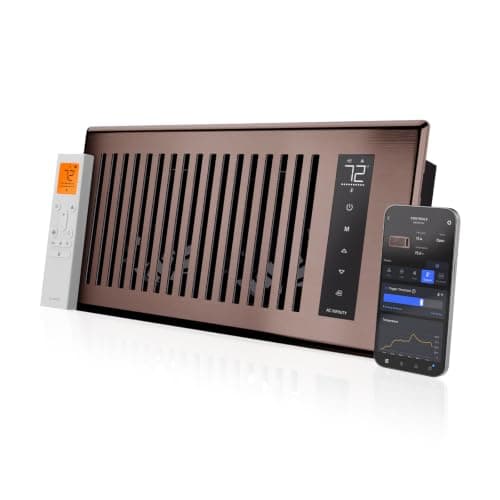 Best overall AC Infinity AIRTAP T4 Register Booster Fan 140 CFM at 16 dBA on 8 watts, with a thermostat controller that runs it only when the system is heating or cooling. | One room at the end of a duct run with weak supply air | |
| 2 | 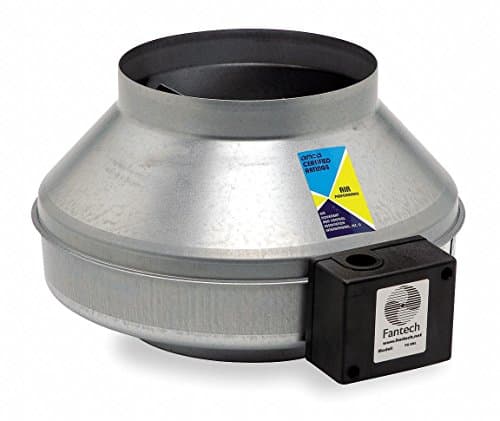 When the duct is the problem Fantech FG 8 Series In-Line Fan 390 CFM from an in-line fan mounted in the duct itself — the right tool when a whole branch is weak rather than one register. | A long branch run that never delivers, where the fix belongs upstream |
What it is
A fan that lives in the vent
A register booster replaces or sits behind the grille in a floor or wall register, pulling air out of the duct and into the room rather than waiting for system pressure to push it. Installation is a matter of minutes: lift the grille, set the unit in, plug it into a nearby socket.
That is the whole appeal — it is the only intervention in a forced-air system that requires no cutting, no wiring and no balancing of anything else. The cost is that it only acts at one outlet.
When it works
The cases where a booster is the correct answer
- The far room at the end of the longest run. Air took the path of least resistance and went somewhere else. A booster restores some balance without re-balancing the system.
- A room over a garage or an addition served by a branch the original system was not sized for.
- One bedroom that is two degrees behind the rest of the house. The classic case, and the one where 8 watts is obviously the right trade.
- A register blocked by furniture layout you cannot change — a booster gives the air enough velocity to leave the area.
This one is not a DIY job
When it does not
Three problems a booster cannot fix
- A closed or stuck damper. Branch dampers near the plenum get closed for a season and left. Free, and worth checking before you spend anything.
- A crushed, disconnected or leaking duct. Flexible duct kinked behind a joist, or a branch that has come apart in a crawl space, is delivering air to the wrong place entirely. A booster at the end of that duct pulls harder on nothing.
- An undersized or failing system. If every room is behind, the problem is the equipment or the whole duct design, and a fan at one outlet moves the shortfall to a different room rather than solving it.
There is a fourth case worth naming because it is so common: the room is not short of air, it is short of insulation or full of west-facing glass. Before boosting a register, rule out the building — a west-facing room and a bonus room over a garage both look like duct problems and usually are not.
Sizing
Register sizes, and what to measure
Boosters are sold by register opening, not by grille size, and the two differ by an inch or more. Lift the grille and measure the hole in the floor or wall.
- 4 x 10 in — the most common size in US houses, and what the AIRTAP T4 fits.
- 4 x 12 in — the next most common, with a matching model in the same range.
- 6 x 10, 6 x 12 and larger — usually returns rather than supplies. Do not put a supply booster in a return.
Noise
The one specification to insist on
A booster sits in the room, at floor level, often near a bed. Noise matters more here than airflow, and it is the specification most listings omit.
16 dBA on the AIRTAP T4 is a published figure from a manufacturer that publishes figures. For comparison, certified bathroom ventilating fans — the only category in home ventilation with a mandatory noise rating — go down to 0.1 sones, and the quiet register boosters are in a similar subjective range. Where a listing states no noise figure at all, assume it was not measured.
Say the unwelcome thing
Do not buy a booster before you check the damper and the duct.
A register booster is cheap enough to buy on impulse, which is exactly why it gets bought instead of a five-minute check. A branch damper closed since last winter, or a flex duct crushed behind a joist, will defeat any fan you fit at the outlet.
Tissue test at the register first, then check the damper, then buy. When air is genuinely arriving and simply not coming out fast enough, 140 CFM for 8 watts is the cheapest useful change in the entire category. When the whole branch is weak, an in-line fan in the duct is the honest fix.
In full
Every pick, and what is wrong with it
Published specifications only, each linked to the page it came from. Where a manufacturer publishes nothing, the row says so — we do not fill blanks in.
1. Best overall
AC Infinity AIRTAP T4 Register Booster Fan
AC Infinity · model AIRTAP T4
140 CFM at 16 dBA on 8 watts, with a thermostat controller that runs it only when the system is heating or cooling.
Two things make this the pick, and neither is airflow. The first is that AC Infinity publishes what it does: 140 CFM, 16 dBA, 8 W, 67,000-hour bearing life, in a category where most listings state a fan size and nothing else.
The second is the controller. It has cooling and heating triggers, so the booster runs when the system is actually delivering conditioned air and stops when it is not. A booster running continuously against a dead duct is just a noise source pulling room air through a hole in the floor.
8 watts is the number that settles the argument for a marginal room. An eight-hour night costs 1.2¢ at 18.34¢/kWh; a full month of nights is 35¢. Nothing else in home cooling changes a room for that.
It fits a 4 by 10-inch register opening, which is the most common floor and wall size in US houses, and the same model exists for 4 by 12. Measure the hole, not the grille.
What’s wrong with it
It can only move what the duct delivers to that register — if the branch is starved, a booster at the end of it has nothing to boost.
Running cost — AIRTAP T4
| Nameplate power | 8 W | manufacturer's published figure |
|---|---|---|
| Energy, 8-hour night | 0.06 kWh | 8 ÷ 1000 × 8 |
| Cost per hour | 0.1¢ | at 18.34¢/kWh |
| Cost per 8-hour night | 1.2¢ | on the highest speed |
| Cost per 30 nights | 35¢ | 1.9 kWh |
Rate: 18.34¢/kWh, the US average residential price for June 2026 (EIA Electric Power Monthly, Table 5.3). Yours will differ — swap it in: (watts ÷ 1000) × hours × your rate.
| Air delivery | 140 CFM |
|---|---|
| Noise | 16 dBA |
| Power | 8 W (12 V DC, 100-240 V AC adapter) |
| Efficiency | 17.5 CFM per watt (our arithmetic) |
| Register size | Fits 4 x 10 in openings |
| Control | LCD with heating and cooling triggers, speeds, timer; IR remote, Alexa and Google |
| Dimensions | 11.49 x 5.51 x 2.12 in |
| Cord | 72 in |
| Bearing life | 67,000 hours (L10) |
| Warranty | 2 years |
Every figure above is from AC Infinity product page, AIRTAP T4 for 4 x 10 in registers. Blanks are shown as “not published” rather than filled in.
2. When the duct is the problem
Fantech FG 8 Series In-Line Fan
Fantech · model FG 8 Series
390 CFM from an in-line fan mounted in the duct itself — the right tool when a whole branch is weak rather than one register.
A register booster works at the outlet. An in-line duct fan works in the duct, upstream, and moves the air for the whole branch. At 390 CFM it is a different order of capability, and a different order of installation: it has to be cut into the duct and wired.
Choose this when more than one register on the same run is weak, or when a single long branch serves an addition or a converted attic. Choose the register booster when one outlet in an otherwise healthy system underperforms.
In-line fans are also quieter at the grille for the same airflow, because the motor is nowhere near the room. The trade is access: everything is in a ceiling or a crawl space, and servicing means getting back to it. The category is covered in in-line duct fans.
What’s wrong with it
Requires cutting into ductwork and a wired connection — a different job from dropping a booster into a register opening.
Running cost
Fantech does not publish a wattage for the FG 8 Series, so we cannot calculate what it costs to run. We are not going to estimate one. If Fantech publishes a nameplate figure, this block will show the arithmetic.
| Air delivery | 390 CFM |
|---|---|
| Efficacy | 4.0 CFM per watt |
| Duct size | 8 in diameter |
| Unit type | In-line (single-port), mounted in the duct run |
| Noise (sones) | Not published for in-line units |
| ENERGY STAR | Certified |
Every figure above is from ENERGY STAR Certified Ventilating Fans dataset. Blanks are shown as “not published” rather than filled in.
Questions people actually ask
Frequently asked
Do register booster fans actually work?
For one weak register in an otherwise healthy system, yes — they pull more of the air that is already reaching the vent into the room. They cannot help if the duct is crushed, a damper is closed, or the system itself is undersized.
How much electricity does a register booster fan use?
Very little. The AC Infinity AIRTAP T4 publishes 8 watts, which is under two cents for an eight-hour night at the national average rate and about 35 cents for a month of nights.
What size register booster fan do I need?
Measure the opening in the floor or wall, not the grille — they differ by an inch or more. The most common US sizes are 4 by 10 and 4 by 12 inches, and boosters are sold to match those openings.
Register booster or in-line duct fan?
A booster for one underperforming outlet; an in-line fan when a whole branch is weak. The in-line unit moves far more air — 390 CFM against 140 — but has to be cut into the duct and wired, and it is quieter at the grille because the motor is elsewhere. In-line duct fans.
Are register booster fans noisy?
The good ones are not — 16 dBA is published for the AIRTAP T4 — but noise is the specification most listings omit, and the unit sits at floor level in the room. If a product states no noise figure, treat that as information.
Sources
Where these numbers came from
- AC Infinity product page, AIRTAP T4 for 4 x 10 in registers — 140 CFM, 16 dBA, 8 W at 12 V DC, controller triggers, dimensions, 67,000-hour bearing life and 2-year warranty
- ENERGY STAR Certified Ventilating Fans dataset — sones and CFM per watt for the certified ventilation category used as the noise comparison
- EIA Electric Power Monthly, Table 5.3 — average residential electricity price
Read next
Where to go from here
Back to Whole-House Airflow, or read how we pick.