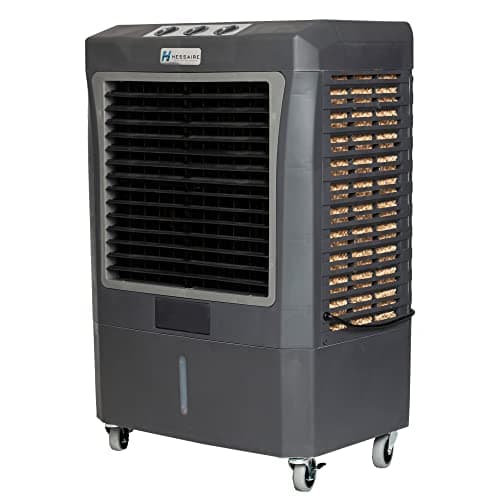
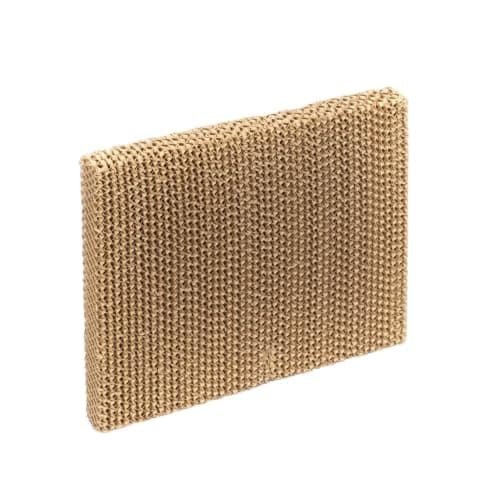
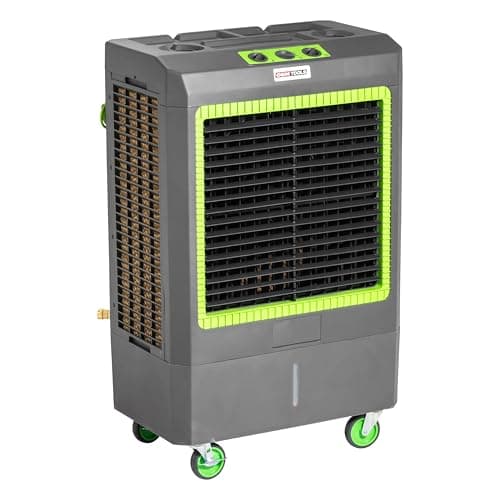
An evaporative cooler — a swamp cooler — pulls air through a wet pad. Evaporating water absorbs heat from that air, so what comes out is genuinely colder than what went in. This is real cooling, not the perceived effect a fan produces, and it costs roughly a fifth of what refrigeration costs.
It also has one absolute condition, and we would rather lead with it than bury it three sections down.
Say the unwelcome thing
If your summers are humid, skip this entire category.
The cooling comes from evaporation, and evaporation needs air with room to accept moisture. In Phoenix in June, at 15% relative humidity, that trade is excellent. In Houston, Miami, Atlanta or most of the eastern US in August, the air is already close to saturated — there is almost no evaporation available, so you get air that is barely cooler and noticeably damper. That feels worse than doing nothing.
There is a second effect that makes it worse still: your own body cools itself by evaporating sweat, using the same physics. Adding moisture to already-humid air makes it harder for your sweat to evaporate, so a swamp cooler in a humid room can leave you feeling warmer while the thermometer reads a degree lower.
Buying a bigger unit does not help. The limit is the air’s capacity to absorb water, not the machine’s ability to supply it. Check your afternoon humidity here before reading anything else in this section.
The threshold
Where the line is
Check your local relative humidity at 3–5pm on a hot day, not in the morning. Relative humidity falls as air warms even when the water content is unchanged, so a dawn reading dramatically overstates how humid the air will be when you would actually run the cooler.
- Under 30% — substantial, obvious cooling. This is what these are for.
- 30–40% — clear, useful cooling.
- 40–50% — modest cooling, noticeable dampness. Marginal.
- Over 60% — effectively a fan that adds humidity. Do not.
Broadly: the desert Southwest and interior West work well; the high plains and Mountain West are good until monsoon moisture arrives in July and August; the Southeast, Gulf Coast, Mid-Atlantic, Northeast, Midwest and coastal Pacific Northwest do not work at all.
Our own analysis
Every coverage claim in this category is CFM divided by 1.64
These units are sold on a square-footage figure, and that figure is what most buyers compare. So we checked it, by dividing each Honeywell model’s published CFM by its published coverage claim.
| Model | CFM | Claimed sq ft | Ratio |
|---|
| CO60PM | 2,697 | 1,643 | 1.64 |
|---|
| CO610PM | 2,669 | 1,626 | 1.64 |
|---|
| CO48PM | 1,702 | 1,037 | 1.64 |
|---|
| CL25AE | 764 | 466 | 1.64 |
|---|
| TC09PEU | 211 | 129 | 1.64 |
|---|
CFM and coverage figures from Honeywell’s own product pages. The division is ours, and you can reproduce it in a minute.
Every model returns 1.64 — from the 211 CFM desk unit to the 2,697 CFM outdoor one, across a thirteen-fold range of airflow. That is not a measurement. The square-footage figure is the airflow figure divided by a constant.
So a coverage claim tells you nothing the CFM number did not already tell you, and it cannot account for humidity — the one variable that decides whether the unit works at all. Which is why we rank these on CFM per watt instead.
Efficiency
Airflow per watt, and a surprise
| Model | CFM | Watts | CFM/W | 30 × 8 hrs |
|---|
| Hessaire MC37M | 3,100 | 250 | 12.4 | $11 |
|---|
| Honeywell CO60PM | 2,697 | 220 | 12.3 | $9.68 |
|---|
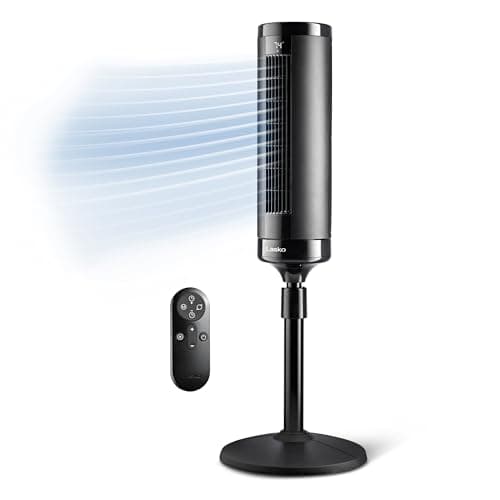
| Honeywell CL25AE | 764 | 235 | 3.3 | $10 |
|---|
Figures from manufacturer pages; CFM/W and cost are our arithmetic at 18.34¢/kWh.
The last row is the useful surprise. The small indoor unit draws more power than the large outdoor unit while moving roughly a quarter of the air. If you assumed the compact model was the frugal choice, it is not — you pay a substantial efficiency penalty for the form factor.
The second condition
They need somewhere for the humid air to go
Dry air is necessary but not sufficient. An evaporative cooler adds moisture continuously, so in a closed room the humidity climbs until evaporation slows and the cooling stops. The machine defeats itself within an hour or two.
It needs airflow through the space: an open window, an open door, a garage door up. That single requirement explains most of what these are good and bad at.
- Excellent: a garage with the door open — the ventilation is already there, the noise does not matter, and refrigeration in an uninsulated space would be futile anyway.
- Good: a patio or deck, where you are cooling people rather than a space.
- Workable: a single dry-climate room with a window open, using one of the quieter indoor units.
- Poor: a sealed bedroom, a screened porch on a still day, or anywhere you wanted a “ventless air conditioner” precisely because you could not open a window.
That last case is worth naming, because it is how a lot of people arrive here. Products sold as ventless air conditioners are usually evaporative coolers, and they specifically require the ventilation you do not have. The windowless-room options are here instead.
Upkeep
What owning one involves
These are the least maintenance-free appliances on this site, and it is worth knowing before you buy.
- Water. Tanks run from 6.6 to 15.9 gallons, and a hot day can empty one. Either refill it daily or plumb a continuous supply. In the arid regions where these work, water is also worth factoring into the running cost.
- Pads. The pad is the machine. A dry pad cools nothing, and a scaled or moldy one restricts airflow and smells. In hard-water areas mineral scale builds noticeably over a season. Rinse them periodically and treat them as a consumable.
- Storage. Drain and dry the unit before winter. Water left in a tank freezes and cracks things; pads left damp grow mold.
- Ice compartments are marketing. Several models offer one. The ice melts quickly and the heat it absorbs is trivial next to the evaporation doing the real work. Not a reason to choose a unit.
If all of that sounds like more than you want to manage, and your climate is marginal anyway, a certified window air conditioner asks nothing of you and works in any weather.