Guide and picks
How much water does an evaporative cooler use?
Tank capacity is on every box. Liters per hour is on none of them, and that is the number you actually need.
By Sawyer V. · Published
The short answer
No manufacturer we checked publishes a water consumption rate. Tank capacity is always stated — 6.6 to 15.9 gallons across the units here — but liters or gallons per hour is not. What consumption actually depends on is how dry your air is, because the cooling and the water use are the same process. The practical answer is to measure it: mark the tank, run it an hour, look again.
Fan & Frost earns a commission when you buy through our links, at no cost to you. It never changes a ranking, and we say so when the right answer is the cheaper unit or nothing at all. Full disclosure · How we pick.
At a glance
The picks, ranked
Tap any row to jump to the full reasoning. Prices are live from Amazon where we have them, and read “check price” where we don’t — never a number we cannot verify today.
| # | Product | Best for | Price |
|---|---|---|---|
| 1 | Largest tank, and a hookup option Honeywell CO60PM Indoor/Outdoor Evaporative Cooler 15.9 gallons with continuous hookup, at 2,697 CFM on 220 W — the largest reservoir of any unit we hold data for. | All-day running where refilling by hand is the limiting factor | |
| 2 | 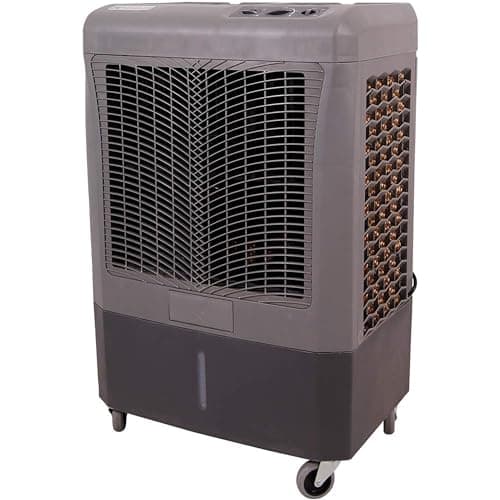 Best air-per-watt with a hookup Hessaire MC37M Mobile Evaporative Cooler 3,100 CFM on 250 W with a 10.3 gallon tank and continuous hookup capability. | A garage or workshop running on a permanent water connection | |
| 3 | Smallest tank, longest between problems Honeywell CL25AE Indoor Evaporative Cooler 6.6 gallons at 764 CFM and 235 W, with a 7.5 hour timer — sized so the tank and the session end together. | A single room, where a small tank is a feature rather than a limit | |
| — | 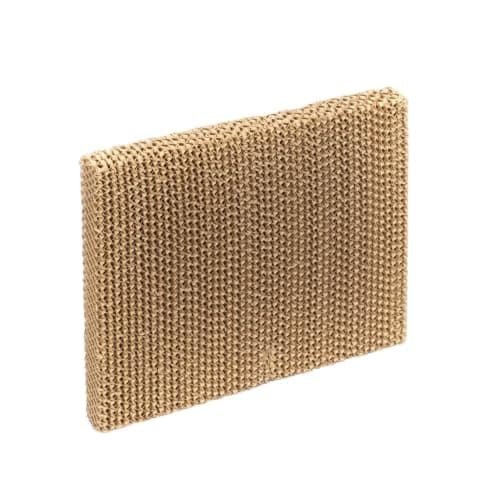 Where the water actually goes Hessaire CP370 Media Pad Set 21 x 23 inch media pads — the component that every mineral in your water ends up inside. | Understanding why hard water is the real running cost |
This is a reasonable question to ask before buying, and it is surprisingly hard to answer from published data.
What we found
Tank size is published. Consumption is not.
We went through the manufacturer pages for every evaporative cooler on this site looking for a water consumption rate — gallons per hour, liters per hour, anything.
None of them publishes one. What they all publish is tank capacity.
| Unit | Tank | Airflow | Consumption rate |
|---|---|---|---|
| Honeywell CO60PM | 15.9 gal | 2,697 CFM | not published |
| Hessaire MC37M | 10.3 gal | 3,100 CFM | not published |
| Honeywell CL25AE | 6.6 gal | 764 CFM | not published |
Manufacturer product pages. There is no certification program for evaporative coolers, so no independent figure exists either.
There is a defensible reason for the omission, and it is the same reason pad replacement intervals are not published: consumption genuinely depends on conditions the manufacturer cannot know.
Why it varies
Water use and cooling are the same thing
This is the concept that makes the whole category make sense.
An evaporative cooler cools by evaporating water into the air stream. Evaporation absorbs heat, and that heat comes out of the air passing through the pad. So the cooling you get is proportional to the water you evaporate. They are not two separate properties of the machine; they are the same event measured two ways.
Which produces some genuinely useful consequences:
- Drier air means more water use and more cooling. Air with capacity to absorb moisture takes more of it. This is why these machines work in deserts and not in Florida.
- Humid air means less water use and less cooling. If your tank is barely going down, the machine is barely working — which is diagnostic, not economical.
- More airflow means more water. A 3,100 CFM unit passes four times the air over its pad as a 764 CFM unit, and evaporates roughly in proportion.
- Running it on low uses less water and cools less. There is no efficiency setting to find here.
So “how much water does it use” has the same answer as “how well does it work”, and both depend on your climate. The humidity thresholds are here.
This one is not a DIY job
How to measure your own consumption in twenty minutes. Since nobody publishes it, this is the honest way to find out.
1. Fill the tank to a level you can identify — a molded line, or a mark you put on with tape.
2. Run the cooler normally for exactly one hour, at the speed you actually use, with the pump on.
3. Refill to the same mark using a measuring jug, and note how much it took. That is your consumption per hour, in your climate, on that setting.
Do it once in dry conditions and once in humid ones and you will have a range that tells you more than any published figure would — because it is your air, not a test chamber.
The real cost
The water is cheap. The minerals are not.
Municipal water costs vary enormously and we are not going to invent a national average to multiply. But there is a more useful point about cost that does not need one.
Evaporation leaves the minerals behind. Pure water leaves as vapor; everything dissolved in it stays in the pad and the tank. So the harder your water, the faster the media scales up and the sooner it needs replacing.
On a machine you run daily in hard water, the recurring cost is media and maintenance rather than water. Neither Hessaire nor Honeywell publishes a replacement interval, so the only guidance is inspection.
Two habits that materially reduce it:
- Run the fan without the pump for the last ten to fifteen minutes. Drying the media before it sits addresses both the scale and the biological growth.
- Drain the tank whenever it will be idle more than a day. Standing water concentrates minerals every hour it sits, and it is the origin of most cooler smells.
The full cleaning procedure, and how to tell when a pad is finished.
Practical
Tank, hookup, or neither
Hand-filled tank suits a machine used for a session — an evening on a patio, an afternoon in a workshop. A 6.6 gallon unit with a 7.5 hour timer is designed for exactly that shape of use.
Continuous hookup suits anything running all day. It is not only convenience: a float valve holds the level constant, which avoids the concentrate-and-refill cycle that precipitates minerals onto the pump and distributor. Both larger units here support it.
Neither, if your air is humid. A cooler in the wrong climate consumes very little water because very little evaporates — and delivers correspondingly little cooling while adding humidity you did not want.
Say the unwelcome thing
Do not judge an evaporative cooler by how little water it uses.
It is an intuitive way to compare machines and it is exactly backwards.
Water consumption is the physical measure of how much cooling is happening. A unit that goes through its tank quickly on a hot dry day is working well. A unit whose tank barely moves is not being frugal — it is not evaporating, which means it is not cooling.
If your cooler is using surprisingly little water, the diagnosis is usually one of three things: the air is too humid for the technology, the distributor is scaled shut so the pad is not wetting evenly, or the media is crusted over.
The last two are fixable. The first one is not, and calls for a different machine entirely.
In full
Every pick, and what is wrong with it
Published specifications only, each linked to the page it came from. Where a manufacturer publishes nothing, the row says so — we do not fill blanks in.
1. Largest tank, and a hookup option
Honeywell CO60PM Indoor/Outdoor Evaporative Cooler
Honeywell · model CO60PM
15.9 gallons with continuous hookup, at 2,697 CFM on 220 W — the largest reservoir of any unit we hold data for.
15.9 gallons. Tank size is the specification manufacturers do publish, and on a machine you intend to run all day it is the one that decides whether you actually use it.
The continuous hookup matters more. A float valve on a hose removes the refill question entirely, and it keeps the water level constant rather than cycling from full to nearly empty — which is when minerals concentrate and precipitate onto the pump and distributor.
2,697 CFM on 220 W, about 32¢ for an eight-hour day. 61 to 65 dBA is loud enough to talk over.
Treat the 1,643 sq ft coverage claim with care — it is a formula, not a measurement.
What’s wrong with it
15.9 gallons is over 130 lb of water when full, so this is cleaned and serviced where it stands.
Running cost — CO60PM
| Nameplate power | 220 W | manufacturer's published figure |
|---|---|---|
| Energy, 8-hour night | 1.76 kWh | 220 ÷ 1000 × 8 |
| Cost per hour | 4.0¢ | at 18.34¢/kWh |
| Cost per 8-hour night | 32¢ | on the highest speed |
| Cost per 30 nights | $9.68 | 52.8 kWh |
Rate: 18.34¢/kWh, the US average residential price for June 2026 (EIA Electric Power Monthly, Table 5.3). Yours will differ — swap it in: (watts ÷ 1000) × hours × your rate.
| Air delivery | 2,697 CFM |
|---|---|
| Power | 220 W |
| Water tank | 15.9 gallons, continuous hookup |
| Air throw | 30 ft |
| Noise | 61-65 dBA |
| Speeds | 3, with oscillation |
| Pads | Triple-sided honeycomb |
| Dimensions | 27.6 W x 18.3 D x 40 H in |
| Weight | 39.2 lb |
| Manufacturer coverage claim | 1,643 sq ft |
| Warranty | 1 year |
Every figure above is from Honeywell Air Comfort product page, CO60PM. Blanks are shown as “not published” rather than filled in.
2. Best air-per-watt with a hookup
Hessaire MC37M Mobile Evaporative Cooler
Hessaire · model MC37M
3,100 CFM on 250 W with a 10.3 gallon tank and continuous hookup capability.
3,100 CFM on 250 W is the most air per watt of the evaporative coolers we hold data for — and airflow is directly tied to water use, because both are proportional to how much evaporation is happening.
More air through the pad means more evaporation, which means more cooling and more water. Those are not separable. A cooler that is using very little water is not cooling much.
10.3 gallons with continuous hookup capability, and 37¢ for an eight-hour day of electricity.
Worth noting what Hessaire declines to publish: no coverage claim and no noise rating. We treat the absent coverage claim as a point in their favor.
What’s wrong with it
40 lb, no published noise rating, and Hessaire publishes no coverage claim either.
Running cost — MC37M
| Nameplate power | 250 W | manufacturer's published figure |
|---|---|---|
| Energy, 8-hour night | 2.00 kWh | 250 ÷ 1000 × 8 |
| Cost per hour | 4.6¢ | at 18.34¢/kWh |
| Cost per 8-hour night | 37¢ | on the highest speed |
| Cost per 30 nights | $11 | 60.0 kWh |
Rate: 18.34¢/kWh, the US average residential price for June 2026 (EIA Electric Power Monthly, Table 5.3). Yours will differ — swap it in: (watts ÷ 1000) × hours × your rate.
| Air delivery | 3,100 CFM |
|---|---|
| Power | 250 W / 2.4 A |
| Water tank | 10.3 gallons, continuous hookup capable |
| Dimensions | 24 L x 16 W x 38 H in |
| Weight | 40 lb |
| Pads | Industrial-grade cooling pads |
| Coverage claim | Not published on the product page |
Every figure above is from Hessaire product page, MC37M. Blanks are shown as “not published” rather than filled in.
3. Smallest tank, longest between problems
Honeywell CL25AE Indoor Evaporative Cooler
Honeywell · model CL25AE
6.6 gallons at 764 CFM and 235 W, with a 7.5 hour timer — sized so the tank and the session end together.
A small tank sounds like a disadvantage and in this category it frequently is not, because water consumption scales with airflow. A 764 CFM unit evaporates far less than a 3,100 CFM one, so 6.6 gallons lasts proportionally longer than the number suggests.
The 7.5 hour timer is the sensible companion to that: the machine is designed to run a session and stop, rather than run continuously on a hookup.
52 to 60 dBA is the quietest published figure of the three, and 25.4 lb means you can carry it to a tap rather than plumbing anything.
The honest weakness is efficiency: 235 W for 764 CFM against 220 W for 2,697 CFM on the CO60PM.
What’s wrong with it
235 W to move 764 CFM is poor air-per-watt against the larger units, which move three to four times the air on similar power.
Running cost — CL25AE
| Nameplate power | 235 W | manufacturer's published figure |
|---|---|---|
| Energy, 8-hour night | 1.88 kWh | 235 ÷ 1000 × 8 |
| Cost per hour | 4.3¢ | at 18.34¢/kWh |
| Cost per 8-hour night | 34¢ | on the highest speed |
| Cost per 30 nights | $10 | 56.4 kWh |
Rate: 18.34¢/kWh, the US average residential price for June 2026 (EIA Electric Power Monthly, Table 5.3). Yours will differ — swap it in: (watts ÷ 1000) × hours × your rate.
| Air delivery | 764 CFM |
|---|---|
| Power | 235 W |
| Water tank | 6.6 gallons |
| Air throw | 33 ft |
| Noise | 52-60 dBA |
| Speeds | 3, oscillating louvers |
| Timer | Up to 7.5 hours |
| Dimensions | 18.9 x 14.6 x 33.3 in |
| Weight | 25.4 lb |
| Manufacturer coverage claim | 466 sq ft |
| Warranty | 1 year |
Every figure above is from Honeywell Air Comfort product page, CL25AE. Blanks are shown as “not published” rather than filled in.
Skip this one
Hessaire CP370 Media Pad Set
Hessaire · model CP370
21 x 23 inch media pads — the component that every mineral in your water ends up inside.
Listed here because the interesting question about water is not how much you use but what it leaves behind.
Evaporative cooling evaporates pure water and leaves everything dissolved in it in the pad. Every gallon that passes through deposits its mineral content there. In hard water, the pad is the consumable your water bill is really paying for.
21 x 23 inches, fitting the MC37, M150 and MFC3600 chassis. And no published replacement interval, which is a real gap.
How to judge when a pad is finished — by inspection, since no calendar exists.
What’s wrong with it
Hessaire publishes no replacement interval for it, so there is no guidance on how often this cost recurs.
Running cost
Hessaire does not publish a wattage for the CP370, so we cannot calculate what it costs to run. We are not going to estimate one. If Hessaire publishes a nameplate figure, this block will show the arithmetic.
| Fits | MC37, M150 and MFC3600 (3,100 CFM) coolers |
|---|---|
| Pad size | 21 x 23 in |
| Type | Replacement media pad set |
| Replacement interval | Not published by the manufacturer |
Every figure above is from Hessaire parts page, CP370 media pad set. Blanks are shown as “not published” rather than filled in.
We are not linking a buy button for this one. If you want to look at it anyway, it is easy enough to find — but we would rather send you to something that fits your room.
Questions people actually ask
Frequently asked
How much water does an evaporative cooler use per hour?
No manufacturer we checked publishes a rate. Tank capacity is always stated — 6.6 to 15.9 gallons across the units here — but consumption per hour is not, because it depends on how dry your air is and how fast the fan is running.
How do I measure my cooler's water usage?
Fill the tank to a mark you can identify, run the cooler normally for exactly one hour with the pump on, then refill to the same mark with a measuring jug. That is your consumption per hour in your climate on that setting.
Why is my evaporative cooler using so little water?
Usually because it is not cooling much. Water use and cooling are the same event — evaporation absorbs the heat. Low consumption means either the air is too humid to absorb moisture, the distributor is scaled shut, or the media is crusted over.
Does an evaporative cooler use more water in dry weather?
Yes, and that is exactly when it works best. Dry air has capacity to absorb moisture, so more water evaporates and more heat is removed. High consumption on a hot dry day is the machine doing its job well.
Is a continuous water hookup worth it?
For all-day running, yes — and not only for convenience. A float valve holds the water level constant, avoiding the full-to-nearly-empty cycle that concentrates minerals and precipitates them onto the pump and distributor.
What does the water actually cost me?
Less than the media does, in hard water. Evaporation leaves every dissolved mineral behind in the pad, so hard water scales the media up faster and shortens its life — and no manufacturer publishes a replacement interval for that either. Pads: when to replace.
Sources
Where these numbers came from
- Honeywell CO60PM product page — 15.9 gal tank, continuous hookup, 2,697 CFM, 220 W
- Honeywell CL25AE product page — 6.6 gal tank, 764 CFM, 235 W, 7.5 h timer
- Hessaire MC37M product page — 10.3 gal tank, continuous hookup, 3,100 CFM, 250 W
- Hessaire CP370 media pad set — 21 x 23 in, no published replacement interval
Read next
Where to go from here
Back to Evaporative Coolers, or read how we pick.