Guide and picks
What size air conditioner do I need?
Five steps and about five minutes. Getting this wrong is the most expensive mistake in the category — and oversizing is worse than undersizing, which surprises almost everyone.
By Sawyer V. · Published
The short answer
Multiply the room’s length by its width in feet, then read the capacity off the ENERGY STAR table below — 5,000 BTU for 100–150 sq ft, 8,000 for 300–350, 12,000 for 450–550. Then apply four adjustments for sun, shade, occupancy and kitchens. If you are buying a portable, size from its SACC figure, not the number on the box.
Fan & Frost earns a commission when you buy through our links, at no cost to you. It never changes a ranking, and we say so when the right answer is the cheaper unit or nothing at all. Full disclosure · How we pick.

At a glance
The picks, ranked
Tap any row to jump to the full reasoning. Prices are live from Amazon where we have them, and read “check price” where we don’t — never a number we cannot verify today.
| # | Product | Best for | Price |
|---|---|---|---|
| 1 | If you calculated 5,000-6,000 BTU Midea U-Shaped Window Air Conditioner, 6,000 BTU The capacity most bedrooms actually need, and the lowest annual running cost of any unit we cover. | Bedrooms and rooms up to about 250 sq ft | |
| 2 | If you calculated 7,000-8,000 BTU GE Profile ClearView Window Air Conditioner, 8,000 BTU The best certified efficiency in its capacity class, in the lightest and shallowest body we found. | Larger bedrooms and living rooms, 300-350 sq ft | |
| 3 | 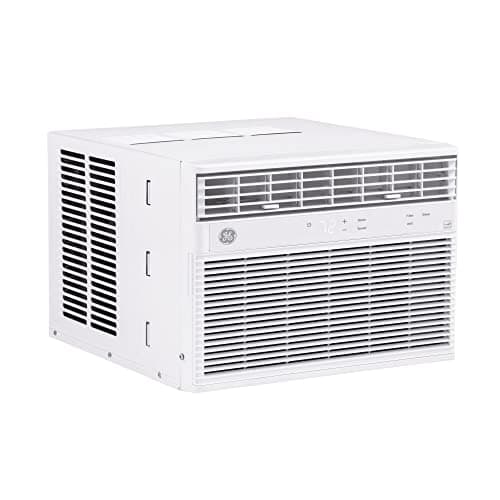 If you calculated 12,000-14,000 BTU GE Profile ClearView Window Air Conditioner, 14,000 BTU It holds CEER 16 at 14,000 BTU, which is unusual — efficiency normally falls as capacity rises. | Open-plan spaces, 550-700 sq ft | |
| — | 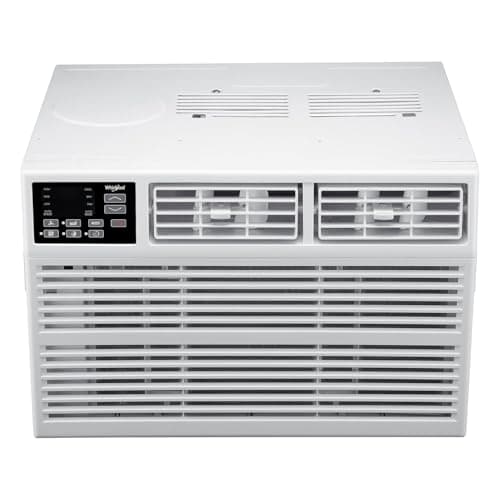 The one nobody should size into Whirlpool Window Air Conditioner, 24,000 BTU If your arithmetic produced 24,000 BTU for one room, the arithmetic is wrong. | 1,400+ sq ft, which is not a room |
Nearly every sizing page on the internet gives you “20 BTU per square foot” and stops. That rule is close enough in the middle of the range and meaningfully wrong at both ends, so we are going to use the actual table instead — and then do the two steps that the rule of thumb skips entirely.
Step one
Measure the room
Length times width, in feet. That is it. A 12 by 14 bedroom is 168 square feet.
Two things worth getting right while you have the tape out. If the space is open-plan — a living room that flows into a kitchen with no door between them — you are cooling all of it, so measure all of it. A room unit cannot cool one half of a shared volume. And if your ceilings are higher than eight feet, note that, because the table assumes eight.
Step two
Read the capacity off the table
This is the ENERGY STAR room air conditioner sizing table, reproduced exactly. It is the closest thing to an official answer that exists for consumer room units.
| Room area (sq ft) | Capacity needed (BTU/h) |
|---|---|
| 100 up to 150 | 5,000 |
| 150 up to 250 | 6,000 |
| 250 up to 300 | 7,000 |
| 300 up to 350 | 8,000 |
| 350 up to 400 | 9,000 |
| 400 up to 450 | 10,000 |
| 450 up to 550 | 12,000 |
| 550 up to 700 | 14,000 |
| 700 up to 1,000 | 18,000 |
| 1,000 up to 1,200 | 21,000 |
| 1,200 up to 1,400 | 23,000 |
| 1,400 up to 1,500 | 24,000 |
| 1,500 up to 2,000 | 30,000 |
| 2,000 up to 2,500 | 34,000 |
Source: ENERGY STAR, Room Air Conditioners. ENERGY STAR notes the capacities “are calculated based on an 8-foot ceiling.”
Our 168 sq ft bedroom falls in the 150–250 band: 6,000 BTU.
Notice the table is not linear. At 150 sq ft you need about 33 BTU per square foot; at 2,500 sq ft, about 14. Small rooms need proportionally more because the walls, ceiling and windows — where the heat actually comes in — do not shrink as fast as the floor area does. This is exactly where the 20-BTU rule of thumb misleads you, and small rooms are the common case.
Step three
Apply the four adjustments
ENERGY STAR publishes four corrections. All four are quoted verbatim below, and they matter — a sunny kitchen can shift the answer by a whole capacity band.
| If | Then |
|---|---|
| The room is heavily shaded | reduce capacity by 10 percent |
| The room is very sunny | increase capacity by 10 percent |
| More than two people regularly occupy the room | add 600 BTUs for each additional person |
| The unit is used in a kitchen | increase capacity by 4,000 BTUs |
All four quoted from ENERGY STAR.
Worked through on our 6,000 BTU bedroom: south-facing with afternoon sun, so add 10% → 6,600 BTU. Two people sleep there, which is the table’s baseline, so no change. Not a kitchen. Round to the nearest available capacity and you are buying a 7,000 BTU unit, or an 8,000 if 7,000 is hard to find in the form factor you need.
The kitchen adjustment is the one people forget and it is the biggest: +4,000 BTU. An oven and a cooktop are space heaters that happen to make dinner. A 250 sq ft open-plan kitchen-diner needs 7,000 + 4,000 = 11,000 BTU, not 7,000.
Higher ceilings: the table assumes eight feet, so a 10-foot ceiling is 25% more air to move. ENERGY STAR’s own guidance is to select a unit with a higher airflow rating rather than simply buying more capacity, because the extra volume is a circulation problem more than a heat-load one.
Step four
If it is a portable, size from SACC
This is the step almost nobody takes, and skipping it is how people end up with a “14,000 BTU” machine that cannot hold a bedroom.
A portable air conditioner’s box figure is measured under a standard that ignores the heat its exhaust duct radiates back into your room and the hot outside air that infiltrates to replace what it blew out. The DOE-rated SACC figure subtracts both.
Real published pairs, from the manufacturers themselves: the Midea Duo MAP14S1TBL is 14,000 BTU on the box and 12,000 BTU SACC. The Whynter ARC-14S is also 14,000 on the box and 9,500 BTU SACC — a 32% reduction.
So take the SACC number to the table above. 9,500 BTU SACC is a 350–400 sq ft machine, not a 550 sq ft one. The full explanation of why the two numbers differ is here, and it is worth ten minutes before you spend several hundred dollars.
Window units need no such correction. Their labeled capacity is their capacity, which is one of several reasons a window unit wins whenever one will physically fit.
Step five
Do not round up “to be safe”
Say the unwelcome thing
A bigger air conditioner is not a safer air conditioner.
ENERGY STAR states it plainly: “An oversized air conditioner costs more to purchase, wastes energy and does not provide better cooling.”
The mechanism is dehumidification. An air conditioner removes moisture only while it is actually running. An oversized unit hits the set temperature quickly, shuts off, and never runs long enough to pull water out of the air. The thermometer says 72°F and the room feels clammy — cold and damp rather than cool and dry. Then it short-cycles: on, off, on, off, which is hard on the compressor and wastes energy in every restart.
A correctly sized unit runs longer at lower intensity, which is exactly what you want. Where you land between two bands, prefer the smaller one unless a specific adjustment above pushed you up.
Worked examples
Four rooms, start to finish
| Room | Sq ft | Base | Adjustments | Buy |
|---|---|---|---|---|
| 12×12 shaded bedroom | 144 | 5,000 | Heavily shaded, −10% | 5,000 |
| 12×14 sunny bedroom | 168 | 6,000 | Very sunny, +10% | 7,000 |
| Studio apartment with kitchenette | 420 | 10,000 | Kitchen, +4,000 | 14,000 |
| 16×20 sunny living room, 4 people | 320 | 8,000 | +10% sun, +1,200 for 2 extra people | 10,000 |
The studio is the instructive one. On floor area alone it wants 10,000 BTU. The kitchenette adds 4,000 and pushes it to a completely different class of machine. Anyone sizing that room off a square-footage calculator alone buys 4,000 BTU too little and never works out why the place is warm when they cook.
Next
Once you know the number
Sizing is only the first constraint. The second is what will physically go in your window, and the third is what it costs to run.
- Window units by capacity — ranked on certified CEER and annual kWh, with real running costs.
- Portable units — for when a window unit will not fit, sized on SACC.
- What renters can install — the constraint that usually decides the form factor.
- The full BTU chart — if you just want the table on its own.
And if your room turns out to need less than 5,000 BTU, or you cannot install anything at all, a fan and a blind may genuinely be the right answer. We would rather say that than sell you a compressor.
In full
Every pick, and what is wrong with it
Published specifications only, each linked to the page it came from. Where a manufacturer publishes nothing, the row says so — we do not fill blanks in.
1. If you calculated 5,000-6,000 BTU
Midea U-Shaped Window Air Conditioner, 6,000 BTU
Midea · model MAW06V1QWT
The capacity most bedrooms actually need, and the lowest annual running cost of any unit we cover.
This is where most bedrooms land, and where most people over-purchase. 6,000 BTU covers 150–250 sq ft, which includes a 12×14 and a 12×16 room.
298 kWh a year — about $55 at 18.34¢/kWh for a whole cooling season, and on the ENERGY STAR Most Efficient list. The U-shape also puts the compressor outside a closed window, which matters in a room you sleep in.
What’s wrong with it
53.1 lb is a two-person lift for most people, and the U-shape needs a single-hung or double-hung sash window — not a casement or a slider.
Running cost — MAW06V1QWT
| Annual energy use | 298 kWh | ENERGY STAR certified figure |
|---|---|---|
| Annual cost | $55 | 298 × 18.34¢/kWh |
| Per cooling month | $14 | spread over a four-month season |
The annual figure is the certified value from the ENERGY STAR Certified Room Air Conditioners dataset, which models a standard cooling season rather than your actual summer. It is more useful than a nameplate wattage here, because a variable-speed compressor spends most of its life well below nameplate.
Rate: 18.34¢/kWh, the US average residential price for June 2026 (EIA Electric Power Monthly, Table 5.3). Yours will differ — swap it in: (watts ÷ 1000) × hours × your rate.
| Cooling capacity | 6,000 BTU/h |
|---|---|
| CEER | 15.1 |
| Annual energy use | 298 kWh/yr |
| vs federal standard | 37% less energy |
| Dimensions | 13.5 H x 19.2 W x 22.0 D in |
| Weight | 53.1 lb |
| Refrigerant | R-32 |
| Installation | U-shape; sash closes through the middle of the unit |
| Compressor | Variable speed |
| ENERGY STAR | Certified, and on the Most Efficient list |
Every figure above is from ENERGY STAR Certified Room Air Conditioners dataset. Blanks are shown as “not published” rather than filled in.
2. If you calculated 7,000-8,000 BTU
GE Profile ClearView Window Air Conditioner, 8,000 BTU
GE Profile · model PWJV08W
The best certified efficiency in its capacity class, in the lightest and shallowest body we found.
CEER 16 is the top of the 8,000 BTU class and works out to 375 kWh a year, about $69 — 47% less energy than the federal standard requires.
At 46.2 lb and 15.3 inches deep it is also the easiest unit in this class to actually get installed, which is the part people underestimate.
What’s wrong with it
It sits inside the window opening rather than straddling the sill, so check your sash height against its 12.6 inches before ordering. No noise figure is published.
Running cost — PWJV08W
| Annual energy use | 375 kWh | ENERGY STAR certified figure |
|---|---|---|
| Annual cost | $69 | 375 × 18.34¢/kWh |
| Per cooling month | $17 | spread over a four-month season |
The annual figure is the certified value from the ENERGY STAR Certified Room Air Conditioners dataset, which models a standard cooling season rather than your actual summer. It is more useful than a nameplate wattage here, because a variable-speed compressor spends most of its life well below nameplate.
Rate: 18.34¢/kWh, the US average residential price for June 2026 (EIA Electric Power Monthly, Table 5.3). Yours will differ — swap it in: (watts ÷ 1000) × hours × your rate.
| Cooling capacity | 8,000 BTU/h |
|---|---|
| CEER | 16 |
| Annual energy use | 375 kWh/yr |
| vs federal standard | 47% less energy |
| Dimensions | 12.6 H x 18.6 W x 15.3 D in |
| Weight | 46.2 lb |
| Refrigerant | R-32 |
| Installation | Does not straddle the windowsill |
| Support bracket | Required |
| Compressor | Variable speed |
| ENERGY STAR | Certified, and on the Most Efficient list |
Every figure above is from ENERGY STAR Certified Room Air Conditioners dataset. Blanks are shown as “not published” rather than filled in.
3. If you calculated 12,000-14,000 BTU
GE Profile ClearView Window Air Conditioner, 14,000 BTU
GE Profile · model PWJV14W
It holds CEER 16 at 14,000 BTU, which is unusual — efficiency normally falls as capacity rises.
656.3 kWh a year, about $120, and 50% below the federal standard. Compare that with a 14,000 BTU portable at 1,300 W, which costs more in two months of overnight running.
If your calculation landed here, double-check it. 14,000 BTU is a 550–700 sq ft machine, and a room that size is usually open-plan — which means you need to have measured the whole connected volume, not one part of it.
What’s wrong with it
70.1 lb is genuinely a two-person installation and past what many windows will take without a support bracket. Check your sill and local code first.
Running cost — PWJV14W
| Annual energy use | 656.3 kWh | ENERGY STAR certified figure |
|---|---|---|
| Annual cost | $120 | 656.3 × 18.34¢/kWh |
| Per cooling month | $30 | spread over a four-month season |
The annual figure is the certified value from the ENERGY STAR Certified Room Air Conditioners dataset, which models a standard cooling season rather than your actual summer. It is more useful than a nameplate wattage here, because a variable-speed compressor spends most of its life well below nameplate.
Rate: 18.34¢/kWh, the US average residential price for June 2026 (EIA Electric Power Monthly, Table 5.3). Yours will differ — swap it in: (watts ÷ 1000) × hours × your rate.
| Cooling capacity | 14,000 BTU/h |
|---|---|
| CEER | 16 |
| Annual energy use | 656.3 kWh/yr |
| vs federal standard | 50% less energy |
| Dimensions | 15.1 H x 20.2 W x 21.3 D in |
| Weight | 70.1 lb |
| Refrigerant | R-32 |
| Installation | Does not straddle the windowsill |
| Compressor | Variable speed |
| ENERGY STAR | Certified, and on the Most Efficient list |
Every figure above is from ENERGY STAR Certified Room Air Conditioners dataset. Blanks are shown as “not published” rather than filled in.
Skip this one
Whirlpool Window Air Conditioner, 24,000 BTU
Whirlpool · model WHAW-241IN
If your arithmetic produced 24,000 BTU for one room, the arithmetic is wrong.
24,000 BTU serves 1,400–1,500 sq ft on the table above, which is most of a small house rather than a room. It is here as a sanity check on your own calculation.
The cost of getting sizing wrong at this end is $260 a year against $69 — and worse comfort, because an oversized unit short-cycles and never dehumidifies properly.
What’s wrong with it
CEER 12.7 and 1,417.3 kWh a year — more than three and a half times the 8,000 BTU unit above — in a 115.7 lb body that needs a support bracket.
Running cost — WHAW-241IN
| Annual energy use | 1417.3 kWh | ENERGY STAR certified figure |
|---|---|---|
| Annual cost | $260 | 1417.3 × 18.34¢/kWh |
| Per cooling month | $65 | spread over a four-month season |
The annual figure is the certified value from the ENERGY STAR Certified Room Air Conditioners dataset, which models a standard cooling season rather than your actual summer. It is more useful than a nameplate wattage here, because a variable-speed compressor spends most of its life well below nameplate.
Rate: 18.34¢/kWh, the US average residential price for June 2026 (EIA Electric Power Monthly, Table 5.3). Yours will differ — swap it in: (watts ÷ 1000) × hours × your rate.
| Cooling capacity | 24,000 BTU/h |
|---|---|
| CEER | 12.7 |
| Annual energy use | 1,417.3 kWh/yr |
| vs federal standard | 35% less energy |
| Dimensions | 20.7 H x 30.0 W x 28.8 D in |
| Weight | 115.7 lb |
| Refrigerant | R-32 |
| Installation | Straddles the window; support bracket territory |
| ENERGY STAR | Certified |
Every figure above is from ENERGY STAR Certified Room Air Conditioners dataset. Blanks are shown as “not published” rather than filled in.
We are not linking a buy button for this one. If you want to look at it anyway, it is easy enough to find — but we would rather send you to something that fits your room.
Questions people actually ask
Frequently asked
What size air conditioner do I need for a 12x12 room?
144 square feet falls in the ENERGY STAR table's 100-to-150 band, so 5,000 BTU per hour. Add 10 percent if it is very sunny, subtract 10 percent if heavily shaded, and add 600 BTU for each person beyond two who regularly occupies it.
How many BTUs do I need per square foot?
About 20 BTU per square foot as a rough average, but the relationship is not linear: the ENERGY STAR table works out to roughly 33 BTU per square foot at 150 sq ft and about 14 at 2,500. Small rooms need proportionally more, so use the table rather than the rule.
Is it better to oversize or undersize an air conditioner?
Undersize, if you must choose. ENERGY STAR states that an oversized unit costs more, wastes energy and does not cool better. It reaches the set temperature too quickly, shuts off before it has removed moisture, and leaves the room cold and clammy while short-cycling the compressor.
Do I need more BTU for high ceilings?
The table assumes an 8-foot ceiling, so a 10-foot ceiling means 25 percent more air in the room. ENERGY STAR's guidance is to choose a unit with a higher airflow rating rather than simply buying more cooling capacity, because the extra volume is mostly a circulation problem.
Does the kitchen adjustment really add 4,000 BTU?
Yes, that is ENERGY STAR's own figure, and it is the adjustment people most often skip. An oven and cooktop are substantial heat sources. A 250 sq ft open-plan kitchen-diner needs 7,000 plus 4,000, which is 11,000 BTU, not 7,000.
Should I size a portable air conditioner the same way?
Same table, different input. Use the unit's DOE-rated SACC figure rather than the BTU number on the box, because SACC accounts for exhaust duct heat and infiltration. A unit sold as 14,000 BTU can be rated 9,500 SACC, which is a 400 sq ft machine rather than a 550 sq ft one. Why the two numbers differ.
Sources
Where these numbers came from
Read next
Where to go from here
Back to Guides & Calculators, or read how we pick.