The picks
The best floor fans and air circulators
Three quite different machines get sold as floor fans, and they do different jobs. Getting the distinction right is most of choosing correctly.
By Sawyer V. · Published
The short answer
For moving air across a whole room, an air circulator like the Vornado 630 — a focused vortex that holds together up to a published 70 ft. For maximum air cheaply, a 20-inch box fan at 73–102 W. For drying or a workshop, an air mover at 178 W. They are not interchangeable.
Fan & Frost earns a commission when you buy through our links, at no cost to you. It never changes a ranking, and we say so when the right answer is the cheaper unit or nothing at all. Full disclosure · How we pick.
At a glance
The picks, ranked
Tap any row to jump to the full reasoning. Prices are live from Amazon where we have them, and read “check price” where we don’t — never a number we cannot verify today.
| # | Product | Best for | Price |
|---|---|---|---|
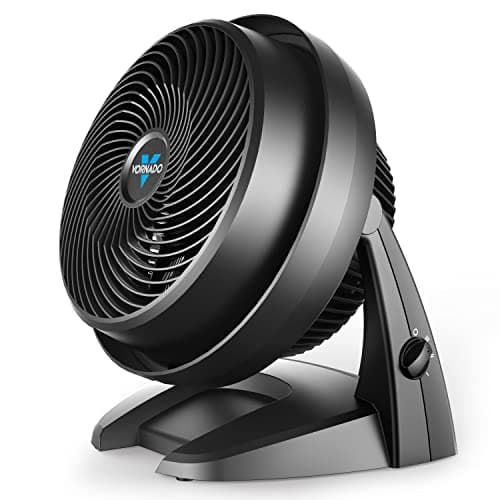
| 1 | Best for whole-room circulation Vornado 630 Medium Air Circulator A published 70 ft reach and a 5-year warranty — it circulates a room rather than stirring its own corner. | Moving air across a whole room rather than at one person | |
| 2 | Most air for the money Lasko Power Plus 20" Box Fan 73-102 W published, a weather-resistant motor and a 2-year warranty — and it doubles as a window fan. | A window, a garage, or washing a big area with air cheaply | |
| 3 | 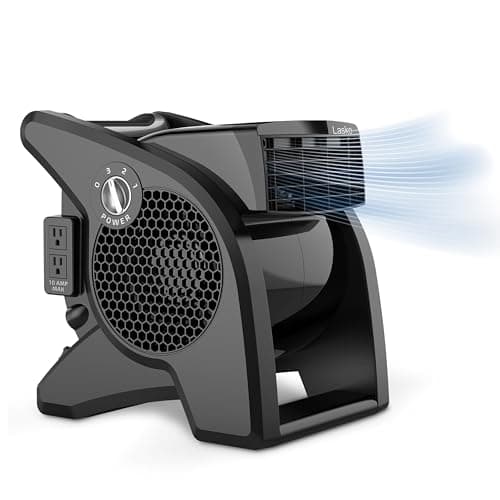 Best for a workshop Lasko Max Performance 15" Air Mover 178 W of directed high-velocity air with two accessory outlets and a 9.5 ft cord — built for a job site. | Drying, ventilating a work area, or a garage | |
| 4 | 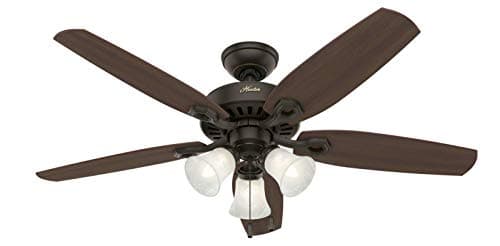 What actually circulates a room best Hunter Vespucci 52" Ceiling Fan 1.8 W on low at a certified 366.7 CFM per watt, moving air across the entire room from above. | A room you own, where the goal is whole-room air movement | |
| — |  The one to skip for this job Lasko Wind Curve 42" Tower Fan 720 CFM at 49 W, spread over a tall column that goes nowhere in particular. | A bedroom, not a room you are trying to circulate |
“Floor fan” covers three genuinely different machines, and most disappointment in this category comes from buying one and expecting another.
Three tools
Reach, spread and velocity are not the same thing
| Type | Airflow shape | Built for | Watts |
|---|---|---|---|
| Air circulator | Focused vortex that holds together over distance | Circulating a whole room | Not published |
| Box fan | Broad, slow flow across a 20-inch face | Moving lots of air a short way, or a window | 73 – 102 W |
| Air mover | Narrow high-velocity jet aimed low | Drying floors, ventilating a work area | 160 – 178 W |
A circulator and a box fan can move similar total volumes of air and produce completely different results in a room. The circulator’s column arrives at the far wall with velocity left in it, deflects, and sets up a loop that turns over the whole room. The box fan’s broad slow flow runs out of energy within a few feet and stirs its own neighborhood.
Neither is better. They answer different questions: “I want the air in this whole room moving” versus “I want a lot of air, right here, cheaply.”
The data problem
What is and is not published
This category is poorly documented, and you should know that going in.
- Vornado publishes a distance in feet, a speed count and a warranty. No wattage, no CFM, no weight, no dimensions, no noise.
- Lasko publishes wattage, dimensions, weight and warranty on both the box fan and the air mover — but no CFM on either.
- ENERGY STAR publishes certified CFM per watt for ceiling fans, which is why the ceiling fan pick above is the only product here we can rank on genuine efficiency.
So a real efficiency ranking of floor fans is not possible from published data, and anyone presenting one has estimated something. We rank on published wattage, published reach claims, build features and warranty, and we mark the gaps.
Say the unwelcome thing
Do not read a distance claim and a CFM figure as comparable.
“Moves air up to 70 feet” and “720 CFM” are not two measurements of the same thing. The first is how far a detectable airstream travels; the second is a volume per minute.
A fan can score well on either while doing badly on the other. A narrow high-velocity jet travels a long way and moves modest total volume — a garden hose with a thumb over the end. A wide slow flow moves enormous volume and goes nowhere.
Decide which you need first, then compare within that group.
Placement
Getting a circulator to actually circulate
This is the part people get wrong, and it is the difference between an air circulator working and feeling like an expensive fan.
- Aim it at a wall, not at yourself. A circulator is designed to bounce its column off a far surface and set up a room-wide loop. Pointing it at your chair turns it into an ordinary fan and wastes the design.
- Aim across the longest dimension. Down the length of a room, not across its width, so the vortex has room to develop.
- Give it clear air in front. A sofa two feet in front of a circulator stops it dead.
- Combine it with a window. A circulator aimed at an open window pushes hot air out, and once the evening air is cooler than the room that is genuine cooling rather than a breeze — the window rule is here.
And if the room is genuinely hot rather than stuffy, none of this is the answer. Above roughly 95°F moving air stops helping at all, and you want something that removes heat.
In full
Every pick, and what is wrong with it
Published specifications only, each linked to the page it came from. Where a manufacturer publishes nothing, the row says so — we do not fill blanks in.
1. Best for whole-room circulation
Vornado 630 Medium Air Circulator
Vornado · model 630
A published 70 ft reach and a 5-year warranty — it circulates a room rather than stirring its own corner.
An air circulator is designed around a different goal from a normal fan. A shrouded, deep-pitch blade produces a focused rotating column of air that holds together over distance instead of dissipating within a few feet. Aim it at a far wall and it sets up circulation around the whole room, rather than a directed breeze at whoever is in front of it.
Vornado’s published claim is “moves air up to 70 feet”. In a long room that is a genuinely different capability from a box fan stirring its immediate surroundings.
The 5-year warranty is the other real differentiator — five times what most of this category offers, and with no performance data published it is one of the few signals available.
We cannot tell you what it costs to run. Vornado publishes no wattage and no CFM for it. For a site that computes running costs from published figures, that is a real limitation, and we say so rather than estimating. A $15 plug-in energy meter would settle it, and we would like to know.
What’s wrong with it
Vornado publishes no wattage, no CFM, no dimensions and no weight — only a distance. That is the least complete spec sheet on this site, and no running cost can be calculated from it.
Running cost
Vornado does not publish a wattage for the 630, so we cannot calculate what it costs to run. We are not going to estimate one. If Vornado publishes a nameplate figure, this block will show the arithmetic.
| Power | Not published |
|---|---|
| Airflow reach | Moves air up to 70 ft |
| Speeds | 3 |
| Air delivery (CFM) | Not published |
| Dimensions | Not published |
| Weight | Not published |
| Warranty | 5 years |
Every figure above is from Vornado product page, 630. Blanks are shown as “not published” rather than filled in.
2. Most air for the money
Lasko Power Plus 20" Box Fan
Lasko · model B20801
73-102 W published, a weather-resistant motor and a 2-year warranty — and it doubles as a window fan.
A box fan moves a large volume of air at low velocity across a broad 20-inch face. That is the opposite profile to the circulator — lots of air, not far.
73–102 W published, which at least lets you compute the cost: about $4.49 for a month of eight-hour nights at 18.34¢/kWh.
The weather-resistant motor and 4.75-inch depth are what make it dual-purpose. Its single best use is not standing on a floor at all — it is sitting in a window exhausting hot air, where it stops making you feel cooler and starts actually lowering the room temperature.
What’s wrong with it
No published CFM, which on a fan sold on volume is a real gap. Its broad slow flow does not reach across a large room the way a circulator's vortex does.
Running cost — B20801
| Nameplate power | 73 W – 102 W | manufacturer's published figure |
|---|---|---|
| Energy, 8-hour night | 0.82 kWh | 102 ÷ 1000 × 8 |
| Cost per hour | 1.9¢ | at 18.34¢/kWh |
| Cost per 8-hour night | 15¢ | on the highest speed |
| Cost per 30 nights | $4.49 | 24.5 kWh |
| Same month, lowest speed | $3.21 | at 73 W |
Rate: 18.34¢/kWh, the US average residential price for June 2026 (EIA Electric Power Monthly, Table 5.3). Yours will differ — swap it in: (watts ÷ 1000) × hours × your rate.
| Power | 73 W - 102 W (0.6-0.9 A at 120 V) |
|---|---|
| Speeds | 3 |
| Dimensions | 21.25 H x 22.5 x 4.75 in |
| Weight | 10.1 lb |
| Motor | Weather-resistant |
| Air delivery (CFM) | Not published |
| Warranty | 2 years |
Every figure above is from Lasko product page, B20801. Blanks are shown as “not published” rather than filled in.
3. Best for a workshop
Lasko Max Performance 15" Air Mover
Lasko · model U15720
178 W of directed high-velocity air with two accessory outlets and a 9.5 ft cord — built for a job site.
An air mover is the third distinct machine in this category, and it is built to dry a floor rather than cool a person. It concentrates air into a narrow, fast stream aimed low across a surface.
160–178 W published — $7.83 for a month of eight-hour days. That is nine times the DC tower fan, and it buys you velocity rather than comfort.
Two details that matter in a garage and nowhere else: two 120 V accessory outlets on the unit and a 9.5-foot cord. In a workshop with one badly placed socket, that is genuinely useful.
12.55 lb with a pivoting head, so it aims where you need it. The garage page covers this properly.
What’s wrong with it
160-178 W and no published CFM. It is loud by design and produces a narrow jet, which is exactly wrong for making a living room comfortable.
Running cost — U15720
| Nameplate power | 160 W – 178 W | manufacturer's published figure |
|---|---|---|
| Energy, 8-hour night | 1.42 kWh | 178 ÷ 1000 × 8 |
| Cost per hour | 3.3¢ | at 18.34¢/kWh |
| Cost per 8-hour night | 26¢ | on the highest speed |
| Cost per 30 nights | $7.83 | 42.7 kWh |
| Same month, lowest speed | $7.04 | at 160 W |
Rate: 18.34¢/kWh, the US average residential price for June 2026 (EIA Electric Power Monthly, Table 5.3). Yours will differ — swap it in: (watts ÷ 1000) × hours × your rate.
| Power | 160 W - 178 W (1.35-1.53 A at 120 V) |
|---|---|
| Speeds | 3 |
| Dimensions | 14.5 H x 14.0 D x 11.5 W in |
| Weight | 12.55 lb |
| Extras | Two 120 V accessory outlets, 9.5 ft cord, pivoting head |
| Air delivery (CFM) | Not published |
| Warranty | 1 year |
Every figure above is from Lasko product page, U15720. Blanks are shown as “not published” rather than filled in.
4. What actually circulates a room best
Hunter Vespucci 52" Ceiling Fan
Hunter · model Vespucci
1.8 W on low at a certified 366.7 CFM per watt, moving air across the entire room from above.
If the goal is whole-room circulation rather than a directed breeze, a ceiling fan does it better than anything standing on the floor, and the certified data makes the case without argument.
366.7 CFM per watt certified, 1.8 W on low, 13.9 W on high. About 7.9¢ for a month of nights. The box fan above costs $4.49 for the same hours, and the Vornado will not tell you.
It also circulates from above, which is the right place — air pushed down from the ceiling reaches the whole floor area, whereas a floor fan has to fight its way past furniture. The full ranking is here.
What’s wrong with it
Permanent installation with wiring and clearance requirements. You cannot move it, and in a rental it is usually not permitted.
Running cost — Vespucci
| Nameplate power | 1.8 W – 13.9 W | manufacturer's published figure |
|---|---|---|
| Energy, 8-hour night | 0.11 kWh | 13.9 ÷ 1000 × 8 |
| Cost per hour | 0.3¢ | at 18.34¢/kWh |
| Cost per 8-hour night | 2.0¢ | on the highest speed |
| Cost per 30 nights | 61¢ | 3.3 kWh |
| Same month, lowest speed | 7.9¢ | at 1.8 W |
Rate: 18.34¢/kWh, the US average residential price for June 2026 (EIA Electric Power Monthly, Table 5.3). Yours will differ — swap it in: (watts ÷ 1000) × hours × your rate.
| Blade span | 52 in |
|---|---|
| Efficiency | 366.7 CFM per watt |
| Power, high speed | 13.9 W |
| Power, low speed | 1.8 W |
| Standby power | 0.8 W |
| Type | Indoor, fan only (no light kit) |
| Warranty | 3 years, components |
| ENERGY STAR | Certified |
Every figure above is from ENERGY STAR Certified Ceiling Fans dataset. Blanks are shown as “not published” rather than filled in.
Skip this one
Lasko Wind Curve 42" Tower Fan
Lasko · model 2554
720 CFM at 49 W, spread over a tall column that goes nowhere in particular.
Tower fans get bought for large rooms because they look substantial and one of them publishes a big CFM number. Volume without velocity does not circulate a room.
720 CFM is genuinely a lot of air, and it is delivered as a soft, wide column that dissipates within a few feet. That is exactly what you want beside a bed and exactly what you do not want when trying to move air from one end of a room to the other.
37–49 W — $2.16 a month of nights, roughly 27 times the ceiling fan on low.
It is a good bedroom fan. It belongs in that roundup, not this one.
What’s wrong with it
37-49 W with no published noise figure, and a tower fan's soft wide column has no reach. For circulating a large room it is the wrong airflow shape entirely.
Running cost — 2554
| Nameplate power | 37 W – 49 W | manufacturer's published figure |
|---|---|---|
| Energy, 8-hour night | 0.39 kWh | 49 ÷ 1000 × 8 |
| Cost per hour | 0.9¢ | at 18.34¢/kWh |
| Cost per 8-hour night | 7.2¢ | on the highest speed |
| Cost per 30 nights | $2.16 | 11.8 kWh |
| Same month, lowest speed | $1.63 | at 37 W |
Rate: 18.34¢/kWh, the US average residential price for June 2026 (EIA Electric Power Monthly, Table 5.3). Yours will differ — swap it in: (watts ÷ 1000) × hours × your rate.
| Power | 37 W - 49 W (0.4 A at 120 V) |
|---|---|
| Air delivery | 720 CFM |
| Speeds | 3 |
| Height | 42.5 in |
| Footprint | 13 x 13 in |
| Weight | 10.62 lb |
| Timer | 7.5-hour auto-off |
| Noise | Not published |
| Warranty | 1 year |
Every figure above is from Lasko product page, 2554. Blanks are shown as “not published” rather than filled in.
We are not linking a buy button for this one. If you want to look at it anyway, it is easy enough to find — but we would rather send you to something that fits your room.
Questions people actually ask
Frequently asked
What is the difference between a floor fan and an air circulator?
Airflow shape. A circulator uses a shrouded deep-pitch blade to produce a focused vortex that holds together over distance — Vornado claims up to 70 ft — so it sets up circulation around a whole room. A conventional floor or box fan produces a broad slow flow that dissipates within a few feet.
How much electricity does a floor fan use?
It depends which kind. A 20-inch box fan draws 73 to 102 W, about $4.49 for thirty eight-hour nights at 18.34¢/kWh. An air mover draws 160 to 178 W. Vornado publishes no wattage for its circulators, so no running cost can be calculated for them.
Are Vornado fans worth it?
The 70 to 80 ft reach claim describes a genuinely different capability from an ordinary fan, and the 5-year warranty is five times the category norm. The difficulty is that Vornado publishes no wattage, no CFM, no weight and no noise figure, so you are buying on a distance claim and a warranty.
Which floor fan moves the most air?
Nobody publishes the figures to answer this. Lasko publishes no CFM for its box fan or air mover, and Vornado publishes none for its circulators. Only ceiling fans have certified airflow data, via ENERGY STAR's CFM-per-watt figure.
Should I aim an air circulator at myself?
No — that wastes the design. A circulator is built to bounce a focused column off a far wall and set up a loop that turns over the whole room. Aim it down the longest dimension of the room, at a wall, with clear air in front of it.
Is an air mover the same as a floor fan?
No. An air mover concentrates air into a narrow high-velocity jet aimed low across a surface, which is designed for drying floors rather than cooling people. In a living room it produces an unpleasant directed blast on one person and little else, at 160 to 178 W.
Sources
Where these numbers came from
- Vornado 630 air circulator — 70 ft reach, 5-year warranty, no wattage published
- Lasko B20801 box fan specifications — 73-102 W, weather-resistant motor
- Lasko U15720 air mover specifications — 160-178 W, two accessory outlets
- ENERGY STAR Certified Ceiling Fans dataset — certified CFM per watt
- EIA Electric Power Monthly, Table 5.3 — electricity rate
Read next
Where to go from here
Back to Fans, or read how we pick.