The picks
The best ceiling fans for a living room
This is the room where a big fan finally has space to be a big fan, and where the light-kit decision costs the most efficiency.
By Sawyer V. · Published
The short answer
Buy the largest span the room and ceiling allow. Span raises the floor on efficiency: median CFM per watt rises from 148.6 to 306.0 across span bands in the certified data. The leader is 483.0 CFM per watt at 60 inches on 16.2 W. And note the light-kit trade — zero of 1,398 certified fans ship an ENERGY STAR lamp.
Fan & Frost earns a commission when you buy through our links, at no cost to you. It never changes a ranking, and we say so when the right answer is the cheaper unit or nothing at all. Full disclosure · How we pick.
At a glance
The picks, ranked
Tap any row to jump to the full reasoning. Prices are live from Amazon where we have them, and read “check price” where we don’t — never a number we cannot verify today.
| # | Product | Best for | Price |
|---|---|---|---|
| 1 | Best overall Aeratron AE+2 60" Ceiling Fan 483.0 CFM per watt at 60 inches — the most efficient certified ceiling fan we hold data for, at 16.2 W on high. | A living room with 9 ft ceilings and no need for a light kit | |
| 2 | Best with a light kit Visual Comfort Kingston 72" LED Ceiling Fan 385.0 CFM per watt across 72 inches with a light kit — the best efficiency we hold data for in a lit fan. | A living room where the fan replaces the main light fitting | |
| 3 | 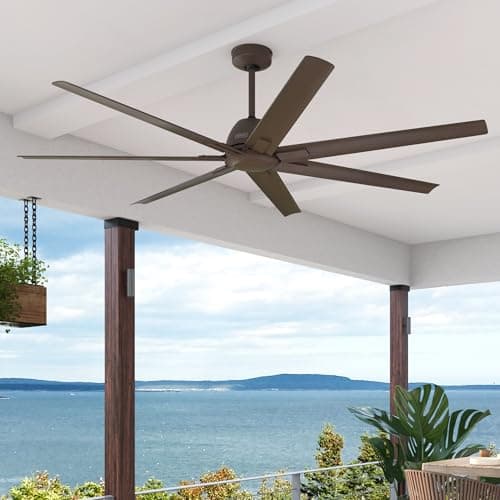 Best for an indoor-outdoor room Hunter Lakeway 72" Ceiling Fan 329.1 CFM per watt at 72 inches with 2.3 W on low, rated for indoor and outdoor use. | A living room that opens onto a terrace, or a sunroom | |
| — | 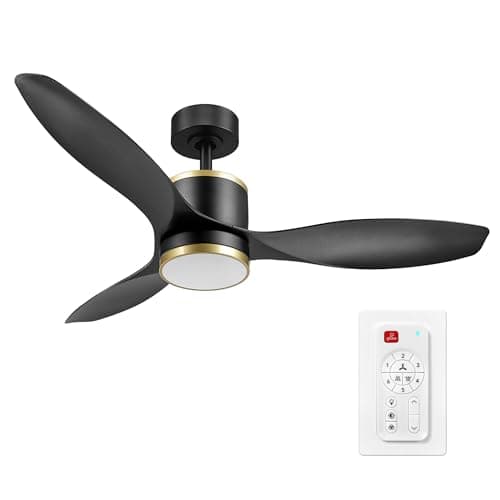 Too small for this room Globe 48" Ceiling Fan with Light Kit 270.7 CFM per watt at 48 inches — a small-room fan in a room that will swallow it. | A bedroom or study — not a living room |
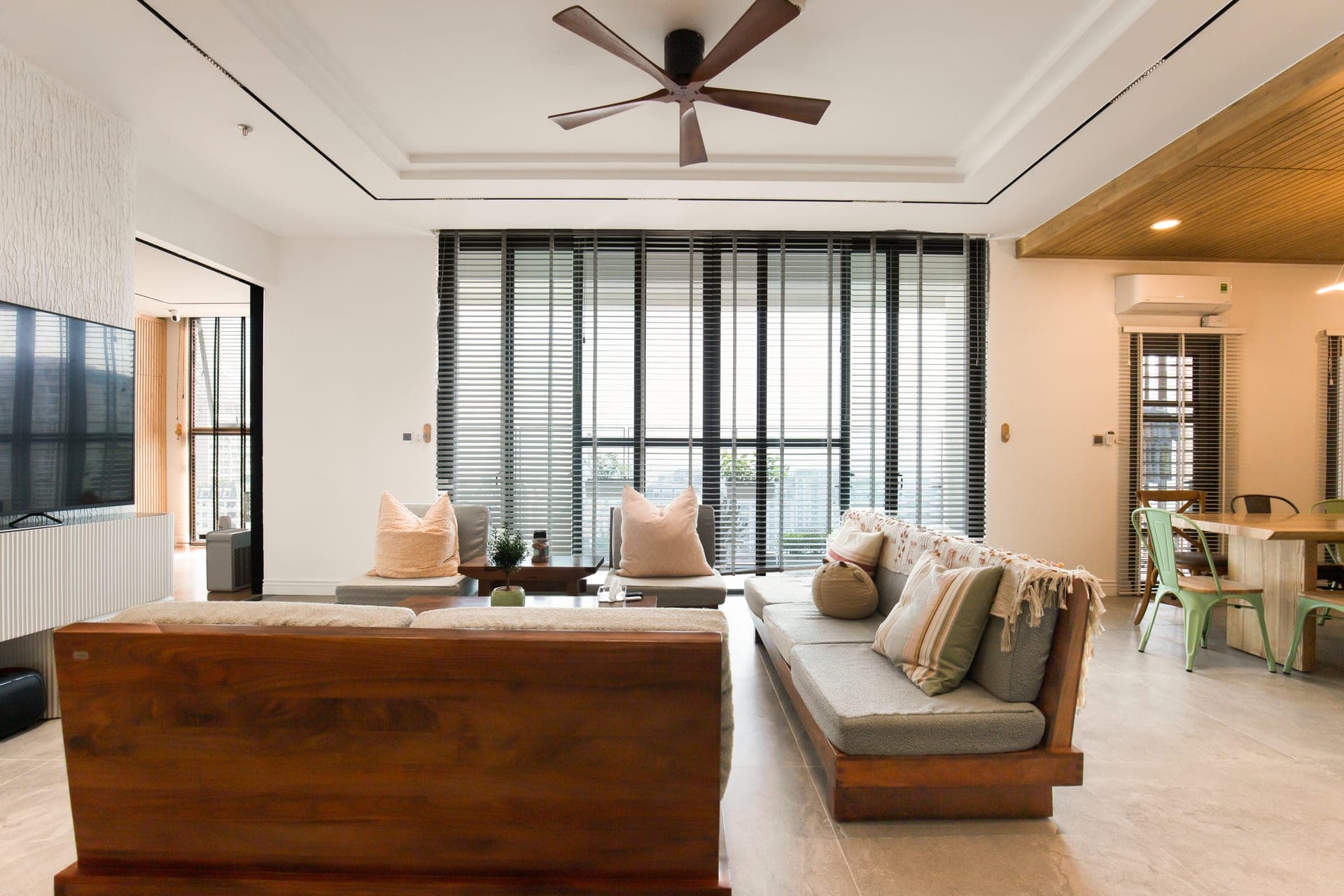
A living room is usually the largest space in the house with a ceiling fixture, which makes it the one room where fan sizing genuinely matters.
Method
What we ranked on
Every fan here is drawn from the ENERGY STAR Certified Ceiling Fans dataset, which holds 1,398 US records with tested CFM per watt and wattage at each speed. We ranked on:
- Span, filtered to sizes that suit a living room — 52 inches and up.
- CFM per watt, the certified efficiency figure.
- Low-speed wattage, because an evening in a living room is spent on low.
- Standby power, which is drawn all year and is published but almost never discussed.
We did not rank on noise, because no ceiling fan publishes a noise rating. The program records efficiency, wattage and standby, and has no acoustic field at all.
The rule
Span raises the floor, design sets the ceiling
Across all 1,398 certified records, median CFM per watt rises from 148.6 in the smallest span band to 306.0 in the largest. Bigger is, on average, roughly twice as efficient.
But the maximum does not follow the same curve. The most efficient fan certified is a 60-inch model at 483.0 CFM per watt, which beats the best 84-inch fan at 422.2.
The practical reading for a living room: a larger span improves your odds, not your ceiling. Going from 48 inches to 60 makes a poor fan less likely; it does not automatically get you a good one. Read the certified figure.
| Fan | Span | CFM/W | High | Low | Light kit |
|---|---|---|---|---|---|
| Aeratron AE+2WI60 | 60 in | 483.0 | 16.2 W | 2.9 W | No |
| Harbor Breeze Cando | 84 in | 422.2 | 30.6 W | 6.0 W | No |
| Fanimation MAD8531 | 84 in | 420.0 | 36.4 W | 3.3 W | No |
| Hunter 53606 | 60 in | 413.5 | 14.3 W | 1.0 W | No |
| Delta Breez VCA728 | 72 in | 409.2 | 25.4 W | 2.7 W | No |
| Visual Comfort Kingston | 72 in | 385.0 | 27.8 W | 4.1 W | Yes |
| Hunter Vespucci | 52 in | 366.7 | 13.9 W | 1.8 W | No |
| Hunter Lakeway | 72 in | 329.1 | 31.0 W | 2.3 W | No |
| Globe 27105 | 48 in | 270.7 | 21.6 W | 3.0 W | Yes |
Look at the light kit column. The top five are all fan only, and the two lit fans sit at 385.0 and 270.7. That is not a coincidence.
The trade
What a light kit costs in a living room
Most living rooms have one ceiling box, so a fan there usually has to be the light as well. It is worth knowing what that decision costs.
- Efficiency. The best lit fan we hold data for reaches 385.0 CFM per watt against 483.0 for the best fan-only unit — about 20%.
- Standby. Lit and remote-controlled fans carry electronics that draw power all year. 1.2 W is about 10.5 kWh annually, before the fan or the light is switched on.
- No certified lamp. Zero of the 1,398 certified ceiling fans ship an ENERGY STAR lamp. Dimmability is near-universal at 1,393 of 1,398, so the light kit is a fixture and controls decision rather than an efficiency one.
None of that is an argument against a light kit in a room that needs one. It is an argument for choosing the fan on its certified figure rather than assuming the lit ones are equivalent. The full lit-fan analysis.
Placement
One large fan or two smaller ones?
A common question in long or open-plan living spaces, and the certified data points one way.
One large fan wins on efficiency. A 60-inch fan at 483.0 CFM per watt on 16.2 W beats two 48-inch fans at 270.7 on 21.6 W each — more air, from less than half the power.
Two fans win on coverage in a genuinely long room, because a ceiling fan only helps people in its airflow and a single fixture over a 30-foot room leaves the ends untouched.
The deciding question is the shape of the room, not its area. A square open space takes one large fan; a long narrow one, or an L-shaped living-dining space, is two zones and wants two.
This one is not a DIY job
A ceiling fan must be supported by a box rated and listed for fan support. A standard lighting outlet box is not, because of the vibration load, and a large fan is heavier and more demanding than a small one.
If the existing box is not fan-rated, replacing it is electrical and structural work for a qualified electrician.
Blade clearance from the floor and from walls is specified by the manufacturer and by electrical code. In a room below 9 ft you may need a flush-mount fan instead of a downrod.
For a sloped or vaulted living room ceiling, check the fan’s maximum slope rating and whether an angled mount is required.
Practical
Getting it right
- Check the box is fan-rated first. It decides whether this is a swap or a project.
- Measure the ceiling height. Below 9 ft, look at downrod length or a flush mount; drop and clearance.
- Size to the room, generously. 52 inches is a minimum for a living room; 60 to 72 is usually better.
- Read the certified CFM per watt rather than assuming a big fan is efficient. The range at 72 inches alone runs 329.1 to 409.2.
- Check the low-speed figure. It is what you will run during an evening, and it ranges from 1.0 W to 6.0 W here.
- Set it to downdraft in summer. The only direction that cools anyone — which way and why.
Say the unwelcome thing
Do not put a 48-inch fan in a living room.
It is the most common sizing mistake in this room, and it comes from shopping on price rather than span.
A ceiling fan cools people, not air. A 48-inch fan moves air in a circle beneath itself, and in a living room the seating around the edges is outside that circle — so the fan runs, the electricity is spent, and the people are not in the airstream.
It is not even cheaper to run. The 48-inch fan here draws 21.6 W on high at 270.7 CFM per watt. The 60-inch efficiency leader draws 16.2 W at 483.0 — less power, far more air, across a span that actually reaches the sofa.
Buy the span the room needs: 483.0 CFM per watt at 60 inches if you do not need a light, or 385.0 at 72 inches with a light kit if the fan is replacing your main fitting.
In full
Every pick, and what is wrong with it
Published specifications only, each linked to the page it came from. Where a manufacturer publishes nothing, the row says so — we do not fill blanks in.
1. Best overall
Aeratron AE+2 60" Ceiling Fan
Aeratron · model AE+2WI60
483.0 CFM per watt at 60 inches — the most efficient certified ceiling fan we hold data for, at 16.2 W on high.
The efficiency ceiling of the entire certified field, and a 60-inch span suits most living rooms better than the 84-inch monsters do.
483.0 CFM per watt against a large-span median of 306.0 — and above even the best 84-inch fan at 422.2. Span raises the floor; design sets the ceiling, and this is the ceiling.
16.2 W on high and 2.9 W on low. That low figure is 0.4¢ for an eight-hour evening at 18.34¢/kWh — running cost stops being a consideration.
Most Efficient certified. The honest limits: no light kit ships with it, so an existing ceiling fixture is being replaced with a fan alone, and a downrod needs the clearance.
What’s wrong with it
No light kit at all, and it needs the ceiling height for a downrod.
Running cost — AE+2WI60
| Nameplate power | 2.9 W – 16.2 W | manufacturer's published figure |
|---|---|---|
| Energy, 8-hour night | 0.13 kWh | 16.2 ÷ 1000 × 8 |
| Cost per hour | 0.3¢ | at 18.34¢/kWh |
| Cost per 8-hour night | 2.4¢ | on the highest speed |
| Cost per 30 nights | 71¢ | 3.9 kWh |
| Same month, lowest speed | 13¢ | at 2.9 W |
Rate: 18.34¢/kWh, the US average residential price for June 2026 (EIA Electric Power Monthly, Table 5.3). Yours will differ — swap it in: (watts ÷ 1000) × hours × your rate.
| Blade span | 60 in |
|---|---|
| Efficiency | 483.0 CFM per watt |
| Power, high speed | 16.2 W |
| Power, low speed | 2.9 W |
| Type | Indoor |
| Light kit | No ENERGY STAR lamp shipped |
| Warranty | 3 years, components |
| ENERGY STAR | Certified, and on the Most Efficient list |
Every figure above is from ENERGY STAR Certified Ceiling Fans dataset. Blanks are shown as “not published” rather than filled in.
2. Best with a light kit
Visual Comfort Kingston 72" LED Ceiling Fan
Visual Comfort & Co. · model Kingston 72 LED
385.0 CFM per watt across 72 inches with a light kit — the best efficiency we hold data for in a lit fan.
Most living rooms want the fan where the light already is, and this is what that costs.
385.0 CFM per watt against 483.0 for the fan-only leader — about a 20% efficiency gap, which is the practical price of the light kit and the extra mass it adds.
72 inches genuinely covers a large open living space from one fixture, at 27.8 W high and 4.1 W low.
1.2 W standby, drawn all 8,760 hours of the year. And, as with every certified fan, no ENERGY STAR lamp is included — zero of 1,398 ship one.
What’s wrong with it
1.2 W of standby drawn all year, and no ENERGY STAR lamp ships with it.
Running cost — Kingston 72 LED
| Nameplate power | 4.1 W – 27.8 W | manufacturer's published figure |
|---|---|---|
| Energy, 8-hour night | 0.22 kWh | 27.8 ÷ 1000 × 8 |
| Cost per hour | 0.5¢ | at 18.34¢/kWh |
| Cost per 8-hour night | 4.1¢ | on the highest speed |
| Cost per 30 nights | $1.22 | 6.7 kWh |
| Same month, lowest speed | 18¢ | at 4.1 W |
Rate: 18.34¢/kWh, the US average residential price for June 2026 (EIA Electric Power Monthly, Table 5.3). Yours will differ — swap it in: (watts ÷ 1000) × hours × your rate.
| Blade span | 72 in |
|---|---|
| Efficiency | 385.0 CFM per watt |
| Power, high speed | 27.8 W |
| Power, low speed | 4.1 W |
| Standby power | 1.2 W |
| Type | Indoor, with light kit |
| Warranty | 3 years, components |
| ENERGY STAR | Certified |
Every figure above is from ENERGY STAR Certified Ceiling Fans dataset. Blanks are shown as “not published” rather than filled in.
3. Best for an indoor-outdoor room
Hunter Lakeway 72" Ceiling Fan
Hunter · model 72" Lakeway
329.1 CFM per watt at 72 inches with 2.3 W on low, rated for indoor and outdoor use.
A large share of living rooms now open onto something, and an indoor-rated fan over a threshold is a mistake that shows up in a few seasons.
Rated for indoor and outdoor use, which covers a covered terrace, a sunroom or a room with doors open all summer.
2.3 W on low — 0.3¢ for an evening — and 31.0 W on high across a 72-inch span.
329.1 CFM per watt is the honest cost. Weather rating means heavier construction and sealed components, and the efficiency figures reflect it. Damp against wet rating.
What’s wrong with it
329.1 is well short of the leaders, which is the usual cost of an outdoor rating.
Running cost — 72" Lakeway
| Nameplate power | 2.3 W – 31 W | manufacturer's published figure |
|---|---|---|
| Energy, 8-hour night | 0.25 kWh | 31 ÷ 1000 × 8 |
| Cost per hour | 0.6¢ | at 18.34¢/kWh |
| Cost per 8-hour night | 4.5¢ | on the highest speed |
| Cost per 30 nights | $1.36 | 7.4 kWh |
| Same month, lowest speed | 10¢ | at 2.3 W |
Rate: 18.34¢/kWh, the US average residential price for June 2026 (EIA Electric Power Monthly, Table 5.3). Yours will differ — swap it in: (watts ÷ 1000) × hours × your rate.
| Blade span | 72 in |
|---|---|
| Efficiency | 329.1 CFM per watt |
| Power, high speed | 31.0 W |
| Power, low speed | 2.3 W |
| Type | Rated for indoor and outdoor use |
| ENERGY STAR | Certified |
Every figure above is from ENERGY STAR Certified Ceiling Fans dataset. Blanks are shown as “not published” rather than filled in.
Skip this one
Globe 48" Ceiling Fan with Light Kit
Globe · model 27105
270.7 CFM per watt at 48 inches — a small-room fan in a room that will swallow it.
Flagged because the cheap mid-size fans get bought for living rooms constantly, on price rather than span.
48 inches is a bedroom or study fan. In a living room it moves air in a circle beneath itself and the seating at the edges feels nothing.
270.7 CFM per watt and 21.6 W on high — note that the 60-inch leader draws less power at 16.2 W while being far more efficient.
It is a perfectly good fan for the room it is sized for. Small-room fans compared.
What’s wrong with it
48 inches will not reach the corners of a living room, and 21.6 W on high buys less air than a bigger fan on less.
Running cost — 27105
| Nameplate power | 3 W – 21.6 W | manufacturer's published figure |
|---|---|---|
| Energy, 8-hour night | 0.17 kWh | 21.6 ÷ 1000 × 8 |
| Cost per hour | 0.4¢ | at 18.34¢/kWh |
| Cost per 8-hour night | 3.2¢ | on the highest speed |
| Cost per 30 nights | 95¢ | 5.2 kWh |
| Same month, lowest speed | 13¢ | at 3 W |
Rate: 18.34¢/kWh, the US average residential price for June 2026 (EIA Electric Power Monthly, Table 5.3). Yours will differ — swap it in: (watts ÷ 1000) × hours × your rate.
| Blade span | 48 in |
|---|---|
| Efficiency | 270.7 CFM per watt |
| Power, high speed | 21.6 W |
| Power, low speed | 3.0 W |
| Standby power | 0.6 W |
| Type | Indoor, with light kit |
| Warranty | 3 years, components |
| ENERGY STAR | Certified |
Every figure above is from ENERGY STAR Certified Ceiling Fans dataset. Blanks are shown as “not published” rather than filled in.
We are not linking a buy button for this one. If you want to look at it anyway, it is easy enough to find — but we would rather send you to something that fits your room.
Questions people actually ask
Frequently asked
What size ceiling fan for a living room?
52 inches is the minimum and 60 to 72 is usually better. Across the certified data median CFM per watt rises from 148.6 in the smallest span band to 306.0 in the largest, so a bigger span improves your odds — though the outright leader is a 60-inch fan at 483.0.
Does a light kit make a ceiling fan less efficient?
Measurably. The best lit fan we hold data for reaches 385.0 CFM per watt against 483.0 for the best fan-only unit, about 20%. Lit and remote fans also carry standby draw — 1.2 W is roughly 10.5 kWh a year before anything is switched on. The lit-fan analysis.
One large ceiling fan or two smaller ones?
One large fan wins on efficiency — a 60-inch unit at 483.0 CFM per watt on 16.2 W beats two 48-inch fans at 270.7 on 21.6 W each. Two win on coverage in a long or L-shaped room, because a fan only helps people in its airflow.
How much does a living room ceiling fan cost to run?
Almost nothing on low. The certified fans here draw 1.0 to 6.0 W at their lowest setting — about 0.4¢ for an eight-hour evening at 18.34¢/kWh. Running cost should not be part of the decision.
Which living room ceiling fan is quietest?
No published data can tell you. The certification program records efficiency, wattage at each speed and standby power, and has no acoustic field at all — so there is no tested, comparable noise figure for any ceiling fan.
Do ceiling fans come with efficient light bulbs?
No — zero of the 1,398 certified ceiling fans ship an ENERGY STAR certified lamp. Dimmability is near-universal at 1,393 of 1,398, so the light kit is a fixture and controls decision rather than an efficiency one.
Sources
Where these numbers came from
Read next
Where to go from here
Back to Whole-House Airflow, or read how we pick.