The picks
The best 6,000 BTU air conditioners
This is the first rung of the ladder where the efficiency label means anything: zero certified units below 6,000 BTU carry it, and several here do.
By Sawyer V. · Published
The short answer
The certified leader is CEER 16 at 281.3 kWh a year — $52 for a season at 18.34¢/kWh — in a 31.6 lb unit that needs no support bracket. The class splits sharply: a handful of units sit at CEER 15.1 to 16, then it falls to 13.7 with nothing in between. And this is the smallest capacity where Most Efficient exists at all.
Fan & Frost earns a commission when you buy through our links, at no cost to you. It never changes a ranking, and we say so when the right answer is the cheaper unit or nothing at all. Full disclosure · How we pick.

At a glance
The picks, ranked
Tap any row to jump to the full reasoning. Prices are live from Amazon where we have them, and read “check price” where we don’t — never a number we cannot verify today.
| # | Product | Best for | Price |
|---|---|---|---|
| 1 | Best overall Midea Window Air Conditioner, 6,000 BTU CEER 16 and 281.3 kWh a year at 31.6 lb, with no support bracket required — the lowest running cost we hold certified data for. | A bedroom, study or small apartment room | |
| 2 | 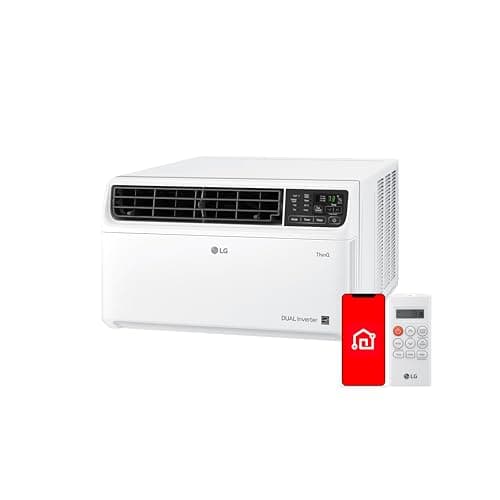 Best household brand LG Dual Inverter Window Air Conditioner, 6,000 BTU CEER 15.5 and 290.3 kWh a year, Most Efficient certified, with a dual inverter compressor. | Buyers who want a name with a service network | |
| 3 | Best for the window sash Midea U-Shaped Window Air Conditioner, 6,000 BTU CEER 15.1 and 298 kWh a year in a U-shape, so the sash closes through the middle of the unit. | A room where you want the window to keep opening | |
| — | 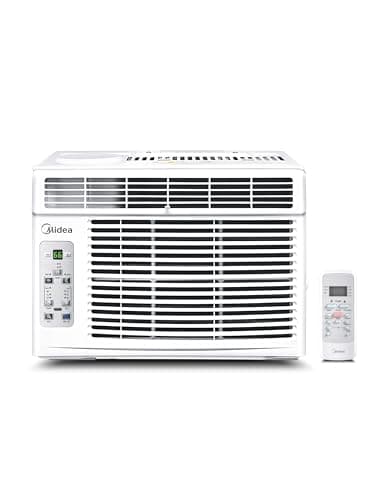 Smaller, and worse Midea Window Air Conditioner, 5,000 BTU 5,000 BTU at CEER 14.4 and 260.4 kWh — less capacity for barely less energy, and no Most Efficient units exist below 6,000. | A very small room where 6,000 BTU genuinely will not fit |
6,000 BTU is the size most single rooms actually need, and it is where the certified data starts rewarding you for paying attention.
Method
What we ranked on
Every unit here is drawn from the ENERGY STAR Certified Room Air Conditioners dataset, filtered to exactly 6,000 BTU/h. That gives 25 certified records. We ranked on:
- Annual energy use in kWh, because it converts directly into money and folds capacity in.
- CEER, the tested efficiency ratio.
- Weight and bracket requirement, because at this size most people install it themselves.
- Most Efficient designation as a tie-breaker.
We did not rank on noise, because no window air conditioner in the certified dataset publishes one. The program records capacity, CEER, annual kWh, dimensions and weight, and has no acoustic field at all.
The cliff
This class splits in two, sharply
Sorted by efficiency, the 6,000 BTU field does not tail off gradually. It falls off a step.
| Unit | CEER | kWh/yr | Weight | Season |
|---|---|---|---|---|
| Midea MAW06S1KWT | 16.0 | 281.3 | 31.6 lb | $52 |
| LG LW6023IVSM | 15.5 | 290.3 | 62.0 lb | $53 |
| Midea MAW06V1QWT (U-shape) | 15.1 | 298 | 53.1 lb | $55 |
| TCL W6WC72 | 13.7 | 328.5 | 39.7 lb | $60 |
| Frigidaire FHWC065TF1 | 13.7 | 328.5 | 31.6 lb | $60 |
| Hisense WCT06W25A | 13.7 | 328.5 | 35.3 lb | $60 |
| Vissani VAW06V1KWTS | 13.7 | 328.5 | 31.6 lb | $60 |
Three units at 15.1 and above, then nothing until 13.7, where the majority of the class sits. There is no 14.x tier at this capacity.
The gap in money is $8.66 a year — small in absolute terms, but it repeats for the life of the unit and the efficient models are not meaningfully more expensive to install.
Note the second cluster too: TCL, Frigidaire, Hisense and Vissani all at exactly CEER 13.7 and 328.5 kWh. That is what a shared chassis looks like — 58% of the certified field shares every published spec with another brand.
The floor
Why not go smaller
The natural instinct in a small room is to drop to 5,000 BTU. The data argues against it.
- Zero of 13 certified sub-6,000 BTU units carry Most Efficient. 6,000 is the floor of that designation.
- The best 5,000 BTU unit is CEER 14.4 against 16 at 6,000. Smaller is less efficient per BTU here, which is unusual.
- You save about 21 kWh a year — $3.83 — for a sixth less capacity.
- An undersized unit runs longer, which erodes even that saving in a room that is warmer than the test assumes.
There is one good reason to go smaller: a window opening that will not take a 6,000 BTU unit. The 5,000 BTU class in full.
Sizing
Is 6,000 BTU right for your room?
The published sizing guidance starts from floor area and then applies adjustments. 6,000 BTU covers a genuinely small room — a bedroom, a study, a small apartment living space — before adjustments.
Add capacity if:
- The room is very sunny. This is the adjustment that most often pushes people up a size, and it is also the one you can remove with shading instead.
- It is on the top floor, or under a roof.
- More than two people use it regularly.
- It is a kitchen, where cooking is a large internal gain.
Subtract if the room is heavily shaded. And remember that oversizing an air conditioner is the expensive mistake — it short-cycles, leaving the room cold and clammy. The full sizing method.
This one is not a DIY job
Even a 31.6 lb unit is a fall hazard from a window. Window air conditioners are supported by the sash, the frame and the side curtains, and none of those were designed for it.
Follow the manual for your specific unit on bracket requirements, screw placement and tilt. Do not assume a light unit is safe without one — the requirement tracks mounting design rather than weight.
Above ground floor level, treat installation as a two-person job regardless of weight, and check whether your building or lease has rules about window units.
Room air conditioner manuals typically require a dedicated grounded outlet and forbid extension cords and adapters.
Say the unwelcome thing
Do not buy the CEER 13.7 unit to save on the purchase price.
Most of the 6,000 BTU class sits at CEER 13.7 and 328.5 kWh a year, and those units are frequently the cheapest on the shelf.
The efficient ones are not a different category of machine. They are the same size, install the same way, and one of them — at 31.6 lb with no bracket required — is easier to fit than most of the cheap tier.
The running difference is $8.66 a year, every year. Over the life of a unit that comfortably exceeds any plausible price gap.
Take the certified figure: CEER 16 at 281.3 kWh or CEER 15.5 with a service network.
In full
Every pick, and what is wrong with it
Published specifications only, each linked to the page it came from. Where a manufacturer publishes nothing, the row says so — we do not fill blanks in.
1. Best overall
Midea Window Air Conditioner, 6,000 BTU
Midea · model MAW06S1KWT-A
CEER 16 and 281.3 kWh a year at 31.6 lb, with no support bracket required — the lowest running cost we hold certified data for.
The top of the class on every measure that matters, and light enough that one person can install it.
281.3 kWh a year is about $52 at 18.34¢/kWh — the lowest annual figure of any certified room air conditioner we hold data for, at any capacity.
CEER 16, on the Most Efficient list, and 45% below the federal standard.
31.6 lb and no support bracket required. That combination is unusual — bracket requirement does not track weight the way you would expect — and it is what makes this a realistic solo installation.
What’s wrong with it
6,000 BTU is genuinely one small room, and it does not heat.
Running cost — MAW06S1KWT-A
| Annual energy use | 281.3 kWh | ENERGY STAR certified figure |
|---|---|---|
| Annual cost | $52 | 281.3 × 18.34¢/kWh |
| Per cooling month | $13 | spread over a four-month season |
The annual figure is the certified value from the ENERGY STAR Certified Room Air Conditioners dataset, which models a standard cooling season rather than your actual summer. It is more useful than a nameplate wattage here, because a variable-speed compressor spends most of its life well below nameplate.
Rate: 18.34¢/kWh, the US average residential price for June 2026 (EIA Electric Power Monthly, Table 5.3). Yours will differ — swap it in: (watts ÷ 1000) × hours × your rate.
| Cooling capacity | 6,000 BTU/h |
|---|---|
| CEER | 16 |
| Annual energy use | 281.3 kWh/yr |
| vs federal standard | 45% less energy |
| Dimensions | 12.1 H x 16.0 W x 13.3 D in |
| Weight | 31.6 lb |
| Installation | Does not straddle the windowsill |
| Support bracket | Not required |
| Compressor | Variable speed |
| Refrigerant | R-32 |
| ENERGY STAR | Certified, and on the Most Efficient list |
Every figure above is from ENERGY STAR Certified Room Air Conditioners dataset. Blanks are shown as “not published” rather than filled in.
2. Best household brand
LG Dual Inverter Window Air Conditioner, 6,000 BTU
LG · model LW6023IVSM
CEER 15.5 and 290.3 kWh a year, Most Efficient certified, with a dual inverter compressor.
The best figure any of the large household brands reaches at this capacity, and the trade it asks for is physical.
CEER 15.5 and 290.3 kWh a year, about $53 at 18.34¢/kWh — only $1.65 a year behind the leader.
Most Efficient certified, with a variable-speed compressor that holds temperature rather than cycling hard.
62.0 lb is the honest cost. That is roughly double the Midea for the same cooling, and it changes whether you can lift it into a window alone. What the install involves.
What’s wrong with it
62.0 lb is nearly double the Midea for a 6,000 BTU unit, which is a real installation difference.
Running cost — LW6023IVSM
| Annual energy use | 290.3 kWh | ENERGY STAR certified figure |
|---|---|---|
| Annual cost | $53 | 290.3 × 18.34¢/kWh |
| Per cooling month | $13 | spread over a four-month season |
The annual figure is the certified value from the ENERGY STAR Certified Room Air Conditioners dataset, which models a standard cooling season rather than your actual summer. It is more useful than a nameplate wattage here, because a variable-speed compressor spends most of its life well below nameplate.
Rate: 18.34¢/kWh, the US average residential price for June 2026 (EIA Electric Power Monthly, Table 5.3). Yours will differ — swap it in: (watts ÷ 1000) × hours × your rate.
| Cooling capacity | 6,000 BTU/h |
|---|---|
| CEER | 15.5 |
| Annual energy use | 290.3 kWh/yr |
| Weight | 62.0 lb |
| Installation | Does not straddle the windowsill |
| Support bracket | Not required |
| Compressor | Variable speed |
| ENERGY STAR | Certified, and on the Most Efficient list |
Every figure above is from ENERGY STAR Certified Room Air Conditioners dataset. Blanks are shown as “not published” rather than filled in.
3. Best for the window sash
Midea U-Shaped Window Air Conditioner, 6,000 BTU
Midea · model MAW06V1QWT
CEER 15.1 and 298 kWh a year in a U-shape, so the sash closes through the middle of the unit.
Slightly behind on efficiency and ahead on everything about living with it.
The U-shape puts the compressor outside the closed sash rather than in the room, which is why this style is markedly quieter indoors and why the window still opens.
298 kWh a year, about $55 at 18.34¢/kWh, at CEER 15.1 — Most Efficient certified, 37% below the federal standard.
53.1 lb, no bracket required, variable-speed compressor and R-32. The whole U-shaped class and where it does not fit.
What’s wrong with it
53.1 lb and the U-shape only suits a standard single-hung or double-hung window.
Running cost — MAW06V1QWT
| Annual energy use | 298 kWh | ENERGY STAR certified figure |
|---|---|---|
| Annual cost | $55 | 298 × 18.34¢/kWh |
| Per cooling month | $14 | spread over a four-month season |
The annual figure is the certified value from the ENERGY STAR Certified Room Air Conditioners dataset, which models a standard cooling season rather than your actual summer. It is more useful than a nameplate wattage here, because a variable-speed compressor spends most of its life well below nameplate.
Rate: 18.34¢/kWh, the US average residential price for June 2026 (EIA Electric Power Monthly, Table 5.3). Yours will differ — swap it in: (watts ÷ 1000) × hours × your rate.
| Cooling capacity | 6,000 BTU/h |
|---|---|
| CEER | 15.1 |
| Annual energy use | 298 kWh/yr |
| vs federal standard | 37% less energy |
| Dimensions | 13.5 H x 19.2 W x 22.0 D in |
| Weight | 53.1 lb |
| Refrigerant | R-32 |
| Installation | U-shape; sash closes through the middle of the unit |
| Compressor | Variable speed |
| ENERGY STAR | Certified, and on the Most Efficient list |
Every figure above is from ENERGY STAR Certified Room Air Conditioners dataset. Blanks are shown as “not published” rather than filled in.
Skip this one
Midea Window Air Conditioner, 5,000 BTU
Midea · model MAW05R1VWWT-T
5,000 BTU at CEER 14.4 and 260.4 kWh — less capacity for barely less energy, and no Most Efficient units exist below 6,000.
Flagged because dropping to 5,000 BTU is the obvious move for a small room, and the certified data says it is a poor trade.
260.4 kWh a year against 281.3 for the 6,000 BTU leader — you save $3.83 a year and give up a sixth of the capacity.
CEER 14.4 against 16. The smaller unit is genuinely less efficient per BTU, so you are paying more per unit of cooling for the privilege of having less of it.
Zero of the 13 certified sub-6,000 BTU units carry Most Efficient. 6,000 BTU is the floor of that designation, and the drop below it is where the class stops being competitive.
What’s wrong with it
You give up 1,000 BTU and 1.6 points of CEER to save about 21 kWh a year.
Running cost — MAW05R1VWWT-T
| Annual energy use | 260.4 kWh | ENERGY STAR certified figure |
|---|---|---|
| Annual cost | $48 | 260.4 × 18.34¢/kWh |
| Per cooling month | $12 | spread over a four-month season |
The annual figure is the certified value from the ENERGY STAR Certified Room Air Conditioners dataset, which models a standard cooling season rather than your actual summer. It is more useful than a nameplate wattage here, because a variable-speed compressor spends most of its life well below nameplate.
Rate: 18.34¢/kWh, the US average residential price for June 2026 (EIA Electric Power Monthly, Table 5.3). Yours will differ — swap it in: (watts ÷ 1000) × hours × your rate.
| Cooling capacity | 5,000 BTU/h |
|---|---|
| CEER | 14.4 |
| Annual energy use | 260.4 kWh/yr |
| vs federal standard | 31% less energy |
| Dimensions | 12.1 H x 16.0 W x 13.3 D in |
| Weight | 30.2 lb |
| Installation | Does not straddle the windowsill |
| Support bracket | Not required |
| Compressor | Variable speed |
| Refrigerant | R-32 |
| ENERGY STAR | Certified (not on the Most Efficient list) |
Every figure above is from ENERGY STAR Certified Room Air Conditioners dataset. Blanks are shown as “not published” rather than filled in.
We are not linking a buy button for this one. If you want to look at it anyway, it is easy enough to find — but we would rather send you to something that fits your room.
Questions people actually ask
Frequently asked
What is the most efficient 6,000 BTU air conditioner?
CEER 16 at 281.3 kWh a year — about $52 for a season at 18.34¢/kWh — in a 31.6 lb unit that needs no support bracket. That is the lowest annual energy figure of any certified room air conditioner at any capacity.
What size room does 6,000 BTU cool?
A genuinely small one — a bedroom, a study or a small apartment living space — before adjustments. Add capacity for a very sunny room, a top floor, more than two occupants, or a kitchen. Shading the glass can remove the sunny-room adjustment entirely. The sizing method.
Should I get a 5,000 BTU unit instead?
Usually not. The best 5,000 BTU unit is CEER 14.4 against 16 at 6,000, and zero of the 13 certified sub-6,000 units carry Most Efficient. You give up a sixth of the capacity to save about 21 kWh a year. The one good reason is a window that will not take the larger unit.
Why do so many 6,000 BTU units have identical specs?
Because they share a chassis. TCL, Frigidaire, Hisense and Vissani all file 6,000 BTU units at exactly CEER 13.7 and 328.5 kWh — the same platform under different badges, which is true of 58% of the certified room air conditioner field. Brands, tested.
How much does a 6,000 BTU air conditioner cost to run?
$52 to $60 for a season at 18.34¢/kWh, depending on whether you buy the CEER 16 unit or one of the CEER 13.7 ones. That gap repeats every year for the life of the machine.
Which 6,000 BTU units need a support bracket?
It varies, and not by weight — the certified data shows bracket requirement is essentially uncorrelated with how heavy a unit is. The 31.6 lb Midea needs none; some heavier units do. Read the manual for your specific model rather than assuming. What the requirement tracks.
Sources
Where these numbers came from
Read next
Where to go from here
Back to Air Conditioners, or read how we pick.