The picks
The best box fans, and what they are actually for
The most air per dollar in home cooling, and almost everyone uses it in the least effective place. The window is where a box fan earns its keep.
By Sawyer V. · Published
The short answer
The Lasko Power Plus B20801: 73–102 W, three speeds, a weather-resistant motor and a 2-year warranty, about $4.49 for a month of eight-hour nights. But put it in a window blowing out once the evening air is cooler than the room, and it stops being a fan and starts being cooling.
Fan & Frost earns a commission when you buy through our links, at no cost to you. It never changes a ranking, and we say so when the right answer is the cheaper unit or nothing at all. Full disclosure · How we pick.
At a glance
The picks, ranked
Tap any row to jump to the full reasoning. Prices are live from Amazon where we have them, and read “check price” where we don’t — never a number we cannot verify today.
| # | Product | Best for | Price |
|---|---|---|---|
| 1 | Best overall Lasko Power Plus 20" Box Fan A weather-resistant motor and a 2-year warranty on a fan that will spend its life sitting in an open window. | A window, a garage, or any room where you want a lot of air cheaply | |
| 2 | Better, if the window is the plan Lasko Twin Window Fan with Remote Purpose-built for the job a box fan does badly: it fits the window, seals it, and runs two motors independently. | A window you want to use for intake, exhaust or both | |
| 3 | 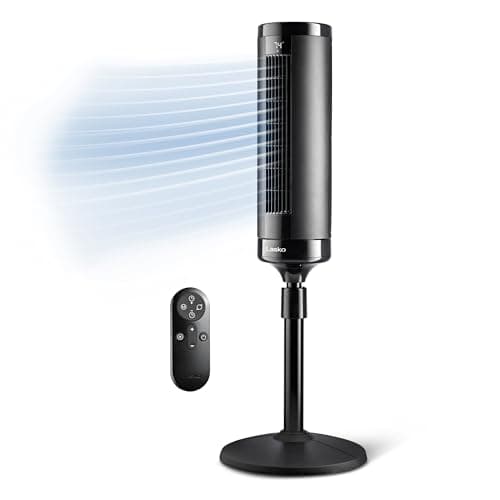 If it is for a bedroom Lasko EcoQuiet 42" DC Tower Fan 23 dBA and 19 W against an unpublished noise figure and 102 W. For a bedside fan this is not a close call. | Sleeping, where a box fan is the wrong tool | |
| — | 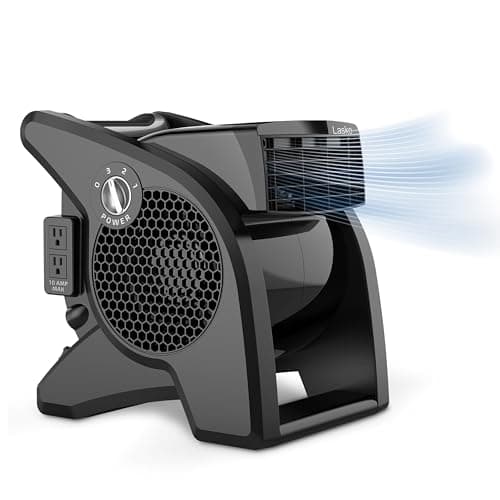 The one to skip for a room Lasko Max Performance 15" Air Mover 178 W of directed blast, which is the wrong shape of airflow for a room and the wrong sound for a house. | Drying a floor, not cooling a person |
A box fan is the cheapest way to move a large amount of air, and it has barely changed in fifty years because there is not much to improve: a 20-inch blade, a simple motor, a square frame that happens to fit a window opening.
The interesting question is not which box fan to buy — they are broadly similar — but where to put it.
The point of the page
In a window, a box fan is doing something completely different
Sitting in the middle of a room, a box fan is a fan. It does not lower the temperature; it moves air across your skin so you feel cooler, and its motor adds a small amount of heat.
In a window, once the outdoor air is cooler than the indoor air, it becomes actual cooling. It exchanges hot indoor air for cooler outdoor air, and the room temperature genuinely falls. That is the difference between feeling better and being cooler, and it costs the same 102 watts either way.
The rule is simple and worth being disciplined about: check that the outdoor temperature is actually below your indoor temperature before you open anything. Not by feel — by thermometer. Opening windows at 7pm when it is still 88°F outside actively makes your house hotter, and this is the single most common mistake in no-AC cooling.
Setup
Three placements, in order of effectiveness
- Exhaust from the hottest room, intake somewhere opposite. Put the box fan in an upstairs window blowing out, and open a downstairs window on the opposite side of the house. Heat rises, so exhausting high pulls cool air in low and drags it through the whole building. This is the most effective thing a box fan can do and it is close to free.
- Two fans, cross-flow. One in a window blowing in, one in a window on the opposite wall blowing out. Directed airflow through the room rather than around it.
- One fan blowing in, window open elsewhere. Simplest, and works, but weaker — you are pushing air in and hoping it finds its way out.
The exhaust-high approach is the same principle as a whole-house fan, at a hundredth of the cost. If a box fan in an upstairs window makes a real difference to your house over an hour, a whole-house fan will do the same thing far faster, and you have tested the idea for the price of a fan you can keep using.
Cost
What one costs to run
| Setting | Per hour | 8-hr night | 30 nights |
|---|---|---|---|
| Low, 73 W | 1.3¢ | 11¢ | $3.21 |
| High, 102 W | 1.9¢ | 15¢ | $4.49 |
Wattage from Lasko’s product page; costs are our arithmetic at 18.34¢/kWh.
For context: a DC tower fan on low is 13¢ over the same period, and a 1,300 W portable air conditioner is $57. The box fan sits in between, and when used in a window it is buying you real temperature reduction rather than just a breeze. The full wattage table is here.
Say the unwelcome thing
Do not tape a furnace filter to it and call it an air purifier.
The box-fan-plus-filter idea circulates widely, and it does move some particulate out of the air. But a box fan motor is designed to spin in free air, not to pull against the static pressure of a filter. Restricting the intake makes the motor work harder, run hotter and draw more current than its design point.
On a cheap fan with no thermal cutout, that is a genuine fire risk, and it is why several fire services have warned about the practice. If you want filtered air, buy something built to pull through a filter. If you want moved air, leave the fan unobstructed.
Buying
What to look for
- A weather-resistant motor, if it will live in a window. This is the main thing that differentiates box fans.
- Depth under about 5 inches, so a sash can close on top of it.
- A carry handle. Sounds trivial; you will move this fan between windows constantly.
- A published wattage. Lasko publishes theirs, which is more than many do, and it lets you work out what it costs.
- Ignore CFM claims in listings. There is no common test procedure for portable fans, so a claimed figure is not comparable between brands — and the two Lasko fans here publish none at all. A handful of makers do publish airflow and wattage on every model, which is the one brand signal worth having: which fan brands publish their numbers.
In full
Every pick, and what is wrong with it
Published specifications only, each linked to the page it came from. Where a manufacturer publishes nothing, the row says so — we do not fill blanks in.
1. Best overall
Lasko Power Plus 20" Box Fan
Lasko · model B20801
A weather-resistant motor and a 2-year warranty on a fan that will spend its life sitting in an open window.
73–102 W across three speeds, which is a lot next to a DC tower fan and cheap next to anything with a compressor. About 15¢ for an eight-hour night at 18.34¢/kWh, or $4.49 for a month of them.
The specification that matters most here is the one people skip: a weather-resistant motor. A box fan’s best application is sitting in an open window, which means it is exposed to night air, humidity and the occasional blown-in rain. A motor not built for that has a short and unhappy life. Lasko’s 2-year warranty on this one, against 1 year on several of their indoor fans, suggests they expect it to be used that way.
21.25 inches tall by 22.5 wide and 4.75 deep, at 10.1 lb. That slim depth is what lets it sit in a sash window with the sash down on top of it.
The missing CFM figure is the frustration. This is a fan bought for volume of air, and Lasko does not tell you the volume of air. We are not going to estimate it.
What’s wrong with it
Lasko publishes no CFM for it, which on a fan whose entire selling point is air volume is a real gap. At 73-102 W it is also 5× the draw of a DC tower fan.
Running cost — B20801
| Nameplate power | 73 W – 102 W | manufacturer's published figure |
|---|---|---|
| Energy, 8-hour night | 0.82 kWh | 102 ÷ 1000 × 8 |
| Cost per hour | 1.9¢ | at 18.34¢/kWh |
| Cost per 8-hour night | 15¢ | on the highest speed |
| Cost per 30 nights | $4.49 | 24.5 kWh |
| Same month, lowest speed | $3.21 | at 73 W |
Rate: 18.34¢/kWh, the US average residential price for June 2026 (EIA Electric Power Monthly, Table 5.3). Yours will differ — swap it in: (watts ÷ 1000) × hours × your rate.
| Power | 73 W - 102 W (0.6-0.9 A at 120 V) |
|---|---|
| Speeds | 3 |
| Dimensions | 21.25 H x 22.5 x 4.75 in |
| Weight | 10.1 lb |
| Motor | Weather-resistant |
| Air delivery (CFM) | Not published |
| Warranty | 2 years |
Every figure above is from Lasko product page, B20801. Blanks are shown as “not published” rather than filled in.
2. Better, if the window is the plan
Lasko Twin Window Fan with Remote
Lasko · model W09550
Purpose-built for the job a box fan does badly: it fits the window, seals it, and runs two motors independently.
If you have concluded that a box fan belongs in a window, this is the fan actually designed for that.
Two independently controlled motors is the feature that matters. You can run both as exhaust, both as intake, or one each way — which sets up a deliberate cross-flow through a single window and works far better than anything a box fan can do alone.
22–31 W and up to 560 CFM published. That is a third of the box fan’s power draw: $1.36 against $4.49 over a month of nights. The adjustable thermostat is genuinely useful overnight — it stops the fan once the room reaches temperature rather than continuing to pull in cold air at 4am.
The constraint is fit: 24 to 32 inches wide. Measure before you buy. More window fan detail here.
What’s wrong with it
Only fits windows 24-32 inches wide, and 560 CFM is less air than a 20-inch box fan almost certainly moves. It is also a single-purpose object — it cannot stand on a floor.
Running cost — W09550
| Nameplate power | 22 W – 31 W | manufacturer's published figure |
|---|---|---|
| Energy, 8-hour night | 0.25 kWh | 31 ÷ 1000 × 8 |
| Cost per hour | 0.6¢ | at 18.34¢/kWh |
| Cost per 8-hour night | 4.5¢ | on the highest speed |
| Cost per 30 nights | $1.36 | 7.4 kWh |
| Same month, lowest speed | 97¢ | at 22 W |
Rate: 18.34¢/kWh, the US average residential price for June 2026 (EIA Electric Power Monthly, Table 5.3). Yours will differ — swap it in: (watts ÷ 1000) × hours × your rate.
| Power | 22 W - 31 W at 120 V |
|---|---|
| Air delivery | Up to 560 CFM |
| Window fit | 24 - 32 in wide |
| Modes | Intake, exhaust or exchange (independent motors) |
| Thermostat | Adjustable |
| Speeds | 3 |
| Dimensions | 12.9 H x 24.0 W x 4.9 D in |
| Weight | 8.0 lb |
| Warranty | 1 year |
Every figure above is from Lasko product page, W09550. Blanks are shown as “not published” rather than filled in.
3. If it is for a bedroom
Lasko EcoQuiet 42" DC Tower Fan
Lasko · model T42710
23 dBA and 19 W against an unpublished noise figure and 102 W. For a bedside fan this is not a close call.
Box fans are bought for bedrooms constantly, usually for the white noise, and it is the one place they are a poor choice.
2.9 to 19 W against 73 to 102 W — 13¢ on low against $4.49 for a month of nights. And 23 dBA published against a box fan that publishes nothing, from an open-frame 20-inch blade that produces broadband turbulent noise rather than a smooth hiss.
Twelve speeds rather than three is the other bedroom advantage: you can find the setting that is just enough, which a three-speed fan rarely offers. The quiet-fan comparison is here.
What’s wrong with it
It moves less air than a 20-inch box fan and costs more to buy. In a garage or a window, the box fan is the right answer and this is not.
Running cost — T42710
| Nameplate power | 2.9 W – 19 W | manufacturer's published figure |
|---|---|---|
| Energy, 8-hour night | 0.15 kWh | 19 ÷ 1000 × 8 |
| Cost per hour | 0.3¢ | at 18.34¢/kWh |
| Cost per 8-hour night | 2.8¢ | on the highest speed |
| Cost per 30 nights | 84¢ | 4.6 kWh |
| Same month, lowest speed | 13¢ | at 2.9 W |
Rate: 18.34¢/kWh, the US average residential price for June 2026 (EIA Electric Power Monthly, Table 5.3). Yours will differ — swap it in: (watts ÷ 1000) × hours × your rate.
| Power | 2.9 W - 19 W (0.06-0.303 A at 120 V) |
|---|---|
| Noise | 23 dBA low, 46 dBA high |
| Speeds | 12 |
| Height | 41.6 in |
| Footprint | 12.8 x 12.8 in |
| Weight | 7.8 lb |
| Timer | 8 hours |
| Air delivery (CFM) | Not published |
| Warranty | 2 years |
Every figure above is from Lasko product page, T42710. Blanks are shown as “not published” rather than filled in.
Skip this one
Lasko Max Performance 15" Air Mover
Lasko · model U15720
178 W of directed blast, which is the wrong shape of airflow for a room and the wrong sound for a house.
Air movers get compared with box fans because both are cheap, square-ish and move serious air. They are not substitutes.
A box fan spreads air broadly across a 20-inch face at low velocity, which is what you want for filling a window opening or washing a room with air. An air mover concentrates it into a narrow, fast stream aimed at a surface, which is what you want for drying a carpet.
160–178 W — $7.83 a month of nights, versus $4.49 for the box fan and 13¢ for a DC tower on low. It is also deliberately loud.
It is a good tool for a garage or a workshop. It is not a box fan.
What’s wrong with it
160-178 W and no published CFM. An air mover concentrates air into a narrow high-velocity stream — useful for drying, useless for making a room comfortable.
Running cost — U15720
| Nameplate power | 160 W – 178 W | manufacturer's published figure |
|---|---|---|
| Energy, 8-hour night | 1.42 kWh | 178 ÷ 1000 × 8 |
| Cost per hour | 3.3¢ | at 18.34¢/kWh |
| Cost per 8-hour night | 26¢ | on the highest speed |
| Cost per 30 nights | $7.83 | 42.7 kWh |
| Same month, lowest speed | $7.04 | at 160 W |
Rate: 18.34¢/kWh, the US average residential price for June 2026 (EIA Electric Power Monthly, Table 5.3). Yours will differ — swap it in: (watts ÷ 1000) × hours × your rate.
| Power | 160 W - 178 W (1.35-1.53 A at 120 V) |
|---|---|
| Speeds | 3 |
| Dimensions | 14.5 H x 14.0 D x 11.5 W in |
| Weight | 12.55 lb |
| Extras | Two 120 V accessory outlets, 9.5 ft cord, pivoting head |
| Air delivery (CFM) | Not published |
| Warranty | 1 year |
Every figure above is from Lasko product page, U15720. Blanks are shown as “not published” rather than filled in.
We are not linking a buy button for this one. If you want to look at it anyway, it is easy enough to find — but we would rather send you to something that fits your room.
Questions people actually ask
Frequently asked
How much electricity does a box fan use?
A 20-inch box fan draws roughly 73 to 102 W across its speed range. At 18.34¢/kWh that is about 15¢ for an eight-hour night on high, or $4.49 over thirty nights.
Should I put a box fan in the window facing in or out?
Out, from the hottest room, with a window open on the opposite side of the house for intake. Heat rises, so exhausting high pulls cooler air in low and drags it through the whole building. Only do this once the outdoor temperature is genuinely below the indoor temperature.
Do box fans actually cool a room?
Not sitting in the room — there they move air so you feel cooler, and the motor adds slight heat. In a window, once the outside air is cooler than inside, a box fan exchanges hot indoor air for cooler outdoor air and the room temperature genuinely falls.
How many CFM does a box fan move?
Lasko does not publish a figure for its box fans, and there is no common test procedure for portable fans, so claimed CFM numbers are not comparable between brands. A purpose-built twin window fan publishes 560 CFM, which is a real and checkable number.
Is it safe to put a filter on a box fan?
It is not a good idea. A box fan motor is designed to spin in free air, and restricting the intake with a filter makes it work harder, run hotter and draw more current than its design point. On a cheap fan with no thermal cutout that is a genuine fire risk.
Is a box fan or a tower fan better for a bedroom?
A tower fan, clearly. A DC tower draws 2.9 W on low against a box fan's 73, publishes 23 dBA where the box fan publishes no noise figure at all, and offers twelve speeds rather than three. Over a month of nights that is 13¢ against $4.49. Tower fans compared.
Sources
Where these numbers came from
Read next
Where to go from here
Back to Fans, or read how we pick.