Guide and picks
Why is my dehumidifier not collecting water?
In most cases the machine is working exactly as designed, and the thing that changed is the air it is working on.
By Sawyer V. · Published
The short answer
Work through it cheapest first. Usually the room is already at setpoint, the coil is iced because the space is cold, or the filter is blocked. A refrigerant dehumidifier needs a coil below the dew point, and in a cold room it either frosts or cannot condense at all — and the certified data records no minimum operating temperature for any of the 554 models.
Fan & Frost earns a commission when you buy through our links, at no cost to you. It never changes a ranking, and we say so when the right answer is the cheaper unit or nothing at all. Full disclosure · How we pick.

At a glance
The picks, ranked
Tap any row to jump to the full reasoning. Prices are live from Amazon where we have them, and read “check price” where we don’t — never a number we cannot verify today.
| # | Product | Best for | Price |
|---|---|---|---|
| 1 | If it is genuinely undersized Waykar Dehumidifier, 49 pints/day 49.43 pints a day at 2.20 L/kWh and 471 kWh a year — capacity that reaches setpoint instead of running forever. | A basement or crawl space a smaller unit cannot hold | |
| 2 | If you keep finding out too late Midea Cube Dehumidifier with Built-in Pump, 50 pints/day 49.95 pints a day at 520 kWh with connected control — it tells you it has stopped. | A basement or crawl space nobody visits | |
| 3 | 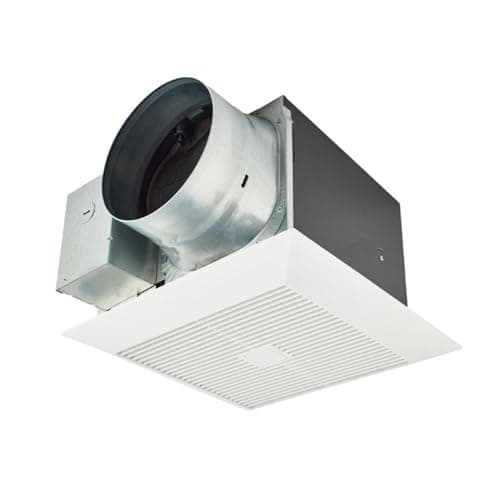 If the room is cold Panasonic WhisperGreen Select FV-0511VK3 Ventilation Fan 110 CFM at 16.7 CFM per watt — it removes moisture by moving it out, with no coil to freeze. | A cool space where condensing is the wrong approach entirely | |
| — | Often it is doing its job Vissani Dehumidifier, 27 pints/day 26.87 pints a day at 283 kWh a year — and a dry tank frequently means it succeeded. | A room that has already reached its humidity setpoint |
Work down this list in order. The cheap causes are far more common than the expensive ones, and two of them are not faults at all.
1
The room has reached the setpoint
The most common answer, and the least satisfying to read.
Any dehumidifier with a humidistat stops the compressor once the room hits the target humidity. From then on the fan may keep turning while no water is produced, which looks identical to a fault.
The test: a cheap thermometer-hygrometer in the room. If it reads at or below your setting, nothing is wrong. Lower the target by 5% and see whether the compressor restarts.
Related: if you set a very low target, the machine will never stop — which is the opposite failure and an expensive one. What to actually set it to.
2
The room is too cold to condense
The most important cause on this page, and the one the certified data cannot help you with.
These machines remove water by condensing it on a coil colder than the surrounding air. Two things go wrong as the room cools:
- The coil drops below freezing. Condensate turns to ice instead of running off. Ice blocks airflow, which drops the coil temperature further, and water removal collapses while the compressor keeps drawing power.
- Cold air holds less water to begin with. Even without frosting, there is simply less moisture available per cubic foot to condense.
Many units have an auto-defrost cycle that manages this down to a stated temperature, below which they do not usefully work. The catch: the certified dataset records no minimum operating temperature for any of its 554 models, so the manual is the only source.
The test: look at the coil. Visible frost is the answer. Turn it off, let it thaw completely, and check the space temperature against the manual before restarting. This is the usual story in a garage or a crawl space.
3
The filter is blocked
Less air across the coil means less moisture presented to it. This shows up first as reduced output and then, in a cool room, as the frosting in cause 2 — restricted airflow makes the coil colder.
The test: pull the filter and hold it to a light. Wash it, let it dry completely, and refit. The full cleaning routine.
4
It is draining somewhere you are not looking
A very common false alarm, especially on units that support both a tank and continuous drainage.
- A hose is connected and the tank is empty by design. The water is going to the drain. Check the drain, not the tank.
- A drain plug was removed and never refitted. Water runs onto the floor instead of into the tank, and evaporates.
- A pump is discharging and you never see it. Same outcome, deliberately.
- The float is stuck. A float jammed in the “full” position stops the unit with an empty tank, which looks like a machine that will not run.
5
It cannot move air
Placement is under-appreciated. These need clearance to draw air in and push it out, and jammed against a wall behind boxes they recirculate their own exhaust — drying the same small volume of air over and over.
Give it the clearance the manual asks for, get it off the floor and away from corners, and keep doors closed in the space you are drying. Humidity equalises slowly through doorways, so an open house is a much larger job than one room.
6
It is genuinely too small
Last on the list because it is diagnosed first far too often.
The signature is specific: the unit runs continuously, produces some water but not much, and the hygrometer never reaches the setpoint. That is different from producing none at all.
If that is the pattern, and the filter is clean and the room is not cold, then the machine is undersized for the load — and an undersized dehumidifier uses more energy over a season than the correct one would have. How to size it properly.
This one is not a DIY job
If the machine runs, drains correctly and the space still never dries, the problem is the building. Water is entering faster than any appliance can remove it.
Grading and drainage, downspout discharge, foundation sealing, a failed vapor barrier or a leaking pipe are the fixes, and they are contractor work. Buying more capacity against an unlimited source just costs more to lose.
Anything involving the sealed refrigerant circuit — a compressor that hums and does not start, a coil that never gets cold, a suspected leak — is licensed work. Refrigerant handling is regulated.
Health effects of damp and mold are a matter for a medical professional, and large areas of visible growth are an assessment matter.
Say the unwelcome thing
Do not buy a bigger dehumidifier because the tank is empty.
An empty tank is the symptom people act on fastest, and in most cases it means the opposite of what they assume.
The two most common causes are that the room has already reached its humidity setpoint — the machine succeeded — or that the coil is iced because the space is too cold to condense. Neither is fixed by more capacity, and the second gets worse with a bigger machine in the same cold room.
Check in order: hygrometer reading, visible frost on the coil, the filter, and where the water is actually going. Genuine undersizing has a distinct signature — continuous running, some water, setpoint never reached.
If it is that, then size up: 49 pints at 2.20 L/kWh. If the room is simply cold, a certified extract fan removes moisture with no coil to freeze.
In full
Every pick, and what is wrong with it
Published specifications only, each linked to the page it came from. Where a manufacturer publishes nothing, the row says so — we do not fill blanks in.
1. If it is genuinely undersized
Waykar Dehumidifier, 49 pints/day
Waykar · model CTH150D
49.43 pints a day at 2.20 L/kWh and 471 kWh a year — capacity that reaches setpoint instead of running forever.
One of the six causes below is real undersizing, and this is the answer to it.
An undersized dehumidifier does not fail visibly. It runs at 100% duty, produces a trickle, never reaches setpoint, and uses more energy over a season than the larger machine would have.
49.43 pints a day at 2.20 L/kWh and 471 kWh a year, about $86 at 18.34¢/kWh — Most Efficient certified, one of only 5 units in the 155-strong 45 to 60 pint band.
Diagnose before buying, though. Undersizing is well down the list of likely causes.
What’s wrong with it
It is basement capacity, and it does not solve a cold-room problem.
Running cost — CTH150D
| Annual energy use | 471 kWh | ENERGY STAR certified figure |
|---|---|---|
| Annual cost | $86 | 471 × 18.34¢/kWh |
| Per cooling month | $22 | spread over a four-month season |
The annual figure is the certified value from the ENERGY STAR Certified Dehumidifiers dataset, which models a standard cooling season rather than your actual summer. It is more useful than a nameplate wattage here, because a variable-speed compressor spends most of its life well below nameplate.
Rate: 18.34¢/kWh, the US average residential price for June 2026 (EIA Electric Power Monthly, Table 5.3). Yours will differ — swap it in: (watts ÷ 1000) × hours × your rate.
| Water removal | 49.43 pints/day (DOE Appendix X1) |
|---|---|
| Efficiency (IEF) | 2.20 L/kWh |
| Annual energy use | 471 kWh/yr |
| Refrigerant | HFC-32 (GWP 675) |
| Connected | No |
| Noise | Not published in the certified dataset |
| ENERGY STAR | Certified, and on the Most Efficient list |
Every figure above is from ENERGY STAR Certified Dehumidifiers dataset. Blanks are shown as “not published” rather than filled in.
2. If you keep finding out too late
Midea Cube Dehumidifier with Built-in Pump, 50 pints/day
Midea · model MAD50PS1BWT-C
49.95 pints a day at 520 kWh with connected control — it tells you it has stopped.
Most of the “it stopped collecting water” reports are discovered weeks after the fact, because the machine lives somewhere nobody goes.
Connected capable — only 35 of 502 certified portables carry the flag. A full tank, a tripped unit or a failed pump becomes a notification.
520 kWh a year, about $95 at 18.34¢/kWh, at 2.01 L/kWh with a built-in pump and a gravity port.
The pump is both the fix for a high drain and a new failure point — what it adds and costs.
What’s wrong with it
520 kWh a year, and a pump is one more thing that can clog.
Running cost — MAD50PS1BWT-C
| Annual energy use | 520 kWh | ENERGY STAR certified figure |
|---|---|---|
| Annual cost | $95 | 520 × 18.34¢/kWh |
| Per cooling month | $24 | spread over a four-month season |
The annual figure is the certified value from the ENERGY STAR Certified Dehumidifiers dataset, which models a standard cooling season rather than your actual summer. It is more useful than a nameplate wattage here, because a variable-speed compressor spends most of its life well below nameplate.
Rate: 18.34¢/kWh, the US average residential price for June 2026 (EIA Electric Power Monthly, Table 5.3). Yours will differ — swap it in: (watts ÷ 1000) × hours × your rate.
| Water removal | 49.95 pints/day (DOE Appendix X1) |
|---|---|
| Efficiency (IEF) | 2.01 L/kWh |
| Annual energy use | 520 kWh/yr |
| Drainage | Built-in pump, plus gravity hose and tank |
| Refrigerant | HFC-32 (GWP 675) |
| Connected | Yes |
| Noise | Not published in the certified dataset |
| ENERGY STAR | Certified |
Every figure above is from ENERGY STAR Certified Dehumidifiers dataset. Blanks are shown as “not published” rather than filled in.
3. If the room is cold
Panasonic WhisperGreen Select FV-0511VK3 Ventilation Fan
Panasonic · model FV-0511VK3
110 CFM at 16.7 CFM per watt — it removes moisture by moving it out, with no coil to freeze.
Worth knowing because the cold-room case has no good refrigerant answer, and ventilation sidesteps the problem.
An extract fan removes the moist air itself rather than condensing water out of it, so there is no coil, no frost and no temperature floor.
16.7 CFM per watt at 0.1 sones, certified and on the Most Efficient list — a fraction of a cent an hour.
The limit is honest: it works only when outdoor air is drier than indoor air, and it exchanges heat along with the moisture. The certified field.
What’s wrong with it
It ventilates; it does not dehumidify to a setpoint, and it exchanges air with outdoors.
Running cost
Panasonic does not publish a wattage for the FV-0511VK3, so we cannot calculate what it costs to run. We are not going to estimate one. If Panasonic publishes a nameplate figure, this block will show the arithmetic.
| Noise | 0.1 sones |
|---|---|
| Air delivery, high | 110 CFM at 0.25 in w.g. |
| Air delivery, medium | 80 CFM |
| Air delivery, low | 50 CFM |
| Efficacy, high | 16.7 CFM per watt |
| Efficacy, medium | 18.4 CFM per watt |
| Efficacy, low | 14.7 CFM per watt |
| Duct size | 6 in diameter |
| Speeds | 3 or more |
| Lighting | None |
| Power | Not published in the certified dataset |
| ENERGY STAR | Certified, and on the Most Efficient list |
Every figure above is from ENERGY STAR Certified Ventilating Fans dataset. Blanks are shown as “not published” rather than filled in.
Skip this one
Vissani Dehumidifier, 27 pints/day
Vissani · model VAD25S1AWTS
26.87 pints a day at 283 kWh a year — and a dry tank frequently means it succeeded.
Marked skip because in the most common case, the answer is to buy nothing at all.
A dehumidifier with a humidistat stops removing water once the room reaches the setpoint. An empty tank after a week is then evidence that it worked, not that it failed.
The tell is the hygrometer. If the room reads at or below your target, the machine is idling correctly.
283 kWh a year, about $52 at 18.34¢/kWh — the lowest of any certified unit we hold, and a good example of a small machine that reaches setpoint quickly and then rests.
What’s wrong with it
Nothing is wrong with it. That is the point of including it here.
Running cost — VAD25S1AWTS
| Annual energy use | 283 kWh | ENERGY STAR certified figure |
|---|---|---|
| Annual cost | $52 | 283 × 18.34¢/kWh |
| Per cooling month | $13 | spread over a four-month season |
The annual figure is the certified value from the ENERGY STAR Certified Dehumidifiers dataset, which models a standard cooling season rather than your actual summer. It is more useful than a nameplate wattage here, because a variable-speed compressor spends most of its life well below nameplate.
Rate: 18.34¢/kWh, the US average residential price for June 2026 (EIA Electric Power Monthly, Table 5.3). Yours will differ — swap it in: (watts ÷ 1000) × hours × your rate.
| Water removal | 26.87 pints/day (DOE Appendix X1) |
|---|---|
| Efficiency (IEF) | 2.01 L/kWh |
| Annual energy use | 283 kWh/yr |
| Refrigerant | HFC-32 (GWP 675) |
| Connected | No |
| Noise | Not published in the certified dataset |
| ENERGY STAR | Certified |
Every figure above is from ENERGY STAR Certified Dehumidifiers dataset. Blanks are shown as “not published” rather than filled in.
We are not linking a buy button for this one. If you want to look at it anyway, it is easy enough to find — but we would rather send you to something that fits your room.
Questions people actually ask
Frequently asked
Why is my dehumidifier not collecting any water?
Most often the room has already reached the humidity setpoint, so the compressor has stopped — which means it worked. The next most common causes are an iced coil in a cold room, a blocked filter, and water draining to a hose you are not checking.
Why does my dehumidifier ice up?
Because it condenses water on a coil colder than the air. In a cold room that coil drops below freezing, condensate becomes ice, and the ice blocks airflow — which makes the coil colder still. A blocked filter causes the same thing by restricting airflow.
What temperature is too cold for a dehumidifier?
It varies by model, and the certified dataset records no minimum operating temperature for any of its 554 units. Many have an auto-defrost cycle that works down to a stated temperature and stop being useful below it. The manual is your only source.
How do I tell if my dehumidifier is undersized?
The signature is continuous running, some water production but not much, and a hygrometer that never reaches the setpoint. That is different from producing no water at all, which usually points to setpoint, frost or a blocked filter. Sizing properly.
My dehumidifier runs but the tank stays empty. Is it broken?
Check whether a drain hose is connected — on units that support continuous drainage the tank is empty by design. Also check whether the drain plug was removed and never refitted, which sends water onto the floor, and whether the float is stuck in the full position.
The space never dries even though the machine works. What now?
Water is entering faster than it can be removed, and that is a building problem. Grading and drainage, downspout discharge, foundation sealing, a failed vapor barrier or a leaking pipe are the fixes — all contractor work, not appliance capacity.
Sources
Where these numbers came from
- ENERGY STAR Certified Dehumidifiers dataset — capacity, IEF, annual kWh and connectivity; the field list contains no minimum operating temperature
- ENERGY STAR Certified Ventilating Fans dataset — CFM per watt and sones for the ventilation alternative
- EIA Electric Power Monthly, Table 5.3 — average residential electricity price
Read next
Where to go from here
Back to Dehumidifiers, or read how we pick.