Guide and picks
How to store a window air conditioner
The real question is whether to take it out at all, and the honest answer depends on the unit's weight and your window more than on any rule.
By Sawyer V. · Published
The short answer
If you remove it: run it on fan-only for a few hours first to dry the coils and pan, clean the filter, drain the base pan, and store it upright, dry and covered, indoors. If you leave it in: seal it thoroughly and fit an outdoor cover. Weight decides for most people — certified units run 31.6 to 140 lb, and lifting the heavy end twice a year is its own risk.
Fan & Frost earns a commission when you buy through our links, at no cost to you. It never changes a ranking, and we say so when the right answer is the cheaper unit or nothing at all. Full disclosure · How we pick.

At a glance
The picks, ranked
Tap any row to jump to the full reasoning. Prices are live from Amazon where we have them, and read “check price” where we don’t — never a number we cannot verify today.
| # | Product | Best for | Price |
|---|---|---|---|
| 1 | Easiest to take out and put away Midea Window Air Conditioner, 6,000 BTU 31.6 lb and 13.3 inches deep — the lightest certified unit we hold data for, and it still reaches CEER 16. | A small room where you want the window back every winter | |
| 2 | 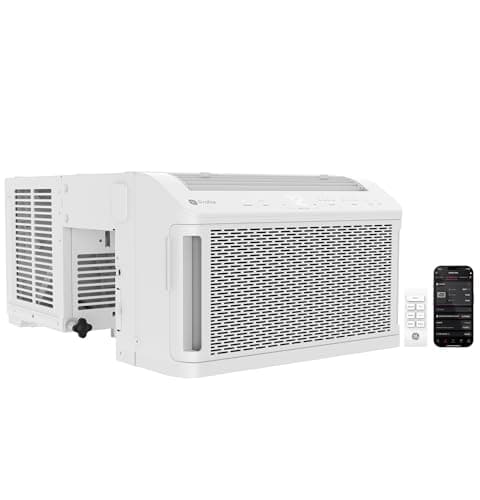 Shallowest of the full-size units GE Profile ClearView Window Air Conditioner, 8,000 BTU 15.3 inches deep and 46.2 lb, at CEER 16 — the shallowest certified 8,000 BTU unit, which matters on a shelf. | A normal room where the unit comes out each autumn | |
| 3 | The unit you never store Friedrich Through-the-Wall Air Conditioner, 10,100 BTU Through-the-wall at CEER 14.2 and 533.5 kWh, on the Most Efficient list — permanent, so there is nothing to store. | Anyone who has decided the annual lift is not worth it | |
| — | Do not plan on storing this one Midea Window Heat Pump Air Conditioner, 9,500 BTU CEER 17.6, the highest in the certified dataset, in a 129 lb saddle unit 41.2 inches deep. | A permanent install — it is not a seasonal machine |
Every autumn the same question: take it out, or leave it in. Both answers are defensible, and the deciding factor is usually physical rather than thermal.
Decide first
Remove it, or leave it
| Remove it | Leave it in | |
|---|---|---|
| Winter drafts | Gone entirely | Real, even sealed and covered |
| Window usable | Yes | No |
| Weather exposure | None | Full — freeze/thaw on the coil |
| Effort | Two lifts a year, 31 to 140 lb | None |
| Risk | Dropping it, or hurting yourself | Slow weathering |
| Storage space needed | Yes, upright and dry | None |
| Best for | Light units, accessible windows | Heavy units, upper floors, saddle designs |
Weight is the honest deciding factor. Certified units run from 31.6 lb to 140 lb, and the top of that range is not something to maneuver out of an upper-floor window twice a year on principle.
Under roughly 50 lb with an easily accessible window: take it out. Over about 90 lb, or a saddle-style unit, or anything above the ground floor without help: leave it in and seal it well. In between, it is a judgement call about how cold your winters are and how much you want that window.
The step people skip
Dry it before you store it
This is the single most important part, and almost nobody does it.
An air conditioner spends its working life with a permanently wet evaporator coil and a base pan holding condensate. Put it straight into a box in a garage and it spends eight months as a sealed, damp, dark environment.
That produces exactly what you would expect: biological growth on the coil, corrosion on the fins, and a smell in June that no amount of filter cleaning removes.
The fix costs nothing: run the unit on fan-only, with cooling off, for several hours before you take it out. The airflow dries the coil while the machine is still in the window. Then tip out whatever remains in the base pan once it is down.
This one is not a DIY job
Store it upright, always. This is not a nice-to-have. The compressor holds oil, and the sealed refrigerant system depends on that oil staying where it belongs. Storing a unit on its side or back lets oil migrate into the refrigerant lines.
If a unit has been stored on its side, stand it upright and leave it standing for at least 24 hours before switching it on so the oil drains back. Starting a compressor with oil in the lines is how units die on their first day back.
The same rule applies to transport. If it travels lying down, it stands up for a day at the other end.
If you remove it
The procedure
- Run it on fan-only for several hours to dry the coil and pan.
- Unplug it at the wall.
- Clean the filter and both coils now, not next spring. A unit stored dirty spends the winter with that debris in contact with damp aluminum. Full cleaning procedure.
- Drain the base pan and tip out any standing water.
- Remove it in the reverse of the install order — sash lock bracket, side curtain screws, then the top flange screws last, with one person holding the unit before the final screws come out.
- Let it air dry indoors for a day before it goes into anything enclosed.
- Cover it loosely — a sheet or a breathable cover, not a sealed plastic bag, which traps residual moisture against the metal.
- Store upright, indoors, off a concrete floor. A pallet, a shelf or a scrap of timber. Concrete wicks moisture.
If you leave it in
Sealing for winter
A unit left in place is a hole in your building envelope with a heat exchanger in it. Two things to do:
Seal the interior side. An insulated indoor cover over the front of the unit stops room air being drawn out through the machine and cold air convecting in. This matters more than the outdoor cover for comfort and heating cost.
Cover the exterior. A fitted outdoor cover keeps snow, ice and debris out of the condenser. It should shed water and breathe — a sealed plastic wrap traps condensation against the coil and does more harm than no cover at all.
Also re-check the seals while you are there. Foam gaskets compress over a season and the strip between the sashes falls out, and in winter those gaps cost heating rather than cooling. The sealing detail.
Say the unwelcome thing
Do not store it in a sealed plastic bag.
It looks like the careful thing to do and it is the opposite. A unit coming out of a window has moisture on the coil, in the pan and in the insulation, however long you ran the fan.
Sealed in plastic, that moisture cannot leave. It condenses on the coldest surface in the bag — which is the aluminum coil and the steel chassis — and stays in contact with it for eight months. That is a corrosion recipe, and it is where the June smell comes from.
Use a breathable cover, or a loose sheet, or the original box with the flaps left open. The goal is keeping dust off, not sealing air out.
And if storage space is genuinely the problem, a through-the-wall unit removes the question permanently.
In full
Every pick, and what is wrong with it
Published specifications only, each linked to the page it came from. Where a manufacturer publishes nothing, the row says so — we do not fill blanks in.
1. Easiest to take out and put away
Midea Window Air Conditioner, 6,000 BTU
Midea · model MAW06S1KWT-A
31.6 lb and 13.3 inches deep — the lightest certified unit we hold data for, and it still reaches CEER 16.
31.6 lb. One person can lift that safely, which changes the whole remove-or-leave calculation — the answer is simply “take it out”.
At 12.1 H x 16.0 W x 13.3 D inches it also fits a shelf rather than needing floor space, which matters when the storage is a shared garage or a closet.
None of that costs efficiency: CEER 16 and 281.3 kWh a year, about $52 for a season and the lowest annual figure in the certified dataset. On the Most Efficient list, 45% below the federal standard.
No support bracket required, R-32, variable speed.
What’s wrong with it
6,000 BTU is a small-room capacity, so it is not an option for a large space.
Running cost — MAW06S1KWT-A
| Annual energy use | 281.3 kWh | ENERGY STAR certified figure |
|---|---|---|
| Annual cost | $52 | 281.3 × 18.34¢/kWh |
| Per cooling month | $13 | spread over a four-month season |
The annual figure is the certified value from the ENERGY STAR Certified Room Air Conditioners dataset, which models a standard cooling season rather than your actual summer. It is more useful than a nameplate wattage here, because a variable-speed compressor spends most of its life well below nameplate.
Rate: 18.34¢/kWh, the US average residential price for June 2026 (EIA Electric Power Monthly, Table 5.3). Yours will differ — swap it in: (watts ÷ 1000) × hours × your rate.
| Cooling capacity | 6,000 BTU/h |
|---|---|
| CEER | 16 |
| Annual energy use | 281.3 kWh/yr |
| vs federal standard | 45% less energy |
| Dimensions | 12.1 H x 16.0 W x 13.3 D in |
| Weight | 31.6 lb |
| Installation | Does not straddle the windowsill |
| Support bracket | Not required |
| Compressor | Variable speed |
| Refrigerant | R-32 |
| ENERGY STAR | Certified, and on the Most Efficient list |
Every figure above is from ENERGY STAR Certified Room Air Conditioners dataset. Blanks are shown as “not published” rather than filled in.
2. Shallowest of the full-size units
GE Profile ClearView Window Air Conditioner, 8,000 BTU
GE Profile · model PWJV08W
15.3 inches deep and 46.2 lb, at CEER 16 — the shallowest certified 8,000 BTU unit, which matters on a shelf.
Depth is the storage specification nobody thinks about until they are trying to fit a unit on a garage shelf. 15.3 inches against 22 for a U-shaped unit is the difference between fitting a standard shelf and not.
46.2 lb is manageable to carry, though getting it out of a window is still a two-person job — one holding, one raising the sash.
CEER 16 and 375 kWh a year, about $69 for a season, on the Most Efficient list and 47% below the federal standard.
Removal is the installation in reverse — and the flange screws come out last, not first.
What’s wrong with it
46.2 lb is a two-person lift over a sill, even though one person can carry it once it is down.
Running cost — PWJV08W
| Annual energy use | 375 kWh | ENERGY STAR certified figure |
|---|---|---|
| Annual cost | $69 | 375 × 18.34¢/kWh |
| Per cooling month | $17 | spread over a four-month season |
The annual figure is the certified value from the ENERGY STAR Certified Room Air Conditioners dataset, which models a standard cooling season rather than your actual summer. It is more useful than a nameplate wattage here, because a variable-speed compressor spends most of its life well below nameplate.
Rate: 18.34¢/kWh, the US average residential price for June 2026 (EIA Electric Power Monthly, Table 5.3). Yours will differ — swap it in: (watts ÷ 1000) × hours × your rate.
| Cooling capacity | 8,000 BTU/h |
|---|---|
| CEER | 16 |
| Annual energy use | 375 kWh/yr |
| vs federal standard | 47% less energy |
| Dimensions | 12.6 H x 18.6 W x 15.3 D in |
| Weight | 46.2 lb |
| Refrigerant | R-32 |
| Installation | Does not straddle the windowsill |
| Compressor | Variable speed |
| ENERGY STAR | Certified, and on the Most Efficient list |
Every figure above is from ENERGY STAR Certified Room Air Conditioners dataset. Blanks are shown as “not published” rather than filled in.
3. The unit you never store
Friedrich Through-the-Wall Air Conditioner, 10,100 BTU
Friedrich · model WCVT10B10B
Through-the-wall at CEER 14.2 and 533.5 kWh, on the Most Efficient list — permanent, so there is nothing to store.
The structural answer to the storage question: a unit that lives in the wall never comes out, and the window is free all year regardless.
533.5 kWh a year, about $98 for a season, and on the ENERGY STAR Most Efficient list despite the CEER 14.2 that the sleeve costs it.
It still needs a seasonal clean and an exterior cover in a harsh winter, but there is no lift, no shelf and no risk of dropping 110 lb down a stairwell.
The requirement is an existing sleeve — cutting a new opening is licensed work. Full comparison.
What’s wrong with it
110 lb and it needs an existing wall sleeve. CEER 14.2 is below a good window unit because the sleeve restricts airflow.
Running cost — WCVT10B10B
| Annual energy use | 533.5 kWh | ENERGY STAR certified figure |
|---|---|---|
| Annual cost | $98 | 533.5 × 18.34¢/kWh |
| Per cooling month | $24 | spread over a four-month season |
The annual figure is the certified value from the ENERGY STAR Certified Room Air Conditioners dataset, which models a standard cooling season rather than your actual summer. It is more useful than a nameplate wattage here, because a variable-speed compressor spends most of its life well below nameplate.
Rate: 18.34¢/kWh, the US average residential price for June 2026 (EIA Electric Power Monthly, Table 5.3). Yours will differ — swap it in: (watts ÷ 1000) × hours × your rate.
| Cooling capacity | 10,100 BTU/h |
|---|---|
| CEER | 14.2 |
| Annual energy use | 533.5 kWh/yr |
| Weight | 110.0 lb |
| Refrigerant | R-32 |
| Installation | Through the wall (existing sleeve required) |
| Compressor | Variable speed |
| ENERGY STAR | Certified, and on the Most Efficient list |
Every figure above is from ENERGY STAR Certified Room Air Conditioners dataset. Blanks are shown as “not published” rather than filled in.
Skip this one
Midea Window Heat Pump Air Conditioner, 9,500 BTU
Midea · model MAH09B1AGR
CEER 17.6, the highest in the certified dataset, in a 129 lb saddle unit 41.2 inches deep.
Included as a caution rather than a criticism. On efficiency it is the best room air conditioner certified — CEER 17.6 and 404.8 kWh a year, about $74, and 80% below the federal standard.
It is also 129 lb and 41.2 inches deep, hanging over the sill like a saddle. That is not a unit you lift out in October and put back in June.
It also heats, which is the argument for leaving it in: a reverse-cycle unit is working in winter rather than sitting in a hole doing nothing. More on that category.
If you buy a saddle unit, plan on it being permanent and seal it properly for winter.
What’s wrong with it
129 lb and over three feet deep. Removing and storing this twice a year is not a realistic annual routine.
Running cost — MAH09B1AGR
| Annual energy use | 404.8 kWh | ENERGY STAR certified figure |
|---|---|---|
| Annual cost | $74 | 404.8 × 18.34¢/kWh |
| Per cooling month | $19 | spread over a four-month season |
The annual figure is the certified value from the ENERGY STAR Certified Room Air Conditioners dataset, which models a standard cooling season rather than your actual summer. It is more useful than a nameplate wattage here, because a variable-speed compressor spends most of its life well below nameplate.
Rate: 18.34¢/kWh, the US average residential price for June 2026 (EIA Electric Power Monthly, Table 5.3). Yours will differ — swap it in: (watts ÷ 1000) × hours × your rate.
| Cooling capacity | 9,500 BTU/h |
|---|---|
| Heating mode | Yes, reverse cycle |
| CEER | 17.6 |
| Annual energy use | 404.8 kWh/yr |
| vs federal standard | 80% less energy |
| Dimensions | 20.9 H x 25.0 W x 41.2 D in |
| Weight | 129.0 lb |
| Installation | Straddles the windowsill (saddle style) |
| Support bracket | Not required |
| Compressor | Variable speed |
| Refrigerant | R-32 |
| ENERGY STAR | Certified, and on the Most Efficient list |
Every figure above is from ENERGY STAR Certified Room Air Conditioners dataset. Blanks are shown as “not published” rather than filled in.
We are not linking a buy button for this one. If you want to look at it anyway, it is easy enough to find — but we would rather send you to something that fits your room.
Questions people actually ask
Frequently asked
Should I remove my window air conditioner for winter?
Weight usually decides it. Under about 50 lb with an accessible window, take it out — you get the window back and no winter draft. Over about 90 lb, on an upper floor, or a saddle-style unit, leave it in and seal it properly; the lift is its own risk.
How do you prepare a window air conditioner for storage?
Run it on fan-only for several hours first so the airflow dries the coil and pan, then unplug it, clean the filter and coils, drain the base pan, and let it air dry indoors for a day before covering it.
Can you store a window air conditioner on its side?
No. The compressor holds oil that must stay in place, and storing a unit on its side or back lets that oil migrate into the refrigerant lines. If one has been stored that way, stand it upright for at least 24 hours before switching it on.
Should I cover a window air conditioner left in over winter?
Yes, on both sides. An insulated indoor cover stops room air being drawn out and cold air convecting in, which matters most for comfort and heating cost. An outdoor cover keeps snow and debris off the condenser — it must breathe rather than seal.
Why does my air conditioner smell when I put it back in?
It was stored damp. The evaporator coil and base pan are wet in normal operation, and a unit boxed up without drying spends the winter as a sealed damp environment. Running it on fan-only before removal, and using a breathable cover, prevents it.
Is it bad to leave a window air conditioner in all year?
It costs you a draft and the use of the window, and exposes the coil to freeze-thaw cycles. Sealed and covered properly, plenty of people do it for years — and for heavy or saddle-style units it is the sensible choice, since the lift carries its own risk. Units that earn their keep in winter.
Sources
Where these numbers came from
Read next
Where to go from here
Back to Air Conditioners, or read how we pick.