The picks
The best dual-hose portable air conditioners
If a portable is genuinely your only option, the hose count is the specification that decides whether it works at all.
By Sawyer V. · Published
The short answer
Dual hose is the only portable configuration worth buying. A single-hose unit depressurizes the room and pulls warm unfiltered air in through every gap; a sealed dual-hose loop does not. Size from DOE SACC, not the box BTU — the two units here are 9,500 and 12,000 SACC against 14,000 on both boxes. And note the category’s standing failure: no ENERGY STAR program covers portables at all.
Fan & Frost earns a commission when you buy through our links, at no cost to you. It never changes a ranking, and we say so when the right answer is the cheaper unit or nothing at all. Full disclosure · How we pick.
At a glance
The picks, ranked
Tap any row to jump to the full reasoning. Prices are live from Amazon where we have them, and read “check price” where we don’t — never a number we cannot verify today.
| # | Product | Best for | Price |
|---|---|---|---|
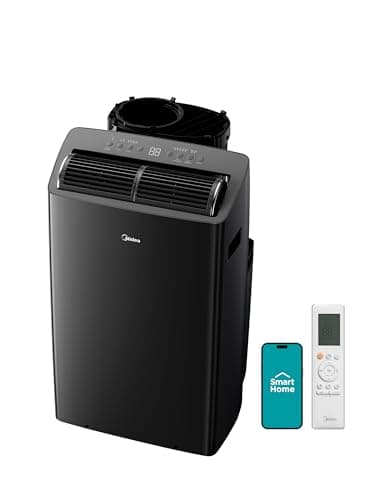
| 1 | Best overall Midea Duo Smart Inverter Portable Air Conditioner 12,000 BTU SACC from a 14,000 BTU box — the smallest published gap between marketing and DOE rating we hold data for. | A room with no usable window opening for a fixed unit | |
| 2 | Best published data Whynter ARC-14S Dual Hose Portable Air Conditioner 1,300 W published, 9,500 BTU SACC, dual hose, 71 pints a day of dehumidification. | Anyone who wants to know what it costs before buying | |
| 3 | 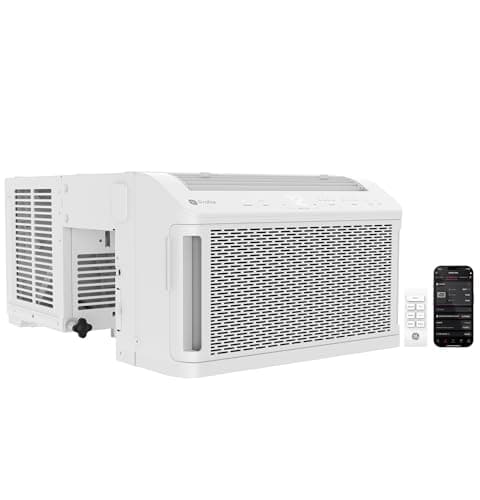 Buy this instead if you can GE Profile ClearView Window Air Conditioner, 8,000 BTU 375 kWh a year at CEER 16, Most Efficient — a whole season for what a portable costs in a week. | Any room with a usable sash window | |
| — | 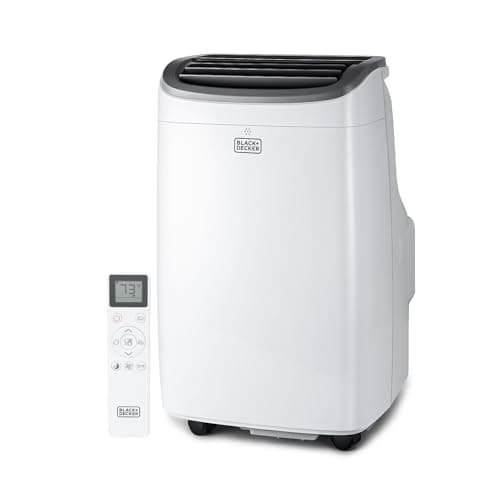 The single-hose problem BLACK+DECKER BPACT08WT Portable Air Conditioner Single hose, 4,000 BTU DOE-rated against 8,000 ASHRAE on the box, and no published wattage. | A small sealed room where the trade-off is understood |
Portables are the least efficient way to cool a room and sometimes the only available one. If you are in that position, the hose count is the decision that matters most.
The mechanism
Why a second hose changes the machine
Every air conditioner needs two air streams: one passing over the cold evaporator to be cooled, and one passing over the hot condenser to carry heat away. A window unit gets these naturally — the indoor half faces in, the outdoor half faces out.
A portable sits entirely indoors, so both halves are in the room.
- Single hose: it draws room air across the condenser and blows it out of the window. The room is now short of that air, so it sucks replacement air in through every gap in the building — warm outdoor air, loft air, crawl space air. You are cooling one stream while importing another.
- Dual hose: one hose draws outdoor air in for the condenser, the other pushes it back out. The condenser loop is sealed off from the room, so indoor pressure stays neutral and no infiltration is created.
That is the whole difference, and it is structural rather than a matter of degree. A single-hose unit does not merely perform worse — it creates a problem the dual-hose unit does not have.
The effect is worst in a small room (infiltration is a larger share of the volume) and in a loft conversion (the make-up air comes from a roof void).
Capacity
Size from SACC, and expect a haircut
Portables carry two capacity numbers and only one of them is honest.
The box BTU is measured under ASHRAE-128 and ignores two real-world losses: heat radiating from the exhaust duct back into the room, and infiltration. DOE SACC — seasonally adjusted cooling capacity — subtracts both.
| Unit | Hoses | Box BTU | DOE SACC | Haircut |
|---|---|---|---|---|
| Midea Duo MAP14S1TBL | Dual | 14,000 | 12,000 | 14.3% |
| Whynter ARC-14S | Dual | 14,000 | 9,500 | 32.1% |
| BLACK+DECKER BPACT08WT | Single | 8,000 | 4,000 | 50.0% |
One thing worth stating plainly, because it is widely assumed and is not true: the size of the haircut is not predicted by hose count. Across the published pairs we hold, dual-hose models appear at both 14.3% and 32.1%. Two hoses is the right buy for the infiltration reason, not because it guarantees a smaller SACC gap. What SACC measures.
The gap
There is no efficiency certification for portables at all
Window and through-the-wall units are covered by a certification program that publishes tested CEER and modeled annual kWh for every model. You can look any of them up and cost it exactly.
Portables are not in that program. There is no certified list, no tested efficiency figure, and no annual energy estimate for any portable air conditioner.
What that means in practice:
- Running cost has to be reconstructed from wattage, which some manufacturers publish and some do not. One of the two units here states none at all.
- No independent efficiency comparison exists between two portables. Any ranking — including ours — is working from capacity and manufacturer claims.
- Noise figures are uncertified dBA, measured however each brand chose.
- The ENERGY STAR logo you sometimes see on a portable listing is not for the air conditioner category, because that category does not exist here.
This one is not a DIY job
Portables need somewhere for the exhaust and the condensate to go, and both are non-negotiable. Venting the exhaust into the room being cooled makes the unit a net heater — it adds its own compressor power to the room along with the heat it moved.
Condensate management varies by model. A unit that fills and shuts off overnight is a common failure, and a drain hose is worth arranging where the model allows one.
Room air conditioner manuals typically require a dedicated grounded outlet and forbid extension cords and adapters. At 1,300 W and 11.6 A that is not a formality.
Never seal a portable’s exhaust into a chimney, an unventilated loft or a crawl space.
Practical
Getting the most out of one
- Insulate the exhaust hose. It runs hot, and every bit of that heat radiates back into the room it just left. This is the cheapest meaningful improvement available.
- Keep the hose short and straight. Coiled hose is more surface area radiating indoors and more resistance to airflow.
- Seal the window kit properly. The supplied panels are usually the weakest part of the installation, and gaps there undo the sealed loop you paid for.
- Close the room. A portable sized for one room and asked to cool a floor will run continuously and never get there.
- Measure the draw. A plug-in energy meter costs very little and settles what the machine actually uses — which for one of these is otherwise unknowable.
- Reconsider a window unit annually. Circumstances change, and the running cost difference is large enough to be worth revisiting.
Say the unwelcome thing
Do not buy a single-hose portable to save money.
The purchase price gap is real and the running consequence is worse than it looks, because a single-hose unit does not just cool less efficiently — it actively imports the heat it is removing.
Exhausting room air outdoors leaves the room short of air, and replacement arrives through every gap in the building: warm outdoor air, loft air, crawl space air. Unconditioned and unfiltered, for as long as the machine runs.
It shows up in the ratings too. The single-hose unit here is DOE-rated at 4,000 BTU against 8,000 on the box — a 50% haircut, the largest we hold data for.
If a portable is genuinely necessary, make it dual hose: 12,000 BTU SACC or 9,500 SACC with a published 1,300 W. If a window is available at all, 375 kWh for a whole season is a different order of expense.
In full
Every pick, and what is wrong with it
Published specifications only, each linked to the page it came from. Where a manufacturer publishes nothing, the row says so — we do not fill blanks in.
1. Best overall
Midea Duo Smart Inverter Portable Air Conditioner
Midea · model MAP14S1TBL
12,000 BTU SACC from a 14,000 BTU box — the smallest published gap between marketing and DOE rating we hold data for.
The best portable in the catalog on the number that matters, and it earns that on the honesty of its own rating.
12,000 BTU SACC against 14,000 marketing BTU is a 14.3% haircut. Across the published pairs we hold, that gap runs from 14.3% to 50% — so this is the top of the range for a rating that means what it says.
Dual hose, 43 dBA (manufacturer figure, uncertified), R-32, 74.96 lb, three speeds.
The gap we will not paper over: Midea states 115 V and no wattage. For an appliance you may run for hours, that is a real omission and it means we cannot put a running cost against it. How to work yours out with a meter.
What’s wrong with it
Midea publishes no wattage at all, so its running cost cannot be calculated honestly.
Running cost
Midea does not publish a wattage for the MAP14S1TBL, so we cannot calculate what it costs to run. We are not going to estimate one. If Midea publishes a nameplate figure, this block will show the arithmetic.
| Marketing capacity | 14,000 BTU |
|---|---|
| DOE-rated capacity | 12,000 BTU SACC |
| Hoses | Dual |
| Noise | 43 dBA |
| Speeds | 3 |
| Refrigerant | R-32 |
| Dimensions | 19.52 W x 16.73 D x 32.48 H in |
| Weight | 74.96 lb |
| Manufacturer coverage claim | 550 sq ft |
| Power | Not published (115 V stated, no wattage) |
| Warranty | 1 year |
Every figure above is from Midea product page, MAP14S1TBL. Blanks are shown as “not published” rather than filled in.
2. Best published data
Whynter ARC-14S Dual Hose Portable Air Conditioner
Whynter · model ARC-14S
1,300 W published, 9,500 BTU SACC, dual hose, 71 pints a day of dehumidification.
Recommended partly for a reason that should not be remarkable: it tells you how much electricity it uses.
1,300 W / 11.6 A at 115 V. That is about $1.91 for an eight-hour night, or $57 for a month of overnight running — against $69 for an efficient window unit’s entire season.
9,500 BTU SACC from a 14,000 BTU box. The honest capacity is a third below the number on the front, which is normal for the category and worth internalising.
Dual hose, R-32, under 51 dBA on low, and 71 pints a day of dehumidification — which in a damp room is a genuine secondary benefit.
What’s wrong with it
9,500 SACC from a 14,000 BTU box is a 32% haircut, and 1,300 W is a genuinely large draw.
Running cost — ARC-14S
| Nameplate power | 1300 W | manufacturer's published figure |
|---|---|---|
| Energy, 8-hour night | 10.40 kWh | 1300 ÷ 1000 × 8 |
| Cost per hour | 24¢ | at 18.34¢/kWh |
| Cost per 8-hour night | $1.91 | on the highest speed |
| Cost per 30 nights | $57 | 312.0 kWh |
Rate: 18.34¢/kWh, the US average residential price for June 2026 (EIA Electric Power Monthly, Table 5.3). Yours will differ — swap it in: (watts ÷ 1000) × hours × your rate.
| Marketing capacity | 14,000 BTU (ASHRAE-128) |
|---|---|
| DOE-rated capacity | 9,500 BTU SACC |
| Hoses | Dual |
| Power | 1,300 W / 11.6 A at 115 V |
| Noise | Under 51 dBA low, under 56 dBA high |
| Dehumidification | 71 pints/day |
| Refrigerant | R-32 |
| Dimensions | 16 W x 19 D x 35.5 H in |
| Weight | 73 lb |
| Manufacturer coverage claim | 500 sq ft |
| Warranty | 1 year unit, 3 years compressor |
Every figure above is from Whynter product page, ARC-14S. Blanks are shown as “not published” rather than filled in.
3. Buy this instead if you can
GE Profile ClearView Window Air Conditioner, 8,000 BTU
GE Profile · model PWJV08W
375 kWh a year at CEER 16, Most Efficient — a whole season for what a portable costs in a week.
On a dual-hose page because the honest recommendation for most people searching this term is to check whether they need a portable at all.
375 kWh for an entire season is about $69 at 18.34¢/kWh. A 1,300 W portable running eight hours a night reaches that in roughly six nights.
CEER 16, Most Efficient, 47% below the federal standard, and 46.2 lb at only 15.3 inches deep — one of the easier certified units to install alone.
The genuine cases for a portable remain: a casement or sliding window, a lease that forbids window units, or a room you need to move the machine between. The comparison in full.
What’s wrong with it
It occupies the window all season, and it cannot be moved between rooms.
Running cost — PWJV08W
| Annual energy use | 375 kWh | ENERGY STAR certified figure |
|---|---|---|
| Annual cost | $69 | 375 × 18.34¢/kWh |
| Per cooling month | $17 | spread over a four-month season |
The annual figure is the certified value from the ENERGY STAR Certified Room Air Conditioners dataset, which models a standard cooling season rather than your actual summer. It is more useful than a nameplate wattage here, because a variable-speed compressor spends most of its life well below nameplate.
Rate: 18.34¢/kWh, the US average residential price for June 2026 (EIA Electric Power Monthly, Table 5.3). Yours will differ — swap it in: (watts ÷ 1000) × hours × your rate.
| Cooling capacity | 8,000 BTU/h |
|---|---|
| CEER | 16 |
| Annual energy use | 375 kWh/yr |
| vs federal standard | 47% less energy |
| Dimensions | 12.6 H x 18.6 W x 15.3 D in |
| Weight | 46.2 lb |
| Refrigerant | R-32 |
| Installation | Does not straddle the windowsill |
| Compressor | Variable speed |
| ENERGY STAR | Certified, and on the Most Efficient list |
Every figure above is from ENERGY STAR Certified Room Air Conditioners dataset. Blanks are shown as “not published” rather than filled in.
Skip this one
BLACK+DECKER BPACT08WT Portable Air Conditioner
BLACK+DECKER · model BPACT08WT
Single hose, 4,000 BTU DOE-rated against 8,000 ASHRAE on the box, and no published wattage.
Included as the contrast case, because the single-hose objection is the entire reason this page exists.
A single-hose unit takes air from the room, uses it to cool the condenser, and blows it outside. Something has to replace that air, and it arrives through gaps around doors, windows, floors and ceilings — unconditioned and unfiltered.
So the machine is continuously importing the heat it is trying to remove. The harder it works, the more arrives.
4,000 BTU DOE-rated against 8,000 ASHRAE — a 50% haircut, the largest we hold data for — and no published wattage. The full comparison.
What’s wrong with it
It exhausts room air outdoors and pulls unconditioned replacement air in through every gap.
Running cost
BLACK+DECKER does not publish a wattage for the BPACT08WT, so we cannot calculate what it costs to run. We are not going to estimate one. If BLACK+DECKER publishes a nameplate figure, this block will show the arithmetic.
| Manufacturer capacity | 4,000 BTU (8,000 BTU ASHRAE) |
|---|---|
| Hoses | Single |
| Refrigerant | R-410A |
| Dimensions | 15.3 W x 14.0 D x 25.0 H in |
| Weight | 52.9 lb |
| Power | Not published by the manufacturer |
| Noise | Not published |
| Coverage claim | Not published by the manufacturer |
| Warranty | 1 year parts and labor, 5 years compressor |
Every figure above is from BLACK+DECKER product page, BPACT08WT. Blanks are shown as “not published” rather than filled in.
We are not linking a buy button for this one. If you want to look at it anyway, it is easy enough to find — but we would rather send you to something that fits your room.
Questions people actually ask
Frequently asked
Is a dual-hose portable air conditioner better than a single hose?
Structurally, yes. A single-hose unit exhausts room air outdoors and creates a slight vacuum, so unconditioned outdoor, loft or crawl-space air is pulled in through every gap. A dual-hose unit seals the condenser loop off from the room, so indoor pressure stays neutral. The full comparison.
What is SACC and why is it lower than the box BTU?
Seasonally adjusted cooling capacity — the DOE rating, which subtracts heat radiating from the exhaust duct back into the room and the effect of infiltration. The box figure is measured under ASHRAE-128 and ignores both. Haircuts across published pairs run 14.3% to 50%. BTU vs SACC.
Do dual-hose portables have a smaller SACC gap?
Not reliably. Across the published pairs we hold, dual-hose models appear at both 14.3% and 32.1% haircuts. Buy two hoses for the infiltration reason, not on an assumption about the rating gap.
How much does a portable air conditioner cost to run?
Where a wattage is published, a 1,300 W unit is about $1.91 for an eight-hour night or $57 for a month of overnight running — against $69 for an efficient window unit's whole season. Some portables publish no wattage at all.
Are portable air conditioners ENERGY STAR certified?
No — there is no ENERGY STAR program for portable air conditioners. Window and through-the-wall units have one, with tested CEER and modeled annual kWh per model. For portables there is no certified list, no tested efficiency figure and no annual energy estimate.
How can I make a portable work better?
Insulate the exhaust hose, keep it short and straight, seal the window kit properly, and close the room. The hose insulation is the cheapest meaningful improvement — the duct runs hot and radiates that heat straight back into the room it just left. Venting properly.
Sources
Where these numbers came from
- Midea Duo MAP14S1TBL product page — 14,000 BTU / 12,000 SACC, dual hose, 43 dBA, no wattage published
- Whynter ARC-14S product page — 14,000 BTU / 9,500 SACC, dual hose, 1,300 W, 71 pints/day
- BLACK+DECKER BPACT08WT product page — 4,000 BTU DOE / 8,000 ASHRAE, single hose
- ENERGY STAR Certified Room Air Conditioners dataset — the comparison case, which covers window and through-the-wall units only
- EIA Electric Power Monthly, Table 5.3 — average residential electricity price
Read next
Where to go from here
Back to Air Conditioners, or read how we pick.