Head to head
Attic fan vs ridge vent
The powered option is not an upgrade of the passive one. In several common situations it is a downgrade with a power cord.
By Sawyer V. · Published
The short answer
Fix the passive system first. A ridge vent plus clear soffits ventilates continuously, silently, for nothing, and cannot depressurize your house. A powered fan moves more air but needs 0.48 square inches of intake per CFM — 5.3 square feet for a 1,600 CFM unit — and takes the shortfall out of your conditioned rooms. Add a fan only when intake is genuinely adequate and the attic still runs hot.
Fan & Frost earns a commission when you buy through our links, at no cost to you. It never changes a ranking, and we say so when the right answer is the cheaper unit or nothing at all. Full disclosure · How we pick.

At a glance
The picks, ranked
Tap any row to jump to the full reasoning. Prices are live from Amazon where we have them, and read “check price” where we don’t — never a number we cannot verify today.
| # | Product | Best for | Price |
|---|---|---|---|
| 1 | 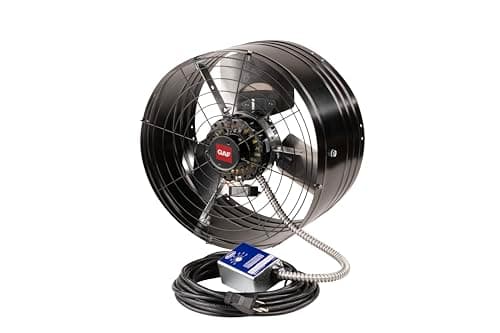 The powered case Maxx Air Premium 1,600 CFM Gable-Mount Power Attic Ventilator 1,600 CFM through an existing gable vent — far more airflow than stack effect delivers, provided the intake can feed it. | An attic with generous soffit intake that still runs hot in the afternoon |
The passive case
What a ridge vent does, and what it costs
A ridge vent is a continuous opening along the peak of the roof, covered so weather stays out. Hot air rises to the ridge, leaves, and pulls cooler air in through the soffits behind it. That is the stack effect, and it runs whenever there is a temperature difference — which in an attic is almost always.
Three things follow, and they are why this is the default:
- Nothing to run, nothing to fail. No motor, no thermostat, no circuit, no service life. The failure mode is a blocked soffit rather than a burnt-out motor.
- It cannot depressurize the house. Passive flow never exceeds what the openings allow, so it cannot pull air from your living space or backdraft a flue.
- It ventilates the whole roof plane, evenly, rather than pulling everything toward one gable end.
The catch is that it is not a purchase you make and install this weekend. A ridge vent goes on when the roof goes on, or as a roofing job, so the realistic question for most people is whether the ridge vent they already have is working.
This one is not a DIY job
Both depend on it
Intake decides either system
Whatever leaves at the top has to enter at the bottom. The figure manufacturers publish for powered fans is 0.48 square inches of net free soffit area per CFM, which the Home Ventilating Institute states as one square foot per 300 CFM — the same number.
| Method | Air moved | Intake needed |
|---|---|---|
| Ridge vent, passive | Varies with temperature difference | Balanced with the exhaust opening |
| Gable fan, 1,020 CFM | 1,020 CFM | 490 sq in (3.4 sq ft) |
| Gable fan, 1,600 CFM | 1,600 CFM | 768 sq in (5.3 sq ft) |
| Solar roof fan, 1,150 CFM | 1,150 CFM, sun permitting | 552 sq in (3.8 sq ft) |
Net free area is the open area after screens and louvers, usually stamped on the vent frame, and it is a fraction of the hole size. The full method for auditing what you have is in attic intake versus exhaust.
The order of operations
What to do, in sequence
- Look at the soffits. Insulation pushed into the eaves is the most common ventilation fault in any house, and baffles fix it for a few dollars a bay.
- Confirm you have exhaust at the top — ridge vent, roof vents or a gable vent — and that it is one type rather than a mixture fighting itself.
- Measure the attic temperature on a hot afternoon, against outdoors, before and after clearing intake.
- Only then consider a fan, sized to the intake you actually have rather than to the attic’s floor area.
There is a fourth option worth naming: a whole-house fan, which is a different machine entirely — it exhausts house air through the attic deliberately, rather than pulling it there by accident. The comparison is in attic fan versus whole-house fan.
Verdict
Which roof needs which
- Ridge vent alone suits most houses with continuous soffit intake and a simple roof line. It is the quiet default and it never costs anything.
- Powered fan earns its place on a complex roof with poor natural flow, a long low-slope attic, or a garage attic with no ridge — and only where intake is adequate.
- Neither, if the real problem is heat reaching the rooms below. That is an insulation and air-sealing job at the ceiling plane, and it beats both options on comfort per dollar.
Say the unwelcome thing
Do not add a powered fan to a roof that already has a working ridge vent.
It is the most common attic-ventilation mistake, and it makes things worse rather than better: the fan short-circuits through the ridge vent, the attic keeps its heat, and the house loses conditioned air through every ceiling penetration.
Clear the soffits first and measure. If the attic still runs hot with genuinely open intake and a single exhaust path, 1,600 CFM through an existing gable vent is the version that adds no roof penetration — and it needs 5.3 square feet of intake to earn its rating.
In full
Every pick, and what is wrong with it
Published specifications only, each linked to the page it came from. Where a manufacturer publishes nothing, the row says so — we do not fill blanks in.
1. The powered case
Maxx Air Premium 1,600 CFM Gable-Mount Power Attic Ventilator
Maxx Air · model CX1600 BLU
1,600 CFM through an existing gable vent — far more airflow than stack effect delivers, provided the intake can feed it.
A powered ventilator does what a ridge vent cannot: it moves air on demand, at a rate set by a motor rather than by how hot the attic happens to be. 1,600 CFM through a gable opening is several times the natural flow of a typical passive system on a calm day.
The condition attached to that figure is the whole argument of this page. By the rule Broan publishes — multiply CFM by 0.48 for the minimum net free intake in square inches — this fan needs 768 square inches, 5.3 square feet, of actual open soffit area. Most houses do not have it, and the fan makes up the difference from the rooms below.
Mounted in an existing gable vent it makes no new roof penetration, which is the version of powered ventilation we would choose — the mounting comparison is in gable versus roof mount.
What’s wrong with it
It runs on electricity, it needs 5.3 sq ft of net free intake to hit its rating, and short of that it pulls conditioned air out of the house.
Running cost
Maxx Air does not publish a wattage for the CX1600 BLU, so we cannot calculate what it costs to run. We are not going to estimate one. If Maxx Air publishes a nameplate figure, this block will show the arithmetic.
| Air delivery | 1,600 CFM |
|---|---|
| Mount | Gable |
| Blade | 14 in |
| Motor | 1/10 HP, 3.3 A at 120 V, 60 Hz |
| Thermostat | Adjustable, 50 - 120 degrees F, pre-wired |
| Humidistat | Not included; XXDUOSTAT thermostat/humidistat sold separately |
| Coverage claim | Attics up to 2,400 sq ft |
| Dimensions | 15 H x 15 W x 5.875 D in |
| Weight | 12 lb |
| Warranty | 2 years, limited |
| Noise | Not published |
| ENERGY STAR | No program exists for attic ventilators |
Every figure above is from Maxx Air product page, CX1600 BLU premium gable-mount power attic ventilator. Blanks are shown as “not published” rather than filled in.
Questions people actually ask
Frequently asked
Is an attic fan better than a ridge vent?
Not usually. A ridge vent ventilates continuously for nothing and cannot depressurize the house. A powered fan moves more air but needs 0.48 square inches of net free intake per CFM, and short of that it draws conditioned air out of your rooms.
Can you have a ridge vent and an attic fan?
You can install both, and it is a mistake. The fan pulls air backward down the nearby ridge vent instead of drawing it across the attic from the soffits, so it ventilates a few feet of roof deck while the rest of the attic stays hot.
How much intake does an attic fan need?
Broan publishes 0.48 square inches of net free soffit area per CFM, the same as the Home Ventilating Institute's one square foot per 300 CFM. A 1,600 CFM fan therefore needs 768 square inches — 5.3 square feet — of actual open area. Auditing your intake.
Do ridge vents work without soffit vents?
Barely. Stack effect needs a low opening to draw from; with blocked or absent soffits the ridge vent has nothing to pull in and the attic stagnates. Clearing insulation out of the eaves and fitting baffles is the cheapest fix in the whole system.
Does an attic fan lower cooling bills?
Sometimes, and it can raise them. A fan that draws part of its air from the conditioned space below is exhausting air you paid to cool, on the hottest afternoons, which is exactly when the air conditioner is working hardest.
Sources
Where these numbers came from
Read next
Where to go from here
Back to Whole-House Airflow, or read how we pick.