The picks
The best fans with remotes and timers
The remote is convenience. The timer is the one that changes how much electricity a fan actually uses, and the published ranges vary more than you would expect.
By Sawyer V. · Published
The short answer
Buy for the timer range, not the remote. Published figures run from 7.5 hours to a full 24-hour programmable timer, and a fan that stops after you fall asleep costs nothing to run for the rest of the night. A remote matters most on a fan you cannot reach — a window fan, or one behind furniture.
Fan & Frost earns a commission when you buy through our links, at no cost to you. It never changes a ranking, and we say so when the right answer is the cheaper unit or nothing at all. Full disclosure · How we pick.
At a glance
The picks, ranked
Tap any row to jump to the full reasoning. Prices are live from Amazon where we have them, and read “check price” where we don’t — never a number we cannot verify today.
| # | Product | Best for | Price |
|---|---|---|---|
| 1 | 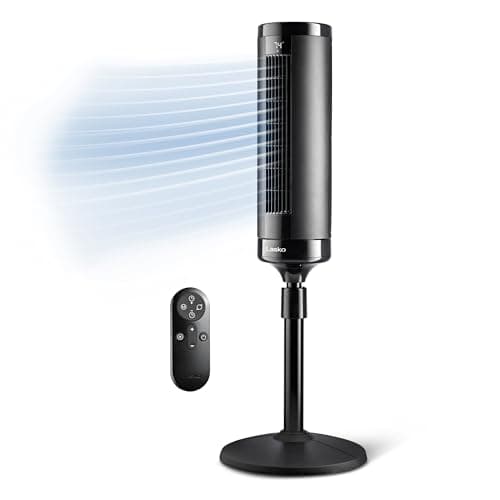 Best overall Lasko EcoQuiet 42" DC Tower Fan 2.9 W on the lowest of 12 speeds with a published 23 dBA and an 8-hour timer — the closest match to how a night actually works. | A bedroom, where twelve speeds and an 8-hour timer match a night | |
| 2 | Where a remote earns the most Lasko Twin Window Fan with Remote Up to 560 CFM on 22 to 31 W, with a remote and an adjustable thermostat that stops it once the room is down. | A window fan, which is always the hardest thing in the room to reach | |
| 3 | 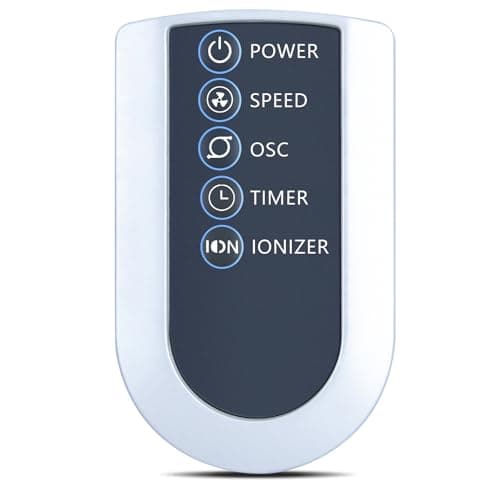 Most airflow with a timer Lasko Wind Curve 42" Tower Fan 720 published CFM on 37 to 49 W with a remote and a 7.5-hour auto-off — a real airflow figure, which is rarer than it should be. | A living room, where the fan has to reach across a bigger space | |
| — | An app instead of a remote Lasko Aria 40" Smart Wi-Fi Tower Fan A 9-hour timer with app and voice control, and Lasko states plainly that a remote is not included. | A household already running voice assistants — not a bedside |
Remotes and timers get bundled together in product listings as though they were one feature. They are not, they solve different problems, and only one of them changes your electricity bill.
The timer
Why the timer is the one that matters
Most fan hours are wasted. A fan cools people by speeding sweat evaporation — it lowers no air temperature and adds a small amount of heat from the motor. Running in an empty room, or beside someone who has been asleep for five hours and no longer needs it, it achieves nothing at all.
A timer converts that from a discipline problem into a setting. And the published ranges vary considerably more than the marketing suggests.
| Fan | Timer | Power, low | Remote |
|---|---|---|---|
| Lasko EcoQuiet 42 in tower | 8 hours | 2.9 W | Yes |
| Lasko Wind Curve 42 in tower | 7.5 h auto-off | 37 W | Yes |
| Lasko Aria 40 in smart tower | 9 hours | 41 W | No — app only |
| Lasko twin window fan | Thermostat, no countdown | 22 W | Yes |
| LG 6,000 BTU window AC | 24 hours | — | Yes, plus app |
Two things stand out. The 24-hour timer belongs to an air conditioner, not a fan — portable fans cluster at 7.5 to 9 hours, which is a night rather than a day. And a thermostat is a different and often better instrument than a countdown, because it responds to the room rather than to a clock.
For a bedside fan, 8 hours is close to ideal: long enough to cover the part of the night you feel it, short enough that it is off before morning.
This one is not a DIY job
A timer is worth far more on a high-draw fan than a low-draw one. Leaving a 2.9 W tower running an extra four hours costs 0.2¢ at 18.34¢/kWh. Leaving a 41 W one running costs 3.0¢ — fourteen times as much for the same four hours of doing nothing.
The remote
Where a remote is genuinely worth paying for
Unlike the timer, a remote’s value depends almost entirely on where the fan is.
- A window fan: essential. It sits behind a sill, usually behind a blind, often behind furniture. Without a remote you will leave it on whatever setting it was on.
- A ceiling fan: essential. The alternative is a pull chain you cannot reach or a wall switch you have to cross the room for — ceiling fans compared.
- A bedside tower: genuinely useful. Changing speed at 2 a.m. without getting up is the whole argument, and it is a good one.
- A desk or clip-on fan: pointless. It is within arm’s reach by definition — desk fans.
- A box fan in a window: it does not have one. Box fans are mechanical-switch products, which is part of why they are cheap.
The practical failure mode with remotes is losing them. A fan with a remote and no usable controls on the body becomes a fan with one speed when the handset disappears behind the sofa. Check there are physical buttons too.
Smart
App control is not a remote
Worth saying clearly, because product listings blur it: an app is not a substitute for a handset in the one situation that matters most.
At 2 a.m., in the dark, half asleep, a physical button you can find by touch beats unlocking a phone, opening an app and waiting for it to connect. One of the fans above has an app, voice control and explicitly no remote, which is the wrong trade for a bedroom and the right one for a living room you control by voice.
Where an app does win is scheduling that repeats — the same on-and-off pattern every weekday, which no countdown timer can do — scheduling cooling in general and smart fans compared.
Noise
Read the noise figures carefully
A fan chosen for a bedside timer is being chosen for a bedroom, so noise is the other specification that matters — and it is the least reliably published on this page.
Portable fan dBA figures are manufacturer-measured, under conditions that are not standardized between brands. They are useful for comparing two fans from the same maker and close to meaningless across makers.
Ceiling fans have no noise rating at all in the certified dataset. Bathroom fans do — sones, measured to a shared procedure — which makes them the one fan category where a noise number means something comparable — what fan noise figures mean and the quietest fans we can evidence.
Say the unwelcome thing
Do not use a smart plug as a timer for a fan you care about.
It looks like the cheap way to add a timer to any fan, and for a simple mechanical fan it genuinely is. For an electronic one it frequently is not.
A fan with a digital control board does not necessarily resume its previous setting when mains power returns. Many come back off, requiring a button press; some return on a default speed rather than yours. Cutting power to a fan is not the same as switching it off.
Test it before relying on it: plug the fan in, set it, pull the plug, plug it back in and see what happens. If it does not resume, the smart plug can only ever turn it off on a schedule, which is still the half that saves electricity. A fan with its own 8-hour timer avoids the question — where smart plugs do and do not work.
In full
Every pick, and what is wrong with it
Published specifications only, each linked to the page it came from. Where a manufacturer publishes nothing, the row says so — we do not fill blanks in.
1. Best overall
Lasko EcoQuiet 42" DC Tower Fan
Lasko · model T42710
2.9 W on the lowest of 12 speeds with a published 23 dBA and an 8-hour timer — the closest match to how a night actually works.
The combination that makes the timer genuinely useful: enough speed steps to find the setting that is just enough, and a timer sized to a night’s sleep.
An 8-hour timer is the right length. Set it going as you get into bed and it stops around the time the room no longer needs it, without you waking to switch it off.
2.9 W on low, 19 W on high, twelve speeds. An eight-hour night on low is 0.4¢ at 18.34¢/kWh. Twelve steps rather than three is what lets you sit at 2.9 W instead of splitting the difference.
23 dBA low and 46 dBA high, with a remote. Treat those figures as indicative — portable fan noise ratings are not certified — and note that no CFM is published.
What’s wrong with it
The dBA figures are manufacturer-measured, and Lasko publishes no CFM at all.
Running cost — T42710
| Nameplate power | 2.9 W – 19 W | manufacturer's published figure |
|---|---|---|
| Energy, 8-hour night | 0.15 kWh | 19 ÷ 1000 × 8 |
| Cost per hour | 0.3¢ | at 18.34¢/kWh |
| Cost per 8-hour night | 2.8¢ | on the highest speed |
| Cost per 30 nights | 84¢ | 4.6 kWh |
| Same month, lowest speed | 13¢ | at 2.9 W |
Rate: 18.34¢/kWh, the US average residential price for June 2026 (EIA Electric Power Monthly, Table 5.3). Yours will differ — swap it in: (watts ÷ 1000) × hours × your rate.
| Power | 2.9 W - 19 W (0.06-0.303 A at 120 V) |
|---|---|
| Noise | 23 dBA low, 46 dBA high |
| Speeds | 12 |
| Height | 41.6 in |
| Footprint | 12.8 x 12.8 in |
| Weight | 7.8 lb |
| Timer | 8 hours |
| Air delivery (CFM) | Not published |
| Warranty | 2 years |
Every figure above is from Lasko product page, T42710. Blanks are shown as “not published” rather than filled in.
2. Where a remote earns the most
Lasko Twin Window Fan with Remote
Lasko · model W09550
Up to 560 CFM on 22 to 31 W, with a remote and an adjustable thermostat that stops it once the room is down.
A window fan sits behind a sill, often behind a blind, frequently behind furniture. It is the one fan in the house where a remote is not a luxury.
An adjustable thermostat rather than a countdown timer, which for a window fan is the better instrument: it stops when the room reaches temperature instead of when a clock runs out.
Up to 560 CFM on 22 to 31 W with independently reversible twin motors — intake, exhaust, or one of each for a full exchange through a single opening.
24 to 32 inch window fit at 8.0 lb. Wider than a box fan needs, so measure before ordering — the window exhaust setup, explained.
What’s wrong with it
It needs a 24 to 32 inch window, and there is no countdown timer — only a thermostat.
Running cost — W09550
| Nameplate power | 22 W – 31 W | manufacturer's published figure |
|---|---|---|
| Energy, 8-hour night | 0.25 kWh | 31 ÷ 1000 × 8 |
| Cost per hour | 0.6¢ | at 18.34¢/kWh |
| Cost per 8-hour night | 4.5¢ | on the highest speed |
| Cost per 30 nights | $1.36 | 7.4 kWh |
| Same month, lowest speed | 97¢ | at 22 W |
Rate: 18.34¢/kWh, the US average residential price for June 2026 (EIA Electric Power Monthly, Table 5.3). Yours will differ — swap it in: (watts ÷ 1000) × hours × your rate.
| Power | 22 W - 31 W at 120 V |
|---|---|
| Air delivery | Up to 560 CFM |
| Window fit | 24 - 32 in wide |
| Modes | Intake, exhaust or exchange (independent motors) |
| Thermostat | Adjustable |
| Speeds | 3 |
| Dimensions | 12.9 H x 24.0 W x 4.9 D in |
| Weight | 8.0 lb |
| Warranty | 1 year |
Every figure above is from Lasko product page, W09550. Blanks are shown as “not published” rather than filled in.
3. Most airflow with a timer
Lasko Wind Curve 42" Tower Fan
Lasko · model 2554
720 published CFM on 37 to 49 W with a remote and a 7.5-hour auto-off — a real airflow figure, which is rarer than it should be.
Worth having on the page because it publishes an actual airflow number, which lets you see what the extra power buys.
720 CFM across three speeds. That is a genuine living-room figure, where the quieter tower above is a personal-space fan that happens to be tall.
37 W on low and 49 W on high. Eight hours on low is 5.4¢ at 18.34¢/kWh, against 0.4¢ for the 12-speed tower. You are paying for reach.
A 7.5-hour auto-off and a remote, at 10.62 lb. No noise figure is published, which on a 720 CFM fan is the specification you would most want — tower fans compared.
What’s wrong with it
37 W on low is thirteen times the tower above, and no noise figure is published.
Running cost — 2554
| Nameplate power | 37 W – 49 W | manufacturer's published figure |
|---|---|---|
| Energy, 8-hour night | 0.39 kWh | 49 ÷ 1000 × 8 |
| Cost per hour | 0.9¢ | at 18.34¢/kWh |
| Cost per 8-hour night | 7.2¢ | on the highest speed |
| Cost per 30 nights | $2.16 | 11.8 kWh |
| Same month, lowest speed | $1.63 | at 37 W |
Rate: 18.34¢/kWh, the US average residential price for June 2026 (EIA Electric Power Monthly, Table 5.3). Yours will differ — swap it in: (watts ÷ 1000) × hours × your rate.
| Power | 37 W - 49 W (0.4 A at 120 V) |
|---|---|
| Air delivery | 720 CFM |
| Speeds | 3 |
| Height | 42.5 in |
| Footprint | 13 x 13 in |
| Weight | 10.62 lb |
| Timer | 7.5-hour auto-off |
| Noise | Not published |
| Warranty | 1 year |
Every figure above is from Lasko product page, 2554. Blanks are shown as “not published” rather than filled in.
Skip this one
Lasko Aria 40" Smart Wi-Fi Tower Fan
Lasko · model T40733
A 9-hour timer with app and voice control, and Lasko states plainly that a remote is not included.
Flagged because “smart” and “has a remote” are assumed to travel together, and here they explicitly do not.
Remote: not included. Lasko publishes this. Control is through the Aria for Home app, Amazon Alexa or Google Assistant, which means finding a phone in the dark rather than a handset.
A 9-hour timer — the longest countdown on this page — with 460 CFM, 90-degree oscillation and five speeds.
41 W on low and 52 W on high, at a published 31.5 to 48.7 dBA. That low figure is the problem for a bedroom: it is fourteen times the 2.9 W tower for less speed granularity — smart fans compared.
What’s wrong with it
41 W on low is fourteen times the quietest tower here, for 460 CFM.
Running cost — T40733
| Nameplate power | 41 W – 52 W | manufacturer's published figure |
|---|---|---|
| Energy, 8-hour night | 0.42 kWh | 52 ÷ 1000 × 8 |
| Cost per hour | 1.0¢ | at 18.34¢/kWh |
| Cost per 8-hour night | 7.6¢ | on the highest speed |
| Cost per 30 nights | $2.29 | 12.5 kWh |
| Same month, lowest speed | $1.80 | at 41 W |
Rate: 18.34¢/kWh, the US average residential price for June 2026 (EIA Electric Power Monthly, Table 5.3). Yours will differ — swap it in: (watts ÷ 1000) × hours × your rate.
| Power | 41 W - 52 W (0.3-0.44 A at 120 V) |
|---|---|
| Air delivery | 460 CFM |
| Noise | 31.5 dBA low, 48.7 dBA high |
| Speeds | 5 |
| Smart control | Aria for Home app (iOS/Android), Amazon Alexa, Google Assistant |
| Height | 39.58 in |
| Footprint | 11.2 x 11.2 in |
| Weight | 9.5 lb |
| Timer | 9 hours |
| Oscillation | 90 degrees |
| Remote | Not included |
| Warranty | 2 years |
Every figure above is from Lasko product page, T40733. Blanks are shown as “not published” rather than filled in.
We are not linking a buy button for this one. If you want to look at it anyway, it is easy enough to find — but we would rather send you to something that fits your room.
Questions people actually ask
Frequently asked
What is the best fan with a timer?
For a bedroom, one with an 8-hour countdown and enough speed steps to sit at its lowest setting — an 8-hour timer matches the part of the night you actually feel the fan. Published portable fan timers run from 7.5 to 9 hours; 24-hour timers belong to air conditioners.
Is a fan timer worth it?
Yes, and it is worth more on a high-draw fan. Four wasted hours on a 2.9 W tower cost almost nothing; on a 41 W one they cost fourteen times as much. A fan cools people rather than rooms, so every hour it runs unattended achieves nothing.
Do all fans with remotes have timers?
No, and the two are separate features. One tower fan here has app and voice control and explicitly no remote; a twin window fan has a remote and a thermostat rather than a countdown timer. Check each one individually rather than assuming.
Is an app better than a remote on a fan?
Not at 2 a.m. A physical button you can find by touch beats unlocking a phone and waiting for an app to connect. An app wins for repeating schedules — the same on-and-off pattern every weekday — which no countdown timer can do. Smart fans compared.
Can I use a smart plug to add a timer to any fan?
Only reliably on a simple mechanical fan. One with a digital control board may come back off after power is restored, or return on a default speed rather than yours. Test it before relying on it — cutting power is not the same as switching off. Smart plugs for cooling.
Which fan has the longest timer?
Among the portable fans here, a 9-hour countdown on a smart tower — though that model has no remote. The longest timer in any cooling product on this site is a 24-hour programmable one, and it belongs to a window air conditioner rather than a fan.
Sources
Where these numbers came from
- Lasko product page, T42710 — 2.9 to 19 W, 12 speeds, 23 to 46 dBA, 8-hour timer, remote included
- Lasko product page, 2554 — 720 CFM, 37 to 49 W, 7.5-hour auto-off, remote included
- Lasko product page, T40733 — 460 CFM, 41 to 52 W, 31.5 to 48.7 dBA, 9-hour timer, app and voice control, remote not included
- Lasko product page, W09550 — up to 560 CFM, 22 to 31 W, adjustable thermostat, remote, 24 to 32 in window fit
- LG product page, LW6023IVSM — 24-hour timer, ThinQ app, Alexa and Google Assistant
- EIA Electric Power Monthly, Table 5.3 — average residential electricity price
Read next
Where to go from here
Back to Fans, or read how we pick.