Guide and picks
Keeping a room cool for pets
The single most useful thing to understand is that the fan trick you rely on does not transfer to your animal.
By Sawyer V. · Published
The short answer
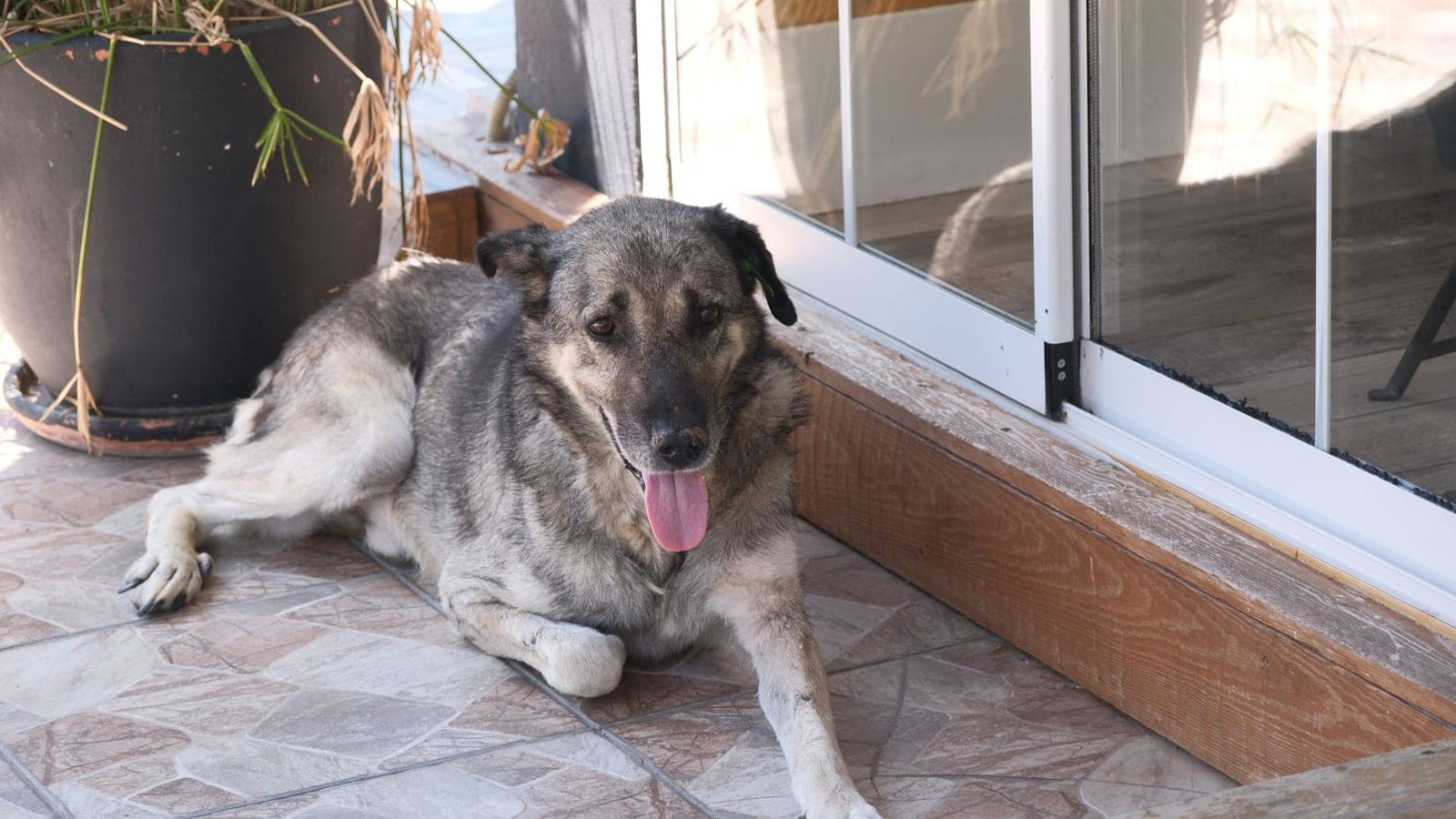
A fan cools you by speeding up evaporation from sweat across your whole skin. Dogs and cats have almost none of that — they lose heat by panting and by conduction to cool surfaces. So a fan aimed at a pet does much less than the same fan aimed at you. Cool the room, not the animal: shade, water, a cool floor surface, and if the room genuinely runs hot, a 298 kWh a year certified air conditioner.
Fan & Frost earns a commission when you buy through our links, at no cost to you. It never changes a ranking, and we say so when the right answer is the cheaper unit or nothing at all. Full disclosure · How we pick.
At a glance
The picks, ranked
Tap any row to jump to the full reasoning. Prices are live from Amazon where we have them, and read “check price” where we don’t — never a number we cannot verify today.
| # | Product | Best for | Price |
|---|---|---|---|
| 1 | 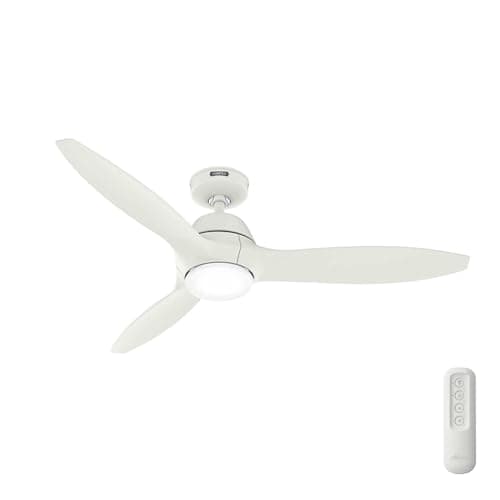 Best overall Hunter Skyway 52" Ceiling Fan with Light Kit 363.8 CFM per watt, 2.1 W on low, and it is mounted on the ceiling — out of reach by design. | Whole-room air movement that no animal can reach | |
| 2 | 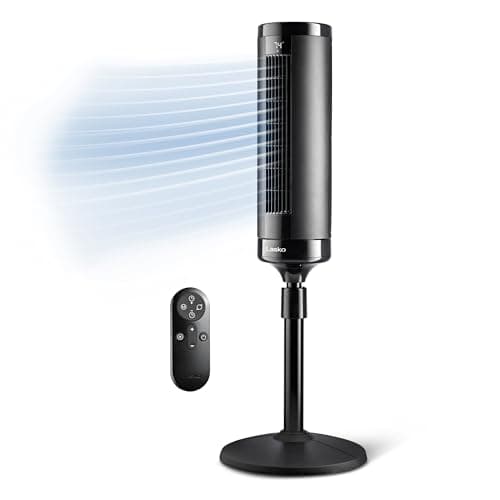 Quietest Lasko EcoQuiet 42" DC Tower Fan 23 dBA and 2.9 W on its lowest of 12 speeds — a tower, so there is no reachable blade. | A noise-sensitive animal, or a crate area | |
| 3 | When the room is genuinely too hot Midea U-Shaped Window Air Conditioner, 6,000 BTU 6,000 BTU at CEER 15.1 and 298 kWh a year — Most Efficient, and it lowers actual air temperature. | A room that stays hot with the animal in it all day | |
| — | 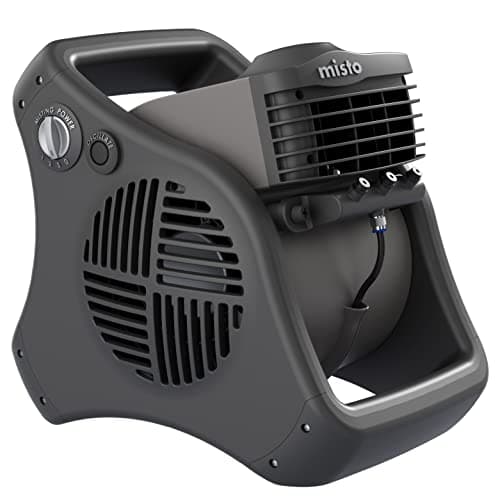 Not for a dog Lasko Misto 15" Outdoor Misting Fan 350 CFM with a misting head — and misting undermines the exact mechanism a dog uses to cool itself. | A dry patio with people on it |
The entire premise of this site is that fans cool people rather than rooms. For animals, even that is mostly not true.
The mechanism
Your cooling trick is not theirs
You shed heat by evaporating sweat from your skin, over a large area. A fan works because moving air carries away the saturated layer sitting against you and lets evaporation continue. That is the whole effect — the fan changes nothing about the air temperature.
Dogs and cats do not have that. Their principal cooling routes are different:
- Panting. Evaporation from the respiratory tract rather than the skin. A fan blowing across a coat does not reach it.
- Conduction to cool surfaces. Lying on tile or stone moves heat directly into the floor. This is why an animal abandons the rug for the bathroom.
- Radiating from thinly-furred areas. Ears, belly, paws. Small surface area.
- Grooming, in cats. Saliva evaporating from fur — a small effect, and one that also needs dry air.
The practical consequence: aiming a fan at your pet is not the intervention you think it is. It is not harmful, and moving air does help a little at thinly-furred areas. It just does far less than the same fan does for you.
What to do instead
Give them options, not a breeze
Animals thermoregulate by moving. Given choices they will find the coolest spot in the house on their own, and they are better at it than you are. Your job is to make sure good options exist.
- Leave a hard floor accessible. Tile, stone or a concrete slab is the single most effective thing in most homes, because conduction is a route that actually works for them.
- Do not shut them in one room. A closed door removes every option but the one you picked.
- Water, in more than one place. Panting spends water. A second bowl costs nothing.
- Shade the glass, not the animal. Direct sun through a window onto a bed is a large heat load on a small area. What shading actually does.
- Move the bed off the sun path for the afternoon. Free, and often the whole fix.
- Then move the room’s air. Whole-room circulation stops a shut-up house going stagnant while you are out — a ceiling fan at 2.1 W does that all day for nothing.
This one is not a DIY job
Heat illness in animals is a veterinary emergency, and this is a buying guide. Nothing here is veterinary advice.
Risk varies enormously by species, breed, age, weight and coat — flat-faced breeds, elderly and very young animals, and heavy-coated dogs are all at markedly higher risk, and the thresholds are not the same as they are for you.
Ask your vet what your specific animal needs, and go to them immediately if you see signs of heat distress. Do not use a website’s comfort thresholds as a health threshold.
Never leave an animal in a parked vehicle, and never in a room with no shade, no water and no cooler surface to move to.
Equipment
Choosing for a room you leave them in
Unattended running changes what matters. Efficiency and reliability outrank peak output, because the machine runs for hours with nobody watching it.
- Prefer a ceiling fan. Nothing to knock over, no cord at floor level, and 2.1 W on low means cost is not a reason to switch it off.
- If a floor fan, make it a tower. No exposed blade at nose height, and secure the cord.
- Prefer variable speed in an air conditioner. It holds a steady temperature instead of cycling hard, and it is quieter — which matters more for an animal than for you.
- Skip the smart-plug scheduling on fans. A fan that switches on unexpectedly in an empty room startles animals. Schedule the air conditioner instead.
- Clean it more often than you would otherwise. Pet hair loads a grille and a filter fast, and a blocked filter is the most common reason a unit stops keeping up. How.
Say the unwelcome thing
Do not buy a misting fan for a dog.
It is the most common well-meant mistake in this room, and it works against the animal’s own mechanism.
A dog cools mainly by panting, which is evaporation from the respiratory tract. Evaporation needs air with spare capacity to absorb water. A misting fan adds water to the air, which is exactly the capacity being spent.
You get a modest air temperature drop in exchange for making panting less effective — a poor trade for an animal whose other cooling routes are limited.
Move air instead, and give them a cool surface. A ceiling fan at 2.1 W on low runs all day for nothing and cannot be knocked over.
In full
Every pick, and what is wrong with it
Published specifications only, each linked to the page it came from. Where a manufacturer publishes nothing, the row says so — we do not fill blanks in.
1. Best overall
Hunter Skyway 52" Ceiling Fan with Light Kit
Hunter · model 52" Skyway (damp-rated)
363.8 CFM per watt, 2.1 W on low, and it is mounted on the ceiling — out of reach by design.
The right answer for a room an animal is left in unsupervised, because the safety question answers itself: a ceiling fan is somewhere no dog, cat or bird can get to.
2.1 W on low means you can leave it running all day for essentially nothing, which matters when the point is to keep a room from going stagnant while nobody is home.
363.8 CFM per watt, certified. It moves the whole room’s air rather than aiming a jet at one spot — which is what you want, because the animal will move to wherever it prefers and you cannot predict where that is.
Damp-rated, so it also suits a covered porch or a utility room where a pet spends time.
What’s wrong with it
It needs an existing ceiling box, and it does not lower air temperature at all.
Running cost — 52" Skyway (damp-rated)
| Nameplate power | 2.1 W – 16.3 W | manufacturer's published figure |
|---|---|---|
| Energy, 8-hour night | 0.13 kWh | 16.3 ÷ 1000 × 8 |
| Cost per hour | 0.3¢ | at 18.34¢/kWh |
| Cost per 8-hour night | 2.4¢ | on the highest speed |
| Cost per 30 nights | 72¢ | 3.9 kWh |
| Same month, lowest speed | 9.2¢ | at 2.1 W |
Rate: 18.34¢/kWh, the US average residential price for June 2026 (EIA Electric Power Monthly, Table 5.3). Yours will differ — swap it in: (watts ÷ 1000) × hours × your rate.
| Blade span | 52 in |
|---|---|
| Efficiency | 363.8 CFM per watt |
| Power, high speed | 16.3 W |
| Power, low speed | 2.1 W |
| Standby power | 0.4 W |
| Type | Indoor, with light kit; damp-rated |
| Warranty | 3 years, components |
| ENERGY STAR | Certified |
Every figure above is from ENERGY STAR Certified Ceiling Fans dataset. Blanks are shown as “not published” rather than filled in.
2. Quietest
Lasko EcoQuiet 42" DC Tower Fan
Lasko · model T42710
23 dBA and 2.9 W on its lowest of 12 speeds — a tower, so there is no reachable blade.
Plenty of animals dislike fan noise more than they dislike being warm, and a stressed pet is a worse outcome than a slightly warm one.
23 dBA on low is genuinely quiet, and 12 speeds means you can find the setting the animal tolerates instead of choosing between three.
2.9 W at that setting — about 1.3¢ for a full day. There is no argument against leaving it on.
The tower format puts the working parts behind a full-height grille with no exposed blade at nose height. The rest of the safety picture — cords and tipping are the real risks, not the blade.
What’s wrong with it
A tower still tips, and a determined dog will find the cord.
Running cost — T42710
| Nameplate power | 2.9 W – 19 W | manufacturer's published figure |
|---|---|---|
| Energy, 8-hour night | 0.15 kWh | 19 ÷ 1000 × 8 |
| Cost per hour | 0.3¢ | at 18.34¢/kWh |
| Cost per 8-hour night | 2.8¢ | on the highest speed |
| Cost per 30 nights | 84¢ | 4.6 kWh |
| Same month, lowest speed | 13¢ | at 2.9 W |
Rate: 18.34¢/kWh, the US average residential price for June 2026 (EIA Electric Power Monthly, Table 5.3). Yours will differ — swap it in: (watts ÷ 1000) × hours × your rate.
| Power | 2.9 W - 19 W (0.06-0.303 A at 120 V) |
|---|---|
| Noise | 23 dBA low, 46 dBA high |
| Speeds | 12 |
| Height | 41.6 in |
| Footprint | 12.8 x 12.8 in |
| Weight | 7.8 lb |
| Timer | 8 hours |
| Air delivery (CFM) | Not published |
| Warranty | 2 years |
Every figure above is from Lasko product page, T42710. Blanks are shown as “not published” rather than filled in.
3. When the room is genuinely too hot
Midea U-Shaped Window Air Conditioner, 6,000 BTU
Midea · model MAW06V1QWT
6,000 BTU at CEER 15.1 and 298 kWh a year — Most Efficient, and it lowers actual air temperature.
The point at which a fan stops being the answer. If the room reaches temperatures that are a problem in themselves, air movement does not fix it — you need the air to actually be cooler.
298 kWh a year, roughly $55 a cooling season, and CEER 15.1 on the Most Efficient list — 37% below the federal standard.
The variable-speed compressor is the feature that matters for an unattended room. It holds a steady temperature rather than swinging between cold blasts and nothing, and it is markedly quieter doing so.
The U-shape puts the compressor outside the closed sash, which is part of why it is quiet indoors. How the quiet ones compare.
What’s wrong with it
It is a window installation, and the U-shape needs a standard sash window.
Running cost — MAW06V1QWT
| Annual energy use | 298 kWh | ENERGY STAR certified figure |
|---|---|---|
| Annual cost | $55 | 298 × 18.34¢/kWh |
| Per cooling month | $14 | spread over a four-month season |
The annual figure is the certified value from the ENERGY STAR Certified Room Air Conditioners dataset, which models a standard cooling season rather than your actual summer. It is more useful than a nameplate wattage here, because a variable-speed compressor spends most of its life well below nameplate.
Rate: 18.34¢/kWh, the US average residential price for June 2026 (EIA Electric Power Monthly, Table 5.3). Yours will differ — swap it in: (watts ÷ 1000) × hours × your rate.
| Cooling capacity | 6,000 BTU/h |
|---|---|
| CEER | 15.1 |
| Annual energy use | 298 kWh/yr |
| vs federal standard | 37% less energy |
| Dimensions | 13.5 H x 19.2 W x 22.0 D in |
| Weight | 53.1 lb |
| Refrigerant | R-32 |
| Installation | U-shape; sash closes through the middle of the unit |
| Compressor | Variable speed |
| ENERGY STAR | Certified, and on the Most Efficient list |
Every figure above is from ENERGY STAR Certified Room Air Conditioners dataset. Blanks are shown as “not published” rather than filled in.
Skip this one
Lasko Misto 15" Outdoor Misting Fan
Lasko · model 7050
350 CFM with a misting head — and misting undermines the exact mechanism a dog uses to cool itself.
A misting fan looks like the obvious kindness on a hot day, and for a dog it is arguably counterproductive.
Dogs cool mainly by panting, which evaporates moisture from the respiratory tract. Like all evaporation, that needs air with spare capacity to absorb water.
A misting fan works by adding water to the air. It drops the air temperature, but it reduces the air’s capacity to absorb more — and panting is the mechanism it is reducing.
The same trade-off applies to people, but people have sweat over their whole body as a second route. Dogs largely do not.
What’s wrong with it
Raising humidity makes panting less effective, which is the opposite of what you want.
Running cost — 7050
| Nameplate power | 72 W – 90 W | manufacturer's published figure |
|---|---|---|
| Energy, 8-hour night | 0.72 kWh | 90 ÷ 1000 × 8 |
| Cost per hour | 1.7¢ | at 18.34¢/kWh |
| Cost per 8-hour night | 13¢ | on the highest speed |
| Cost per 30 nights | $3.96 | 21.6 kWh |
| Same month, lowest speed | $3.17 | at 72 W |
Rate: 18.34¢/kWh, the US average residential price for June 2026 (EIA Electric Power Monthly, Table 5.3). Yours will differ — swap it in: (watts ÷ 1000) × hours × your rate.
| Power | 72 W - 90 W (0.8 A at 120 V) |
|---|---|
| Air delivery | Up to 350 CFM |
| Speeds | 3 |
| Dimensions | 14.85 H x 16.25 L x 12.3 W in |
| Weight | 13.23 lb |
| Water connection | 9 ft hose to a standard garden hose, adjustable valve |
| Cord | In-line GFCI |
| Noise | Not published |
| Warranty | 1 year |
Every figure above is from Lasko product page, 7050. Blanks are shown as “not published” rather than filled in.
We are not linking a buy button for this one. If you want to look at it anyway, it is easy enough to find — but we would rather send you to something that fits your room.
Questions people actually ask
Frequently asked
Do fans help pets stay cool?
Much less than they help you. A fan works by speeding evaporation from sweat across your skin, and dogs and cats have almost none of that. They cool by panting and by lying on cool surfaces, neither of which a fan aimed at them does much for. How fans actually work.
What is the best way to keep a dog cool indoors?
Give it options rather than a breeze: access to a hard floor it can lie on, more than one water bowl, shade over the glass, and a bed that is not in the afternoon sun path. Animals find the coolest spot themselves if you leave the options open.
Are misting fans good for dogs?
No. Misting raises humidity, and panting is evaporation from the respiratory tract that needs dry-ish air to work. You trade a small air temperature drop for making the animal's main cooling route less effective.
Should I leave a fan on for my pet while I am out?
A ceiling fan, yes — it cannot be knocked over, there is no cord at floor level, and a certified one runs at 2.1 W on low. A floor fan is more of a judgement call, and a tower is the safer format. Fan safety with animals.
What temperature is too hot for a pet?
That is a veterinary question, not a buying-guide one, and it varies enormously by species, breed, age and coat. Ask your vet about your specific animal, and go to them immediately if you see signs of heat distress.
Which air conditioner is best for a room a pet is left in?
A variable-speed unit, because it holds a steady temperature rather than cycling hard, and it is quieter doing so. The certified 6,000 BTU unit here runs at 298 kWh a year on the Most Efficient list. Clean the filter more often than you otherwise would — pet hair loads it fast.
Sources
Where these numbers came from
- ENERGY STAR Certified Ceiling Fans dataset — CFM per watt, high and low wattage
- ENERGY STAR Certified Room Air Conditioners dataset — CEER, annual kWh, Most Efficient flag
- Lasko T42710 product page — 2.9-19 W, 23 dBA low, 12 speeds
- Lasko 7050 Misto product page — 350 CFM, 72-90 W, misting head
- EIA Electric Power Monthly, Table 5.3 — electricity rate
Read next
Where to go from here
Back to Room Cooling, or read how we pick.