Guide and picks
Why is my fan not working?
Fans fail in about six ways, and the symptom tells you which one. Only two of the six are worth throwing the fan away for.
By Sawyer V. · Published
The short answer
Match the symptom. Hums but does not spin is usually a seized bearing or a failed start capacitor. Spins but moves little air is almost always dust on the blades and guard. Stops after a while is thermal cutout, meaning the motor is overheating — usually because of dust. Nothing at all is the cord, the switch or the outlet. Cleaning solves more of these than any repair.
Fan & Frost earns a commission when you buy through our links, at no cost to you. It never changes a ranking, and we say so when the right answer is the cheaper unit or nothing at all. Full disclosure · How we pick.
At a glance
The picks, ranked
Tap any row to jump to the full reasoning. Prices are live from Amazon where we have them, and read “check price” where we don’t — never a number we cannot verify today.
| # | Product | Best for | Price |
|---|---|---|---|
| 1 | 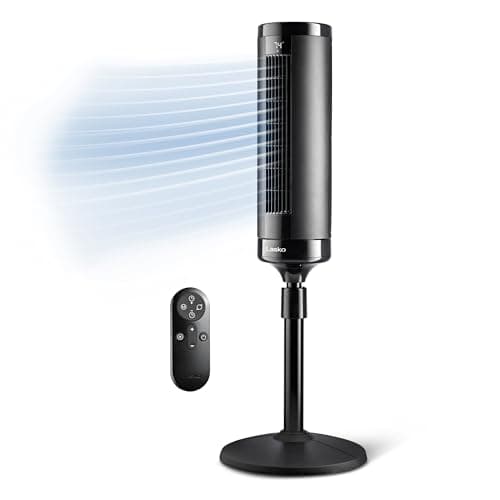 When the old one is not worth saving Lasko EcoQuiet 42" DC Tower Fan 2.9 W on low and 23 dBA, with a DC motor and a two-year warranty — a fraction of an old fan's consumption. | Replacing an old AC-motor fan with something far cheaper to run | |
| 2 | 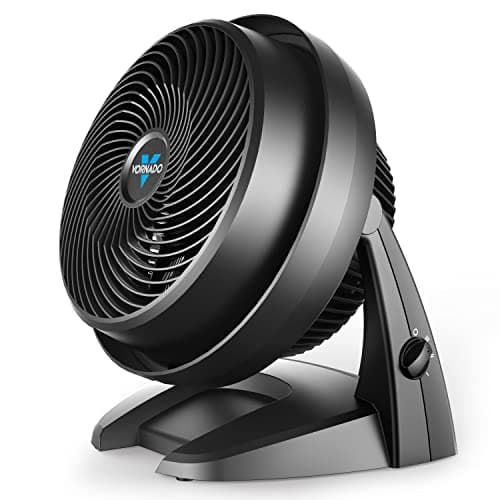 Longest warranty in the category Vornado 630 Medium Air Circulator A five-year warranty, which is five times the category norm and the clearest signal of expected service life we can point to. | Anyone tired of replacing fans every couple of summers | |
| 3 | 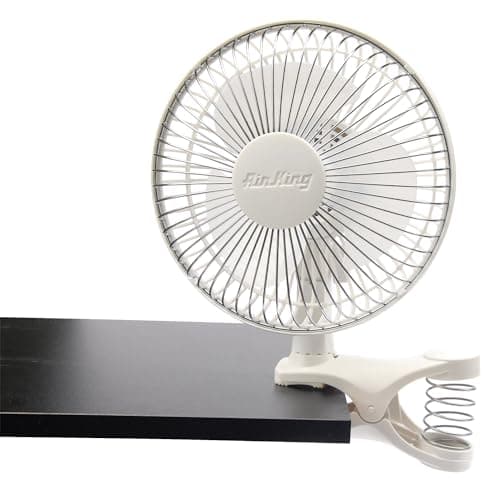 Built to a commercial specification Air King 6" Commercial Grade Clip-On Fan ETL listed and OSHA compliant, at 9 to 12 W and 34 dBA, with a metal-guard commercial build. | Somewhere a domestic fan keeps failing — a workshop or a hot kitchen | |
| — | The fan most likely to be the problem Lasko Power Plus 20" Box Fan 73 to 102 W from an induction motor, in a sealed housing that is not designed to be opened for cleaning. | A window or a garage — not a room you are trying to cool cheaply |
Fans are simple machines: a motor, a switch, a set of blades and a bearing. That means there are only so many things that can go wrong, and the symptom usually identifies which.
Diagnose
Six symptoms and what each one means
| Symptom | Most likely cause | Worth fixing? |
|---|---|---|
| Nothing at all — no sound, no movement | Cord, plug, switch or the outlet itself | Yes, usually free |
| Hums but the blades do not turn | Seized bearing, or a failed start capacitor | Sometimes |
| Spins, but barely moves any air | Dust on the blades and guard | Yes — cleaning fixes it |
| Runs, then stops after 10–30 minutes | Thermal cutout tripping on an overheating motor | Yes — usually dust |
| Runs but rattles, buzzes or whines | Loose guard, unbalanced blades, or a worn bearing | Usually |
| Head no longer sweeps | Oscillation gearbox | Yes, and it still works as a fixed fan |
This one is not a DIY job
Unplug it before you touch anything. Not switched off — unplugged, at the wall. A fan that has tripped its thermal cutout will restart on its own once the motor cools, with no warning and with your fingers wherever they happen to be.
Do not open a sealed motor housing. Cleaning blades, guards and vents is routine maintenance. Anything behind the motor casing involves mains wiring and capacitors, and a capacitor can hold a charge after the fan is unplugged.
A burning smell or a scorch mark means stop. That is not a maintenance issue. Unplug it and do not use it again.
The common one
Most of these are dust
Three of the six symptoms above trace back to the same cause, and it is the one people are least likely to suspect because the fan looks like it is working.
Dust on the blades changes their shape. A fan blade is an aerofoil, and a layer of felted dust on the leading edge stops it cutting air cleanly. It moves less air per revolution while the motor works just as hard.
Three consequences follow:
- Airflow drops without any change in noise or power draw, so the fan seems to have simply become weaker.
- The motor runs hotter, because it is doing the same work with dust also blocking the vents that cool it. Eventually the thermal cutout trips, and you get a fan that runs for twenty minutes and stops.
- Uneven loading causes vibration, because dust never deposits equally on every blade. That shows up as a rattle or a beat, and on a ceiling fan as a wobble.
Before diagnosing anything else, clean it properly — blades, guard front and back, and the motor housing vents. The full procedure is here. It resolves a large share of the fans people are about to throw away.
Walkthrough
Working through it
If nothing happens at all. Try a different outlet, and try something else in the original one — a tripped GFCI or a dead socket is common and free to find. Then check the cord along its whole length for damage, particularly where it enters the fan body. Then work the switch through every position, since a worn selector can lose one contact while others still work.
If it hums but does not turn. Unplug it and turn the blades by hand. If they are stiff or will not move, the bearing has seized — sometimes a fan that has sat unused in a damp garage will free up with a few drops of light machine oil on the shaft. If the blades spin freely by hand but the motor only hums under power, the start capacitor has most likely failed, which is not a repair to attempt yourself.
If it stops after a while. That is the thermal cutout working correctly. Clean everything, make sure the vents are clear, give it space on all sides, and try again. If it still cuts out with clean blades and clear vents, the motor is failing.
If it rattles. Check every screw on the guard and the housing first — that is most rattles. Then look for a cracked or bent blade. On a ceiling fan the diagnosis is different and starts at the mounting.
If the oscillation has stopped. The gearbox has usually stripped, most often because somebody forced the head by hand. It is rarely worth repairing and it does not stop the fan working as a fixed fan — which, if you are the only person in the room, is arguably better anyway.
Prevention
What actually extends a fan's life
- Clean it twice a season, not once at the end. Dust accumulates fastest on a fan in constant use, which is exactly when you need it working.
- Keep the motor vents clear. They matter more than the blades for the motor’s survival, and they are the part people never look at.
- Give it air on all sides. A fan pushed against a wall or into a corner is starved on the intake side, which makes the motor work harder for less output.
- Store it dry and covered. Most seized bearings come from a winter in a damp garage, not from use.
- Do not force the oscillation head. The single most common avoidable failure in the category.
Say the unwelcome thing
Do not replace a fan that has only lost airflow.
“It does not blow like it used to” is the most common reason people buy a new fan, and it is the symptom most reliably fixed with a cloth.
Dust on the blades degrades airflow gradually enough that you never notice a day-to-day change — you just eventually conclude the fan has worn out. It has not; its blades have changed shape.
Clean it properly before buying anything. If it is genuinely worn out, the replacement case is strong on running cost alone: an old AC-motor fan at 50 to 100 W against 2.9 W on low for a DC model. But find out which situation you are in first.
In full
Every pick, and what is wrong with it
Published specifications only, each linked to the page it came from. Where a manufacturer publishes nothing, the row says so — we do not fill blanks in.
1. When the old one is not worth saving
Lasko EcoQuiet 42" DC Tower Fan
Lasko · model T42710
2.9 W on low and 23 dBA, with a DC motor and a two-year warranty — a fraction of an old fan's consumption.
The repair-or-replace calculation is different from what it used to be, because the running cost gap is now large.
An older AC-motor fan typically draws 50 to 100 watts. This draws 2.9 W on low and 19 W on high — 0.4¢ against 11¢ for an eight-hour night on a box fan’s lowest setting.
23 dBA on low is the quietest published figure on this site, and twelve speeds means you can actually use the low settings where the savings are.
Two-year warranty. Why DC motors change these numbers so much.
What’s wrong with it
Lasko publishes no CFM for it, and 19 W on high is nearly seven times its low draw.
Running cost — T42710
| Nameplate power | 2.9 W – 19 W | manufacturer's published figure |
|---|---|---|
| Energy, 8-hour night | 0.15 kWh | 19 ÷ 1000 × 8 |
| Cost per hour | 0.3¢ | at 18.34¢/kWh |
| Cost per 8-hour night | 2.8¢ | on the highest speed |
| Cost per 30 nights | 84¢ | 4.6 kWh |
| Same month, lowest speed | 13¢ | at 2.9 W |
Rate: 18.34¢/kWh, the US average residential price for June 2026 (EIA Electric Power Monthly, Table 5.3). Yours will differ — swap it in: (watts ÷ 1000) × hours × your rate.
| Power | 2.9 W - 19 W (0.06-0.303 A at 120 V) |
|---|---|
| Noise | 23 dBA low, 46 dBA high |
| Speeds | 12 |
| Height | 41.6 in |
| Footprint | 12.8 x 12.8 in |
| Weight | 7.8 lb |
| Timer | 8 hours |
| Air delivery (CFM) | Not published |
| Warranty | 2 years |
Every figure above is from Lasko product page, T42710. Blanks are shown as “not published” rather than filled in.
2. Longest warranty in the category
Vornado 630 Medium Air Circulator
Vornado · model 630
A five-year warranty, which is five times the category norm and the clearest signal of expected service life we can point to.
If you are here because a fan has failed, warranty length is worth more attention than it usually gets. Five years against the one to two years that most of this category offers.
A warranty is a manufacturer’s own estimate of failure rate, backed by money. It is the closest thing to a durability figure anyone in this category publishes — nobody publishes MTBF.
The design supports it: a deep shrouded circulator with a substantial motor, built to run continuously rather than in bursts.
The honest gap: no published wattage, CFM, dimensions or weight. The 70-foot air movement claim is Vornado’s own.
What’s wrong with it
Vornado publishes no wattage, no CFM and no dimensions, so it cannot be compared numerically with anything.
Running cost
Vornado does not publish a wattage for the 630, so we cannot calculate what it costs to run. We are not going to estimate one. If Vornado publishes a nameplate figure, this block will show the arithmetic.
| Power | Not published |
|---|---|
| Airflow reach | Moves air up to 70 ft |
| Speeds | 3 |
| Air delivery (CFM) | Not published |
| Dimensions | Not published |
| Weight | Not published |
| Warranty | 5 years |
Every figure above is from Vornado product page, 630. Blanks are shown as “not published” rather than filled in.
3. Built to a commercial specification
Air King 6" Commercial Grade Clip-On Fan
Air King · model 9145
ETL listed and OSHA compliant, at 9 to 12 W and 34 dBA, with a metal-guard commercial build.
If fans keep dying in one particular place, the environment is usually the reason — dust, grease, heat or vibration — and a commercial-grade fan is built for that.
ETL listed and OSHA compliant is a jobsite specification on a small product, and it comes with the construction to match rather than just the paperwork.
9 to 12 W — 1.8¢ for an eight-hour day — and 34 to 37 dBA, a three-decibel spread across its whole range.
The spring-loaded clip also gets it off surfaces where dust and grease collect, which is itself a longevity measure.
What’s wrong with it
One-year warranty, and 190 CFM from a 6-inch blade is personal airflow rather than room airflow.
Running cost — 9145
| Nameplate power | 9 W – 12 W | manufacturer's published figure |
|---|---|---|
| Energy, 8-hour night | 0.10 kWh | 12 ÷ 1000 × 8 |
| Cost per hour | 0.2¢ | at 18.34¢/kWh |
| Cost per 8-hour night | 1.8¢ | on the highest speed |
| Cost per 30 nights | 53¢ | 2.9 kWh |
| Same month, lowest speed | 40¢ | at 9 W |
Rate: 18.34¢/kWh, the US average residential price for June 2026 (EIA Electric Power Monthly, Table 5.3). Yours will differ — swap it in: (watts ÷ 1000) × hours × your rate.
| Power | 9 W - 12 W (0.1-0.2 A at 120 V) |
|---|---|
| Air delivery | Up to 190 CFM |
| Noise | 34 dBA low, 37 dBA high |
| Speeds | 2 |
| Mounting | Spring-loaded clip, non-marking |
| Dimensions | 10.38 H x 6.25 L x 8.13 W in |
| Weight | 2.22 lb |
| Cord | 6 ft, 3-conductor |
| Listing | ETL listed, OSHA compliant |
| Warranty | 1 year |
Every figure above is from Air King product page, 9145 (via Lasko). Blanks are shown as “not published” rather than filled in.
Skip this one
Lasko Power Plus 20" Box Fan
Lasko · model B20801
73 to 102 W from an induction motor, in a sealed housing that is not designed to be opened for cleaning.
Listed here because box fans are disproportionately represented among the fans people are trying to diagnose, and often the honest answer is that repair is not viable.
The grille is typically riveted or heat-staked rather than screwed, so getting to the blades to clean them properly is difficult — and dust on the blades is the single most common cause of both airflow loss and thermal cutout.
The running cost makes the replacement decision easier anyway: 73 W on its lowest setting is 11¢ a night, against 0.4¢ for a DC tower fan.
What’s wrong with it
The construction that makes it cheap also makes it disposable — most box fans are not practically serviceable.
Running cost — B20801
| Nameplate power | 73 W – 102 W | manufacturer's published figure |
|---|---|---|
| Energy, 8-hour night | 0.82 kWh | 102 ÷ 1000 × 8 |
| Cost per hour | 1.9¢ | at 18.34¢/kWh |
| Cost per 8-hour night | 15¢ | on the highest speed |
| Cost per 30 nights | $4.49 | 24.5 kWh |
| Same month, lowest speed | $3.21 | at 73 W |
Rate: 18.34¢/kWh, the US average residential price for June 2026 (EIA Electric Power Monthly, Table 5.3). Yours will differ — swap it in: (watts ÷ 1000) × hours × your rate.
| Power | 73 W - 102 W (0.6-0.9 A at 120 V) |
|---|---|
| Speeds | 3 |
| Dimensions | 21.25 H x 22.5 x 4.75 in |
| Weight | 10.1 lb |
| Motor | Weather-resistant |
| Air delivery (CFM) | Not published |
| Warranty | 2 years |
Every figure above is from Lasko product page, B20801. Blanks are shown as “not published” rather than filled in.
We are not linking a buy button for this one. If you want to look at it anyway, it is easy enough to find — but we would rather send you to something that fits your room.
Questions people actually ask
Frequently asked
Why does my fan hum but not spin?
Usually a seized bearing or a failed start capacitor. Unplug it and turn the blades by hand — if they are stiff, the bearing has seized and light machine oil on the shaft sometimes frees it. If they spin freely but the motor only hums under power, it is the capacitor.
Why does my fan keep turning off by itself?
The thermal cutout is tripping because the motor is overheating, and the usual cause is dust — on the blades, which makes the motor work harder, and in the vents, which stops it cooling. Clean both and give the fan clearance on all sides.
Why is my fan not blowing as much air?
Almost always dust on the blades. A fan blade is an aerofoil, and felted dust on the leading edge stops it cutting air cleanly, so it moves less air per revolution while the motor works just as hard. It degrades gradually enough that people assume the fan has worn out. How to clean a fan.
Is it worth repairing a fan?
Often, yes — cleaning fixes three of the six common symptoms, and loose guard screws fix most rattles. It is not worth it for a failed motor, a failed capacitor on a cheap fan, or a stripped oscillation gearbox, and box fans are generally not built to be opened.
Why has my fan stopped oscillating?
The oscillation gearbox has usually stripped, most often because the head was forced by hand. It is rarely economic to repair, and it does not stop the fan working as a fixed fan — which for one person in one place is arguably better anyway.
Can I oil a fan motor?
A few drops of light machine oil on an accessible shaft can free a bearing that has seized from disuse. Do not open a sealed motor housing to do it — that means mains wiring and capacitors, which can hold a charge even after the fan is unplugged.
Sources
Where these numbers came from
Read next
Where to go from here
Back to Fans, or read how we pick.