The picks
The best portable air conditioners, ranked on SACC
Ranked on the number that describes your room rather than the number on the carton. Two units here are both sold as 14,000 BTU and differ by 2,500 BTU of actual capacity.
By Sawyer V. · Published
The short answer
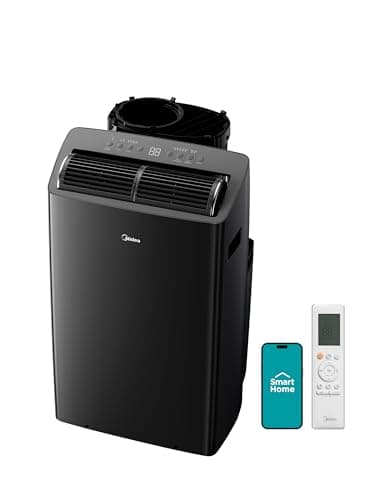
The Midea Duo MAP14S1TBL is the pick: 14,000 BTU on the box and 12,000 BTU SACC, dual hose, 43 dBA. The Whynter ARC-14S carries the same headline figure but is DOE-rated 9,500 SACC — a 32% haircut against Midea’s 14%. Buy either only if a window unit will not fit.
Fan & Frost earns a commission when you buy through our links, at no cost to you. It never changes a ranking, and we say so when the right answer is the cheaper unit or nothing at all. Full disclosure · How we pick.
At a glance
The picks, ranked
Tap any row to jump to the full reasoning. Prices are live from Amazon where we have them, and read “check price” where we don’t — never a number we cannot verify today.
| # | Product | Best for | Price |
|---|---|---|---|
| 1 | Best overall Midea Duo Smart Inverter Portable Air Conditioner The smallest SACC haircut we found and the quietest published figure, which is the combination that matters here. | Rooms up to about 550 sq ft, where quiet matters | |
| 2 | Best documented Whynter ARC-14S Dual Hose Portable Air Conditioner A 32% SACC haircut, but the only unit here that publishes its wattage — so it is the only one whose running cost we can actually calculate. | A room around 400 sq ft, if you want every number published | |
| 3 | The one you should probably buy instead GE Profile ClearView Window Air Conditioner, 8,000 BTU A window unit at a third of the running cost, with a certified efficiency figure no portable can offer. | Anyone with a usable sash window |
Almost every portable air conditioner roundup ranks by the number on the box. That number is measured under a standard that ignores the heat the exhaust duct radiates back into your room and the outside air that infiltrates to replace what the unit blew out. It describes the refrigeration circuit, not your room.
This page ranks on SACC instead — the DOE-rated Seasonally Adjusted Cooling Capacity, defined by the test procedure at 10 CFR part 430, appendix CC, which subtracts both effects.
The finding
Two 14,000 BTU units that are not the same machine
| Unit | On the box | DOE SACC | Reduction | Honest room size |
|---|---|---|---|---|
| Midea Duo MAP14S1TBL | 14,000 | 12,000 | 14.3% | 450–550 sq ft |
| Whynter ARC-14S | 14,000 | 9,500 | 32.1% | 350–400 sq ft |
Capacity figures are each manufacturer’s own published pair. Room sizes are those SACC values read against the ENERGY STAR table.
Same headline number, 2,500 BTU apart in what reaches your room, and a whole capacity band apart in the room they can serve. A roundup that ranks “14,000 BTU portables” without mentioning SACC has put two materially different machines in one bucket.
The full explanation of why the two numbers differ is here, including why the haircut varies so much between units.
Hoses
Single hose versus dual hose
Both picks above are dual-hose, and that is deliberate. A single-hose portable takes the air it needs to cool its condenser from the room, then blows it outside. Your room is now at slightly negative pressure, so hot outdoor air is drawn in around doors, windows and floorboards to make up the volume. You are effectively paying to pull the outdoors in while trying to escape it.
A dual-hose unit takes condenser air from outside through a second duct, so the room stays pressure-neutral. Structurally that should produce a smaller SACC haircut — and note from the table that configuration is not the whole story, since both units above are dual hose and one still loses 32%. Check the published figure rather than inferring it from the hose count.
Running cost
What a portable costs to run
The Whynter is the only unit here that publishes a wattage, so it is the only one we can calculate. At 1,300 W and 18.34¢/kWh:
| One hour | 24¢ |
|---|---|
| An 8-hour night | $1.91 |
| 30 nights | $57 |
| A month, 24/7 | $174 |
That is nameplate draw, so treat it as a ceiling — the compressor cycles, and an inverter model modulates down. Real consumption is usually half to three-quarters of it. The full working is here.
Midea publishes no wattage at all for the Duo, so no honest running cost for it exists in public and we are not going to estimate one. That is a genuine mark against an otherwise excellent unit, and it is odd for a machine whose selling point is inverter efficiency.
Say the unwelcome thing
Nothing sold as a 'ventless portable air conditioner' is an air conditioner.
A refrigeration cycle must reject its waste heat somewhere. With no duct, that somewhere is the room you are standing in — plus the compressor’s own electrical losses. The net effect is slightly warmer air.
Products sold under that name are either evaporative coolers, which cool real air but only in dry climates and add humidity, or they are fans. Both can be worth owning. Neither is an air conditioner, and if you have a windowless room this is the page to read.
Install
Before you buy: three checks
- Will the window kit fit your window? Most kits suit a vertical sash. Casement windows that crank outward and horizontal sliders often need a different kit or a custom panel.
- Where will the unit stand? It needs to be near the window, because a long coiled hose is a hot radiator inside the room you are cooling. Short and straight.
- How does it drain? Both units here recycle condensate, but in humid weather every portable eventually needs draining. Somewhere you can put a hose or reach a tank.
And the check that comes before all three: whether a window unit will fit instead. Nothing on this page beats that.
In full
Every pick, and what is wrong with it
Published specifications only, each linked to the page it came from. Where a manufacturer publishes nothing, the row says so — we do not fill blanks in.
1. Best overall
Midea Duo Smart Inverter Portable Air Conditioner
Midea · model MAP14S1TBL
The smallest SACC haircut we found and the quietest published figure, which is the combination that matters here.
Midea publishes both capacity numbers on its own page: 14,000 BTU and 12,000 BTU SACC. That 14.3% reduction is the smallest we found, and against the Whynter’s 32% it is the whole reason this ranks first. Both are dual-hose machines with the same headline figure, and one of them delivers 2,500 BTU more into your actual room.
12,000 BTU SACC maps to roughly 450–550 sq ft on the ENERGY STAR sizing table — which, unusually, is close to Midea’s own 550 sq ft coverage claim. Manufacturers in this category routinely claim coverage based on the box figure; Midea’s claim is broadly defensible against its own SACC. We notice that sort of thing.
43 dBA is the other reason. That is a genuinely quiet figure for a machine with a compressor in the room, and it is comfortably below the Whynter’s “under 56 dBA” on high. It runs an inverter compressor, which modulates rather than cycling on and off — quieter, and better at holding a steady temperature.
The dual-hose configuration is not a luxury here. A single-hose unit draws the air it needs from the room and blows it outside, leaving the room at negative pressure so hot outside air infiltrates to replace it. Dual-hose draws condenser air from outside instead. That penalty is exactly what SACC measures.
What’s wrong with it
Midea publishes no wattage for it, so we cannot compute its running cost — an odd gap for an inverter unit whose selling point is efficiency. It is also the heaviest thing here at 74.96 lb.
Running cost
Midea does not publish a wattage for the MAP14S1TBL, so we cannot calculate what it costs to run. We are not going to estimate one. If Midea publishes a nameplate figure, this block will show the arithmetic.
| Marketing capacity | 14,000 BTU |
|---|---|
| DOE-rated capacity | 12,000 BTU SACC |
| Hoses | Dual |
| Noise | 43 dBA |
| Speeds | 3 |
| Refrigerant | R-32 |
| Dimensions | 19.52 W x 16.73 D x 32.48 H in |
| Weight | 74.96 lb |
| Manufacturer coverage claim | 550 sq ft |
| Power | Not published (115 V stated, no wattage) |
| Warranty | 1 year |
Every figure above is from Midea product page, MAP14S1TBL. Blanks are shown as “not published” rather than filled in.
2. Best documented
Whynter ARC-14S Dual Hose Portable Air Conditioner
Whynter · model ARC-14S
A 32% SACC haircut, but the only unit here that publishes its wattage — so it is the only one whose running cost we can actually calculate.
Whynter deserves credit for transparency and criticism for a coverage claim, in that order.
The transparency: this is the only portable in this roundup that publishes a wattage. 1,300 W, 11.6 A at 115 V, stated plainly. It also labels both capacity figures with their standards — “14,000 BTU (ASHRAE-128)” and “9,500 BTU (DOE 2017)” — which is more than most do. Because of that we can tell you it costs about $1.91 for an eight-hour night at nameplate draw and around $57 for a month of them.
The criticism: 9,500 BTU SACC serves about 350–400 sq ft on the ENERGY STAR table, and the same product page claims 500 sq ft. Both numbers are Whynter’s own. The gap between them is the SACC haircut going unmentioned in the coverage claim, and if you size your room from the claim you will be disappointed.
Sized honestly at 400 sq ft it is a capable machine: dual hose, R-32, 71 pints a day of dehumidification, and a 3-year compressor warranty against the 1-year Midea offers. Under 51 dBA on low is respectable, though not the Midea’s 43.
What’s wrong with it
9,500 BTU SACC against a 14,000 BTU headline is the largest gap we found, and Whynter's own page claims 500 sq ft coverage — which its SACC figure does not support. It also draws 1,300 W.
Running cost — ARC-14S
| Nameplate power | 1300 W | manufacturer's published figure |
|---|---|---|
| Energy, 8-hour night | 10.40 kWh | 1300 ÷ 1000 × 8 |
| Cost per hour | 24¢ | at 18.34¢/kWh |
| Cost per 8-hour night | $1.91 | on the highest speed |
| Cost per 30 nights | $57 | 312.0 kWh |
Rate: 18.34¢/kWh, the US average residential price for June 2026 (EIA Electric Power Monthly, Table 5.3). Yours will differ — swap it in: (watts ÷ 1000) × hours × your rate.
| Marketing capacity | 14,000 BTU (ASHRAE-128) |
|---|---|
| DOE-rated capacity | 9,500 BTU SACC |
| Hoses | Dual |
| Power | 1,300 W / 11.6 A at 115 V |
| Noise | Under 51 dBA low, under 56 dBA high |
| Dehumidification | 71 pints/day |
| Refrigerant | R-32 |
| Dimensions | 16 W x 19 D x 35.5 H in |
| Weight | 73 lb |
| Manufacturer coverage claim | 500 sq ft |
| Warranty | 1 year unit, 3 years compressor |
Every figure above is from Whynter product page, ARC-14S. Blanks are shown as “not published” rather than filled in.
3. The one you should probably buy instead
GE Profile ClearView Window Air Conditioner, 8,000 BTU
GE Profile · model PWJV08W
A window unit at a third of the running cost, with a certified efficiency figure no portable can offer.
Putting a window unit in a portable roundup is not a dodge. It is the single most useful thing this page can tell you, and leaving it out would be the dishonest choice.
This unit uses 375 kWh for an entire year. The Whynter above uses more than that in six weeks of overnight running. The GE is also ENERGY STAR certified at CEER 16 with a tested efficiency figure — and there is no ENERGY STAR program for portable air conditioners at all, so no portable has a comparable number to put next to it.
The physical reason is simple. A window unit sits in the wall with its hot side outside. A portable sits in the room with a hot duct running across your floor, radiating back into the space it is cooling. That is not a manufacturing quality difference; it is geometry, and no portable can engineer its way out of it.
So: if a window unit will physically fit, buy a window unit. Buy a portable when it will not.
What’s wrong with it
It needs a vertical sash window it can fit inside, and it occupies that window permanently for the season. If you have a casement window, a slider, or no window at all, this is not available to you.
Running cost — PWJV08W
| Annual energy use | 375 kWh | ENERGY STAR certified figure |
|---|---|---|
| Annual cost | $69 | 375 × 18.34¢/kWh |
| Per cooling month | $17 | spread over a four-month season |
The annual figure is the certified value from the ENERGY STAR Certified Room Air Conditioners dataset, which models a standard cooling season rather than your actual summer. It is more useful than a nameplate wattage here, because a variable-speed compressor spends most of its life well below nameplate.
Rate: 18.34¢/kWh, the US average residential price for June 2026 (EIA Electric Power Monthly, Table 5.3). Yours will differ — swap it in: (watts ÷ 1000) × hours × your rate.
| Cooling capacity | 8,000 BTU/h |
|---|---|
| CEER | 16 |
| Annual energy use | 375 kWh/yr |
| vs federal standard | 47% less energy |
| Dimensions | 12.6 H x 18.6 W x 15.3 D in |
| Weight | 46.2 lb |
| Refrigerant | R-32 |
| Installation | Does not straddle the windowsill |
| Support bracket | Required |
| Compressor | Variable speed |
| ENERGY STAR | Certified, and on the Most Efficient list |
Every figure above is from ENERGY STAR Certified Room Air Conditioners dataset. Blanks are shown as “not published” rather than filled in.
Questions people actually ask
Frequently asked
What is the best portable air conditioner?
The Midea Duo MAP14S1TBL, on the figures that matter: 12,000 BTU SACC against a 14,000 BTU headline is the smallest capacity haircut we found, it is dual hose, and 43 dBA is the quietest published noise figure here. Whynter's ARC-14S carries the same headline number but is DOE-rated 9,500 SACC.
Why is my portable AC rated lower than the BTU on the box?
The box number is usually measured under ASHRAE 128, which ignores exhaust duct heat and infiltration. SACC is the DOE-rated figure and subtracts both, so it describes what actually reaches your room. Real reductions range from about 14 to 32 percent depending on the unit. The full explanation.
Is a dual hose portable air conditioner worth it?
Yes, structurally. A single-hose unit blows room air outside and hot outdoor air infiltrates to replace it, which cancels part of the cooling. A dual-hose unit takes condenser air from outside instead. But configuration is not the whole story — both units here are dual hose and one still loses 32 percent of its capacity.
How much does a portable air conditioner cost to run?
A 1,300 W unit at 18.34¢/kWh costs about 24¢ an hour, $1.91 for an eight-hour night, and roughly $57 for thirty nights. That is nameplate draw, so treat it as a ceiling — the compressor cycles off once the room is at temperature. The full arithmetic.
Are portable air conditioners ENERGY STAR certified?
No. There is no ENERGY STAR program for portable air conditioners — the certified room air conditioner dataset contains window and through-the-wall units only. Portables are covered by the DOE test procedure, which is what gives you SACC, but there is no efficiency certification on top of it.
Do ventless portable air conditioners work?
Not as air conditioners. A refrigeration cycle has to put its waste heat somewhere, and with no duct that somewhere is your room — so the net effect is slightly warmer air. Anything sold under that name is either an evaporative cooler or a fan. What to do instead.
Sources
Where these numbers came from
- Whynter ARC-14S specifications — 14,000 BTU ASHRAE / 9,500 SACC, 1,300 W
- Midea Duo MAP14S1TBL specifications — 14,000 BTU / 12,000 SACC, 43 dBA
- eCFR — 10 CFR part 430, subpart B, appendix CC (SACC test procedure)
- ENERGY STAR Certified Room Air Conditioners dataset — no portable category exists
- ENERGY STAR — Room Air Conditioners sizing table
Read next
Where to go from here
Back to Air Conditioners, or read how we pick.