The picks
Best 5,000 BTU air conditioners
The smallest certified class is also the least differentiated. Several of the units are demonstrably the same machine with different badges.
By Sawyer V. · Published
The short answer
The best certified figure under 6,000 BTU is CEER 14.4 at 260.4 kWh a year — and five records across Vissani, Brothers and Midea share it identically, along with the same 30.2 lb weight and the same dimensions. They are one chassis with three badges. None of the 13 units under 6,000 BTU is on the Most Efficient list. Stepping up to 6,000 BTU buys CEER 16 for 21 kWh more a year.
Fan & Frost earns a commission when you buy through our links, at no cost to you. It never changes a ranking, and we say so when the right answer is the cheaper unit or nothing at all. Full disclosure · How we pick.
At a glance
The picks, ranked
Tap any row to jump to the full reasoning. Prices are live from Amazon where we have them, and read “check price” where we don’t — never a number we cannot verify today.
| # | Product | Best for | Price |
|---|---|---|---|
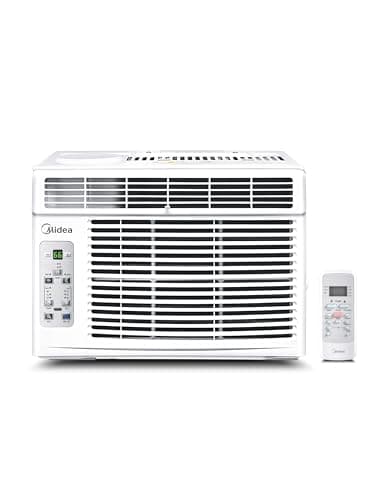
| 1 | Best in class, such as it is Midea Window Air Conditioner, 5,000 BTU CEER 14.4 and 260.4 kWh a year at 30.2 lb — the joint-best certified figure in the sub-6,000 BTU class. | A very small room where 5,000 BTU is genuinely the right size | |
| 2 | The step up that costs almost nothing Midea Window Air Conditioner, 6,000 BTU 6,000 BTU at CEER 16 and 281.3 kWh — 20% more capacity for 21 kWh a year, and it is Most Efficient listed. | Almost anyone shopping at 5,000 BTU | |
| 3 | 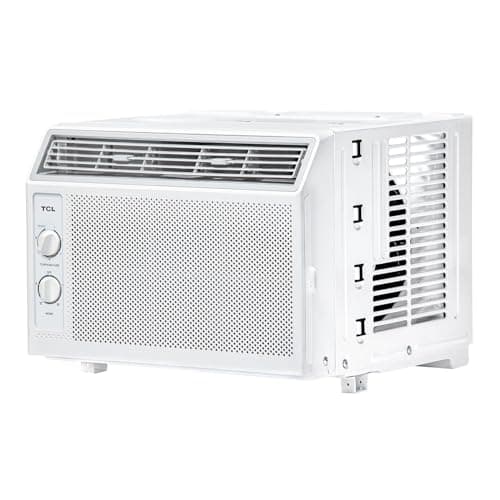 The other 5,000 BTU chassis TCL Window Air Conditioner, 5,000 BTU CEER 13.7 and 273.7 kWh at 41.9 lb — more energy, more weight, less efficiency than the class leader. | Nothing in particular — it is here to show the spread | |
| — | 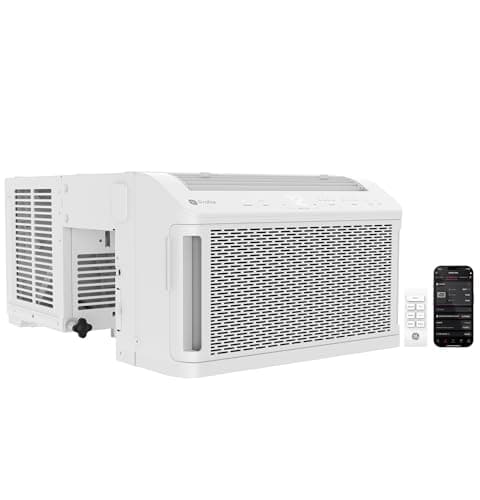 What the class above looks like GE Profile ClearView Window Air Conditioner, 8,000 BTU 8,000 BTU at CEER 16 and 375 kWh — the efficiency tier a 5,000 BTU unit cannot reach. | A normal small bedroom, rather than a very small one |
5,000 BTU is the entry point of the certified room air conditioner field, and it behaves differently from every class above it.
Our analysis
Five records, three brands, one machine
We pulled all 485 certified room air conditioner records and filtered to units under 6,000 BTU. Thirteen records, and something obvious in them.
Five of those records share identical specifications: 5,000 BTU, CEER 14.4, 260.4 kWh a year, 30.2 lb, 12.1 by 16.0 by 13.3 inches, 31% below the federal standard.
The brands on them are Vissani, Brothers and Midea.
That is not a coincidence or a rounding artifact. Identical weight to a tenth of a pound and identical dimensions across three badges means one original manufacturer supplying multiple brands — which is normal and unremarkable in appliances, and useful to know when shopping.
The practical consequence: in this class, brand tells you almost nothing. Comparing a Vissani against a Midea at these specs is comparing the same machine to itself. Compare the certified numbers instead, and where the numbers are identical, compare on warranty, availability and support.
The second finding
Nothing under 6,000 BTU is Most Efficient
Across the 13 certified units below 6,000 BTU, zero carry the ENERGY STAR Most Efficient designation.
For comparison, 171 of 485 certified room air conditioners overall carry it — about 35%.
The reason is visible in the efficiency figures. The best sub-6,000 BTU unit manages CEER 14.4; the 6,000 to 7,999 BTU class reaches 16, and the 8,000 to 13,999 class reaches 17.6. The small class is simply a less efficient tier.
| Capacity band | Best CEER | Best kWh/yr | vs standard |
|---|---|---|---|
| Under 6,000 BTU | 14.4 | 260.4 | 31% |
| 6,000 – 7,999 BTU | 16 | 281.3 | 45% |
| 8,000 – 13,999 BTU | 17.6 | 397.4 | 80% |
Best figure in each band from the ENERGY STAR Certified Room Air Conditioners dataset.
This one is not a DIY job
The step from 5,000 to 6,000 BTU is unusually good value in energy terms. 260.4 kWh a year becomes 281.3 — about $3.83 more for a whole season — and buys 20% more capacity plus a jump from CEER 14.4 to 16.
That is not an argument for buying capacity you do not need. An oversized unit short-cycles and dehumidifies poorly regardless of its rating.
It is an argument for checking your sizing carefully rather than reaching for the smallest and cheapest. If the room genuinely sits at the boundary, the sizing method will tell you which side it falls on.
Where 5,000 BTU fits
The rooms this size actually suits
ENERGY STAR’s sizing guidance puts 5,000 BTU at the small end — a compact bedroom, a home office, a nursery, a study.
Then the adjustments matter more here than anywhere, because there is no headroom:
- Very sunny room: add capacity. A small unit in a west-facing room will run continuously and lose. That case in detail.
- Heavily shaded: reduce capacity — and at 5,000 BTU there is nothing below to reduce to.
- More than two people regularly: add capacity per person.
- Kitchen: add substantially, and fix the extraction first.
The honest read is that 5,000 BTU has almost no margin. If any adjustment applies, you are probably in the 6,000 BTU class already.
Say the unwelcome thing
Do not choose in this class on brand.
It is the one category on this site where brand is demonstrably meaningless, and the certified data proves it rather than implying it.
Five records — badged Vissani, Brothers and Midea — share the same CEER, the same annual kWh, the same weight to a tenth of a pound, and the same dimensions. Whatever differences exist between them, they are not in anything the certification measures.
So compare the published figures, and where those are identical, decide on warranty terms, parts availability and support instead.
And before any of that, check whether the 6,000 BTU class is the right size — where the efficiency and the Most Efficient listings actually start.
In full
Every pick, and what is wrong with it
Published specifications only, each linked to the page it came from. Where a manufacturer publishes nothing, the row says so — we do not fill blanks in.
1. Best in class, such as it is
Midea Window Air Conditioner, 5,000 BTU
Midea · model MAW05R1VWWT-T
CEER 14.4 and 260.4 kWh a year at 30.2 lb — the joint-best certified figure in the sub-6,000 BTU class.
260.4 kWh a year, about $48 for a cooling season. That is the lowest annual consumption of any certified room air conditioner — because it is the smallest machine, not because it is the best engineered.
30.2 lb and 12.1 H x 16.0 W x 13.3 D inches makes it a one-person install and easy to store. No support bracket required.
Be clear about what you are buying: CEER 14.4 and 31% less energy than the federal standard. Against 47% and 45% for the 8,000 and 6,000 BTU leaders, this is the weakest efficiency tier in the certified field.
R-32, variable-speed compressor.
What’s wrong with it
Not on the Most Efficient list, because nothing under 6,000 BTU is. Four other certified records share these exact specs under different brands.
Running cost — MAW05R1VWWT-T
| Annual energy use | 260.4 kWh | ENERGY STAR certified figure |
|---|---|---|
| Annual cost | $48 | 260.4 × 18.34¢/kWh |
| Per cooling month | $12 | spread over a four-month season |
The annual figure is the certified value from the ENERGY STAR Certified Room Air Conditioners dataset, which models a standard cooling season rather than your actual summer. It is more useful than a nameplate wattage here, because a variable-speed compressor spends most of its life well below nameplate.
Rate: 18.34¢/kWh, the US average residential price for June 2026 (EIA Electric Power Monthly, Table 5.3). Yours will differ — swap it in: (watts ÷ 1000) × hours × your rate.
| Cooling capacity | 5,000 BTU/h |
|---|---|
| CEER | 14.4 |
| Annual energy use | 260.4 kWh/yr |
| vs federal standard | 31% less energy |
| Dimensions | 12.1 H x 16.0 W x 13.3 D in |
| Weight | 30.2 lb |
| Installation | Does not straddle the windowsill |
| Support bracket | Not required |
| Compressor | Variable speed |
| Refrigerant | R-32 |
| ENERGY STAR | Certified (not on the Most Efficient list) |
Every figure above is from ENERGY STAR Certified Room Air Conditioners dataset. Blanks are shown as “not published” rather than filled in.
2. The step up that costs almost nothing
Midea Window Air Conditioner, 6,000 BTU
Midea · model MAW06S1KWT-A
6,000 BTU at CEER 16 and 281.3 kWh — 20% more capacity for 21 kWh a year, and it is Most Efficient listed.
This is the argument the data makes, and it is a strong one.
CEER 16 against 14.4. 281.3 kWh a year against 260.4 — about $3.83 more for a whole season. And 45% below the federal standard against 31%.
For roughly 21 kWh a year you get 20% more capacity and a substantially better efficiency tier. It is also on the Most Efficient list, which nothing under 6,000 BTU is.
31.6 lb, 13.3 inches deep, no bracket required — physically almost identical to install and store.
What’s wrong with it
31.6 lb against 30.2, and 6,000 BTU is still a small-room capacity. It does not solve a large room.
Running cost — MAW06S1KWT-A
| Annual energy use | 281.3 kWh | ENERGY STAR certified figure |
|---|---|---|
| Annual cost | $52 | 281.3 × 18.34¢/kWh |
| Per cooling month | $13 | spread over a four-month season |
The annual figure is the certified value from the ENERGY STAR Certified Room Air Conditioners dataset, which models a standard cooling season rather than your actual summer. It is more useful than a nameplate wattage here, because a variable-speed compressor spends most of its life well below nameplate.
Rate: 18.34¢/kWh, the US average residential price for June 2026 (EIA Electric Power Monthly, Table 5.3). Yours will differ — swap it in: (watts ÷ 1000) × hours × your rate.
| Cooling capacity | 6,000 BTU/h |
|---|---|
| CEER | 16 |
| Annual energy use | 281.3 kWh/yr |
| vs federal standard | 45% less energy |
| Dimensions | 12.1 H x 16.0 W x 13.3 D in |
| Weight | 31.6 lb |
| Installation | Does not straddle the windowsill |
| Support bracket | Not required |
| Compressor | Variable speed |
| Refrigerant | R-32 |
| ENERGY STAR | Certified, and on the Most Efficient list |
Every figure above is from ENERGY STAR Certified Room Air Conditioners dataset. Blanks are shown as “not published” rather than filled in.
3. The other 5,000 BTU chassis
TCL Window Air Conditioner, 5,000 BTU
TCL · model W5WC72
CEER 13.7 and 273.7 kWh at 41.9 lb — more energy, more weight, less efficiency than the class leader.
Included because it is a genuinely different machine from the five-record chassis above, and it is worse on every axis.
CEER 13.7 against 14.4. 273.7 kWh a year against 260.4 — more energy for the same 5,000 BTU. And 41.9 lb against 30.2, which is a real difference when you are lifting it into a window.
25% below the federal standard is the narrowest margin here. It clears certification and not much more.
The useful lesson: even within a class this small and this undifferentiated, the published figures still separate the units. There is no reason to buy blind.
What’s wrong with it
25% below the federal standard is the weakest margin on this page, and 41.9 lb is nearly 12 lb heavier for the same capacity.
Running cost — W5WC72
| Annual energy use | 273.7 kWh | ENERGY STAR certified figure |
|---|---|---|
| Annual cost | $50 | 273.7 × 18.34¢/kWh |
| Per cooling month | $13 | spread over a four-month season |
The annual figure is the certified value from the ENERGY STAR Certified Room Air Conditioners dataset, which models a standard cooling season rather than your actual summer. It is more useful than a nameplate wattage here, because a variable-speed compressor spends most of its life well below nameplate.
Rate: 18.34¢/kWh, the US average residential price for June 2026 (EIA Electric Power Monthly, Table 5.3). Yours will differ — swap it in: (watts ÷ 1000) × hours × your rate.
| Cooling capacity | 5,000 BTU/h |
|---|---|
| CEER | 13.7 |
| Annual energy use | 273.7 kWh/yr |
| vs federal standard | 25% less energy |
| Dimensions | 12.5 H x 16.0 W x 15.5 D in |
| Weight | 41.9 lb |
| Compressor | Variable speed |
| Refrigerant | R-32 |
| ENERGY STAR | Certified (not on the Most Efficient list) |
Every figure above is from ENERGY STAR Certified Room Air Conditioners dataset. Blanks are shown as “not published” rather than filled in.
Skip this one
GE Profile ClearView Window Air Conditioner, 8,000 BTU
GE Profile · model PWJV08W
8,000 BTU at CEER 16 and 375 kWh — the efficiency tier a 5,000 BTU unit cannot reach.
Listed as a skip because oversizing is a real cost, not because this is a worse machine.
CEER 16 and 375 kWh a year, about $69, with 47% less energy than the federal standard — the top of the 8,000 BTU class and on the Most Efficient list.
But an oversized unit reaches the thermostat setpoint in minutes, shuts off before the coil has removed meaningful moisture, and leaves a small room cold and clammy. Why that happens.
Size from the room, not from the efficiency rating. The method.
What’s wrong with it
375 kWh against 260.4 is 44% more energy, and 46.2 lb against 30.2. If the room only needs 5,000 BTU, this is oversized.
Running cost — PWJV08W
| Annual energy use | 375 kWh | ENERGY STAR certified figure |
|---|---|---|
| Annual cost | $69 | 375 × 18.34¢/kWh |
| Per cooling month | $17 | spread over a four-month season |
The annual figure is the certified value from the ENERGY STAR Certified Room Air Conditioners dataset, which models a standard cooling season rather than your actual summer. It is more useful than a nameplate wattage here, because a variable-speed compressor spends most of its life well below nameplate.
Rate: 18.34¢/kWh, the US average residential price for June 2026 (EIA Electric Power Monthly, Table 5.3). Yours will differ — swap it in: (watts ÷ 1000) × hours × your rate.
| Cooling capacity | 8,000 BTU/h |
|---|---|
| CEER | 16 |
| Annual energy use | 375 kWh/yr |
| vs federal standard | 47% less energy |
| Dimensions | 12.6 H x 18.6 W x 15.3 D in |
| Weight | 46.2 lb |
| Refrigerant | R-32 |
| Installation | Does not straddle the windowsill |
| Compressor | Variable speed |
| ENERGY STAR | Certified, and on the Most Efficient list |
Every figure above is from ENERGY STAR Certified Room Air Conditioners dataset. Blanks are shown as “not published” rather than filled in.
We are not linking a buy button for this one. If you want to look at it anyway, it is easy enough to find — but we would rather send you to something that fits your room.
Questions people actually ask
Frequently asked
What is the most efficient 5,000 BTU air conditioner?
CEER 14.4 at 260.4 kWh a year is the best certified figure under 6,000 BTU — and five records across Vissani, Brothers and Midea share it identically, along with the same 30.2 lb weight and dimensions.
Are any 5,000 BTU air conditioners ENERGY STAR Most Efficient?
No. Zero of the 13 certified units under 6,000 BTU carry the designation, against 171 of 485 across the whole field. The small class is simply a less efficient tier — CEER 14.4 at best, against 16 at 6,000 BTU and 17.6 above that.
Should I buy 5,000 or 6,000 BTU?
Check your sizing carefully, because the step up is unusually good value. 6,000 BTU reaches CEER 16 and 281.3 kWh against 14.4 and 260.4 — roughly 21 kWh a year more for 20% more capacity and a much better efficiency tier. Sizing method.
Why do different brands of 5,000 BTU air conditioner have identical specs?
Because they are the same machine. Five certified records badged Vissani, Brothers and Midea share the same CEER, annual kWh, weight to a tenth of a pound, and dimensions — one original manufacturer supplying multiple brands.
What room size does 5,000 BTU suit?
The small end of ENERGY STAR's guidance — a compact bedroom, office, nursery or study. It has almost no margin for the adjustments, so a very sunny room, extra occupants or a kitchen pushes you into the 6,000 BTU class.
Is a bigger air conditioner better for a small room?
No. An oversized unit reaches the setpoint in minutes and shuts off before the coil has removed meaningful moisture, leaving the room cold and clammy — which feels worse than a slightly warmer, drier one.
Sources
Where these numbers came from
Read next
Where to go from here
Back to Air Conditioners, or read how we pick.