The picks
Best bathroom exhaust fans
Everyone assumes quiet costs you airflow. Across 905 certified fans the correlation runs the other way, and hard enough to change what you buy.
By Sawyer V. · Published
The short answer
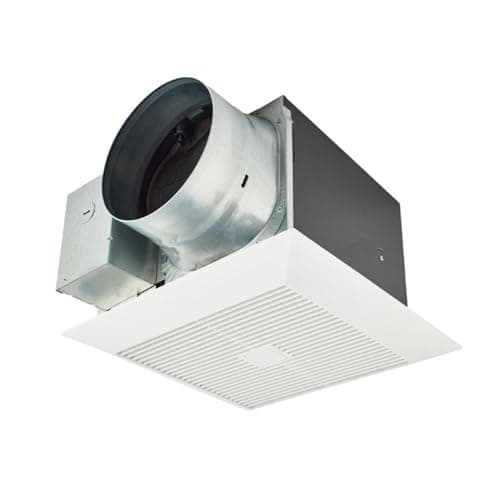
The Panasonic WhisperGreen Select FV-0511VK3 is the pick — 110 CFM at 0.1 sones and 16.7 CFM per watt, the joint-highest efficacy in the certified dataset. Across 905 certified bathroom fans we found quieter models are consistently more efficient, not less (correlation −0.51). And 72% of multi-speed fans move air more efficiently below full speed, so the high setting is rarely the one to leave it on.
Fan & Frost earns a commission when you buy through our links, at no cost to you. It never changes a ranking, and we say so when the right answer is the cheaper unit or nothing at all. Full disclosure · How we pick.
At a glance
The picks, ranked
Tap any row to jump to the full reasoning. Prices are live from Amazon where we have them, and read “check price” where we don’t — never a number we cannot verify today.
| # | Product | Best for | Price |
|---|---|---|---|
| 1 | Best overall Panasonic WhisperGreen Select FV-0511VK3 Ventilation Fan 0.1 sones and 16.7 CFM per watt at 110 CFM — joint-highest efficacy in the certified dataset, at the quietest rating it publishes. | A bathroom next to a bedroom, or any room you want silent | |
| 2 | 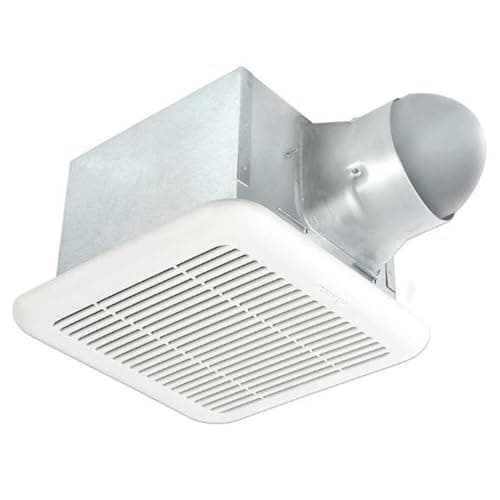 Flattest efficiency curve Delta BreezSignature SIG80-110 Ventilation Fan 0.1 sones and 15.3 / 15.4 CFM per watt — essentially identical efficiency at both speeds, which is rare. | A fan you want to leave running without thinking about the speed | |
| 3 | Best for a 4-inch duct Ortech ODD-70-1 Ventilation Fan 16.7 CFM per watt through a 4-inch duct — the same efficacy as the best 6-inch fan, at 75 CFM. | A retrofit where the existing duct is 4 inches and staying that way | |
| — | 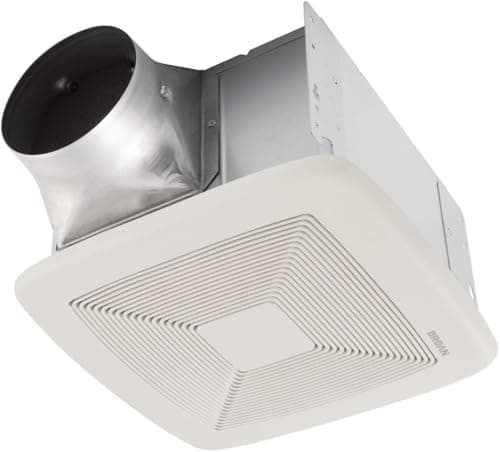 Good fan, wrong page Broan-NuTone Premium Ventilation Fan 14.2 CFM per watt is excellent — but 1.4 sones is fourteen times the perceived loudness of the picks above. | A large utility room or a run that genuinely needs 154 CFM |
A bathroom fan is the only appliance in the house people buy hoping to never notice it. That makes noise the specification that matters, and it is also the one most likely to be misread.
Our analysis
Quiet and efficient are the same design choice
The intuition is that a quiet fan must be a restricted fan — slower, more baffled, working harder for less air. We pulled the complete ENERGY STAR Certified Ventilating Fans dataset to check, and the intuition is wrong.
Across 905 US-market bathroom and utility fans carrying sones, airflow and efficacy together, the correlation between sones and CFM per watt is −0.51.
Negative, and not weakly. Quieter fans are more efficient fans, and the relationship is strong enough to use as a shopping heuristic.
| Relationship | Correlation | Reading |
|---|---|---|
| Sones vs CFM per watt | −0.51 | Quieter fans are more efficient |
| Sones vs airflow | −0.12 | Essentially none — quiet is not low-flow |
| Airflow vs CFM per watt | 0.19 | Weak — bigger is barely better |
Pearson correlations computed by us over 905 US-market bathroom/utility records in the ENERGY STAR Certified Ventilating Fans dataset.
The second row matters too. If quiet fans were quiet because they moved less air, sones and airflow would correlate. At −0.12 they barely do — so a 0.1-sone fan is not a weak fan.
The mechanism is that both properties come from the same hardware. A large, slow-turning blower wheel driven by a DC or ECM motor is quiet and efficient. A small wheel spun fast to hit the same airflow is loud and wasteful. There is no trade-off to manage, because the good fans are good at both.
Which gives you a genuinely useful rule: shop on sones and you will land on an efficient fan by accident.
Second finding
Your fan is probably most efficient below full speed
Multi-speed fans publish an efficacy figure for each speed, and comparing them across the dataset produces a result worth acting on.
Of 351 certified multi-speed bathroom fans:
- 252 (71.8%) are more efficient at a lower speed than at full.
- Only 87 (24.8%) peak at their top speed.
- Where a lower speed wins, the median gain is 23.9% more air per watt, and the largest is 81.4%.
Among the 264 fans with three rated speeds, only 60 peak at the top. 204 peak at the middle or the lowest setting.
The Panasonic is a clean example: 16.7 CFM/W at 110 CFM, 18.4 at 80 CFM, 14.7 at 50. Its best setting is the middle one.
So if you have a multi-speed fan, the useful pattern is continuous low or medium ventilation, with high reserved for clearing steam after a shower. That is also how these fans are designed to be used, and it is why so many of them ship with a continuous-run mode.
The scale
What a sone rating actually tells you
This is where most bathroom fan shopping goes wrong, so it is worth stating plainly.
Sones are linear against perceived loudness. Two sones sounds twice as loud as one sone. Four sounds four times as loud. There is no logarithm and no arithmetic to do.
Decibels are logarithmic, so a 3 dB difference is often dismissed as marginal. People carry that intuition to sones and badly underestimate what they are reading — then wonder why the “only slightly louder” fan is unbearable.
| Sones | Where it sits in the data |
|---|---|
| 0.1 | The floor of the certified dataset |
| 0.3 or below | 262 of 905 certified fans |
| 0.7 | The dataset median |
| 1.0 or below | 671 of 905 certified fans |
| 1.5 | The 90th percentile — louder than 9 in 10 |
| 2.8 | The loudest certified fan in the dataset |
A 1.5-sone fan is fifteen times as loud as a 0.1-sone fan. Both are certified, both are sold in the same aisle, and the difference is not visible unless you read the number.
This one is not a DIY job
Sizing a bathroom fan. The long-standing rule of thumb is one CFM per square foot of floor area, with 50 CFM as a practical minimum. A 9 by 8 foot bathroom is 72 square feet, so 80 CFM covers it comfortably.
For bathrooms with a separate enclosed toilet, a jetted tub, or a ceiling above about nine feet, the volume-based method used by ventilation codes is more appropriate than the floor-area rule — check what your local code requires rather than assuming.
The duct matters as much as the fan. Certified CFM is measured at 0.25 inches of water gauge. A long flexible duct with sags and elbows presents far more resistance than that, and the fan delivers correspondingly less. Short, straight, smooth-walled and properly supported beats a bigger fan on a bad run.
It has to exhaust outdoors. Terminating a bathroom duct in an attic dumps moisture into the roof structure. That is a building problem, not a ventilation one.
Also
The Most Efficient shortlist is genuinely short
ENERGY STAR certification is a floor, not a distinction — 912 bathroom fans carry it. The Most Efficient designation is the narrower list, and it is much narrower than people assume: 80 fans, about 9% of the certified field.
All four picks above are on it. If you want one filter that removes most of the noise from this category, that is the one to use. What the two labels actually mean.
Say the unwelcome thing
Do not buy a bathroom fan with a light unless you need the light.
Fan-light combinations are everywhere and they compromise the part you actually care about. The fixture has to share a housing with a lamp, a driver and a lens, which constrains the blower wheel and the airflow path.
Every pick on this page is fan-only. That is not a coincidence — it is what lets them hit 0.1 sones and 16.7 CFM per watt in the same product.
If the bathroom needs a ceiling light, a separate light is usually cheaper, gives you a free choice of fixture, and lets you switch the two independently — which is what you want if the fan is going to run continuously on low.
Choose
Which one
6-inch duct, want the best: the Panasonic FV-0511VK3 — 0.1 sones, 16.7 CFM/W, and 18.4 at its medium speed.
6-inch duct, set-and-forget: the Delta SIG80-110, whose two speeds are equally efficient.
Existing 4-inch duct: the Ortech ODD-70-1 — the same 16.7 CFM/W without touching the ductwork.
Three speeds and you want the range: the Broan PTE511RK, at 0.1 to 0.3 sones across its settings.
In full
Every pick, and what is wrong with it
Published specifications only, each linked to the page it came from. Where a manufacturer publishes nothing, the row says so — we do not fill blanks in.
1. Best overall
Panasonic WhisperGreen Select FV-0511VK3 Ventilation Fan
Panasonic · model FV-0511VK3
0.1 sones and 16.7 CFM per watt at 110 CFM — joint-highest efficacy in the certified dataset, at the quietest rating it publishes.
0.1 sones. That is the floor of the certified dataset, and it is worth being precise about what it means: the sone scale is linear, so 0.1 against the 0.7 sones of a very good conventional fan is seven times quieter, as perceived.
16.7 CFM per watt at 110 CFM ties for the highest efficacy of any certified bathroom fan we hold data for — against a dataset median of 4.7.
The detail that changes how you use it: its medium speed is more efficient than its high. 110 CFM at 16.7 CFM/W, 80 CFM at 18.4, 50 CFM at 14.7. Run it at 80 CFM continuously and you are getting the best air-per-watt the machine can produce.
On the ENERGY STAR Most Efficient list, which only 80 of 912 certified bathroom fans reach.
What’s wrong with it
It needs a 6-inch duct, and the certified dataset publishes no wattage for it, so you cannot compute a running cost directly.
Running cost
Panasonic does not publish a wattage for the FV-0511VK3, so we cannot calculate what it costs to run. We are not going to estimate one. If Panasonic publishes a nameplate figure, this block will show the arithmetic.
| Noise | 0.1 sones |
|---|---|
| Air delivery, high | 110 CFM at 0.25 in w.g. |
| Air delivery, medium | 80 CFM |
| Air delivery, low | 50 CFM |
| Efficacy, high | 16.7 CFM per watt |
| Efficacy, medium | 18.4 CFM per watt |
| Efficacy, low | 14.7 CFM per watt |
| Duct size | 6 in diameter |
| Speeds | 3 or more |
| Lighting | None |
| Power | Not published in the certified dataset |
| ENERGY STAR | Certified, and on the Most Efficient list |
Every figure above is from ENERGY STAR Certified Ventilating Fans dataset. Blanks are shown as “not published” rather than filled in.
2. Flattest efficiency curve
Delta BreezSignature SIG80-110 Ventilation Fan
Delta · model SIG80-110
0.1 sones and 15.3 / 15.4 CFM per watt — essentially identical efficiency at both speeds, which is rare.
Also 0.1 sones, and also on the Most Efficient list. What distinguishes it is a specification most people never look at: its two speeds are 15.3 and 15.4 CFM per watt.
That flatness is unusual. Most fans lose efficiency badly away from their best speed — the Broan PTE511RK drops from 14.5 to 9.8 CFM/W between its high and low. This one does not care which speed you use.
Practically, that means you can set it to whichever airflow your bathroom actually needs and stop thinking about it. The speed is field-selectable at install: 110 or 80 CFM, both through a 6-inch duct.
What’s wrong with it
15.3 CFM/W is a point behind the Panasonic, and two speeds rather than three gives you less room to tune it.
Running cost
Delta does not publish a wattage for the SIG80-110, so we cannot calculate what it costs to run. We are not going to estimate one. If Delta publishes a nameplate figure, this block will show the arithmetic.
| Noise | 0.1 sones |
|---|---|
| Air delivery, high | 110 CFM at 0.25 in w.g. |
| Air delivery, low | 80 CFM |
| Efficacy, high | 15.3 CFM per watt |
| Efficacy, low | 15.4 CFM per watt |
| Duct size | 6 in diameter |
| Speeds | 2, field-selectable |
| Lighting | None |
| Power | Not published in the certified dataset |
| ENERGY STAR | Certified, and on the Most Efficient list |
Every figure above is from ENERGY STAR Certified Ventilating Fans dataset. Blanks are shown as “not published” rather than filled in.
3. Best for a 4-inch duct
Ortech ODD-70-1 Ventilation Fan
Ortech · model ODD-70-1
16.7 CFM per watt through a 4-inch duct — the same efficacy as the best 6-inch fan, at 75 CFM.
The practical problem with almost every fan on this page is that it wants 6-inch duct, and a lot of existing bathrooms have 4-inch.
Enlarging a duct run through a ceiling and out through a roof or soffit is real construction. This fan makes it unnecessary: 75 CFM at 16.7 CFM per watt through 4 inches, matching the best 6-inch fan on efficacy.
0.4 sones is four times the 0.1 units here in perceived loudness — but it is still well under the dataset median of 0.7, and quieter than the large majority of what is sold.
One fixed speed, no lighting, and on the Most Efficient list. A deliberately plain product that does one job properly.
What’s wrong with it
0.4 sones is four times the Panasonic's rating, and one fixed speed means no tuning at all.
Running cost
Ortech does not publish a wattage for the ODD-70-1, so we cannot calculate what it costs to run. We are not going to estimate one. If Ortech publishes a nameplate figure, this block will show the arithmetic.
| Noise | 0.4 sones |
|---|---|
| Air delivery | 75 CFM at 0.25 in w.g. |
| Efficacy | 16.7 CFM per watt |
| Duct size | 4 in diameter |
| Speeds | 1 |
| Lighting | None |
| Power | Not published in the certified dataset |
| ENERGY STAR | Certified, and on the Most Efficient list |
Every figure above is from ENERGY STAR Certified Ventilating Fans dataset. Blanks are shown as “not published” rather than filled in.
Skip this one
Broan-NuTone Premium Ventilation Fan
Broan-NuTone · model PREMIUM series
14.2 CFM per watt is excellent — but 1.4 sones is fourteen times the perceived loudness of the picks above.
We have recommended this fan elsewhere on the site and it is a good product. Set against the certified field for bathrooms specifically, it is not the one to buy.
1.4 sones. Because sones are linear, that is fourteen times the perceived loudness of a 0.1-sone fan — not a marginal difference, and exactly the difference between a fan you leave running and one you switch off.
14.2 CFM per watt at 154.4 CFM is genuinely strong, and if your run needs that much air it earns its place. For a normal bathroom at 80–110 CFM, the picks above are quieter and more efficient.
What’s wrong with it
Nothing is wrong with it mechanically. It is simply the wrong choice when 0.1-sone fans exist at higher efficacy.
Running cost
Broan-NuTone does not publish a wattage for the PREMIUM series, so we cannot calculate what it costs to run. We are not going to estimate one. If Broan-NuTone publishes a nameplate figure, this block will show the arithmetic.
| Air delivery | 154.4 CFM at 0.25 in w.g. |
|---|---|
| Efficacy | 14.2 CFM per watt |
| Noise | 1.4 sones |
| Duct size | 6 in diameter |
| Unit type | Ceiling-mounted, bathroom/utility room |
| Power | Not published in the certified dataset |
| ENERGY STAR | Certified |
Every figure above is from ENERGY STAR Certified Ventilating Fans dataset. Blanks are shown as “not published” rather than filled in.
We are not linking a buy button for this one. If you want to look at it anyway, it is easy enough to find — but we would rather send you to something that fits your room.
Questions people actually ask
Frequently asked
Are quieter bathroom fans less powerful?
No — the certified data shows the opposite. Across 905 US bathroom fans, sones and efficiency correlate at −0.51, meaning quieter fans move more air per watt. Sones and airflow correlate at only −0.12, so a quiet fan is not a low-flow fan.
What is a good sone rating for a bathroom fan?
0.3 or below puts you in the quietest 262 of 905 certified fans; the dataset median is 0.7 and the 90th percentile is 1.5. Because sones are linear, a 1.5-sone fan is fifteen times as loud as a 0.1-sone one.
Should I run a bathroom fan on high?
Usually not continuously. Of 351 certified multi-speed fans, 71.8% move air more efficiently at a lower speed, with a median gain of 23.9%. Use low or medium for continuous ventilation and save high for clearing steam.
What size bathroom exhaust fan do I need?
The common rule is one CFM per square foot of floor area with a 50 CFM minimum, so a 72 square foot bathroom suits an 80 CFM fan. Bathrooms with an enclosed toilet, a jetted tub, or a high ceiling should be sized by volume against local code instead.
Does the duct size matter more than the fan?
It matters as much. Certified CFM is measured against 0.25 inches of water gauge, and a long sagging flexible duct with elbows presents far more resistance than that. A short, straight, smooth duct beats a larger fan on a poor run.
How many bathroom fans are ENERGY STAR Most Efficient?
About 80 of the 912 certified bathroom and utility fans, roughly 9%. Plain certification is a floor that most of the category clears; Most Efficient is the genuinely selective list. What the labels mean.
Sources
Where these numbers came from
Read next
Where to go from here
Back to Whole-House Airflow, or read how we pick.