The picks
Best outdoor ceiling fans
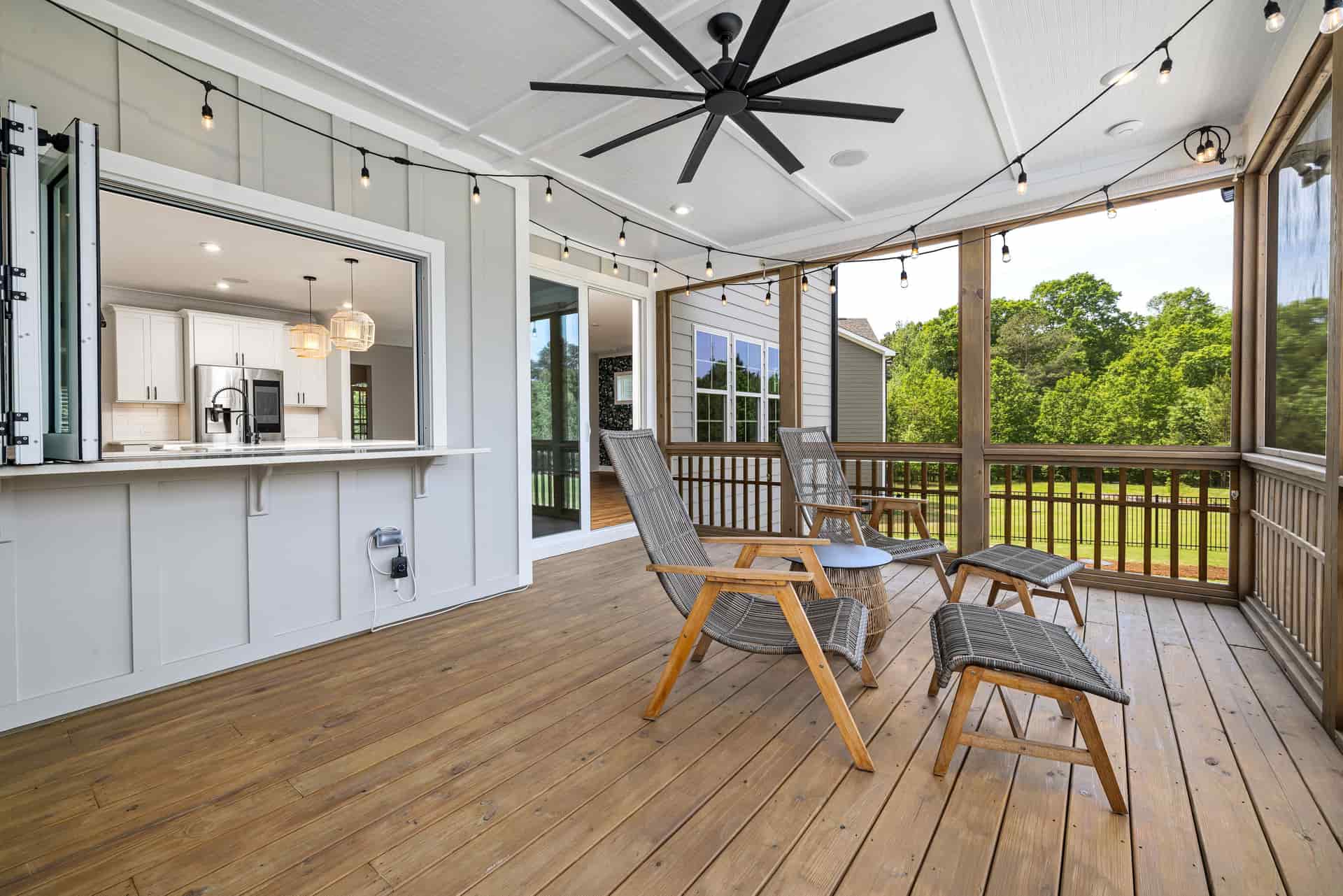
Outdoors there are no walls to bounce air off, so span does more work than it does indoors. The efficiency data happens to point the same way.
By Sawyer V. · Published
The short answer
The Harbor Breeze Cando 84-inch is the most efficient outdoor-rated fan in the certified data — 422.2 CFM per watt on 30.6 W. The Hunter Lakeway 72-inch (329.1 CFM/W) and Georgetown 52-inch (326.3 CFM/W, 20.6 W) are both rated for indoor and outdoor use. Before you buy any of them, confirm damp-rated versus wet-rated with the manufacturer — the certified datasets do not record it.
Fan & Frost earns a commission when you buy through our links, at no cost to you. It never changes a ranking, and we say so when the right answer is the cheaper unit or nothing at all. Full disclosure · How we pick.
At a glance
The picks, ranked
Tap any row to jump to the full reasoning. Prices are live from Amazon where we have them, and read “check price” where we don’t — never a number we cannot verify today.
| # | Product | Best for | Price |
|---|---|---|---|
| 1 | 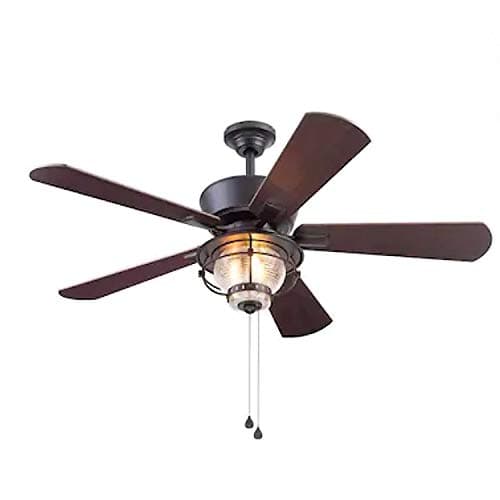 Most efficient outdoor-rated fan certified Harbor Breeze Cando 84" Ceiling Fan 422.2 CFM per watt on 30.6 W — the highest figure of any outdoor-rated fan in the certified dataset. | A large covered patio, pergola or outdoor room with the height for it | |
| 2 | 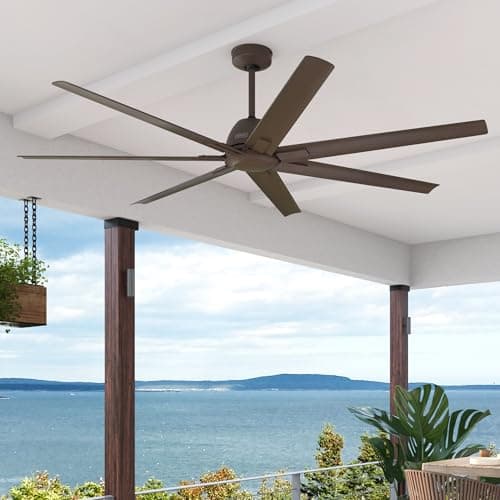 Best large span with an indoor-outdoor rating Hunter Lakeway 72" Ceiling Fan 329.1 CFM per watt at 72 inches, rated for both indoor and outdoor use — and 2.3 W on low is remarkable. | A covered porch, or an indoor room you might reuse it in later | |
| 3 | 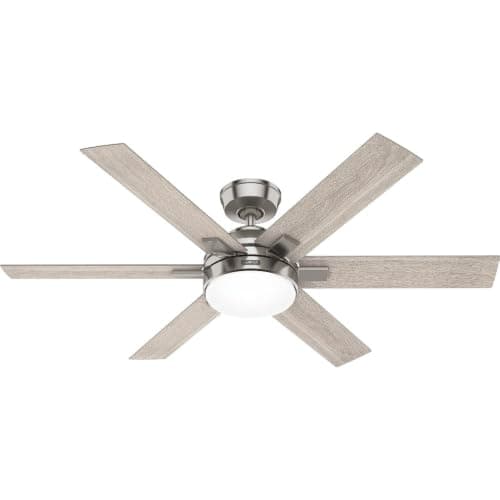 Best for a normal-sized porch Hunter Georgetown 52" Ceiling Fan 326.3 CFM per watt on just 20.6 W, at a 52-inch span that fits a real porch rather than an outdoor room. | A standard covered porch, balcony or small patio | |
| — | 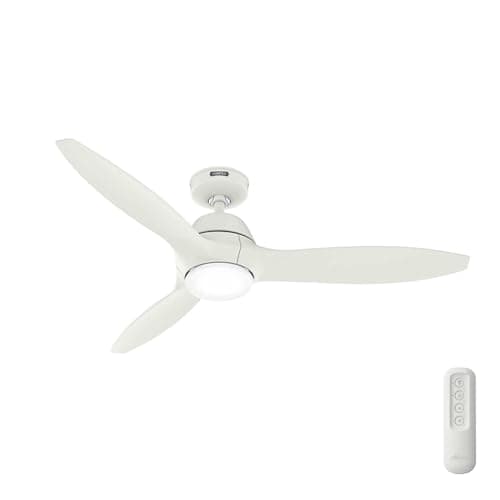 Damp-rated, which is not the same as outdoor-rated Hunter Skyway 52" Ceiling Fan with Light Kit 363.8 CFM per watt is excellent, and the ENERGY STAR record classes it as an indoor fan that is damp-rated. | A sheltered indoor space with humidity — a sunroom, not a patio |
Outdoors, a ceiling fan has a harder job and a simpler one. Harder, because there are no walls to contain the air it moves — the column of air it pushes down spreads and dissipates instead of circulating back. Simpler, because you do not have to worry about cooling a volume. You only have to put moving air on the people sitting under it.
Read this first
Damp-rated, wet-rated, and what the datasets do not tell you
This is the one thing to get right, and it is genuinely easy to get wrong because the terms are used loosely in retail listings.
- Dry-rated — indoors, in a normal room. Any moisture exposure is outside its design.
- Damp-rated — humidity and condensation, but not direct water. Covered porches that stay genuinely dry, sunrooms, bathrooms, laundries, enclosed patios.
- Wet-rated — direct water contact. Open pergolas, gazebos, exposed decks, anywhere rain reaches. Sealed motor housing, corrosion-resistant hardware, all-weather blades.
The ENERGY STAR certified ceiling fan dataset records whether a fan is indoor, outdoor, or rated for both. It does not record damp versus wet. That distinction comes from the manufacturer’s own safety listing, and you have to go and look at it.
Which is why the Hunter Skyway is on this page as a caution rather than a pick. It is damp-rated, it appears in outdoor fan searches constantly, and it is the wrong product for anywhere rain reaches.
The practical test: stand where the fan will go and ask whether that spot has ever been rained on. If you have to think about it, buy wet-rated.
The data
Certified efficiency, by span
| Fan | Span | CFM/W | High | Low | Rating in dataset |
|---|---|---|---|---|---|
| Harbor Breeze Cando | 84 in | 422.2 | 30.6 W | 6.0 W | Outdoor |
| Hunter Skyway | 52 in | 363.8 | 16.3 W | 2.1 W | Indoor, damp-rated |
| Hunter Lakeway | 72 in | 329.1 | 31.0 W | 2.3 W | Indoor and outdoor |
| Hunter Georgetown | 52 in | 326.3 | 20.6 W | 1.5 W | Indoor and outdoor |
ENERGY STAR Certified Ceiling Fans dataset. “Rating in dataset” is the indoor/outdoor classification ENERGY STAR records; it is not a damp/wet listing.
Two things stand out. The 84-inch fan draws less power than the 72-inch while moving substantially more air per watt — span is doing the work, not the motor. And every one of these idles at 1.5 to 6.0 watts on low, which puts an all-evening run somewhere between 0.2¢ and 0.7¢.
Outdoors is different
Why span matters more on a patio
Indoors, a ceiling fan sets up a circulation pattern. Air goes down through the blade disc, out across the floor, up the walls, and back to the fan. The room recirculates, so a modest fan can keep a whole room stirred.
Outdoors there are no walls, so there is no circulation pattern to set up. What you get is the column of air directly beneath the blade disc, spreading and weakening as it goes. Nothing comes back.
Two consequences that change how you choose:
- Coverage is roughly the footprint under the fan, rather than the room. Sit outside that footprint and you feel very little. This is why a single 52-inch fan over a long patio table leaves half the table unserved.
- Any breeze competes with the fan. A modest crosswind will simply blow the column sideways. Larger, slower-moving air columns hold together against that better than small fast ones.
Both point the same direction: go bigger outdoors than you would indoors for the same seating area. Which is convenient, because bigger is also where the efficiency is.
This one is not a DIY job
Outdoor fans need an outdoor-rated electrical box, and it has to be rated for a fan. Those are two separate requirements. A standard ceiling box will not carry the dynamic load of a spinning fan, and a standard indoor box has no business in a location exposed to moisture.
Blade clearance rules still apply outdoors: keep the tips well clear of posts, beams and walls, and keep the blades comfortably above head height for anyone standing.
An 84-inch fan is a substantial object. If it is going on an existing porch ceiling, confirm what the joist above it actually is before you hang it there.
Say the unwelcome thing
Do not buy an outdoor ceiling fan for an uncovered patio.
Even wet-rated fans need something to hang from, and an uncovered patio has no ceiling. People solve this with a post-mounted arm or a pergola crossbeam, and both introduce problems: the fan ends up too low, too close to structure for proper blade clearance, or mounted to something that flexes.
A ceiling fan needs unobstructed air above the blades as much as below. Mounted tight under a solid pergola beam, it is starved on the intake side and moves far less air than its rating.
For genuinely open outdoor space, a misting fan or a patio evaporative cooler is the more sensible category — both actually lower air temperature rather than only moving it, and neither needs a ceiling.
Choose
Which one
Large covered patio or outdoor room: the 84-inch Cando, if you have the height and the span. Best efficiency of anything we have data for, and the coverage a big space needs.
Covered porch of normal proportions: the 52-inch Georgetown at 20.6 W. Right-sized, indoor-and-outdoor rated, and 1.5 W on low.
Something in between, or a fan you might move indoors: the 72-inch Lakeway.
And in every case, confirm damp versus wet with the manufacturer before you order. It is the one specification that decides whether the fan survives, and it is the one the certified data does not carry.
In full
Every pick, and what is wrong with it
Published specifications only, each linked to the page it came from. Where a manufacturer publishes nothing, the row says so — we do not fill blanks in.
1. Most efficient outdoor-rated fan certified
Harbor Breeze Cando 84" Ceiling Fan
Harbor Breeze · model 84" Cando
422.2 CFM per watt on 30.6 W — the highest figure of any outdoor-rated fan in the certified dataset.
422.2 CFM per watt. Across all 1,398 US-market records in the certified ceiling fan dataset, that is the highest figure carried by any outdoor-rated fan, and the highest of any fan at an 84-inch span.
It is not the overall maximum. A 60-inch indoor Aeratron reaches 483.0 CFM per watt — span raises the typical figure, but the very best results come from motor and blade design. The full span analysis.
30.6 W on high — about 3.4¢ for a six-hour evening — and 6.0 W on low, which is 0.7¢ for the same evening. Listed by ENERGY STAR as an outdoor ceiling fan.
The thing to check is not the fan. It is the mounting: an 84-inch fan wants a rated outdoor box, proper blade clearance from walls and posts, and enough height that nobody standing on the patio meets it.
What’s wrong with it
84 inches needs real space and real ceiling height, and a span that large is disproportionate over a small patio table.
Running cost — 84" Cando
| Nameplate power | 6 W – 30.6 W | manufacturer's published figure |
|---|---|---|
| Energy, 8-hour night | 0.24 kWh | 30.6 ÷ 1000 × 8 |
| Cost per hour | 0.6¢ | at 18.34¢/kWh |
| Cost per 8-hour night | 4.5¢ | on the highest speed |
| Cost per 30 nights | $1.35 | 7.3 kWh |
| Same month, lowest speed | 26¢ | at 6 W |
Rate: 18.34¢/kWh, the US average residential price for June 2026 (EIA Electric Power Monthly, Table 5.3). Yours will differ — swap it in: (watts ÷ 1000) × hours × your rate.
| Blade span | 84 in |
|---|---|
| Efficiency | 422.2 CFM per watt |
| Power, high speed | 30.6 W |
| Power, low speed | 6.0 W |
| Type | Outdoor ceiling fan |
| ENERGY STAR | Certified |
Every figure above is from ENERGY STAR Certified Ceiling Fans dataset. Blanks are shown as “not published” rather than filled in.
2. Best large span with an indoor-outdoor rating
Hunter Lakeway 72" Ceiling Fan
Hunter · model 72" Lakeway
329.1 CFM per watt at 72 inches, rated for both indoor and outdoor use — and 2.3 W on low is remarkable.
2.3 W on low. That is the number worth stopping on — about 0.3¢ for an eight-hour night, which is close enough to nothing that leaving it running overnight is a non-decision.
329.1 CFM per watt at 31.0 W on high. Notably, it draws slightly more power than the 84-inch Cando while delivering less air per watt — a clean demonstration that span beats motor specification in this category.
The ENERGY STAR record lists it as rated for indoor and outdoor use, which makes it the flexible choice if the porch might one day become a room, or if you might move it.
What’s wrong with it
31.0 W on high for less air per watt than the 84-inch Cando, which draws slightly less power for substantially more airflow.
Running cost — 72" Lakeway
| Nameplate power | 2.3 W – 31 W | manufacturer's published figure |
|---|---|---|
| Energy, 8-hour night | 0.25 kWh | 31 ÷ 1000 × 8 |
| Cost per hour | 0.6¢ | at 18.34¢/kWh |
| Cost per 8-hour night | 4.5¢ | on the highest speed |
| Cost per 30 nights | $1.36 | 7.4 kWh |
| Same month, lowest speed | 10¢ | at 2.3 W |
Rate: 18.34¢/kWh, the US average residential price for June 2026 (EIA Electric Power Monthly, Table 5.3). Yours will differ — swap it in: (watts ÷ 1000) × hours × your rate.
| Blade span | 72 in |
|---|---|
| Efficiency | 329.1 CFM per watt |
| Power, high speed | 31.0 W |
| Power, low speed | 2.3 W |
| Type | Rated for indoor and outdoor use |
| ENERGY STAR | Certified |
Every figure above is from ENERGY STAR Certified Ceiling Fans dataset. Blanks are shown as “not published” rather than filled in.
3. Best for a normal-sized porch
Hunter Georgetown 52" Ceiling Fan
Hunter · model 52" Georgetown
326.3 CFM per watt on just 20.6 W, at a 52-inch span that fits a real porch rather than an outdoor room.
The practical pick. Most covered porches are not 84 inches wide in any useful sense, and a fan whose blades pass within a few inches of a post or a wall does not perform to its rating.
326.3 CFM per watt on 20.6 W — a third less power than either larger fan for only marginally less efficiency, and about 2.3¢ for a six-hour evening. 1.5 W on low is the lowest low-speed draw of any outdoor-rated fan here.
Also rated for indoor and outdoor use. If you want the same fan inside, the indoor comparison is here.
What’s wrong with it
52 inches will not cover a large patio, and outdoors there are no walls to help the air along.
Running cost — 52" Georgetown
| Nameplate power | 1.5 W – 20.6 W | manufacturer's published figure |
|---|---|---|
| Energy, 8-hour night | 0.16 kWh | 20.6 ÷ 1000 × 8 |
| Cost per hour | 0.4¢ | at 18.34¢/kWh |
| Cost per 8-hour night | 3.0¢ | on the highest speed |
| Cost per 30 nights | 91¢ | 4.9 kWh |
| Same month, lowest speed | 6.6¢ | at 1.5 W |
Rate: 18.34¢/kWh, the US average residential price for June 2026 (EIA Electric Power Monthly, Table 5.3). Yours will differ — swap it in: (watts ÷ 1000) × hours × your rate.
| Blade span | 52 in |
|---|---|
| Efficiency | 326.3 CFM per watt |
| Power, high speed | 20.6 W |
| Power, low speed | 1.5 W |
| Type | Rated for indoor and outdoor use |
| ENERGY STAR | Certified |
Every figure above is from ENERGY STAR Certified Ceiling Fans dataset. Blanks are shown as “not published” rather than filled in.
Skip this one
Hunter Skyway 52" Ceiling Fan with Light Kit
Hunter · model 52" Skyway (damp-rated)
363.8 CFM per watt is excellent, and the ENERGY STAR record classes it as an indoor fan that is damp-rated.
On efficiency alone this beats every outdoor-rated fan on the page except the Cando — 363.8 CFM per watt on 16.3 W. It is listed here as a skip anyway, because the rating is the whole point of this category.
The certified record classes it as an indoor fan with a damp rating. Damp-rated hardware is built for humidity and condensation — a bathroom, a laundry, a sunroom, a fully enclosed porch. It is not built for water landing on it.
If your covered porch gets driven rain in a storm, or your patio has an open pergola over it, this is the wrong fan and the failure will not be covered.
What’s wrong with it
Damp-rated means condensation and humidity, not rain. Fitting one where it can get wet is how you get a seized motor and a warranty refusal.
Running cost — 52" Skyway (damp-rated)
| Nameplate power | 2.1 W – 16.3 W | manufacturer's published figure |
|---|---|---|
| Energy, 8-hour night | 0.13 kWh | 16.3 ÷ 1000 × 8 |
| Cost per hour | 0.3¢ | at 18.34¢/kWh |
| Cost per 8-hour night | 2.4¢ | on the highest speed |
| Cost per 30 nights | 72¢ | 3.9 kWh |
| Same month, lowest speed | 9.2¢ | at 2.1 W |
Rate: 18.34¢/kWh, the US average residential price for June 2026 (EIA Electric Power Monthly, Table 5.3). Yours will differ — swap it in: (watts ÷ 1000) × hours × your rate.
| Blade span | 52 in |
|---|---|
| Efficiency | 363.8 CFM per watt |
| Power, high speed | 16.3 W |
| Power, low speed | 2.1 W |
| Standby power | 0.4 W |
| Type | Indoor, with light kit; damp-rated |
| Warranty | 3 years, components |
| ENERGY STAR | Certified |
Every figure above is from ENERGY STAR Certified Ceiling Fans dataset. Blanks are shown as “not published” rather than filled in.
We are not linking a buy button for this one. If you want to look at it anyway, it is easy enough to find — but we would rather send you to something that fits your room.
Questions people actually ask
Frequently asked
What is the most efficient outdoor ceiling fan?
Of the certified fans at that span, the Harbor Breeze Cando 84-inch at 422.2 CFM per watt, drawing 30.6 W on high and 6.0 W on low. Blade span is the main driver — a larger disc moves the same air more slowly, and slow air movement is far cheaper.
What is the difference between damp-rated and wet-rated?
Damp-rated handles humidity and condensation but not water landing on it — covered porches that stay dry, sunrooms, bathrooms. Wet-rated handles direct water: open pergolas, gazebos, exposed decks. If a location has ever been rained on, you need wet-rated.
Does ENERGY STAR say whether a fan is wet-rated?
No. The certified ceiling fan dataset records whether a fan is indoor, outdoor, or rated for both, but it does not record the damp-versus-wet distinction. That comes from the manufacturer's own safety listing and has to be checked separately.
What size ceiling fan do I need for a patio?
Larger than you would use indoors for the same area. Outdoors there are no walls to set up a circulation pattern, so coverage is roughly the footprint under the blades. A larger, slower-moving air column also holds together better against a crosswind. Fan sizing guide.
Can I put a ceiling fan on an uncovered patio?
There is nothing to hang it from, and the usual workarounds cause problems — post-mounted arms sit too low, and mounting tight under a pergola beam starves the intake side so the fan moves far less than its rating. A misting fan or patio evaporative cooler suits open space better.
How much does an outdoor ceiling fan cost to run?
Very little. The certified fans here draw 1.5 to 6.0 watts on low and 16.3 to 31.0 watts on high, so a six-hour evening on low costs a few cents at current average residential rates.
Sources
Where these numbers came from
Read next
Where to go from here
Back to Whole-House Airflow, or read how we pick.