The picks
The best air conditioners for renters
Read the lease clause before you read a review. Almost every restriction is about brackets and exterior appearance, which rules out fewer units than most renters assume.
By Sawyer V. · Published
The short answer
Start with a U-shaped window unit like the Midea MAW06V1QWT: no bracket, no drilling, nothing hanging outside, and the window still opens. It uses 298 kWh a year (about $55). If your lease bans window units outright or you have casement windows, a dual-hose portable is the fallback — at roughly three times the running cost.
Fan & Frost earns a commission when you buy through our links, at no cost to you. It never changes a ranking, and we say so when the right answer is the cheaper unit or nothing at all. Full disclosure · How we pick.

At a glance
The picks, ranked
Tap any row to jump to the full reasoning. Prices are live from Amazon where we have them, and read “check price” where we don’t — never a number we cannot verify today.
| # | Product | Best for | Price |
|---|---|---|---|
| 1 | Best for most renters Midea U-Shaped Window Air Conditioner, 6,000 BTU No bracket, no drilling, nothing protruding — and the window still opens above it. | A bedroom up to about 250 sq ft, on a sash window | |
| 2 | 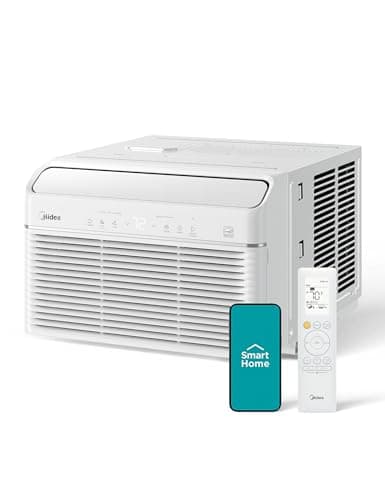 Easiest to install alone BLACK+DECKER Window Air Conditioner, 8,000 BTU 44.1 lb, the lightest 8,000 BTU unit in the certified data, and it sits inside the opening rather than straddling the sill. | A larger room, when you are lifting it by yourself | |
| 3 | 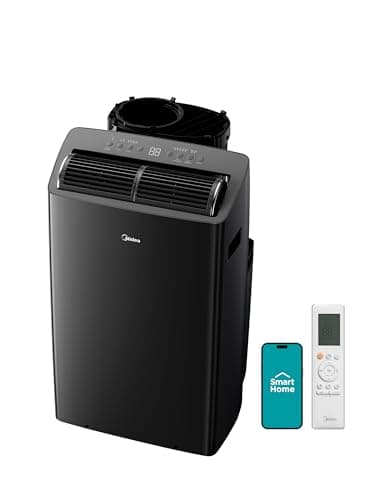 When window units are genuinely banned Midea Duo Smart Inverter Portable Air Conditioner The fallback, not the default: nothing goes in the window frame, but you pay for that every month. | Casement windows, sliders, or an absolute lease prohibition | |
| — | 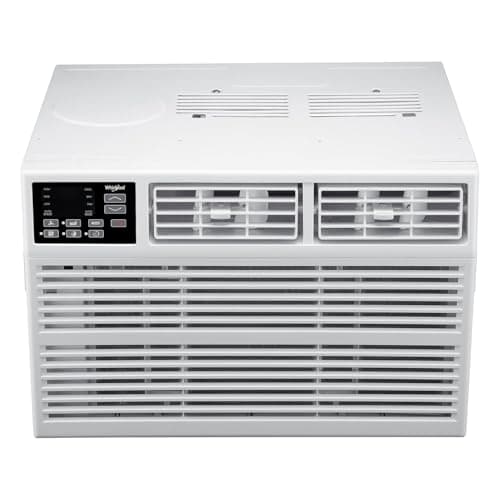 The one to skip Whirlpool Window Air Conditioner, 24,000 BTU 115.7 lb straddling a window you do not own, at the worst efficiency here. | Nobody in a rental |
The renting constraint is real but it is almost always narrower than people assume. Before you rule out the efficient options, find out what your lease actually says.
Start here
What leases usually forbid
In our reading of how these clauses are typically written, restrictions cluster into four categories, and only one of them rules out a window unit outright:
- Brackets and exterior fixings. Anything screwed into the frame or the facade. This is the most common clause, and it is about the building fabric and liability rather than cooling. A U-shaped unit needs neither.
- Anything protruding over a sidewalk or a neighbor. Weight above a public path is an insurance question. Again, a unit that sits inside the opening is a different proposition.
- Exterior appearance. Common in managed buildings and HOAs. Worth asking specifically what is permitted rather than assuming.
- Any modification to the window. This is the clause that genuinely rules window units out, and it is the least common of the four.
Ask before you buy, and ask specifically. “May I install a U-shaped window unit that requires no bracket and no drilling, and leaves the window openable?” is a very different question from “may I install an air conditioner?” — and it gets a different answer often enough to be worth asking.
What it costs you
The price of assuming you cannot
This is why the lease question is worth ten minutes. At 18.34¢/kWh:
| Option | Energy | Cost |
|---|---|---|
| U-shaped window unit, 6,000 BTU | 298 kWh/year | $55 /year |
| Window unit, 8,000 BTU | 375 kWh/year | $69 /year |
| Portable, 1,300 W, 30 nights | 312 kWh/month | $57 /month |
Window figures are ENERGY STAR certified annual energy use; the portable is nameplate draw at 8 hours a night, so treat it as a ceiling. Costs are our arithmetic at 18.34¢/kWh.
The portable’s monthly figure and the window unit’s annual figure are roughly the same number. Over a four-month season the difference is real money on a renter’s bill.
Say the unwelcome thing
Do not buy a 'ventless' unit because you cannot use a window.
The category is a trap aimed squarely at renters. A refrigeration cycle must reject its heat somewhere, and with no duct that somewhere is your room. Anything sold as a ventless or hose-free air conditioner is an evaporative cooler or a fan.
Evaporative coolers are genuinely useful in dry climates and useless in humid ones, and they need an open window to work at all — which defeats the purpose if you bought one because you could not use your window. The windowless-room page covers the real options.
Practical
Installing without damaging anything
- Photograph the window before you start. Both sides. It settles any argument at move-out.
- Use foam and weatherstrip, not expanding foam or caulk. The side panels that ship with the unit plus removable weatherstrip seal well and come off cleanly. Anything that cures is a deposit problem.
- Keep the box. You will be uninstalling it in October and storing it, and the box is also what you sell it in.
- Check the circuit. Older rentals often have shared circuits. A 1,300 W portable plus anything else substantial on the same circuit will trip a breaker, and a window unit at 400–900 W is a far easier load.
- Never run a window or portable unit on an extension cord. Both draw high current continuously. This is a genuine fire risk and every manufacturer’s manual prohibits it.
Before you buy anything
The cheaper move first
For a lot of rented bedrooms, most of the season is solvable without a compressor: blackout blinds closed during the day, a window fan running as an exhaust once the outside air drops below the inside air, and a quiet fan at 19 W for the night. That combination costs a couple of dollars a month to run and requires no permission from anyone.
Then buy the air conditioner for the weeks when it is genuinely not enough. The apartment page works through the whole sequence, and the sizing guide will stop you buying more capacity than the room needs.
In full
Every pick, and what is wrong with it
Published specifications only, each linked to the page it came from. Where a manufacturer publishes nothing, the row says so — we do not fill blanks in.
1. Best for most renters
Midea U-Shaped Window Air Conditioner, 6,000 BTU
Midea · model MAW06V1QWT
No bracket, no drilling, nothing protruding — and the window still opens above it.
The U-shape is what makes this a renter’s unit. The window sash closes down through the middle of the unit rather than resting on top of it, so the unit sits in the opening rather than hanging out of it. No support bracket, no screws into the frame, nothing cantilevered over the sidewalk.
That matters because most lease restrictions are about brackets and exterior appearance, not about cooling. A landlord objecting to “window air conditioners” is usually objecting to hardware bolted to their building and to the liability of something heavy above a sidewalk. A U-shaped unit avoids both, and showing a landlord a photograph of the installation is often enough.
The efficiency is a genuine bonus rather than a consolation: 298 kWh a year, about $55 at 18.34¢/kWh, and on the ENERGY STAR Most Efficient list. Compare that with a 1,300 W portable, which can use more than that in six weeks of overnight running.
Being able to still open the window is a small thing that turns out to matter over a summer — you can air the room on a cool evening without uninstalling anything.
What’s wrong with it
53.1 lb is a lot to hold over a sill on your own, and the U-shape only fits a single-hung or double-hung sash window. Casements and sliders are out.
Running cost — MAW06V1QWT
| Annual energy use | 298 kWh | ENERGY STAR certified figure |
|---|---|---|
| Annual cost | $55 | 298 × 18.34¢/kWh |
| Per cooling month | $14 | spread over a four-month season |
The annual figure is the certified value from the ENERGY STAR Certified Room Air Conditioners dataset, which models a standard cooling season rather than your actual summer. It is more useful than a nameplate wattage here, because a variable-speed compressor spends most of its life well below nameplate.
Rate: 18.34¢/kWh, the US average residential price for June 2026 (EIA Electric Power Monthly, Table 5.3). Yours will differ — swap it in: (watts ÷ 1000) × hours × your rate.
| Cooling capacity | 6,000 BTU/h |
|---|---|
| CEER | 15.1 |
| Annual energy use | 298 kWh/yr |
| vs federal standard | 37% less energy |
| Dimensions | 13.5 H x 19.2 W x 22.0 D in |
| Weight | 53.1 lb |
| Refrigerant | R-32 |
| Installation | U-shape; sash closes through the middle of the unit |
| Compressor | Variable speed |
| ENERGY STAR | Certified, and on the Most Efficient list |
Every figure above is from ENERGY STAR Certified Room Air Conditioners dataset. Blanks are shown as “not published” rather than filled in.
2. Easiest to install alone
BLACK+DECKER Window Air Conditioner, 8,000 BTU
BLACK+DECKER · model BD08NWES
44.1 lb, the lightest 8,000 BTU unit in the certified data, and it sits inside the opening rather than straddling the sill.
If nobody is around to hold the other end, weight is the specification that decides everything. 44.1 lb is the lightest 8,000 BTU unit in the ENERGY STAR certified data, and nine pounds lighter than the Midea U-shaped despite being 2,000 BTU larger.
It also does not straddle the windowsill, which is the same bracket-free advantage as the U-shape, just without the openable window. For a living room rather than a bedroom, that trade is usually fine.
400 kWh a year, about $73 — still a fraction of any portable.
What’s wrong with it
It occupies the window for the season — no opening it — and CEER 15 means 25 kWh a year more than the best in class.
Running cost — BD08NWES
| Annual energy use | 400 kWh | ENERGY STAR certified figure |
|---|---|---|
| Annual cost | $73 | 400 × 18.34¢/kWh |
| Per cooling month | $18 | spread over a four-month season |
The annual figure is the certified value from the ENERGY STAR Certified Room Air Conditioners dataset, which models a standard cooling season rather than your actual summer. It is more useful than a nameplate wattage here, because a variable-speed compressor spends most of its life well below nameplate.
Rate: 18.34¢/kWh, the US average residential price for June 2026 (EIA Electric Power Monthly, Table 5.3). Yours will differ — swap it in: (watts ÷ 1000) × hours × your rate.
| Cooling capacity | 8,000 BTU/h |
|---|---|
| CEER | 15 |
| Annual energy use | 400 kWh/yr |
| vs federal standard | 38% less energy |
| Dimensions | 13.5 H x 18.6 W x 19.6 D in |
| Weight | 44.1 lb |
| Refrigerant | R-32 |
| Installation | Does not straddle the windowsill |
| Compressor | Variable speed |
| ENERGY STAR | Certified |
Every figure above is from ENERGY STAR Certified Room Air Conditioners dataset. Blanks are shown as “not published” rather than filled in.
3. When window units are genuinely banned
Midea Duo Smart Inverter Portable Air Conditioner
Midea · model MAP14S1TBL
The fallback, not the default: nothing goes in the window frame, but you pay for that every month.
When a lease genuinely prohibits anything in a window frame, or your windows crank outward, this is the answer — and it is a good one. Dual hose, 12,000 BTU SACC against a 14,000 BTU headline (the smallest haircut we found), and 43 dBA.
Be clear-eyed about the trade. The exhaust hose still runs hot through the room, and the machine still occupies floor space. It is the right buy under a real constraint, and the wrong buy simply because it looked easier in the shop.
Before you settle for it, check whether your lease actually forbids a U-shaped unit or merely forbids brackets — the two are usually conflated, and only one of them rules out the cheaper option.
What’s wrong with it
Every portable pays the duct-heat penalty, and Midea publishes no wattage so its running cost cannot be calculated. It also occupies about two square feet of floor.
Running cost
Midea does not publish a wattage for the MAP14S1TBL, so we cannot calculate what it costs to run. We are not going to estimate one. If Midea publishes a nameplate figure, this block will show the arithmetic.
| Marketing capacity | 14,000 BTU |
|---|---|
| DOE-rated capacity | 12,000 BTU SACC |
| Hoses | Dual |
| Noise | 43 dBA |
| Speeds | 3 |
| Refrigerant | R-32 |
| Dimensions | 19.52 W x 16.73 D x 32.48 H in |
| Weight | 74.96 lb |
| Manufacturer coverage claim | 550 sq ft |
| Power | Not published (115 V stated, no wattage) |
| Warranty | 1 year |
Every figure above is from Midea product page, MAP14S1TBL. Blanks are shown as “not published” rather than filled in.
Skip this one
Whirlpool Window Air Conditioner, 24,000 BTU
Whirlpool · model WHAW-241IN
115.7 lb straddling a window you do not own, at the worst efficiency here.
This is the shape of unit that gave window air conditioners their reputation with landlords: heavy, straddling the sill, hanging over whatever is below, and requiring hardware fixed to the building.
It is also the wrong capacity. 24,000 BTU serves 1,400–1,500 sq ft on the ENERGY STAR table — most of a small house. In a rented room it would short-cycle, never dehumidify properly, and cost about $260 a year against $55 for the unit at the top of this page.
If you have a genuinely large open-plan rental, you want two smaller units or a conversation with the landlord about a mini-split, not a hundred pounds hanging out of a window on somebody else’s building.
What’s wrong with it
It straddles the window and needs a support bracket, which is exactly the fixing most leases prohibit — and at 1,417 kWh a year it costs more to run than three of the units above combined.
Running cost — WHAW-241IN
| Annual energy use | 1417.3 kWh | ENERGY STAR certified figure |
|---|---|---|
| Annual cost | $260 | 1417.3 × 18.34¢/kWh |
| Per cooling month | $65 | spread over a four-month season |
The annual figure is the certified value from the ENERGY STAR Certified Room Air Conditioners dataset, which models a standard cooling season rather than your actual summer. It is more useful than a nameplate wattage here, because a variable-speed compressor spends most of its life well below nameplate.
Rate: 18.34¢/kWh, the US average residential price for June 2026 (EIA Electric Power Monthly, Table 5.3). Yours will differ — swap it in: (watts ÷ 1000) × hours × your rate.
| Cooling capacity | 24,000 BTU/h |
|---|---|
| CEER | 12.7 |
| Annual energy use | 1,417.3 kWh/yr |
| vs federal standard | 35% less energy |
| Dimensions | 20.7 H x 30.0 W x 28.8 D in |
| Weight | 115.7 lb |
| Refrigerant | R-32 |
| Installation | Straddles the window; support bracket territory |
| ENERGY STAR | Certified |
Every figure above is from ENERGY STAR Certified Room Air Conditioners dataset. Blanks are shown as “not published” rather than filled in.
We are not linking a buy button for this one. If you want to look at it anyway, it is easy enough to find — but we would rather send you to something that fits your room.
Questions people actually ask
Frequently asked
What air conditioner can I use in an apartment without drilling?
A U-shaped window unit needs no bracket and no drilling — the sash closes through the middle of the unit and it sits inside the opening. Several conventional units also sit inside the opening rather than straddling the sill. A portable requires nothing in the window frame at all beyond a vent panel.
Do landlords allow window air conditioners?
Most restrictions target brackets, exterior fixings and anything hanging over a sidewalk, rather than cooling as such. A U-shaped unit avoids all three, so it is worth asking specifically about that rather than about air conditioners in general — the answers are often different.
Are portable air conditioners better for renters?
Easier to install and to remove, but roughly three times the running cost, and they occupy floor space and put a hot duct in the room. Use one when your window type or your lease genuinely rules a window unit out, not as a default. The full comparison.
What size air conditioner do I need for a rented bedroom?
Usually 5,000 to 6,000 BTU. The ENERGY STAR table puts 100-150 sq ft at 5,000 and 150-250 sq ft at 6,000, and most rented bedrooms fall in that range. Resist buying 8,000 because it is the common size — oversizing leaves the room cold and clammy. Size it properly.
Can I use an extension cord with a window air conditioner?
No. Both window and portable units draw high current continuously, and every manufacturer's manual prohibits extension cords for exactly that reason. It is a genuine fire risk. If the outlet is in the wrong place, the answer is a different position for the unit or an electrician.
Will a window air conditioner damage the window frame?
A unit that sits inside the opening and is sealed with the supplied foam panels and removable weatherstrip should not. Damage tends to come from brackets screwed into frames, from expanding foam or caulk that cures in place, and from water not draining outward. Photograph the window before installing.
Sources
Where these numbers came from
Read next
Where to go from here
Back to Air Conditioners, or read how we pick.