Head to head
Evaporative cooler vs air conditioner
One adds humidity, the other removes it. That single difference decides the whole comparison, and it decides it by climate rather than by budget.
By Sawyer V. · Published
The short answer
An evaporative cooler uses about 250 W against a portable air conditioner’s 1,300 W — roughly a fifth of the running cost. But it adds humidity and only works below about 40% RH, while an air conditioner removes humidity and works anywhere. Dry climate: evaporative. Humid: air conditioner. No overlap.
Fan & Frost earns a commission when you buy through our links, at no cost to you. It never changes a ranking, and we say so when the right answer is the cheaper unit or nothing at all. Full disclosure · How we pick.

At a glance
The picks, ranked
Tap any row to jump to the full reasoning. Prices are live from Amazon where we have them, and read “check price” where we don’t — never a number we cannot verify today.
| # | Product | Best for | Price |
|---|---|---|---|
| 1 | 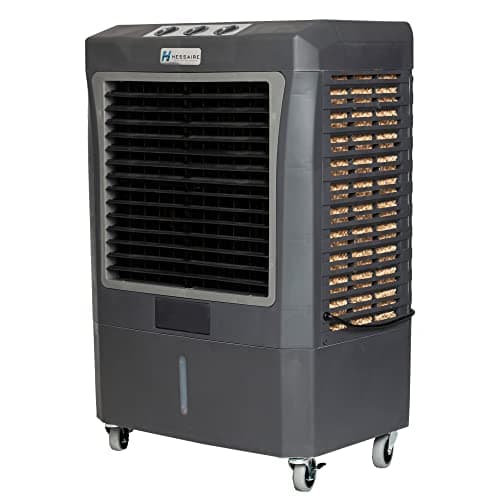 The dry-climate pick Hessaire MC37M Mobile Evaporative Cooler 3,100 CFM on 250 W, which is a fifth of a portable AC's draw for real cooling — where the air is dry enough. | A garage, patio or workshop below 40% humidity | |
| 2 | The any-climate pick Midea U-Shaped Window Air Conditioner, 6,000 BTU 298 kWh for an entire year, and it removes humidity rather than adding it. | A bedroom anywhere, humid or dry | |
| — | The expensive middle option Whynter ARC-14S Dual Hose Portable Air Conditioner Works in any climate like the window unit, but costs like the worst of both worlds. | A room where neither of the above will physically fit |
These are frequently compared as though they were two price points for the same job. They are not. They are two different physical processes that happen to both lower a temperature, and they do opposite things to the humidity in the room — which is what actually decides the answer.
Mechanism
What each one physically does
An evaporative cooler pulls air through a wet pad. Water evaporates, absorbing heat from the air, so the air comes out cooler and wetter. The heat has not left the building — it has been converted into water vapor that is now in your air. It needs dry air to accept that vapor, and it needs somewhere for the humid air to go.
An air conditioner runs a refrigeration cycle. It absorbs heat on the cold side and rejects it outside on the hot side, and while it does that, moisture condenses out on the cold coil and drains away. Heat genuinely leaves the room, humidity genuinely drops, and it works in any climate and in a sealed space.
Side by side
The comparison
| Evaporative cooler | Air conditioner | |
|---|---|---|
| Effect on humidity | Adds it | Removes it |
| Works in humid air | No — useless above ~60% RH | Yes, anywhere |
| Works in a closed room | No — needs a window or door open | Yes |
| Typical power | 220–250 W | 300–1,400 W |
| 30 × 8-hour periods | $11 | $57 portable / $55 per YEAR for a 6,000 BTU window unit |
| Water needed | 6.6–15.9 gallons, refilled or plumbed | None |
| Maintenance | Pads rinsed and replaced; tank drained | Filter cleaned |
| Install | Wheel it in, fill it, plug it in | Window unit fitted, or portable vented |
| Noise | 52–65 dBA published | 43 dBA up to not-published |
| Fresh air | Constant — it is pulling outside air in | Recirculates the same air |
Running cost
The arithmetic, at one rate
All figures at 18.34¢/kWh, the US average residential price. Yours will differ — the formula is (watts ÷ 1000) × hours × your rate.
| Machine | Power | 8 hours | 30 × 8 hours |
|---|---|---|---|
| Honeywell CO60PM evaporative | 220 W | 32¢ | $9.68 |
| Hessaire MC37M evaporative | 250 W | 37¢ | $11 |
| Whynter ARC-14S portable AC | 1300 W | $1.91 | $57 |
| Midea 6,000 BTU window AC | 298 kWh/yr | — | $55 / YEAR |
Wattages from manufacturer pages; the window unit figure is ENERGY STAR certified annual energy use. Costs are our arithmetic.
Two things worth noticing in that table. The evaporative cooler is about a fifth of the portable’s running cost, which is the headline everyone quotes. But a correctly sized window air conditioner costs about the same per year as the evaporative cooler costs per month, which almost nobody mentions — because the comparison is usually drawn against a portable, the least efficient form of refrigeration.
The evaporative cooler still wins on running cost against a window unit. But the gap is far narrower than the “a fifth of the power” framing suggests, and it comes with real conditions attached.
Water
The cost nobody puts in the comparison
An evaporative cooler consumes water continuously — that is the mechanism. A 10 to 16 gallon tank running through a hot day is a real quantity, and in the arid regions where these units work, water is often the more expensive and more constrained resource.
Practically it also means either refilling the tank daily or plumbing a continuous supply, plus draining and drying the unit when you store it. Neither is difficult. Both are things an air conditioner does not ask of you.
The decision
Which one you should buy
Buy an evaporative cooler if all three are true:
- Your afternoon humidity on hot days is below about 40%.
- The space has a door or window that stays open — a garage, patio, workshop, or a room you are happy to ventilate.
- You are willing to keep it filled and keep the pads clean.
Buy an air conditioner if any of these is true:
- Your summers are humid. This one is absolute — no evaporative cooler works in saturated air, regardless of size or brand.
- The space must stay closed, for security, noise or pets.
- You need reliable, predictable temperature control rather than “cooler than outside, depending on the weather”.
- You do not want to manage water.
In a dry climate the two are genuinely complementary rather than competing: an evaporative cooler in the garage where the door is open anyway, and a window unit in the bedroom where it needs to be closed. That is usually the right answer for a house in Phoenix.
In full
Every pick, and what is wrong with it
Published specifications only, each linked to the page it came from. Where a manufacturer publishes nothing, the row says so — we do not fill blanks in.
1. The dry-climate pick
Hessaire MC37M Mobile Evaporative Cooler
Hessaire · model MC37M
3,100 CFM on 250 W, which is a fifth of a portable AC's draw for real cooling — where the air is dry enough.
250 W is the number that makes this comparison interesting. About $11 for thirty eight-hour days at 18.34¢/kWh, against roughly $57 for a 1,300 W portable air conditioner over the same period.
And unlike a fan, this is real cooling — the air leaving the pads is genuinely colder than the air entering them, not merely moving faster.
The conditions are the whole story though. Dry air, and somewhere for the humid air to go. Check your afternoon humidity before you buy.
What’s wrong with it
Useless above about 60% relative humidity, needs a door or window open, and needs its 10.3 gallon tank refilled or plumbed. It is a machine with conditions attached.
Running cost — MC37M
| Nameplate power | 250 W | manufacturer's published figure |
|---|---|---|
| Energy, 8-hour night | 2.00 kWh | 250 ÷ 1000 × 8 |
| Cost per hour | 4.6¢ | at 18.34¢/kWh |
| Cost per 8-hour night | 37¢ | on the highest speed |
| Cost per 30 nights | $11 | 60.0 kWh |
Rate: 18.34¢/kWh, the US average residential price for June 2026 (EIA Electric Power Monthly, Table 5.3). Yours will differ — swap it in: (watts ÷ 1000) × hours × your rate.
| Air delivery | 3,100 CFM |
|---|---|
| Power | 250 W / 2.4 A |
| Water tank | 10.3 gallons, continuous hookup capable |
| Dimensions | 24 L x 16 W x 38 H in |
| Weight | 40 lb |
| Pads | Industrial-grade cooling pads |
| Coverage claim | Not published on the product page |
Every figure above is from Hessaire product page, MC37M. Blanks are shown as “not published” rather than filled in.
2. The any-climate pick
Midea U-Shaped Window Air Conditioner, 6,000 BTU
Midea · model MAW06V1QWT
298 kWh for an entire year, and it removes humidity rather than adding it.
This is where the comparison stops being about power draw. 298 kWh a year is about $55 at 18.34¢/kWh — for a whole cooling season, from a certified figure.
More importantly it dehumidifies. In a humid climate that is doing at least as much for your comfort as the temperature drop, and it is the exact opposite of what an evaporative cooler does. Two machines that both claim to cool a room, moving humidity in opposite directions.
It also works in a closed room, which the evaporative cooler structurally cannot.
What’s wrong with it
Needs a vertical sash window, occupies it for the season, and at 53.1 lb is a two-person lift for most people.
Running cost — MAW06V1QWT
| Annual energy use | 298 kWh | ENERGY STAR certified figure |
|---|---|---|
| Annual cost | $55 | 298 × 18.34¢/kWh |
| Per cooling month | $14 | spread over a four-month season |
The annual figure is the certified value from the ENERGY STAR Certified Room Air Conditioners dataset, which models a standard cooling season rather than your actual summer. It is more useful than a nameplate wattage here, because a variable-speed compressor spends most of its life well below nameplate.
Rate: 18.34¢/kWh, the US average residential price for June 2026 (EIA Electric Power Monthly, Table 5.3). Yours will differ — swap it in: (watts ÷ 1000) × hours × your rate.
| Cooling capacity | 6,000 BTU/h |
|---|---|
| CEER | 15.1 |
| Annual energy use | 298 kWh/yr |
| vs federal standard | 37% less energy |
| Dimensions | 13.5 H x 19.2 W x 22.0 D in |
| Weight | 53.1 lb |
| Refrigerant | R-32 |
| Installation | U-shape; sash closes through the middle of the unit |
| Compressor | Variable speed |
| ENERGY STAR | Certified, and on the Most Efficient list |
Every figure above is from ENERGY STAR Certified Room Air Conditioners dataset. Blanks are shown as “not published” rather than filled in.
Skip this one
Whynter ARC-14S Dual Hose Portable Air Conditioner
Whynter · model ARC-14S
Works in any climate like the window unit, but costs like the worst of both worlds.
We include this to make the size of the gap concrete rather than to criticize the machine, which is a good one in the right room.
At 1,300 W it costs about $57 for thirty eight-hour nights. The evaporative cooler above costs $11 for the same hours; the window unit costs $55 for a year.
If a window unit fits, buy the window unit. If your air is dry and you can leave a door open, the evaporative cooler is a fifth of the cost. The portable is what you buy when neither of those is true, and it should be a considered choice rather than a default.
What’s wrong with it
1,300 W — five times the evaporative cooler and, per month, more than the window unit costs per year. Its duct also sits inside the room it is cooling.
Running cost — ARC-14S
| Nameplate power | 1300 W | manufacturer's published figure |
|---|---|---|
| Energy, 8-hour night | 10.40 kWh | 1300 ÷ 1000 × 8 |
| Cost per hour | 24¢ | at 18.34¢/kWh |
| Cost per 8-hour night | $1.91 | on the highest speed |
| Cost per 30 nights | $57 | 312.0 kWh |
Rate: 18.34¢/kWh, the US average residential price for June 2026 (EIA Electric Power Monthly, Table 5.3). Yours will differ — swap it in: (watts ÷ 1000) × hours × your rate.
| Marketing capacity | 14,000 BTU (ASHRAE-128) |
|---|---|
| DOE-rated capacity | 9,500 BTU SACC |
| Hoses | Dual |
| Power | 1,300 W / 11.6 A at 115 V |
| Noise | Under 51 dBA low, under 56 dBA high |
| Dehumidification | 71 pints/day |
| Refrigerant | R-32 |
| Dimensions | 16 W x 19 D x 35.5 H in |
| Weight | 73 lb |
| Manufacturer coverage claim | 500 sq ft |
| Warranty | 1 year unit, 3 years compressor |
Every figure above is from Whynter product page, ARC-14S. Blanks are shown as “not published” rather than filled in.
We are not linking a buy button for this one. If you want to look at it anyway, it is easy enough to find — but we would rather send you to something that fits your room.
Questions people actually ask
Frequently asked
Which costs less to run, an evaporative cooler or an air conditioner?
An evaporative cooler, at 220 to 250 W against 1,300 W for a large portable — about a fifth. Against a correctly sized window unit the gap is much narrower: a certified 6,000 BTU window unit uses 298 kWh a year, roughly what the evaporative cooler uses in a month of daily running.
Is an evaporative cooler as good as an air conditioner?
In a dry climate, for a ventilated space, it does a genuinely comparable job for far less power. In a humid climate it does not work at all, because the cooling comes from evaporation and humid air cannot accept more moisture. They are not two price points for the same job.
Do evaporative coolers add humidity?
Yes, that is the mechanism — water evaporates into the air, absorbing heat, so the air leaves cooler and wetter. An air conditioner does the opposite: moisture condenses on its cold coil and drains away. That difference is what makes climate the deciding factor.
Can I use an evaporative cooler and an air conditioner together?
Not in the same room, no — the cooler adds humidity that the air conditioner then spends energy removing, so they work against each other. In the same house they complement each other well: the cooler in an open garage or patio, the air conditioner in a closed bedroom.
How much water does an evaporative cooler use?
Tanks run from about 6.6 gallons on an indoor unit to 15.9 gallons on a large outdoor one, and a hot day can consume a full tank. That means daily refilling or a plumbed continuous supply — and in the arid regions where these work, water is worth factoring into the comparison.
Which is better for a garage?
An evaporative cooler, clearly, provided your climate is dry. A garage with the door open is the ideal application: the ventilation these units require is already there, the noise does not matter, and cooling a leaky uninsulated space with refrigeration is throwing money away. The garage picks.
Sources
Where these numbers came from
Read next
Where to go from here
Back to Evaporative Coolers, or read how we pick.