Head to head
Big Ass Fans Haiku 84 vs 60 inch
Both are on the ENERGY STAR Most Efficient list. One is the most efficient thing in the room; the other is the only one that fits under an eight-foot ceiling.
By Sawyer V. · Published
The short answer
If the ceiling allows it, the 84-inch Haiku is the better fan — 418.0 CFM per watt against 339.0, and it even draws less standby power (2.0 W against 2.5). The 60-inch low-mount exists for a specific constraint: a ceiling under about eight feet, where a downrod cannot give you the 7 ft of floor clearance a fan needs. On absolute power it is the lighter load — 16.2 W against 39.8.
Fan & Frost earns a commission when you buy through our links, at no cost to you. It never changes a ranking, and we say so when the right answer is the cheaper unit or nothing at all. Full disclosure · How we pick.

At a glance
The picks, ranked
Tap any row to jump to the full reasoning. Prices are live from Amazon where we have them, and read “check price” where we don’t — never a number we cannot verify today.
| # | Product | Best for | Price |
|---|---|---|---|
| 1 | 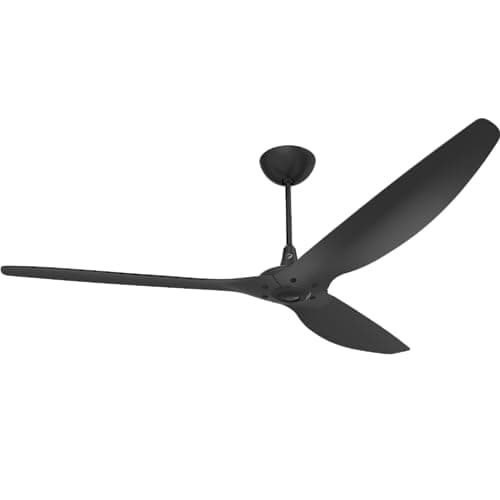 The 84-inch case Big Ass Fans Haiku MK-i61 84" Ceiling Fan 418.0 CFM per watt certified on 39.8 W, on the Most Efficient list, at the largest blade span available in a residential ceiling fan. | A great room, vaulted space or open-plan floor with at least nine feet of ceiling and 18 inches of clearance to every wall | |
| 2 | 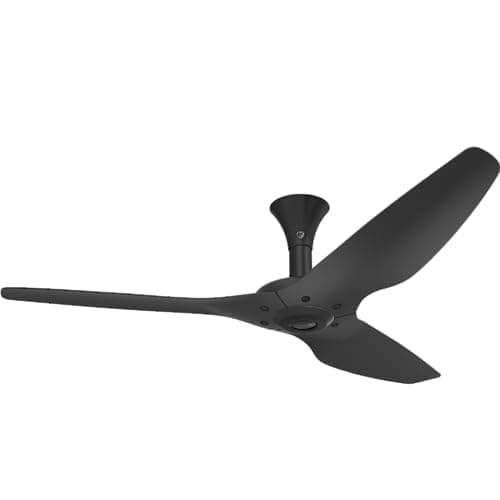 The 60-inch low-mount case Big Ass Fans Haiku 60" Low-Mount Ceiling Fan 339.0 CFM per watt on 16.2 W, also on the Most Efficient list, in a low-mount body that fits where the 84-inch cannot go. | A room with a ceiling under about eight feet, where a downrod cannot deliver legal floor clearance |
Both of these are ENERGY STAR certified and both are on the Most Efficient list, so this is not a good-versus-bad comparison. It is a span-versus-mount decision, and the ceiling makes it for you more often than the budget does.
Head to head
Certified figures, side by side
| Haiku MK-i61, 84 in | Haiku low-mount, 60 in | |
|---|---|---|
| Blade span | 84 in | 60 in |
| Efficiency | 418.0 CFM per watt | 339.0 CFM per watt |
| Power, high speed | 39.8 W | 16.2 W |
| Standby power | 2.0 W | 2.5 W |
| Mount | Standard | Low-mount (HSSD) |
| Connected | Yes | Not certified as connected |
| Light kit | No ENERGY STAR lamp | Fan only |
| Warranty | 5 years, components | 5 years, components |
| ENERGY STAR | Certified, Most Efficient | Certified, Most Efficient |
| A month of evenings | $1.75 | 71¢ |
Span, efficiency, power and warranty from the ENERGY STAR Certified Ceiling Fans dataset; running costs are our arithmetic at 18.34¢/kWh. Prices checked 11 October 2026: the 84-inch was $2,150.00 and the 60-inch $1,750.00. The buttons above carry the live price and the date.
The decider
Ceiling height, then clearance, then efficiency
Work through these in order and the decision usually makes itself.
- Under about 8 ft of ceiling: low-mount, and the 84-inch is out regardless of what you would prefer. A fan needs 7 ft of floor clearance and a downrod cannot create height.
- Over 9 ft, and 18 inches of clearance to every wall: the 84-inch. More air, more efficiently, more gently.
- Over 9 ft but a narrow room: still the 60-inch. A blade passing within a few inches of a wall does not deliver its rated airflow, so a fan too wide for its room is wasted span. The span table by room size.
This one is not a DIY job
Standby draw is the one place the smaller fan loses outright. 2.5 W against 2.0 W sounds trivial until you multiply by 8,760 hours: $4.02 against $3.21 a year, paid whether anyone is in the room or not. Both are above the 0.90 W average for non-connected certified fans.
Which one
How to choose
- Great room with height: the 84-inch. Best efficiency, widest span, lower standby.
- Standard 8 ft ceiling: the 60-inch low-mount. It is the only one of the two you can legally and safely fit.
- Lowest absolute power draw: the 60-inch, at 16.2 W against 39.8.
- Most air per watt: the 84-inch, by 23 per cent.
- You want app and voice control: the 84-inch, which is the one certified as connected.
Say the unwelcome thing
Do not buy an 84-inch fan for a standard room.
A seven-foot span needs at least 18 inches of clearance to every wall and 7 feet of floor clearance underneath, which rules out most rooms with an 8-foot ceiling. Fitted into a room that is too small, the fan runs on its lowest setting permanently and the only thing you have bought is a clearance problem.
Neither of these ships an ENERGY STAR certified lamp — no certified ceiling fan does, in the entire dataset. If the room needs light from the fan, that is a fixture decision rather than an efficiency one.
In full
Every pick, and what is wrong with it
Published specifications only, each linked to the page it came from. Where a manufacturer publishes nothing, the row says so — we do not fill blanks in.
1. The 84-inch case
Big Ass Fans Haiku MK-i61 84" Ceiling Fan
Big Ass Fans · model MK-i61-071806
418.0 CFM per watt certified on 39.8 W, on the Most Efficient list, at the largest blade span available in a residential ceiling fan.
418.0 CFM per watt on 39.8 W, certified, and on the ENERGY STAR Most Efficient list. 84 inches is the top of the residential market — the certified dataset holds nothing wider.
The efficiency advantage is the span, not the brand. A seven-foot blade moves a very large volume of air slowly, and moving air slowly is what cheap-in-watts looks like. It is also what comfortable feels like: a wide gentle column instead of the draught a small fast fan produces.
2.0 W of standby is the number to hold against it, and it is worth doing the arithmetic: a connected fan draws that for all 8,760 hours of the year, which is $3.21 annually before the blades turn. Our analysis of the certified field found connected fans average 1.74 W standby against 0.90 W for everything else.
Running it is close to free: 5.8¢ for an eight-hour evening at 18.34¢/kWh, $1.75 across a month.
Clearance is the real gate. A seven-foot span wants 18 inches to the nearest wall on every side and 7 ft of floor clearance beneath. Downrod and clearance arithmetic.
What’s wrong with it
39.8 W on high is two and a half times the 60-inch, 84 inches needs real clearance, and connected control costs 2.0 W of standby every hour of the year.
Running cost — MK-i61-071806
| Nameplate power | 39.8 W | manufacturer's published figure |
|---|---|---|
| Energy, 8-hour night | 0.32 kWh | 39.8 ÷ 1000 × 8 |
| Cost per hour | 0.7¢ | at 18.34¢/kWh |
| Cost per 8-hour night | 5.8¢ | on the highest speed |
| Cost per 30 nights | $1.75 | 9.6 kWh |
Rate: 18.34¢/kWh, the US average residential price for June 2026 (EIA Electric Power Monthly, Table 5.3). Yours will differ — swap it in: (watts ÷ 1000) × hours × your rate.
| Blade span | 84 in |
|---|---|
| Efficiency | 418.0 CFM per watt |
| Power, high speed | 39.8 W |
| Standby power | 2.0 W |
| Connected functionality | Yes |
| Type | Indoor |
| Warranty | 5 years, components |
| ENERGY STAR | Certified, and on the Most Efficient list |
Every figure above is from ENERGY STAR Certified Ceiling Fans dataset. Blanks are shown as “not published” rather than filled in.
2. The 60-inch low-mount case
Big Ass Fans Haiku 60" Low-Mount Ceiling Fan
Big Ass Fans · model MK-HK4-05240001
339.0 CFM per watt on 16.2 W, also on the Most Efficient list, in a low-mount body that fits where the 84-inch cannot go.
339.0 CFM per watt on 16.2 W, certified and on the Most Efficient list. In absolute terms this is the lighter load by a wide margin: 71¢ across a month of evenings against $1.75.
The reason to buy it is mount type. A low-mount fan fixes the motor tight to the ceiling, which is what you do when the ceiling is under about eight feet and a downrod would put the blades below the 7 ft of floor clearance a fan needs. That is a safety requirement, not a preference.
The cost of that mount is measurable and we should name it: 339.0 against 418.0 CFM per watt is a 19 per cent penalty, which matches the pattern across the certified field — a fan drawing air through a restricted gap above the blade does more work for the same air. The flush-mount penalty, measured.
2.5 W of standby is the highest figure in our ceiling fan dataset — $4.02 a year before the fan does anything. On a fan-only unit with no light kit, that is all radio.
What’s wrong with it
19 per cent less efficient than its bigger sibling, 2.5 W of standby — the highest in our dataset — and it ships as a fan only, with no light.
Running cost — MK-HK4-05240001
| Nameplate power | 16.2 W | manufacturer's published figure |
|---|---|---|
| Energy, 8-hour night | 0.13 kWh | 16.2 ÷ 1000 × 8 |
| Cost per hour | 0.3¢ | at 18.34¢/kWh |
| Cost per 8-hour night | 2.4¢ | on the highest speed |
| Cost per 30 nights | 71¢ | 3.9 kWh |
Rate: 18.34¢/kWh, the US average residential price for June 2026 (EIA Electric Power Monthly, Table 5.3). Yours will differ — swap it in: (watts ÷ 1000) × hours × your rate.
| Blade span | 60 in |
|---|---|
| Efficiency | 339.0 CFM per watt |
| Power, high speed | 16.2 W |
| Standby power | 2.5 W |
| Type | Indoor low-mount (HSSD), fan only |
| Warranty | 5 years, components |
| ENERGY STAR | Certified, and on the Most Efficient list |
Every figure above is from ENERGY STAR Certified Ceiling Fans dataset. Blanks are shown as “not published” rather than filled in.
Questions people actually ask
Frequently asked
Which Big Ass Fans Haiku should I buy, the 84 or the 60 inch?
The 84-inch if your ceiling is over about nine feet and you have 18 inches of clearance to every wall — it certifies 418.0 CFM per watt against 339.0 and draws less standby power. The 60-inch low-mount if your ceiling is under about eight feet, where a downrod cannot deliver the 7 ft of floor clearance a fan requires.
Is the 84-inch Haiku more efficient than the 60-inch?
Yes, by 23 per cent: 418.0 CFM per watt against 339.0, both certified. The wider blade moves a much larger volume of air slowly, which is cheaper in watts than spinning a smaller blade faster. In absolute terms the 60-inch is still the lighter load at 16.2 W against 39.8.
Why does the low-mount fan certify worse?
A low-mount fixes the motor tight to the ceiling, so the fan draws air through a restricted gap above the blade. That costs efficiency and the penalty here is 19 per cent. It is the same pattern across the certified field, and it is the price of fitting a fan under a low ceiling. The flush-mount penalty.
How much do these cost to run?
About 5.8¢ and 2.4¢ for an eight-hour evening at 18.34¢/kWh, or $1.75 and 71¢ across a month. Add standby: 2.0 W and 2.5 W respectively, drawn all 8,760 hours of the year, which is $3.21 and $4.02 annually.
What ceiling height do I need for an 84-inch ceiling fan?
Enough to leave 7 feet of floor clearance beneath the blades after the downrod and canopy, which in practice means about nine feet or more. You also need 18 inches of clearance to the nearest wall on every side, which rules out narrow rooms regardless of height. Downrod and clearance arithmetic.
Is a smart ceiling fan worth the standby power?
It costs about 2 to 2.5 W drawn continuously, or roughly a dollar and a half to two dollars a year more than a non-connected fan. That is small in absolute terms, but connected fans average 1.74 W standby against 0.90 W for everything else, and the spread runs from 0.5 W to 2.5 W — so it is avoidable if you check the figure. Smart ceiling fans and standby.
Sources
Where these numbers came from
Read next
Where to go from here
Back to Whole-House Airflow, or read how we pick.