The picks
The best smart air conditioners
Wi-Fi has become standard equipment on room air conditioners, which makes the app the wrong thing to shop on and the efficiency spread the right one.
By Sawyer V. · Published
The short answer
Almost every certified room air conditioner now has an app — it is not a feature you shop for any more. What still differs is efficiency: models with near-identical app screens span CEER 14.7 to 16, or 525.5 down to 468.8 kWh a year. And note that zero of 505 certified units are ENERGY STAR “connected capable”, which is a different thing from Wi-Fi.
Fan & Frost earns a commission when you buy through our links, at no cost to you. It never changes a ranking, and we say so when the right answer is the cheaper unit or nothing at all. Full disclosure · How we pick.
At a glance
The picks, ranked
Tap any row to jump to the full reasoning. Prices are live from Amazon where we have them, and read “check price” where we don’t — never a number we cannot verify today.
| # | Product | Best for | Price |
|---|---|---|---|
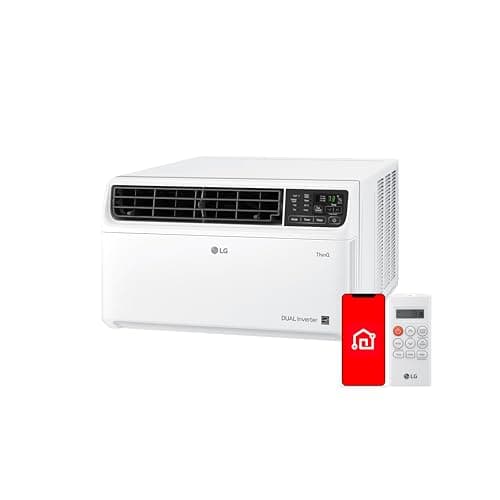
| 1 | Best overall LG Dual Inverter Window Air Conditioner, 6,000 BTU CEER 15.5 and 290.3 kWh a year with LG ThinQ, Alexa and Google Assistant, a 24-hour timer and no support bracket required. | A bedroom or small room where the schedule matters more than the capacity | |
| 2 | Best for a real room Midea U-Shaped Window Air Conditioner, 10,000 BTU (U2) CEER 16 and Most Efficient, with the SmartHome app, Apple Watch control, 32 dBA and a three-year warranty. | Up to about 350 sq ft, with the window still usable | |
| 3 | 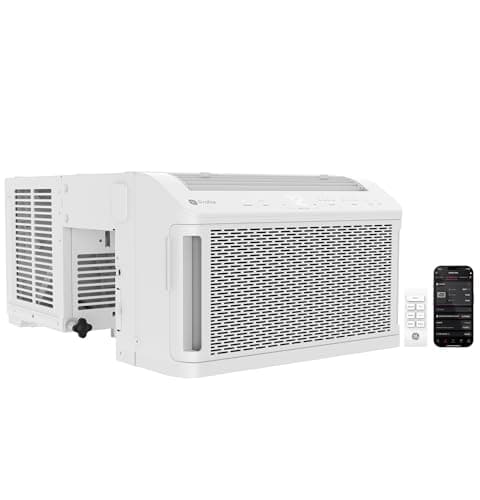 Most integrations GE Profile ClearView Smart Window Air Conditioner, 10,300 BTU SmartHQ with Alexa, Google Assistant, IFTTT, Nest and Sonos, plus a built-in condensate pump — the deepest integration list here. | A household already running Nest, Sonos or IFTTT automations | |
| — | 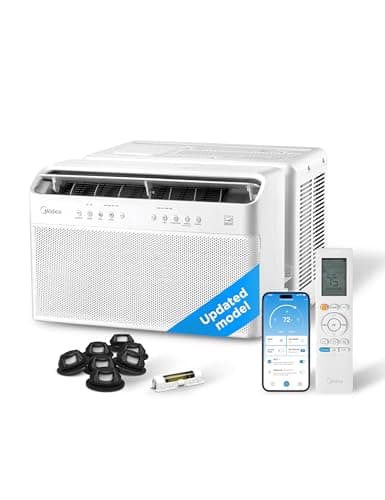 The one that proves the point Midea U-Shaped Window Air Conditioner, 10,000 BTU (V1) Same app, same 32 dBA, same shape as the U2 — and CEER 15, 500 kWh a year, no Most Efficient badge and a third of the warranty. | Nothing the U2 above does not do better |
A few years ago “smart air conditioner” picked out a small premium slice of the market. It does not any more. Pull the certified room air conditioner dataset today and the units without app control are the unusual ones.
That changes what this page should be. It is not a list of the units that have Wi-Fi, because that is nearly all of them. It is a guide to what the app is actually good for, and to the spread that hides behind four near-identical app screens.
The badge
Zero of 505 units are “connected capable”
The ENERGY STAR certified dataset carries a field called connected capable. Across all 505 US-market certified room air conditioners in the current pull, the value is “No” on every single record.
That sounds like it contradicts everything above, and it does not. The two things are simply different. Wi-Fi means you can control the unit from a phone. Connected capable, in the ENERGY STAR sense, means the unit can respond to a signal from your utility and shed load during a grid peak — demand response, not convenience.
No room air conditioner currently certified does that. So if you have seen the connected-capable field and assumed it was the Wi-Fi column, it was not, and its emptiness tells you nothing about whether a unit has an app. Check the manufacturer’s page for that.
The same shape of confusion runs through the Most Efficient list — what that badge does and does not mean.
Spread
The efficiency range behind identical apps
| Unit | CEER | kWh/yr | Most Efficient |
|---|---|---|---|
| Midea U-shaped 10,000 BTU (U2) | 16 | 468.8 | Yes |
| LG 6,000 BTU dual inverter | 15.5 | 290.3 | Yes |
| Midea U-shaped 10,000 BTU (V1) | 15 | 500 | No |
| GE Profile ClearView 10,300 BTU | 14.7 | 525.5 | No |
All four have an app. All four have voice control. The certified spread between the best and worst is CEER 16 to 14.7, about 9%, and between the two 10,000 BTU-class units alone it is 468.8 kWh against 525.5 — a 12% difference for the same job in the same size of room.
The LG’s much lower annual figure is not a fifth data point about efficiency. It is a smaller air conditioner. Compare CEER between units, and annual kWh only within a size class.
Use
What the app is genuinely good for
Three things, and they are worth having. Everything else is a novelty you will use twice.
- Pre-cooling before you get home. The single best use. A room takes a long time to come down, and starting that while you are still out is the difference between arriving into a cool room and waiting an hour for one.
- Schedules that match your day. A 24-hour timer set to stop shortly after you fall asleep and restart before you wake costs nothing and saves real hours of runtime — and the hours you run matter as much as the setting.
- Noticing it is still on. Unglamorous, and the reason most people keep the app after the first week.
What it will not do is make an oversized unit behave or a poorly sealed window seal. The app controls the compressor, not the room.
This one is not a DIY job
If your unit has no app and you want scheduling, a smart plug is not a substitute. Cutting mains power to an inverter compressor and restoring it is not the same as a scheduled start, and many units come back in a default mode rather than yours. Check the unit has auto-restart before trying it — where smart plugs do and do not work.
Smart elsewhere
Smart fans are a better value proposition
Worth saying plainly: on a fan, app control costs almost nothing and adds genuine scheduling value. On an air conditioner, the app is bundled into a unit you were buying anyway, so the only real decision left is the certified efficiency.
If you are building out connected cooling more broadly, the fan side is where the interesting products are — smart portable fans and smart ceiling fans, where 53 of 1,439 certified ceiling fans carry connected functionality.
Say the unwelcome thing
Do not pay a premium for the app.
It is standard equipment now. Paying extra for “smart” in a room air conditioner in 2026 is paying for something the cheaper unit on the next shelf also has.
The two units in this article that are not on the Most Efficient list are also the two with the most prominent smart marketing. That is not a conspiracy, it is a reminder that the feature list and the certified record are written by different departments.
Find the full model number, check it against the certified dataset, and buy the CEER. The app comes with it — CEER 16, Most Efficient, and an app.
In full
Every pick, and what is wrong with it
Published specifications only, each linked to the page it came from. Where a manufacturer publishes nothing, the row says so — we do not fill blanks in.
1. Best overall
LG Dual Inverter Window Air Conditioner, 6,000 BTU
LG · model LW6023IVSM
CEER 15.5 and 290.3 kWh a year with LG ThinQ, Alexa and Google Assistant, a 24-hour timer and no support bracket required.
The one unit here that pairs full app control with the Most Efficient badge, in a body light enough to fit without a bracket.
LG ThinQ, plus “Hey Google” and Amazon Alexa, with a published 24-hour timer, sleep mode, auto restart and four-way air direction. That timer range is what makes scheduling genuinely useful rather than a gimmick.
CEER 15.5 and 290.3 kWh a year — about $53 at 18.34¢/kWh, the lowest annual figure of anything on this page, because it is the smallest unit here. It is on the Most Efficient list.
No support bracket required at 62.0 lb. The honest limits: 6,000 BTU covers about 250 square feet, and LG publishes 44 dB where the Midea units claim 32 dBA — though those figures come from different test conditions and are not strictly comparable.
What’s wrong with it
6,000 BTU is a small room only, and LG publishes 44 dB where rivals claim 32 dBA.
Running cost — LW6023IVSM
| Annual energy use | 290.3 kWh | ENERGY STAR certified figure |
|---|---|---|
| Annual cost | $53 | 290.3 × 18.34¢/kWh |
| Per cooling month | $13 | spread over a four-month season |
The annual figure is the certified value from the ENERGY STAR Certified Room Air Conditioners dataset, which models a standard cooling season rather than your actual summer. It is more useful than a nameplate wattage here, because a variable-speed compressor spends most of its life well below nameplate.
Rate: 18.34¢/kWh, the US average residential price for June 2026 (EIA Electric Power Monthly, Table 5.3). Yours will differ — swap it in: (watts ÷ 1000) × hours × your rate.
| Cooling capacity | 6,000 BTU/h |
|---|---|
| CEER | 15.5 |
| Annual energy use | 290.3 kWh/yr |
| Weight | 62.0 lb |
| Installation | Does not straddle the windowsill |
| Support bracket | Not required |
| Compressor | Variable speed |
| ENERGY STAR | Certified, and on the Most Efficient list |
Every figure above is from ENERGY STAR Certified Room Air Conditioners dataset. Blanks are shown as “not published” rather than filled in.
2. Best for a real room
Midea U-Shaped Window Air Conditioner, 10,000 BTU (U2)
Midea · model MAW10U2QWT
CEER 16 and Most Efficient, with the SmartHome app, Apple Watch control, 32 dBA and a three-year warranty.
The best efficiency on this page and the longest warranty, in the U-shaped body that lets the window close through the middle of the unit.
CEER 16 and 468.8 kWh a year, Most Efficient certified — $86 a year at 18.34¢/kWh, and 47% under the federal standard.
SmartHome app, Apple Watch and voice assistants, with a published 32 dBA at its quietest and a manufacturer claim of up to 45% energy savings from the variable-speed compressor.
Three years of warranty against one on the V1 version of the same shape. Requires a support bracket at 54.7 lb, and the U-shape only makes sense in a vertically sliding sash window — casement and horizontal sliders need a different answer.
What’s wrong with it
It needs a support bracket, and the U-shape only works on a sash window that slides vertically.
Running cost — MAW10U2QWT
| Annual energy use | 468.8 kWh | ENERGY STAR certified figure |
|---|---|---|
| Annual cost | $86 | 468.8 × 18.34¢/kWh |
| Per cooling month | $21 | spread over a four-month season |
The annual figure is the certified value from the Midea product page, MAW10U2QWT, with certified figures from the ENERGY STAR Room Air Conditioners dataset, which models a standard cooling season rather than your actual summer. It is more useful than a nameplate wattage here, because a variable-speed compressor spends most of its life well below nameplate.
Rate: 18.34¢/kWh, the US average residential price for June 2026 (EIA Electric Power Monthly, Table 5.3). Yours will differ — swap it in: (watts ÷ 1000) × hours × your rate.
| Cooling capacity | 10,000 BTU/h DOE |
|---|---|
| CEER | 16 |
| Annual energy use | 468.8 kWh/yr |
| vs federal standard | 47% less energy |
| Coverage claim | Up to 350 sq ft |
| Noise | As low as 32 dBA |
| Smart control | SmartHome app, Apple Watch, voice assistants |
| Dimensions | 13.46 H x 19.17 W x 21.97 D in |
| Weight | 54.7 lb certified / 54.67 lb published |
| Refrigerant | R-32 |
| Installation | U-shape; straddles the window |
| Support bracket | Required |
| Compressor | Variable speed, up to 45% more efficient (manufacturer claim) |
| Warranty | 3 years |
| ENERGY STAR | Certified, and on the Most Efficient list |
Every figure above is from Midea product page, MAW10U2QWT, with certified figures from the ENERGY STAR Room Air Conditioners dataset. Blanks are shown as “not published” rather than filled in.
3. Most integrations
GE Profile ClearView Smart Window Air Conditioner, 10,300 BTU
GE Profile · model PHNT10CC
SmartHQ with Alexa, Google Assistant, IFTTT, Nest and Sonos, plus a built-in condensate pump — the deepest integration list here.
If the point of a smart air conditioner is that it participates in automations you already have, this is the one that actually does.
Built-in Wi-Fi via SmartHQ, with published compatibility for Alexa, Google Assistant, IFTTT, Nest and Sonos. Most rivals list two voice assistants and stop.
A built-in condensate pump moves the water the unit collects out through the chassis, which removes the drip and the tilt fuss — usually the most annoying part of living with a window unit.
CEER 14.7 and 525.5 kWh a year is the cost, about $10 a year more than the CEER 16 pick above. It is certified but not Most Efficient, it weighs 80 lb, and at 28 inches deep it protrudes further than anything else here.
What’s wrong with it
CEER 14.7 is the worst efficiency on this page, it weighs 80 lb, and it is 28 inches deep.
Running cost — PHNT10CC
| Annual energy use | 525.5 kWh | ENERGY STAR certified figure |
|---|---|---|
| Annual cost | $96 | 525.5 × 18.34¢/kWh |
| Per cooling month | $24 | spread over a four-month season |
The annual figure is the certified value from the GE Appliances product page, PHNT10CC, with certified figures filed as PHNT10CCH1 in the ENERGY STAR Room Air Conditioners dataset, which models a standard cooling season rather than your actual summer. It is more useful than a nameplate wattage here, because a variable-speed compressor spends most of its life well below nameplate.
Rate: 18.34¢/kWh, the US average residential price for June 2026 (EIA Electric Power Monthly, Table 5.3). Yours will differ — swap it in: (watts ÷ 1000) × hours × your rate.
| Cooling capacity | 10,300 BTU/h |
|---|---|
| CEER | 14.7 |
| Annual energy use | 525.5 kWh/yr |
| vs federal standard | 35% less energy |
| Coverage claim | Up to 450 sq ft |
| Smart control | Built-in Wi-Fi via SmartHQ; Alexa, Google Assistant, IFTTT, Nest and Sonos |
| Condensate | Built-in pump |
| Dimensions | 12.8 H x 19.7 W x 28.0 D in |
| Weight | 80.0 lb |
| Refrigerant | R-32 |
| Installation | Straddles the windowsill |
| Support bracket | Required |
| Compressor | Variable speed |
| Noise | Not published as a dBA figure |
| ENERGY STAR | Certified; NOT on the Most Efficient list |
Every figure above is from GE Appliances product page, PHNT10CC, with certified figures filed as PHNT10CCH1 in the ENERGY STAR Room Air Conditioners dataset. Blanks are shown as “not published” rather than filled in.
Skip this one
Midea U-Shaped Window Air Conditioner, 10,000 BTU (V1)
Midea · model MAW10V1QWT
Same app, same 32 dBA, same shape as the U2 — and CEER 15, 500 kWh a year, no Most Efficient badge and a third of the warranty.
Included because it is the cleanest demonstration of why “smart” is the wrong filter. This unit and the U2 pick above share a body style, an app, a voice-assistant list and a 32 dBA claim.
CEER 15 against 16. 500 kWh a year against 468.8 — $5.72 a year more at 18.34¢/kWh, forever.
38% under the federal standard, not 47%, and no Most Efficient badge. The manufacturer claims “up to 35% more efficient” where the U2 claims 45%.
One year of warranty against three. Nothing in the app tells you any of this. It is on the certified record and nowhere else — the full sixteen-model spread at this size.
What’s wrong with it
The app screen is identical to the better unit's, so nothing in the smart experience warns you.
Running cost — MAW10V1QWT
| Annual energy use | 500 kWh | ENERGY STAR certified figure |
|---|---|---|
| Annual cost | $92 | 500 × 18.34¢/kWh |
| Per cooling month | $23 | spread over a four-month season |
The annual figure is the certified value from the Midea product page, MAW10V1QWT, with certified figures from the ENERGY STAR Room Air Conditioners dataset, which models a standard cooling season rather than your actual summer. It is more useful than a nameplate wattage here, because a variable-speed compressor spends most of its life well below nameplate.
Rate: 18.34¢/kWh, the US average residential price for June 2026 (EIA Electric Power Monthly, Table 5.3). Yours will differ — swap it in: (watts ÷ 1000) × hours × your rate.
| Cooling capacity | 10,000 BTU/h DOE |
|---|---|
| CEER | 15 |
| Annual energy use | 500 kWh/yr |
| vs federal standard | 38% less energy |
| Coverage claim | Up to 450 sq ft |
| Noise | As low as 32 dBA |
| Smart control | SmartHome app, Apple Watch, voice assistants |
| Dimensions | 13.5 H x 19.2 W x 22.0 D in |
| Weight | 53.1 lb certified / 54.01 lb published |
| Refrigerant | R-32 |
| Installation | U-shape; straddles the window |
| Support bracket | Required |
| Compressor | Variable speed, up to 35% more efficient (manufacturer claim) |
| Warranty | 1 year |
| ENERGY STAR | Certified; NOT on the Most Efficient list |
Every figure above is from Midea product page, MAW10V1QWT, with certified figures from the ENERGY STAR Room Air Conditioners dataset. Blanks are shown as “not published” rather than filled in.
We are not linking a buy button for this one. If you want to look at it anyway, it is easy enough to find — but we would rather send you to something that fits your room.
Questions people actually ask
Frequently asked
Are smart air conditioners worth it?
The app is worth having and is no longer worth paying extra for, because nearly every certified room air conditioner has one. Pre-cooling before you get home is the genuinely useful function. Buy on certified efficiency and the app comes with the unit.
What does 'connected capable' mean on an ENERGY STAR listing?
It means the unit can respond to a utility demand-response signal and shed load during a grid peak — not that it has Wi-Fi. All 505 US-market certified room air conditioners in the current dataset are listed as not connected capable, even though most have apps. What the badges mean.
Can I use Alexa or Google Assistant with a window air conditioner?
Yes, on most current models. LG units work with ThinQ plus Alexa and Google Assistant; Midea units work with the SmartHome app, Apple Watch and voice assistants; GE Profile adds IFTTT, Nest and Sonos through SmartHQ.
Do smart air conditioners use more electricity?
Not because they are smart. But the two units in this comparison with the heaviest smart marketing are also the two that miss the Most Efficient list — CEER 14.7 and 15 against 16 for the best. The app and the efficiency are unrelated, so check both.
Can I make an old air conditioner smart with a plug?
Partly. A smart plug can cut and restore power on a schedule, but that is not the same as a scheduled start — many units return in a default mode rather than the one you left. Check the unit has auto-restart before relying on it. Smart plugs for cooling.
What is the most efficient smart air conditioner?
Among app-controlled room units, CEER 16 at 468.8 kWh a year is the ceiling — a 10,000 BTU U-shaped model that is also on the Most Efficient list and carries a three-year warranty. Nothing with an app is certified above CEER 16.
Sources
Where these numbers came from
- ENERGY STAR Certified Room Air Conditioners dataset — 505 US-market records, CEER, annual kWh, Most Efficient status and the connected-capable field
- LG product page, LW6023IVSM — ThinQ, Hey Google and Alexa, 44 dB, 24-hour timer, sleep mode
- Midea product page, MAW10U2QWT — SmartHome app, Apple Watch, voice assistants, 32 dBA, 3-year warranty
- GE Appliances product page, PHNT10CC — SmartHQ with Alexa, Google Assistant, IFTTT, Nest and Sonos; built-in pump
- ENERGY STAR Certified Ceiling Fans dataset — connected functionality on 53 of 1,439 US records
- EIA Electric Power Monthly, Table 5.3 — average residential electricity price
Read next
Where to go from here
Back to Air Conditioners, or read how we pick.