The picks
Best smart ceiling fans
Smart ceiling fans are a genuinely small category, and the certified data shows exactly what the radio costs you when the fan is doing nothing.
By Sawyer V. · Published
The short answer
Connected ceiling fans are rare: 53 of 1,398 certified US fans, or 3.8%. They also idle harder — mean standby power is 1.74 W against 0.90 W for non-connected fans, roughly double, drawn continuously all year. The best of them is the Big Ass Fans MK-i61 at 418.0 CFM per watt. Whether the standby is worth paying depends entirely on whether you will actually use the scheduling.
Fan & Frost earns a commission when you buy through our links, at no cost to you. It never changes a ranking, and we say so when the right answer is the cheaper unit or nothing at all. Full disclosure · How we pick.
At a glance
The picks, ranked
Tap any row to jump to the full reasoning. Prices are live from Amazon where we have them, and read “check price” where we don’t — never a number we cannot verify today.
| # | Product | Best for | Price |
|---|---|---|---|
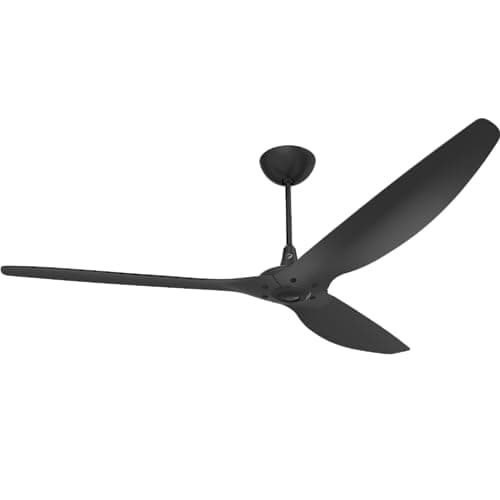
| 1 | Best connected fan certified Big Ass Fans Haiku MK-i61 84" Ceiling Fan 418.0 CFM per watt at 84 inches, connected, with a five-year component warranty — rare in a category where three is standard. | A large room where you want scheduling and the best airflow available | |
| 2 | Lowest standby of the connected fans Hunter 60" Smart Ceiling Fan (51883) 0.8 W standby — below the 0.90 W average for fans with no radio at all — at 311.7 CFM per watt. | A normal room where you want scheduling without an always-on penalty | |
| 3 | 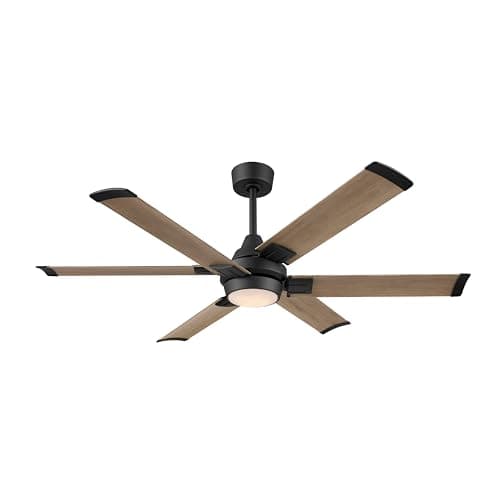 Lowest standby overall Minka Aire 56" Smart Ceiling Fan (F841L) 0.5 W standby and 301.0 CFM per watt at 56 inches — the lowest idle draw of any connected fan here. | A smaller room, where the always-on draw matters most in proportion | |
| — | What connectivity costs in performance Aeratron AE+2 60" Ceiling Fan 483.0 CFM per watt on 16.2 W, no radio — 55% more air per watt than the best connected 60-inch fan. | Anyone who would rather have the best fan than a scheduled one |
Smart ceiling fans get marketed as a category. In the certified data they are barely one — and the data records something about them that the marketing does not.
How small
53 of 1,398
The ENERGY STAR Certified Ceiling Fans dataset records whether each fan has connected functionality. Across all US-market records:
53 fans are connected. 1,345 are not. That is 3.8% of the certified field.
Two practical consequences follow from a subset that small. Your choice is genuinely narrow, and — because the best-engineered motors are spread across the whole field — the odds that the best fan for your room happens to be in the connected 3.8% are not good.
That is what the pick list above shows: the best connected 60-inch fan manages 311.7 CFM per watt where the best 60-inch fan overall manages 483.0.
Our analysis
Connectivity roughly doubles standby power
Standby power is the draw when the fan is switched off but still energised — listening for a signal, holding a radio awake, powering an indicator.
We compared the two groups:
| Group | Fans | Mean standby | Max standby |
|---|---|---|---|
| Connected | 53 | 1.74 W | 4.2 W |
| Not connected | 1,345 | 0.90 W | 3.2 W |
Computed by us from the ENERGY STAR Certified Ceiling Fans dataset, US-market records.
1.74 W against 0.90 W — a difference of about 0.84 W, drawn continuously.
In money that is roughly $1.35 a year, which is genuinely trivial. Worth putting in proportion, though: a certified fan on low draws 1.1 W, so the standby penalty of connectivity is comparable to running a small fan continuously.
And the averages hide a wide range. The Minka Aire manages 0.5 W and the Hunter 51883 0.8 W — both below the non-connected average. So the penalty is a design choice, not an inevitable cost of adding a radio, and it is worth checking the individual figure rather than assuming.
This one is not a DIY job
The most useful smart fan feature is scheduling, and it is the one people least often set up. A fan that starts before you come home, or steps down at bedtime, is doing something a pull chain cannot.
Voice control is the feature people actually use, and it is also available without a smart fan — a smart switch or an in-canopy module adds it to almost any fan, though it controls power rather than speed unless the fan supports it.
Check what happens when the network is down. A fan that is unusable without its cloud service is a worse fan than one with a pull chain. Local control — a physical remote, wall control or chain that works regardless — is worth confirming.
Do not add a standard wall dimmer to a ceiling fan. Fan motors and dimmers designed for lighting are not compatible, and this matters more on smart fans where the electronics are in the canopy. Use the control the manufacturer specifies.
Worth it?
When to buy connected, and when not to
Worth it if you will genuinely schedule it — a living room used on a predictable evening pattern, a bedroom you want stepping down overnight, or a room you want running before you arrive. That is a real benefit no manual fan offers.
Worth it if the fan is somewhere awkward to reach: a high ceiling where a pull chain is out of the question, or a room where the wall switch is in the wrong place.
Not worth it if you want the best-performing fan for the room. The connected subset is 3.8% of the field and the efficiency leaders are not in it — you would be giving up 55% of the air per watt at 60 inches.
Not worth it if the plan is voice control alone. A smart switch achieves that on any fan, and leaves the fan choice open to the whole certified field.
Say the unwelcome thing
Do not buy a connected fan for energy savings.
It gets sold as an efficiency feature and the certified data points the other way.
Connected fans draw 1.74 W standby on average against 0.90 W — nearly double, continuously, whether the fan runs or not. And the connected subset does not contain the efficient fans: the best connected 60-inch model is 311.7 CFM per watt against 483.0 for the field.
Scheduling can genuinely reduce run time, and if you will use it, that may outweigh both. But the saving comes from the schedule you set, not from the fan being smart — and a fan that runs at 1.1 to 2.9 W on low has very little run time worth optimizing in the first place.
Buy connected for convenience. Buy the efficient fan for efficiency.
In full
Every pick, and what is wrong with it
Published specifications only, each linked to the page it came from. Where a manufacturer publishes nothing, the row says so — we do not fill blanks in.
1. Best connected fan certified
Big Ass Fans Haiku MK-i61 84" Ceiling Fan
Big Ass Fans · model MK-i61-071806
418.0 CFM per watt at 84 inches, connected, with a five-year component warranty — rare in a category where three is standard.
418.0 CFM per watt at 84 inches puts it third overall in the certified dataset and first among connected fans by a wide margin — the next best connected model manages 311.7.
Five years on components is the specification that separates it. Across 1,398 certified fans the warranty is overwhelmingly three years; only about 85 records offer five or more.
Two honest costs. 39.8 W on high — 4.4¢ for a six-hour evening — is the highest of any fan on this site. And 2.0 W standby is above even the connected average, which works out around $3.21 a year doing nothing.
What’s wrong with it
2.0 W standby is above the connected average, and 39.8 W on high is the highest draw of any fan we hold data for.
Running cost — MK-i61-071806
| Nameplate power | 39.8 W | manufacturer's published figure |
|---|---|---|
| Energy, 8-hour night | 0.32 kWh | 39.8 ÷ 1000 × 8 |
| Cost per hour | 0.7¢ | at 18.34¢/kWh |
| Cost per 8-hour night | 5.8¢ | on the highest speed |
| Cost per 30 nights | $1.75 | 9.6 kWh |
Rate: 18.34¢/kWh, the US average residential price for June 2026 (EIA Electric Power Monthly, Table 5.3). Yours will differ — swap it in: (watts ÷ 1000) × hours × your rate.
| Blade span | 84 in |
|---|---|
| Efficiency | 418.0 CFM per watt |
| Power, high speed | 39.8 W |
| Standby power | 2.0 W |
| Connected functionality | Yes |
| Type | Indoor |
| Warranty | 5 years, components |
| ENERGY STAR | Certified, and on the Most Efficient list |
Every figure above is from ENERGY STAR Certified Ceiling Fans dataset. Blanks are shown as “not published” rather than filled in.
2. Lowest standby of the connected fans
Hunter 60" Smart Ceiling Fan (51883)
Hunter · model 51883
0.8 W standby — below the 0.90 W average for fans with no radio at all — at 311.7 CFM per watt.
0.8 W standby. That is the number that makes this the sensible connected pick: it is below the 0.90 W mean for the 1,345 certified fans with no connectivity at all.
In other words, connectivity does not have to cost standby power. Most connected fans draw more; this one does not, which suggests the penalty in the averages is design choice rather than physics.
20.0 W on high, 1.7 W on low — about 0.2¢ for an eight-hour night on low.
The trade is efficiency: 311.7 CFM per watt against 483.0 for the best 60-inch fan certified. That is a real gap, and it is the price of the feature here.
What’s wrong with it
311.7 CFM per watt is well behind the best non-connected 60-inch fans, which reach 483.0.
Running cost — 51883
| Nameplate power | 1.7 W – 20 W | manufacturer's published figure |
|---|---|---|
| Energy, 8-hour night | 0.16 kWh | 20 ÷ 1000 × 8 |
| Cost per hour | 0.4¢ | at 18.34¢/kWh |
| Cost per 8-hour night | 2.9¢ | on the highest speed |
| Cost per 30 nights | 88¢ | 4.8 kWh |
| Same month, lowest speed | 7.5¢ | at 1.7 W |
Rate: 18.34¢/kWh, the US average residential price for June 2026 (EIA Electric Power Monthly, Table 5.3). Yours will differ — swap it in: (watts ÷ 1000) × hours × your rate.
| Blade span | 60 in |
|---|---|
| Efficiency | 311.7 CFM per watt |
| Power, high speed | 20.0 W |
| Power, low speed | 1.7 W |
| Standby power | 0.8 W |
| Connected functionality | Yes |
| Type | Indoor |
| Warranty | 3 years, components |
| ENERGY STAR | Certified, and on the Most Efficient list |
Every figure above is from ENERGY STAR Certified Ceiling Fans dataset. Blanks are shown as “not published” rather than filled in.
3. Lowest standby overall
Minka Aire 56" Smart Ceiling Fan (F841L)
Minka Aire · model F841L-ALW
0.5 W standby and 301.0 CFM per watt at 56 inches — the lowest idle draw of any connected fan here.
0.5 W standby is about 80¢ a year — genuinely negligible, and a quarter of the Big Ass Fans figure.
That matters more than it sounds in a smaller room, because standby is the one draw that does not scale with use. A fan you run two hours a day still pays the standby for the other twenty-two.
22.8 W on high, 2.0 W on low at 56 inches. The efficiency is the weak point at 301.0 CFM per watt, against a median of 190.4 for the 52–59 inch band — so above typical for its size, well below the best available.
Most Efficient listed, three-year component warranty.
What’s wrong with it
301.0 CFM per watt is the weakest of the three, and 22.8 W on high is high for a 56-inch fan.
Running cost — F841L-ALW
| Nameplate power | 2 W – 22.8 W | manufacturer's published figure |
|---|---|---|
| Energy, 8-hour night | 0.18 kWh | 22.8 ÷ 1000 × 8 |
| Cost per hour | 0.4¢ | at 18.34¢/kWh |
| Cost per 8-hour night | 3.3¢ | on the highest speed |
| Cost per 30 nights | $1.00 | 5.5 kWh |
| Same month, lowest speed | 8.8¢ | at 2 W |
Rate: 18.34¢/kWh, the US average residential price for June 2026 (EIA Electric Power Monthly, Table 5.3). Yours will differ — swap it in: (watts ÷ 1000) × hours × your rate.
| Blade span | 56 in |
|---|---|
| Efficiency | 301.0 CFM per watt |
| Power, high speed | 22.8 W |
| Power, low speed | 2.0 W |
| Standby power | 0.5 W |
| Connected functionality | Yes |
| Type | Indoor |
| Warranty | 3 years, components |
| ENERGY STAR | Certified, and on the Most Efficient list |
Every figure above is from ENERGY STAR Certified Ceiling Fans dataset. Blanks are shown as “not published” rather than filled in.
Skip this one
Aeratron AE+2 60" Ceiling Fan
Aeratron · model AE+2WI60
483.0 CFM per watt on 16.2 W, no radio — 55% more air per watt than the best connected 60-inch fan.
Listed as a skip against the brief, and it shows the size of the trade clearly.
483.0 CFM per watt on 16.2 W, against the best connected 60-inch fan at 311.7 on 20.0 W. That is 55% more air per watt on 19% less power, at the same span.
The gap is not caused by the radio — a radio does not affect airflow. It is that the connected subset is small (53 fans) and does not happen to include the best-engineered motors.
2.9 W on low, about 0.4¢ a night, and no standby draw to pay year-round. The full span analysis.
What’s wrong with it
No app, no voice control, no scheduling. If you specifically want those, this is not the fan.
Running cost — AE+2WI60
| Nameplate power | 2.9 W – 16.2 W | manufacturer's published figure |
|---|---|---|
| Energy, 8-hour night | 0.13 kWh | 16.2 ÷ 1000 × 8 |
| Cost per hour | 0.3¢ | at 18.34¢/kWh |
| Cost per 8-hour night | 2.4¢ | on the highest speed |
| Cost per 30 nights | 71¢ | 3.9 kWh |
| Same month, lowest speed | 13¢ | at 2.9 W |
Rate: 18.34¢/kWh, the US average residential price for June 2026 (EIA Electric Power Monthly, Table 5.3). Yours will differ — swap it in: (watts ÷ 1000) × hours × your rate.
| Blade span | 60 in |
|---|---|
| Efficiency | 483.0 CFM per watt |
| Power, high speed | 16.2 W |
| Power, low speed | 2.9 W |
| Type | Indoor |
| Light kit | No ENERGY STAR lamp shipped |
| Warranty | 3 years, components |
| ENERGY STAR | Certified, and on the Most Efficient list |
Every figure above is from ENERGY STAR Certified Ceiling Fans dataset. Blanks are shown as “not published” rather than filled in.
We are not linking a buy button for this one. If you want to look at it anyway, it is easy enough to find — but we would rather send you to something that fits your room.
Questions people actually ask
Frequently asked
How many ceiling fans are smart?
Very few. Only 53 of the 1,398 US-market certified ceiling fans record connected functionality — 3.8% of the field. That makes the choice genuinely narrow, and the best-performing motors are mostly outside it.
Do smart ceiling fans use more electricity?
At idle, yes. Connected fans average 1.74 W standby against 0.90 W for the rest — roughly double, drawn continuously. In money that is a few cents a year, but it is comparable to running a small fan on low around the clock.
Is a smart ceiling fan worth it?
If you will actually schedule it, or the fan is somewhere awkward to reach, yes. If you want the best-performing fan for the room, no — the best connected 60-inch fan manages 311.7 CFM per watt against 483.0 for the field.
Can I make a normal ceiling fan smart?
For power and often for speed, yes — a smart switch or an in-canopy module adds app and voice control to most fans. That keeps your fan choice open to the whole certified field rather than the connected 3.8%.
Does a smart ceiling fan work without wi-fi?
It depends on the model, and it is worth confirming before buying. A fan that is unusable without its cloud service is a worse fan than one with a pull chain — look for local control via a physical remote or wall control that works regardless.
Do all smart fans have high standby draw?
No, and that is the useful detail in the averages. Two connected fans here manage 0.5 W and 0.8 W standby, both below the 0.90 W average for fans with no radio at all — so the penalty is a design choice rather than inherent.
Sources
Where these numbers came from
Read next
Where to go from here
Back to Whole-House Airflow, or read how we pick.