Guide and picks
How to size an evaporative cooler
Every other appliance on this site is sized by capacity. An evaporative cooler is sized by how fast it replaces the air, which is a different calculation entirely.
By Sawyer V. · Published
The short answer
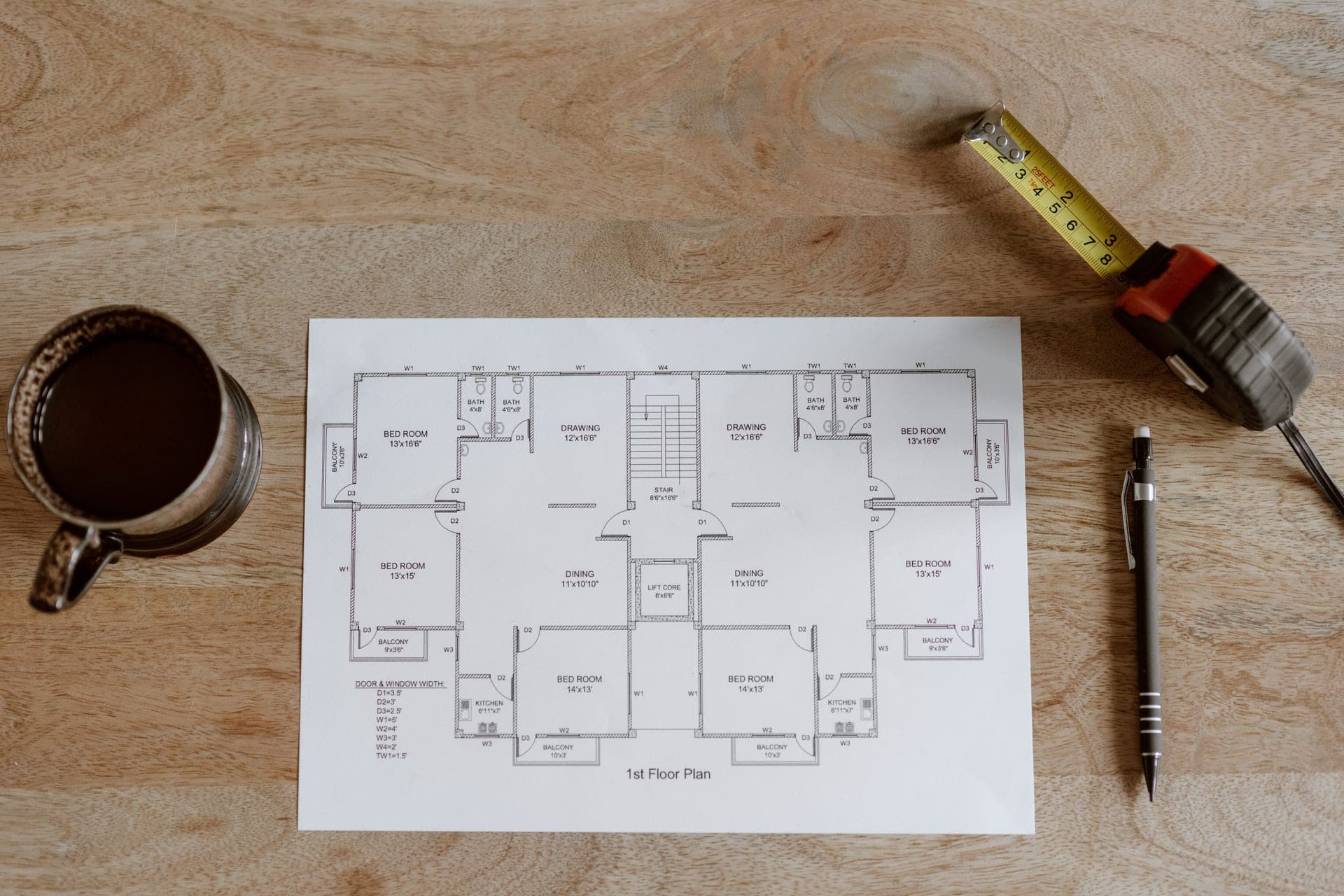
Size on CFM and air changes per hour, not on the square footage claim. The arithmetic is CFM = room volume × air changes per hour ÷ 60. A 400 sq ft room with 8 ft ceilings is 3,200 cubic feet, so 20 air changes an hour needs about 1,070 CFM and 30 needs 1,600. And you must have an opening for the air to leave, or none of it works.
Fan & Frost earns a commission when you buy through our links, at no cost to you. It never changes a ranking, and we say so when the right answer is the cheaper unit or nothing at all. Full disclosure · How we pick.
At a glance
The picks, ranked
Tap any row to jump to the full reasoning. Prices are live from Amazon where we have them, and read “check price” where we don’t — never a number we cannot verify today.
| # | Product | Best for | Price |
|---|---|---|---|
| 1 | 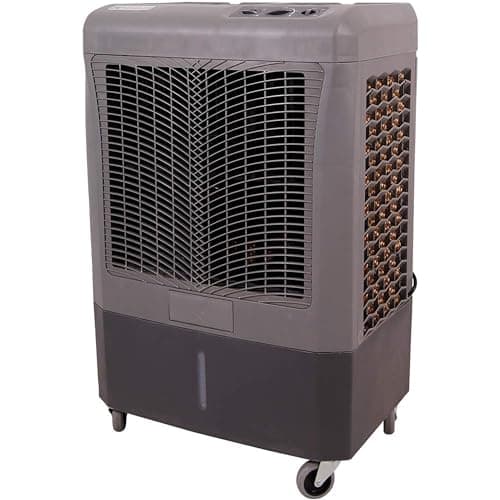 Mid-size, 3,100 CFM Hessaire MC37M Mobile Evaporative Cooler 3,100 CFM on 250 W with a continuous water hookup — enough air for a two-car garage at a sensible air-change rate. | A garage, workshop or covered patio of moderate size | |
| 2 | 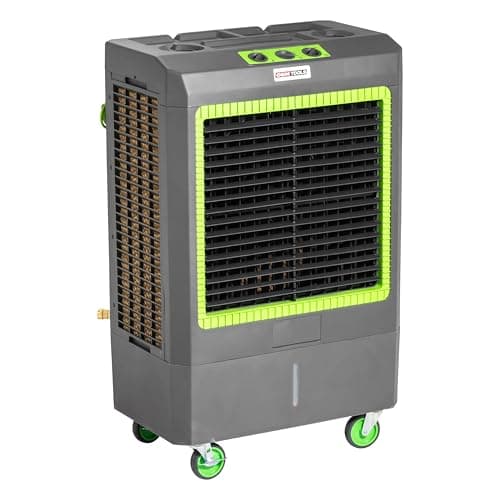 Large, 5,300 CFM Hessaire MC61M Mobile Evaporative Cooler, 5,300 CFM 5,300 CFM on 430 W with a 14.6 gallon reservoir — the largest portable airflow we hold data for. | A large workshop, a warehouse bay, or a big open patio | |
| 3 | Small, 764 CFM Honeywell CL25AE Indoor Evaporative Cooler 764 CFM on 235 W with a 33 ft throw and a published 52 to 60 dBA. | A single room with a window open | |
| — | Where the coverage claim breaks down Honeywell CO60PM Indoor/Outdoor Evaporative Cooler 2,697 CFM on 220 W with a 1,643 sq ft coverage claim — which the air-change arithmetic does not support indoors. | A large outdoor or semi-outdoor space |
Evaporative coolers are the one category on this site where the sizing question has a genuinely different shape, and where the number on the box is least useful.
Why it differs
You are sizing airflow, not capacity
An air conditioner is sized in BTU: a quantity of heat removed per hour. You match capacity to the room’s heat gain, and oversizing is the expensive mistake.
An evaporative cooler removes no heat from the building at all. It takes outdoor air, evaporates water into it — which cools that air — and pushes it into the space, displacing the air already there. The old air leaves through an opening.
So the question is not “how much cooling?” but “how fast do you replace the air?” That is measured in air changes per hour, and it is why every evaporative cooler is sold on CFM.
The arithmetic
Volume, air changes, CFM
The calculation is short enough to do on a phone, and it is just arithmetic rather than a rule of thumb.
- Room volume = length × width × ceiling height, in cubic feet.
- Required CFM = volume × air changes per hour ÷ 60.
Worked through for a few common spaces, at two different air-change rates:
| Space | Volume | At 20 ACH | At 30 ACH |
|---|---|---|---|
| 200 sq ft room, 8 ft ceiling | 1,600 cu ft | 533 CFM | 800 CFM |
| 400 sq ft room, 8 ft ceiling | 3,200 cu ft | 1,067 CFM | 1,600 CFM |
| Single-car garage, 250 sq ft | 2,000 cu ft | 667 CFM | 1,000 CFM |
| Two-car garage, 600 sq ft | 4,800 cu ft | 1,600 CFM | 2,400 CFM |
| Large workshop, 1,000 sq ft | 8,000 cu ft | 2,667 CFM | 4,000 CFM |
| Warehouse bay, 2,000 sq ft | 16,000 cu ft | 5,333 CFM | 8,000 CFM |
About the air-change rate. Higher rates are generally recommended for hotter and drier conditions, and for spaces with large heat gains. We are showing 20 and 30 as a bracket rather than asserting a single correct figure, because no test procedure governs this — unlike BTU sizing, which has a published table behind it. Treat it as a range and consult the manufacturer for their own recommendation.
Note how quickly this outgrows the portable class. A 1,000 sq ft workshop at 30 air changes wants 4,000 CFM, which the largest portable here does not reach.
The claim
Why coverage figures are not a sizing method
Every evaporative cooler is marketed with a square-footage coverage claim, and they do not survive the arithmetic.
- 2,697 CFM claiming 1,643 sq ft is about 12 air changes an hour at an 8 ft ceiling.
- 764 CFM claiming 466 sq ft is about 12 air changes an hour at the same ceiling height.
- 3,100 CFM publishes no coverage claim at all, which is arguably the most honest of the three.
Those are internally consistent with each other, which suggests a shared convention rather than a test. But they sit below the rates generally recommended for evaporative cooling, and no procedure defines them, so they are not comparable between brands the way certified CFM is.
The CFM figure is the one to use. It is the thing the machine actually does.
The requirement
Air has to leave, or nothing happens
This is the part that sizing guides skip and it defeats more evaporative installations than undersizing does.
An evaporative cooler works by replacing the air in a space. If there is nowhere for the displaced air to go, the machine pressurizes the room, airflow collapses, and the air simply recirculates — getting more humid each pass until it stops cooling at all.
- You need an outlet roughly matched to the inlet. An open window, an open door, a garage door raised a foot.
- Put the outlet away from the cooler so air sweeps across the space rather than short-circuiting.
- More CFM means more opening, not less. A 5,300 CFM unit needs a substantial exit.
- In a sealed room it does not work at all — which is why these fail in windowless rooms.
This is also why evaporative cooling suits garages, workshops and patios: those spaces already have the opening.
This one is not a DIY job
Climate decides whether any of this matters. Evaporative cooling depends on the air having spare capacity to absorb moisture. Above roughly 60% relative humidity the temperature drop is small whatever size you buy, and sizing up does not help.
Check your climate before sizing — where the limit is and which regions suit it.
Fixed and ducted whole-house evaporative coolers are sized by a different process and installed on a roof or wall. That is contractor work with structural, electrical and plumbing elements.
Adding moisture to an enclosed space has building consequences. Persistent condensation is a sign the ventilation is inadequate.
Say the unwelcome thing
Do not size an evaporative cooler from its coverage claim.
The square-footage figure on the box has no test procedure behind it, is not comparable between brands, and does not account for the one variable that matters most — ceiling height.
Two rooms of 400 sq ft with 8 ft and 14 ft ceilings differ by 75% in volume, and an evaporative cooler is sized on volume because it is replacing air rather than removing heat.
Run the arithmetic instead: volume × air changes per hour ÷ 60. A 400 sq ft room at 8 ft is 3,200 cubic feet, which wants roughly 1,070 to 1,600 CFM.
Then buy on published CFM: 3,100 CFM on 250 W for a garage, or 5,300 CFM on 430 W for a large workshop — and make sure the air has somewhere to go.
In full
Every pick, and what is wrong with it
Published specifications only, each linked to the page it came from. Where a manufacturer publishes nothing, the row says so — we do not fill blanks in.
1. Mid-size, 3,100 CFM
Hessaire MC37M Mobile Evaporative Cooler
Hessaire · model MC37M
3,100 CFM on 250 W with a continuous water hookup — enough air for a two-car garage at a sensible air-change rate.
A useful anchor for the arithmetic: 3,100 CFM gives roughly 20 air changes an hour in about 9,300 cubic feet — a two-car garage with an 8 ft ceiling, near enough.
250 W for that airflow is about 18¢ for a four-hour session. Evaporation does the cooling rather than a compressor, which is why the CFM per watt is so high.
Continuous hookup capable matters at this airflow — a 10.3 gallon tank will not last a working day.
The standing caveat applies: performance depends on your climate, and above roughly 60% relative humidity this does very little whatever size you buy.
What’s wrong with it
It needs power and water at the space, and pads are a consumable.
Running cost — MC37M
| Nameplate power | 250 W | manufacturer's published figure |
|---|---|---|
| Energy, 8-hour night | 2.00 kWh | 250 ÷ 1000 × 8 |
| Cost per hour | 4.6¢ | at 18.34¢/kWh |
| Cost per 8-hour night | 37¢ | on the highest speed |
| Cost per 30 nights | $11 | 60.0 kWh |
Rate: 18.34¢/kWh, the US average residential price for June 2026 (EIA Electric Power Monthly, Table 5.3). Yours will differ — swap it in: (watts ÷ 1000) × hours × your rate.
| Air delivery | 3,100 CFM |
|---|---|
| Power | 250 W / 2.4 A |
| Water tank | 10.3 gallons, continuous hookup capable |
| Dimensions | 24 L x 16 W x 38 H in |
| Weight | 40 lb |
| Pads | Industrial-grade cooling pads |
| Coverage claim | Not published on the product page |
Every figure above is from Hessaire product page, MC37M. Blanks are shown as “not published” rather than filled in.
2. Large, 5,300 CFM
Hessaire MC61M Mobile Evaporative Cooler, 5,300 CFM
Hessaire · model MC61M
5,300 CFM on 430 W with a 14.6 gallon reservoir — the largest portable airflow we hold data for.
The top of the portable range, and the size where getting the arithmetic right matters most, because oversizing here is unpleasant rather than merely wasteful.
5,300 CFM gives about 20 air changes an hour in roughly 15,900 cubic feet — a large workshop or a three-bay garage.
430 W, about 32¢ for a four-hour session at 18.34¢/kWh, with a 14.6 gallon reservoir and float valve.
57 lb and 28 by 17 by 46 inches. In a small space this is a wind tunnel, not a cooler — size down rather than buying headroom you cannot use.
What’s wrong with it
430 W and 57 lb, and 5,300 CFM into a small space is more air than anyone wants.
Running cost — MC61M
| Nameplate power | 430 W | manufacturer's published figure |
|---|---|---|
| Energy, 8-hour night | 3.44 kWh | 430 ÷ 1000 × 8 |
| Cost per hour | 7.9¢ | at 18.34¢/kWh |
| Cost per 8-hour night | 63¢ | on the highest speed |
| Cost per 30 nights | $19 | 103.2 kWh |
Rate: 18.34¢/kWh, the US average residential price for June 2026 (EIA Electric Power Monthly, Table 5.3). Yours will differ — swap it in: (watts ÷ 1000) × hours × your rate.
| Air delivery | 5,300 CFM |
|---|---|
| Power | 430 W / 4.3 A |
| Water tank | 14.6 gallons, float valve |
| Dimensions | 28 L x 17 W x 46 H in |
| Weight | 57 lb |
| Pads | Replaceable media pads |
| Manufacturer coverage claim | Up to 1,600 sq ft |
Every figure above is from Hessaire product page, 5,300 CFM mobile cooler (MC61M). Blanks are shown as “not published” rather than filled in.
3. Small, 764 CFM
Honeywell CL25AE Indoor Evaporative Cooler
Honeywell · model CL25AE
764 CFM on 235 W with a 33 ft throw and a published 52 to 60 dBA.
The indoor end of the range, and a good illustration of why the small units are a worse deal per unit of air.
764 CFM on 235 W is about 3.3 CFM per watt. The 3,100 CFM unit above manages 12.4 and the 5,300 CFM unit 12.3 — roughly four times better.
764 CFM gives about 20 air changes an hour in 2,290 cubic feet, so a room of roughly 285 sq ft at 8 ft ceilings.
52 to 60 dBA published, a 6.6 gallon tank and a manufacturer coverage claim of 466 sq ft — which, note, is well above what the air-change arithmetic supports. The indoor case.
What’s wrong with it
235 W for 764 CFM is poor airflow per watt against the larger units, and it still needs the window open.
Running cost — CL25AE
| Nameplate power | 235 W | manufacturer's published figure |
|---|---|---|
| Energy, 8-hour night | 1.88 kWh | 235 ÷ 1000 × 8 |
| Cost per hour | 4.3¢ | at 18.34¢/kWh |
| Cost per 8-hour night | 34¢ | on the highest speed |
| Cost per 30 nights | $10 | 56.4 kWh |
Rate: 18.34¢/kWh, the US average residential price for June 2026 (EIA Electric Power Monthly, Table 5.3). Yours will differ — swap it in: (watts ÷ 1000) × hours × your rate.
| Air delivery | 764 CFM |
|---|---|
| Power | 235 W |
| Water tank | 6.6 gallons |
| Air throw | 33 ft |
| Noise | 52-60 dBA |
| Speeds | 3, oscillating louvers |
| Timer | Up to 7.5 hours |
| Dimensions | 18.9 x 14.6 x 33.3 in |
| Weight | 25.4 lb |
| Manufacturer coverage claim | 466 sq ft |
| Warranty | 1 year |
Every figure above is from Honeywell Air Comfort product page, CL25AE. Blanks are shown as “not published” rather than filled in.
Skip this one
Honeywell CO60PM Indoor/Outdoor Evaporative Cooler
Honeywell · model CO60PM
2,697 CFM on 220 W with a 1,643 sq ft coverage claim — which the air-change arithmetic does not support indoors.
A good machine, flagged to show exactly why coverage claims should not be your sizing method.
2,697 CFM and a 1,643 sq ft coverage claim. At 8 ft ceilings that is 13,144 cubic feet, which 2,697 CFM turns over roughly 12 times an hour — well below the rates usually recommended for evaporative cooling.
The claim is not dishonest; it is simply not a test result. No procedure governs coverage figures and they are not comparable between brands.
220 W, 15.9 gallons with continuous hookup, 30 ft throw, 61 to 65 dBA. Used outdoors where the air is unbounded, the coverage framing makes more sense than it does in a room.
What’s wrong with it
A 1,643 sq ft claim from 2,697 CFM is about 2.5 air changes an hour in a room with 8 ft ceilings.
Running cost — CO60PM
| Nameplate power | 220 W | manufacturer's published figure |
|---|---|---|
| Energy, 8-hour night | 1.76 kWh | 220 ÷ 1000 × 8 |
| Cost per hour | 4.0¢ | at 18.34¢/kWh |
| Cost per 8-hour night | 32¢ | on the highest speed |
| Cost per 30 nights | $9.68 | 52.8 kWh |
Rate: 18.34¢/kWh, the US average residential price for June 2026 (EIA Electric Power Monthly, Table 5.3). Yours will differ — swap it in: (watts ÷ 1000) × hours × your rate.
| Air delivery | 2,697 CFM |
|---|---|
| Power | 220 W |
| Water tank | 15.9 gallons, continuous hookup |
| Air throw | 30 ft |
| Noise | 61-65 dBA |
| Speeds | 3, with oscillation |
| Pads | Triple-sided honeycomb |
| Dimensions | 27.6 W x 18.3 D x 40 H in |
| Weight | 39.2 lb |
| Manufacturer coverage claim | 1,643 sq ft |
| Warranty | 1 year |
Every figure above is from Honeywell Air Comfort product page, CO60PM. Blanks are shown as “not published” rather than filled in.
We are not linking a buy button for this one. If you want to look at it anyway, it is easy enough to find — but we would rather send you to something that fits your room.
Questions people actually ask
Frequently asked
How do I size an evaporative cooler?
On CFM, using air changes per hour. Multiply length by width by ceiling height for the volume in cubic feet, multiply by your target air changes per hour, and divide by 60. A 400 sq ft room with 8 ft ceilings is 3,200 cubic feet, so 20 air changes needs about 1,070 CFM.
How many air changes per hour does an evaporative cooler need?
Higher rates suit hotter, drier conditions and spaces with large heat gains. We show 20 and 30 as a working bracket rather than a single figure, because unlike BTU sizing no test procedure governs it — check the manufacturer's own recommendation.
Are evaporative cooler coverage claims accurate?
They are not test results. A 2,697 CFM unit claiming 1,643 sq ft works out at about 12 air changes an hour at an 8 ft ceiling, below the rates generally recommended. No procedure defines these figures, so they are not comparable between brands.
Does ceiling height matter for evaporative cooler sizing?
A great deal, which is why coverage claims in square feet mislead. Two 400 sq ft rooms with 8 ft and 14 ft ceilings differ by 75% in volume, and an evaporative cooler is sized on volume because it replaces air rather than removing heat.
Do I need a window open for an evaporative cooler?
Yes, always. These work by replacing the air in a space, so the displaced air needs somewhere to go. Without an outlet the room pressurizes, airflow collapses, and the same air recirculates getting more humid until it stops cooling. Setting one up.
Can I just buy the biggest one?
In a small space that is a wind tunnel rather than a cooler, and it needs a correspondingly large exit opening. Size from the volume — 5,300 CFM is roughly 20 air changes an hour in 15,900 cubic feet, which is a large workshop, not a room.
Sources
Where these numbers came from
- Hessaire MC37M product page — 3,100 CFM, 250 W, 10.3 gal continuous hookup
- Hessaire 5,300 CFM mobile cooler (MC61M) product page — 5,300 CFM, 430 W, 14.6 gal, 57 lb
- Honeywell CL25AE product page — 764 CFM, 235 W, 6.6 gal, 52-60 dBA, 466 sq ft claim
- Honeywell CO60PM product page — 2,697 CFM, 220 W, 15.9 gal, 1,643 sq ft claim
- EIA Electric Power Monthly, Table 5.3 — average residential electricity price
Read next
Where to go from here
Back to Evaporative Coolers, or read how we pick.